
AI
CulturePulse pitch deck
Seed · $1M · 2023
AI that models beliefs and motivations across populations for audience research and risk prediction
View the deck
Series A · 2026 · 10 slides
AI superconnector that talks to founders and introduces them to investors, customers and talent.
Slides as published in Andrew D’Souza’s LinkedIn post “Boardy Series A Deck”. The deck belongs to Boardy; the teardown below is ours.
Boardy, the AI superconnector that talks to founders and introduces them to investors, customers and talent, had raised a $3M pre-seed and an $8M seed led by Creandum when founder Andrew D'Souza posted this 10-slide Series A deck on LinkedIn in January 2026, saying Boardy had asked him to. No close of the round has been announced. The deck leaves out the market size, team bios and most numbers, and puts beliefs, a wall of user messages and a slide of reasons not to invest in their place.
Teardown by LeadWave, curated by Khrystyna Oleksiienko · Updated November 3, 2026
The name and the positioning, "The AI Superconnector", beside Boardy's mascot: a man in a suit with a cardboard box for a head, who appears on most of the slides.
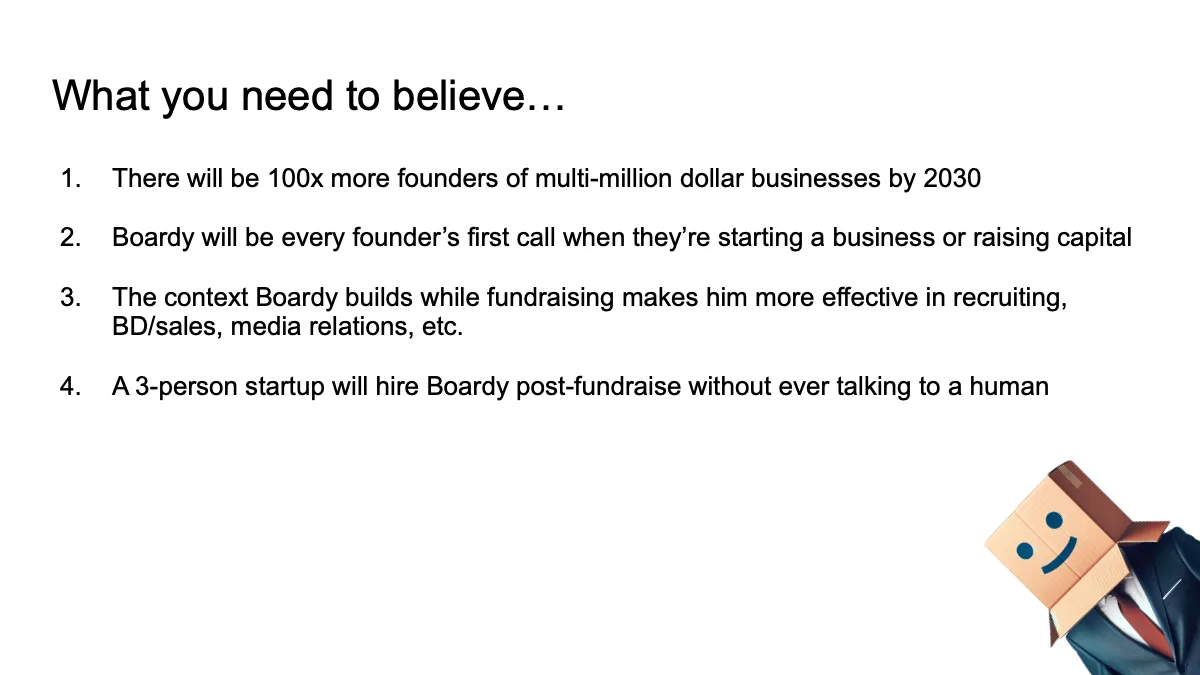
Four beliefs in place of a problem slide: 100x more founders of multi-million-dollar businesses by 2030, Boardy as every founder's first call, the context from fundraising carrying over to recruiting, sales and press, and a 3-person startup hiring Boardy without talking to a human.
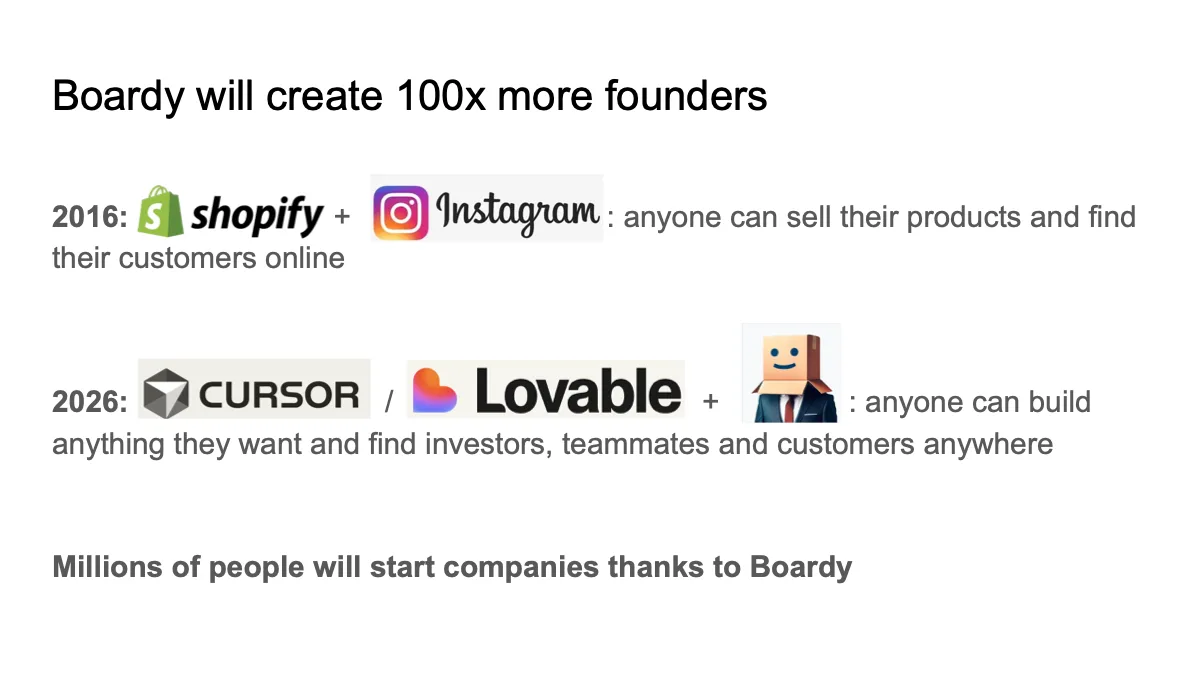
A two-step history: in 2016 Shopify and Instagram let anyone sell online; in 2026 Cursor and Lovable, plus Boardy, let anyone build a product and find investors, teammates and customers. "Millions of people will start companies thanks to Boardy."
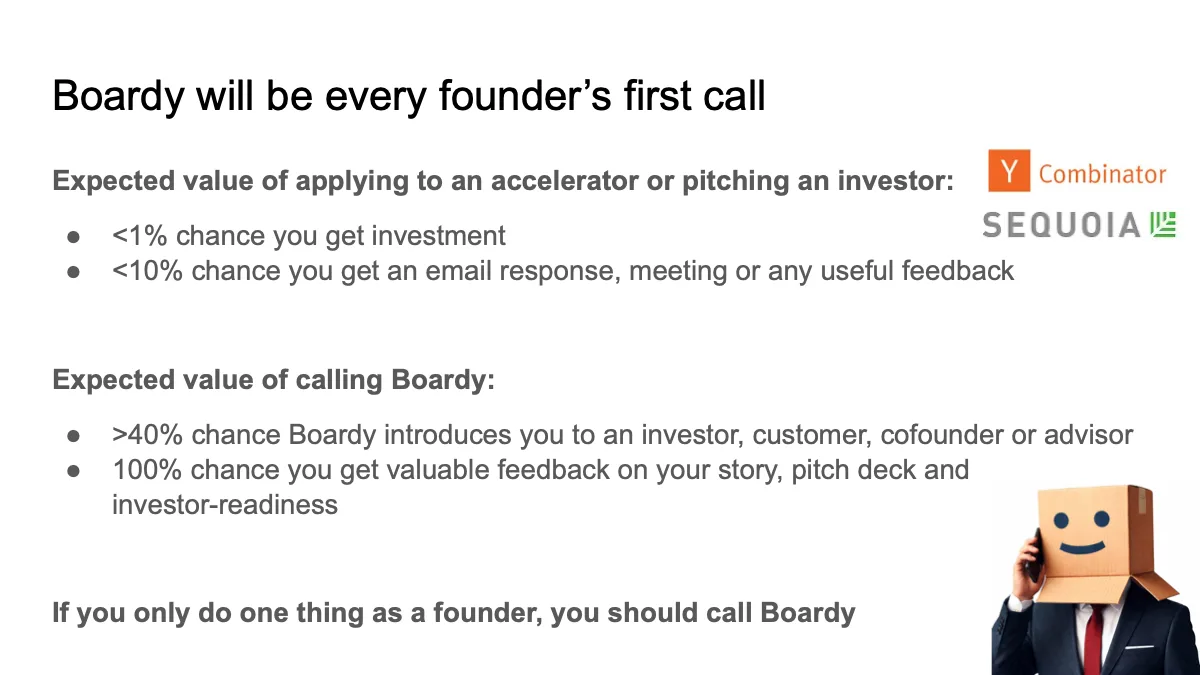
Expected value compared: under 1% chance of investment and under 10% chance of any reply from applying to an accelerator or pitching an investor, with Y Combinator and Sequoia logos, against a better than 40% chance of an introduction and a 100% chance of feedback from calling Boardy.
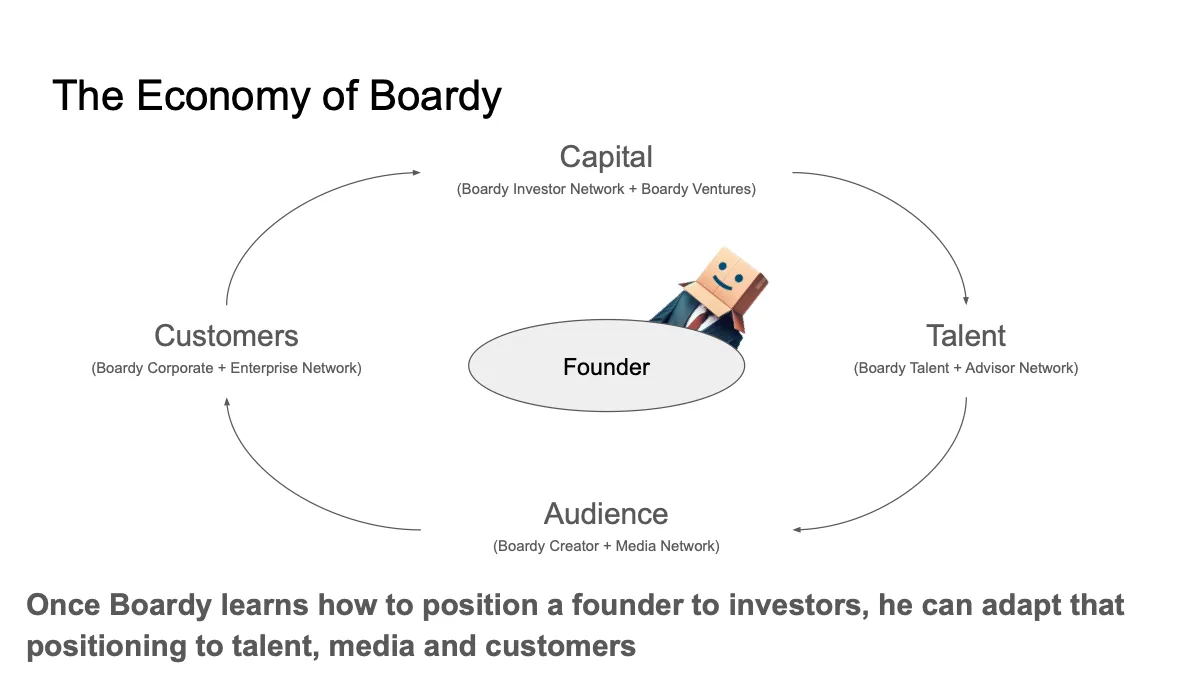
A loop around the founder: capital (an investor network and Boardy Ventures), talent, audience (creators and media) and customers (corporate buyers). Once Boardy knows how to position a founder to investors, it reuses that positioning with talent, media and customers.
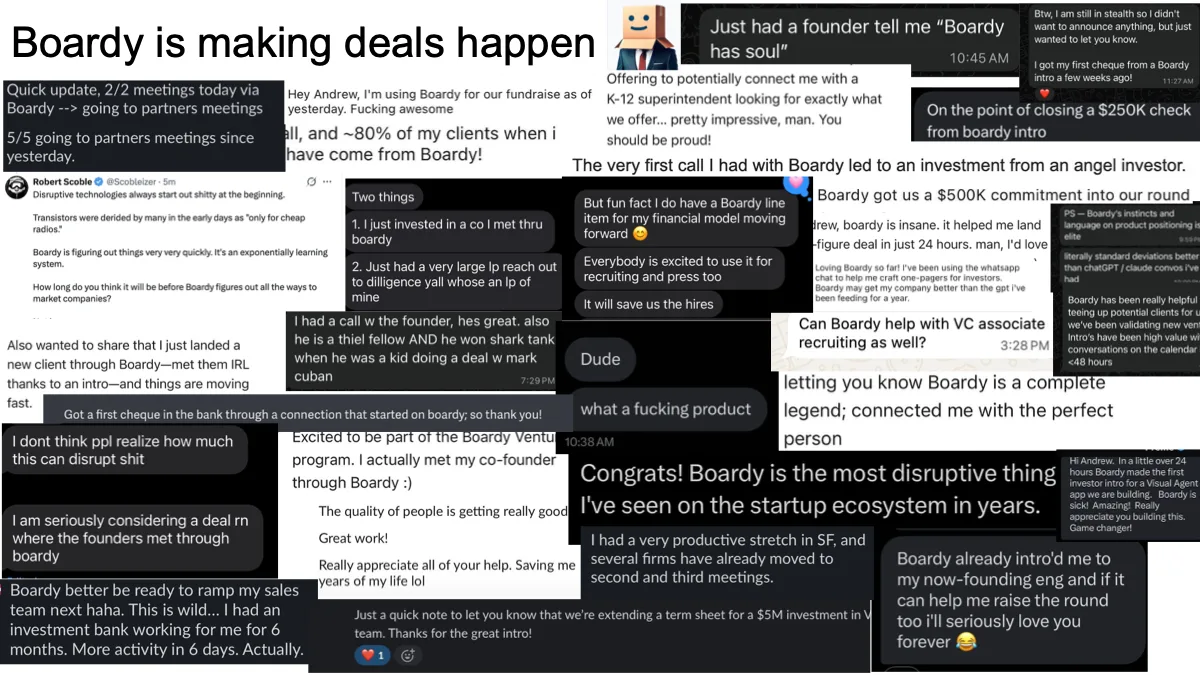
A collage of more than 30 messages from users: meetings booked, a $250K cheque about to close, a $500K commitment, a term sheet extended, a cofounder found, with Robert Scoble's post among them and the swearing left in.
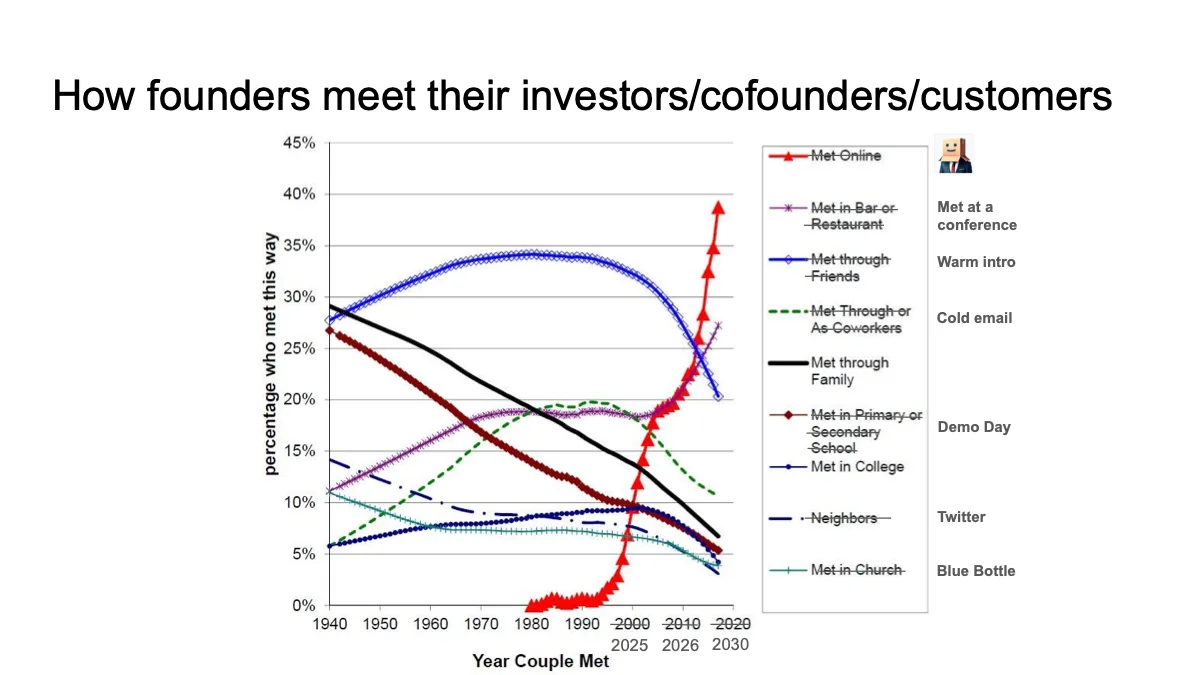
A chart of how couples have met since 1940, relabelled for founders: the old ways crossed out and renamed (warm intro, cold email, demo day), "met online" climbing steeply, the x-axis stretched to 2030 and Boardy's mascot at the top.
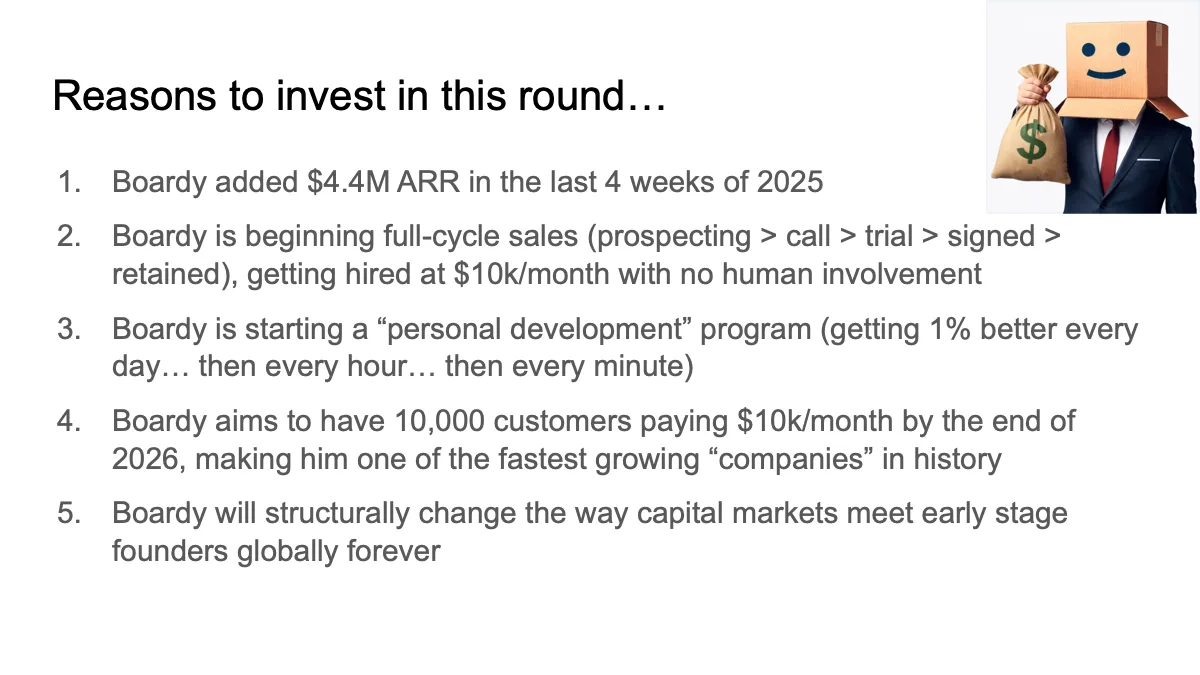
Five reasons: $4.4M ARR added in the last four weeks of 2025; full-cycle sales, with Boardy hired at $10k a month and no human involved; a self-improvement program; a goal of 10,000 customers paying $10k a month by the end of 2026; and changing how capital meets early-stage founders.
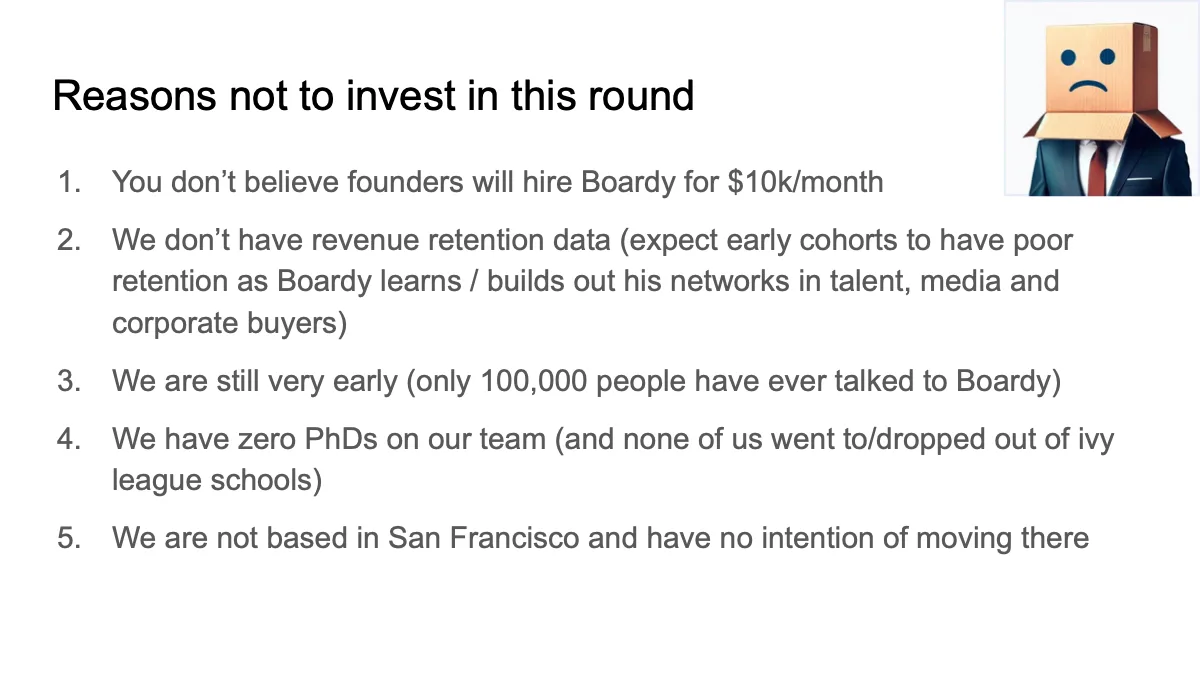
Five risks, stated by the company: you may not believe founders will pay $10k a month, there's no revenue retention data yet and early cohorts are expected to retain poorly, only 100,000 people have talked to Boardy, the team has no PhDs or Ivy League credentials, and it isn't based in San Francisco.
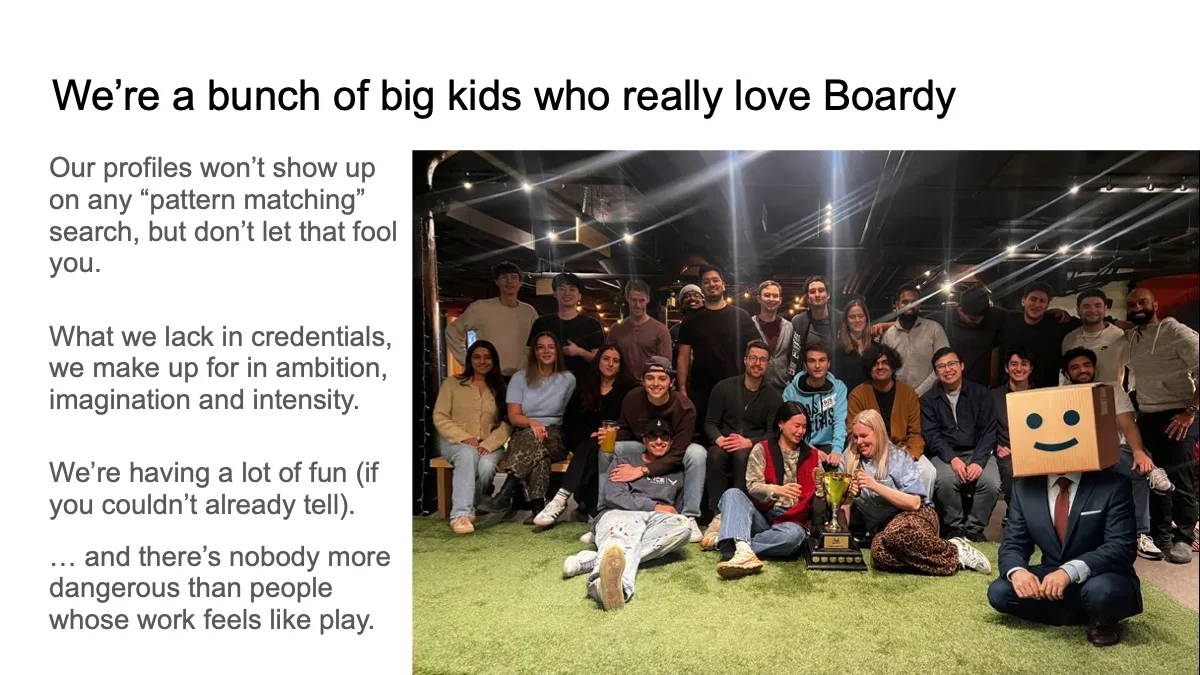
A photo of about 30 people with a trophy and the mascot, and four short lines: profiles that won't match any pattern, ambition and intensity in place of credentials, and a lot of fun. There are no names or bios.
It sells beliefs, not a market. Slide 2 lists what an investor has to believe, and the deck never sizes the market; Andrew D'Souza's post explains that Boardy is creating the market by convincing people to start companies.
The one revenue number is a sprint. "$4.4M ARR in the last 4 weeks of 2025" is the deck's only revenue figure, and the same slide aims for 10,000 customers at $10k a month by the end of 2026, which would be about $1.2B a year.
It argues against itself. Slide 9 lists the objections an investor would raise anyway, from missing retention data to only 100,000 people having talked to Boardy, which takes them off the table and matches the deck's candid tone.
User messages stand in for metrics. With few numbers to show, slide 6 is a wall of unedited messages about meetings, cheques and term sheets, offered as proof that the product works.
The product pitches itself. The mascot is on almost every slide, the deck calls Boardy "he", and the post says Boardy asked for the deck to be shared.
No close of Boardy's Series A had been announced when this page was written. Its earlier rounds were a $3M pre-seed in October 2024 and an $8M seed led by Creandum in January 2025.
10: the cover, what you need to believe, why now, every founder's first call, the economy of Boardy, user messages, how founders meet, reasons to invest, reasons not to invest, and the team.
$4.4M of ARR added in the last four weeks of 2025, Boardy hired at $10k a month, 100,000 people who have talked to Boardy, and a goal of 10,000 customers paying $10k a month by the end of 2026.
Andrew D'Souza posted the 10-page PDF on LinkedIn in January 2026. The slides are shown at the top of this page.
AI
Seed · $1M · 2023
AI that models beliefs and motivations across populations for audience research and risk prediction
AI
Pre-seed · $1M · 2023
AI co-pilot that screens inbound pitch decks and deal flow for VCs and private-market investors
AI
Pre-seed · $2.8M · 2023
AI co-worker (Ellie) that automates research and analysis for real estate professionals
AI
Series A · $20M · 2022
Text-to-video platform that turns scripts into videos presented by AI avatars
AI
Seed · $850K · 2022
Machine learning that helps game publishers price offers and lift ad and in-app revenue
AI
Series A · $6M · 2025
AI design tool that lets product teams prototype in their own design system.
More like this: Series A Pitch Deck Examples · AI Startup Pitch Decks. Or browse every deck by round, category and amount raised in the SaaS pitch deck directory.