
Finance & Payments
Brex pitch deck
Series B · $50M · 2018
Corporate cards, expense management and business accounts for startups and larger companies.
Read the teardown634.5K views
Series A · $30M · 2020 · 18 slides
CFTC-regulated exchange where people trade on the outcome of real-world events.
Slides as published in Alfred Lin’s X article “The Kalshi Series A Deck”. The deck belongs to Kalshi; the teardown below is ours.
Kalshi was two years old, still waiting for its CFTC designation and had no live product when Tarek Mansour and Luana Lopes Lara pitched this 18-slide deck to Sequoia in late 2020. Sequoia led the $30 million Series A, announced in February 2021, with Charles Schwab, Henry Kravis and SV Angel joining. With nothing trading yet, the deck sells the regulatory moat: event contracts as the next step after grain futures and interest rate swaps, and approvals no rival could get quickly.
Teardown by LeadWave, curated by Khrystyna Oleksiienko · Updated November 3, 2026
The name, the one-line pitch "Trade on event outcomes." and the app icon. Every slide carries a "Kalshi Confidential" footer.
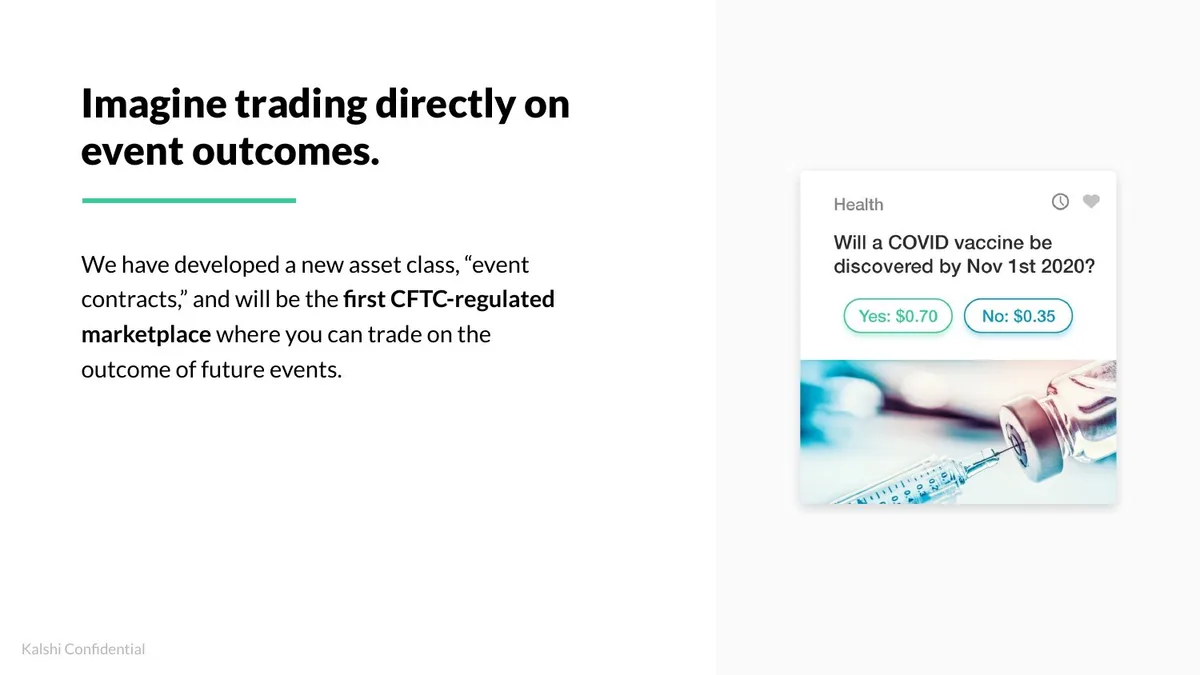
Kalshi has developed a new asset class, "event contracts", and will be the first CFTC-regulated marketplace for trading on future events. A sample market asks whether a COVID vaccine will be discovered by Nov 1, 2020, priced at Yes $0.70 and No $0.35.
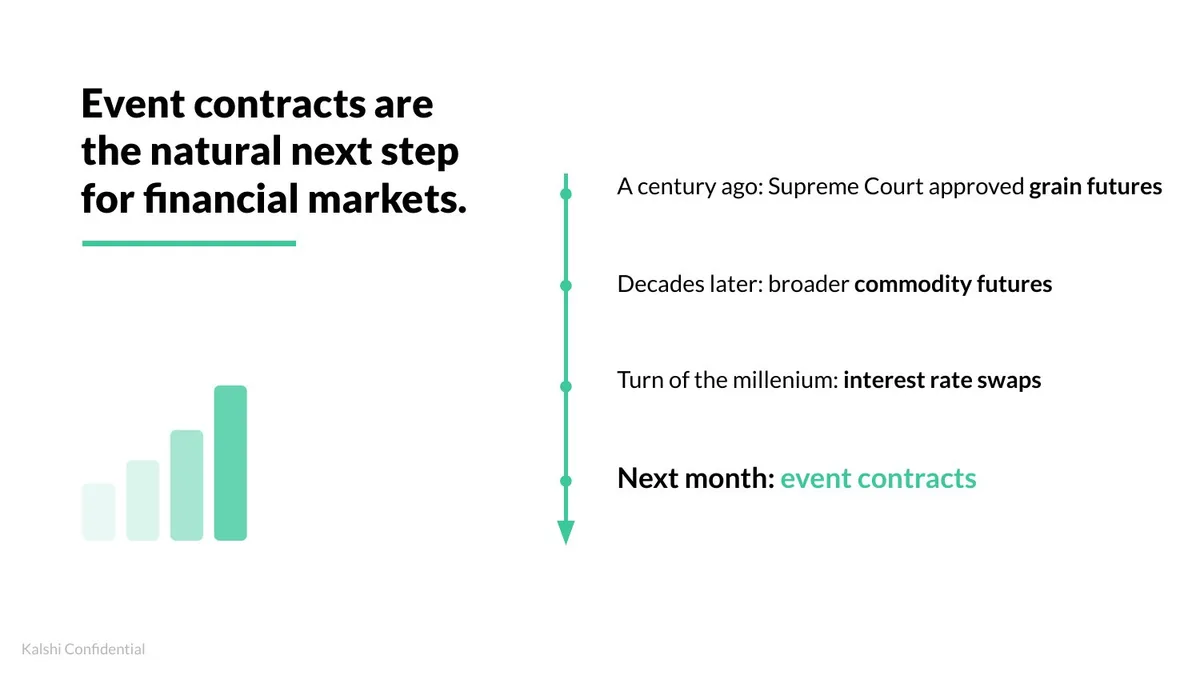
A timeline from grain futures, approved by the Supreme Court a century ago, to commodity futures and interest rate swaps, ending with "Next month: event contracts".
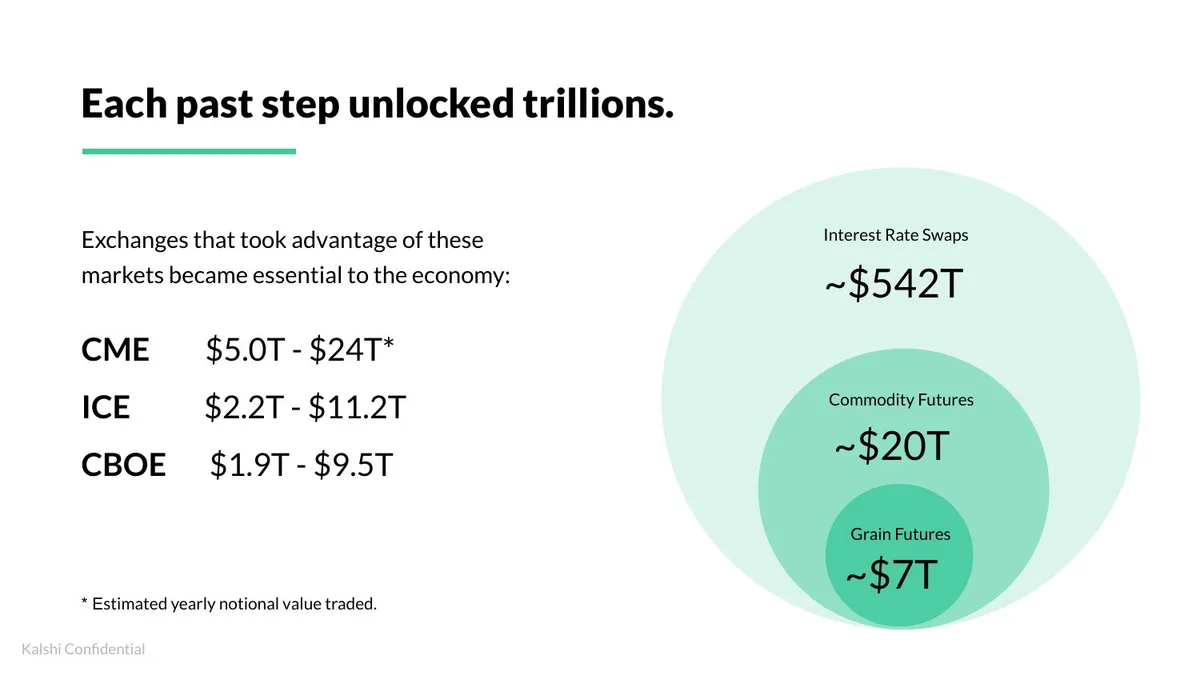
Each of those markets in notional value: grain futures about $7T, commodity futures about $20T, interest rate swaps about $542T. The exchanges built on them trade $5.0T to $24T (CME), $2.2T to $11.2T (ICE) and $1.9T to $9.5T (CBOE) a year.
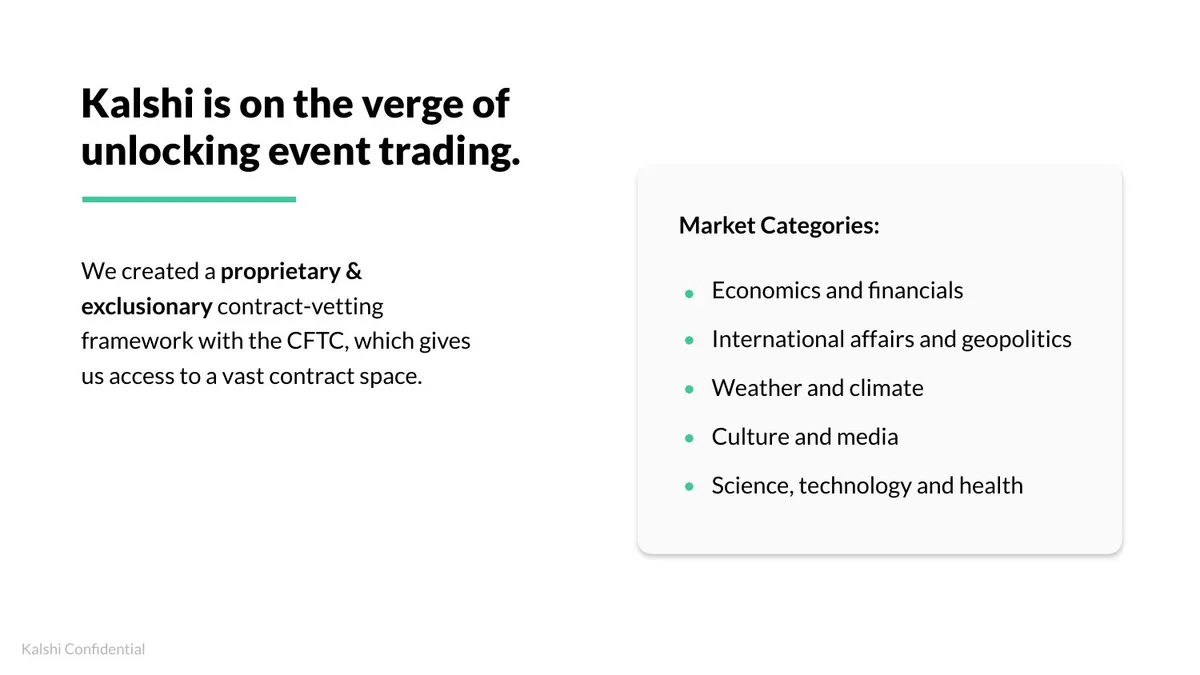
A proprietary contract-vetting framework agreed with the CFTC, covering five market categories: economics and finance, geopolitics, weather and climate, culture and media, and science, technology and health.
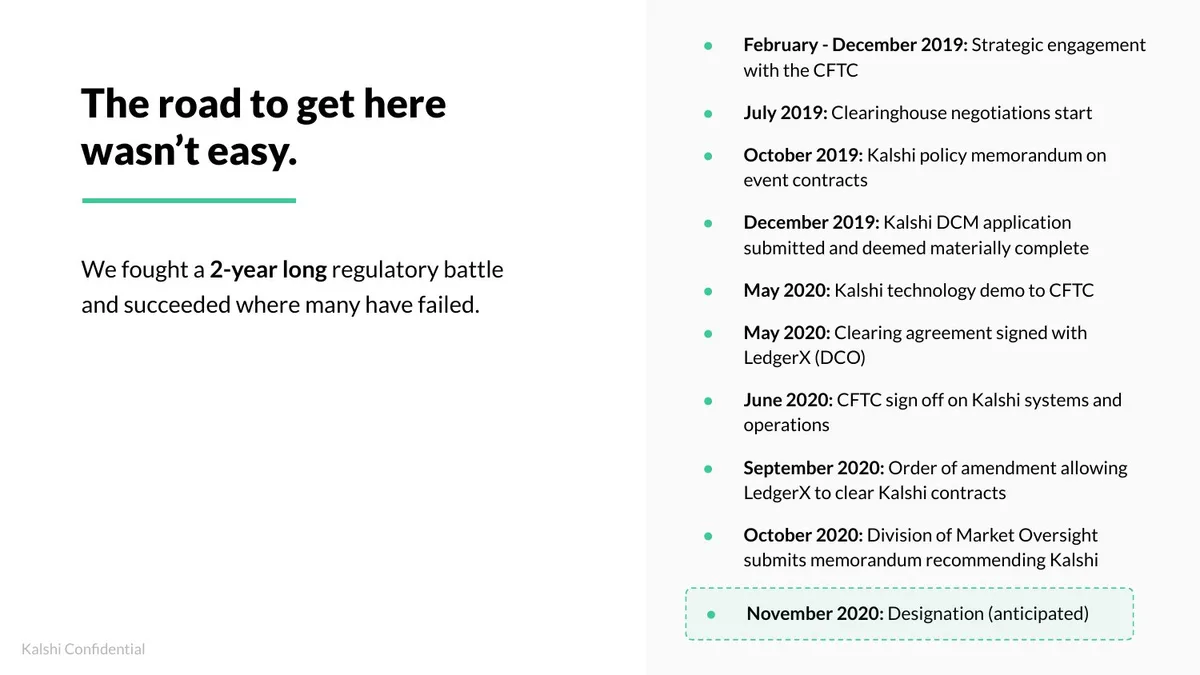
A two-year regulatory timeline: CFTC engagement from February 2019, the exchange application in December 2019, a clearing agreement with LedgerX in May 2020, CFTC sign-off on Kalshi's systems in June 2020, and designation expected in November 2020.
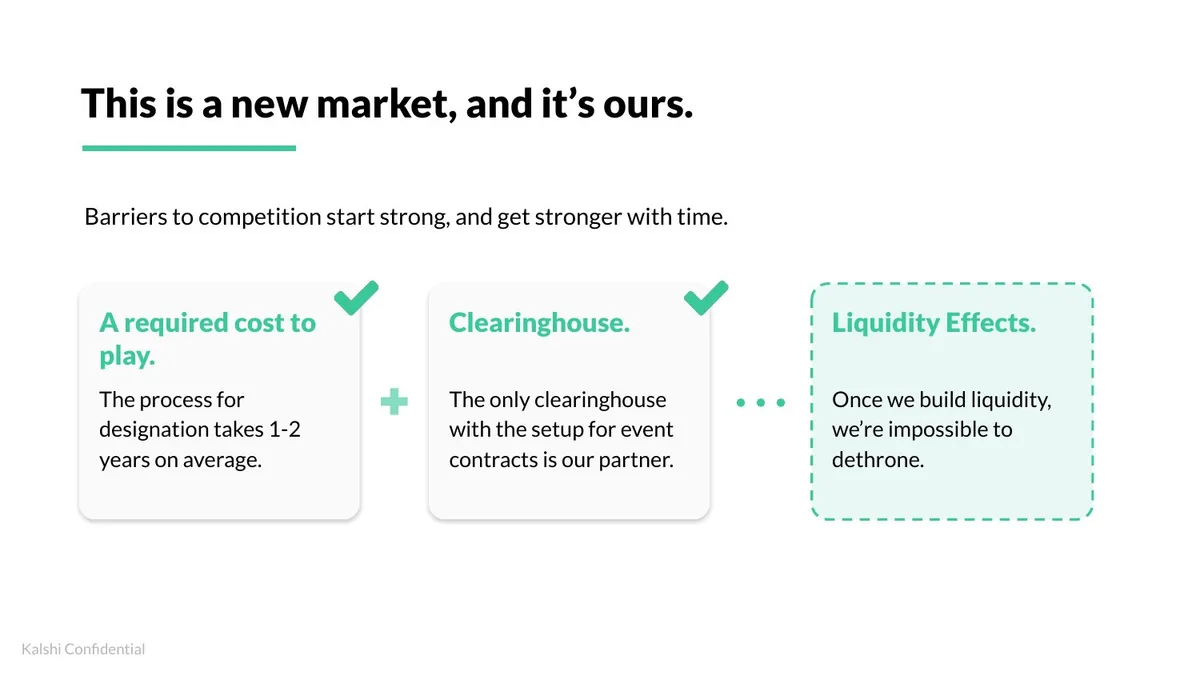
The barriers to competition in three parts: designation takes 1 to 2 years, the only clearinghouse set up for event contracts is Kalshi's partner, and liquidity effects make the first exchange "impossible to dethrone".
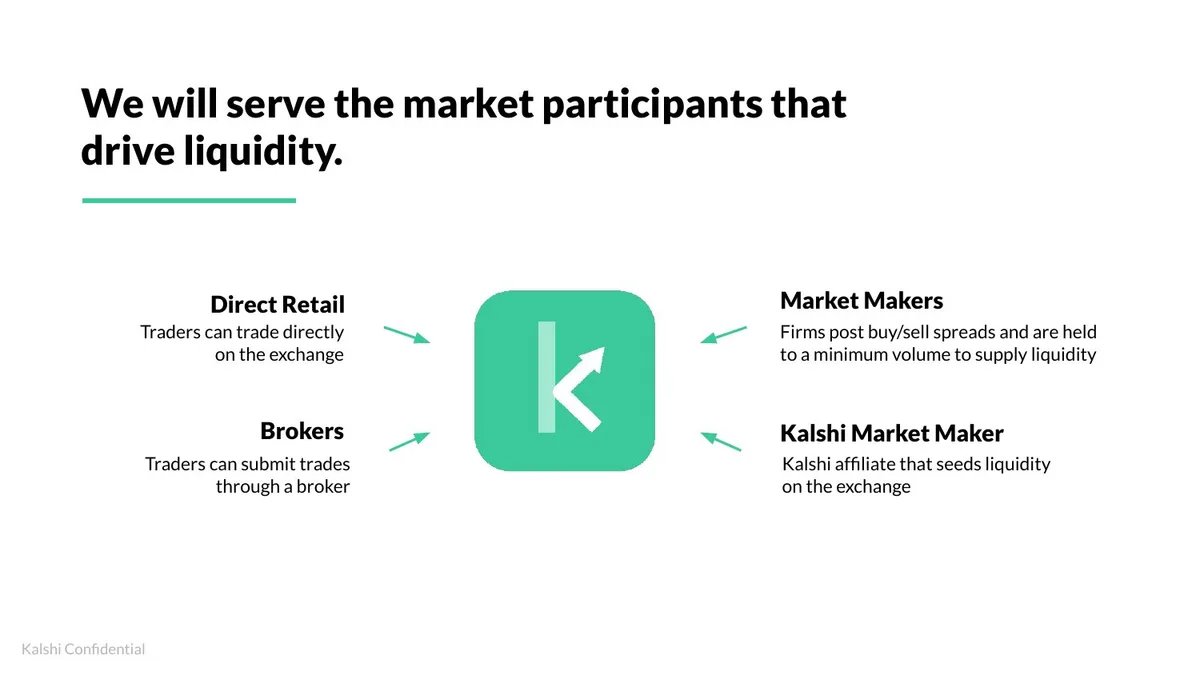
Four kinds of participant around the exchange: direct retail traders, brokers, market makers held to a minimum volume, and Kalshi's own affiliate market maker to seed liquidity.
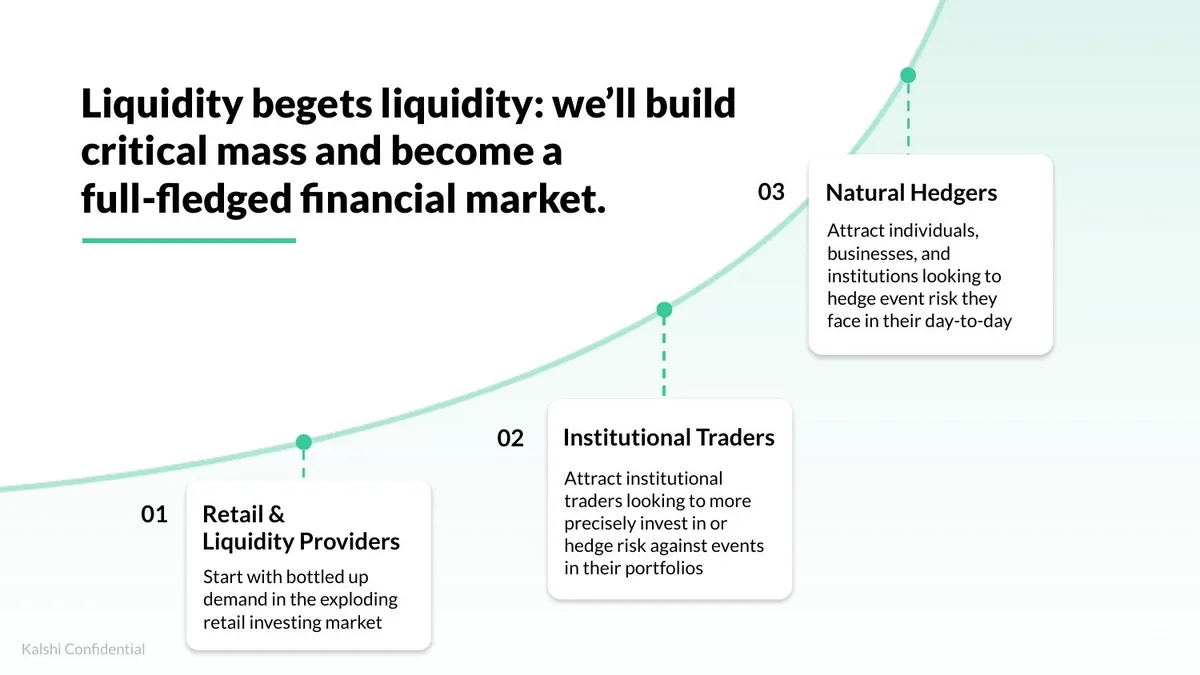
A three-stage plan on a rising curve: retail traders and liquidity providers first, then institutional traders, then natural hedgers, the people and businesses exposed to event risk.
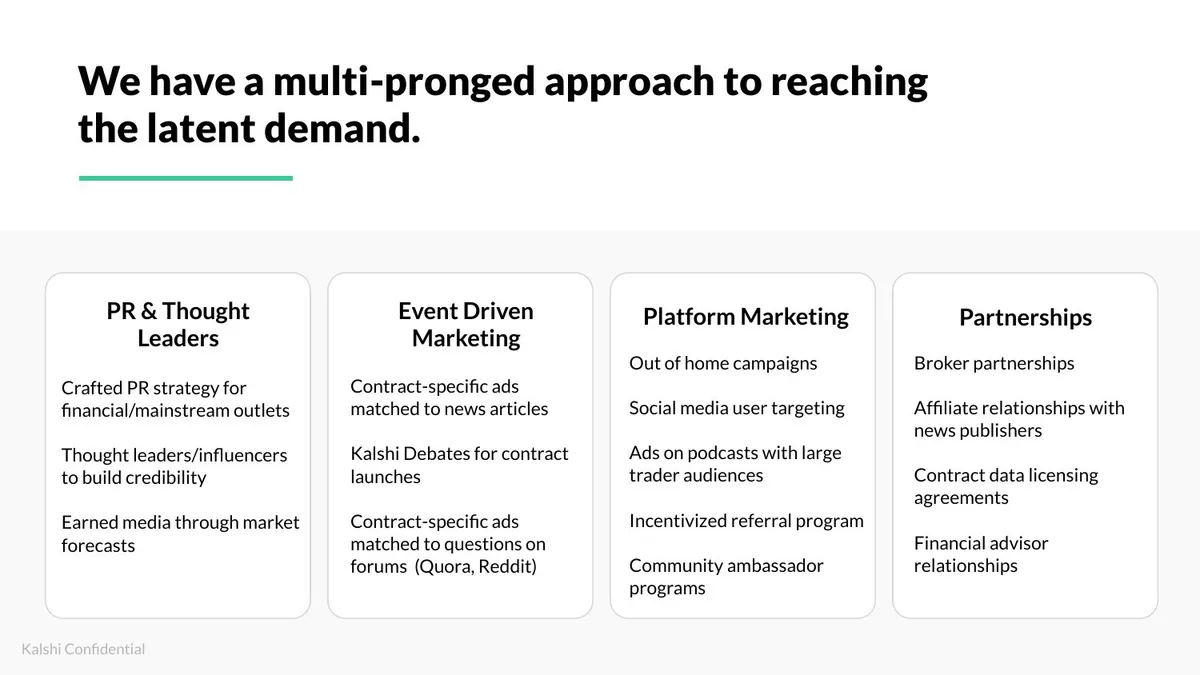
Four channels: PR and thought leaders; event-driven marketing, with ads matched to news articles and to questions on Quora and Reddit; platform marketing, from out-of-home ads to podcasts and referrals; and partnerships with brokers, news publishers and financial advisors.
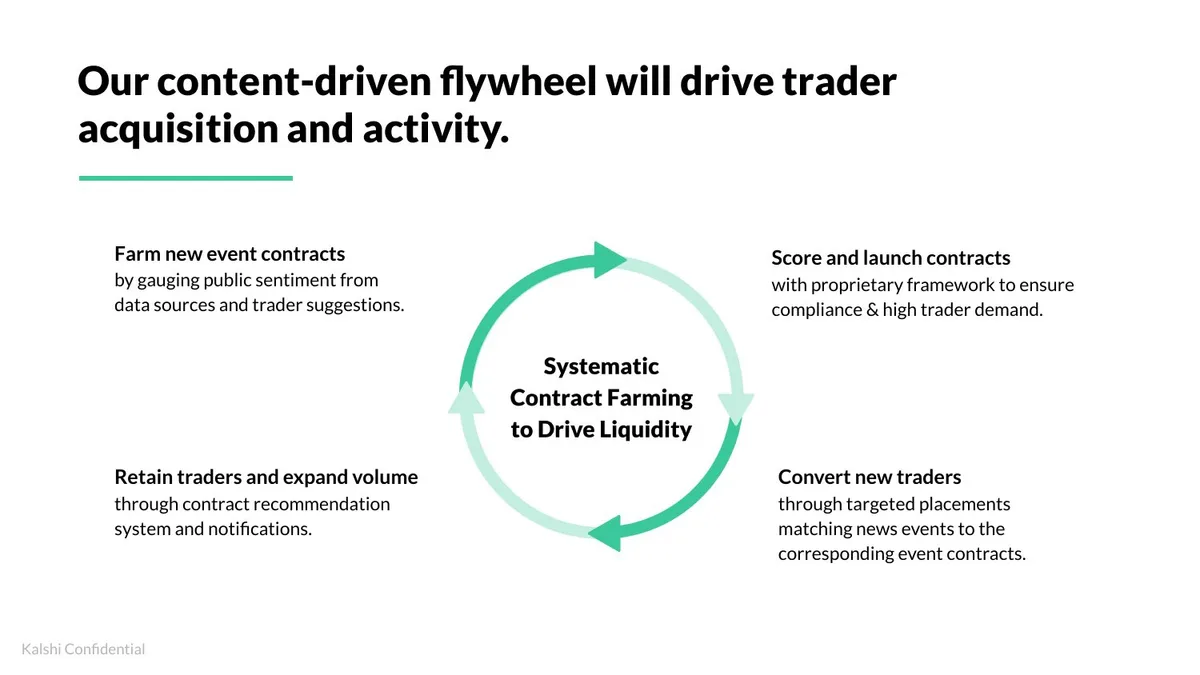
"Systematic contract farming": find new contracts from public sentiment and trader suggestions, score and launch them, convert traders with placements matched to the news, and keep them with recommendations and notifications.
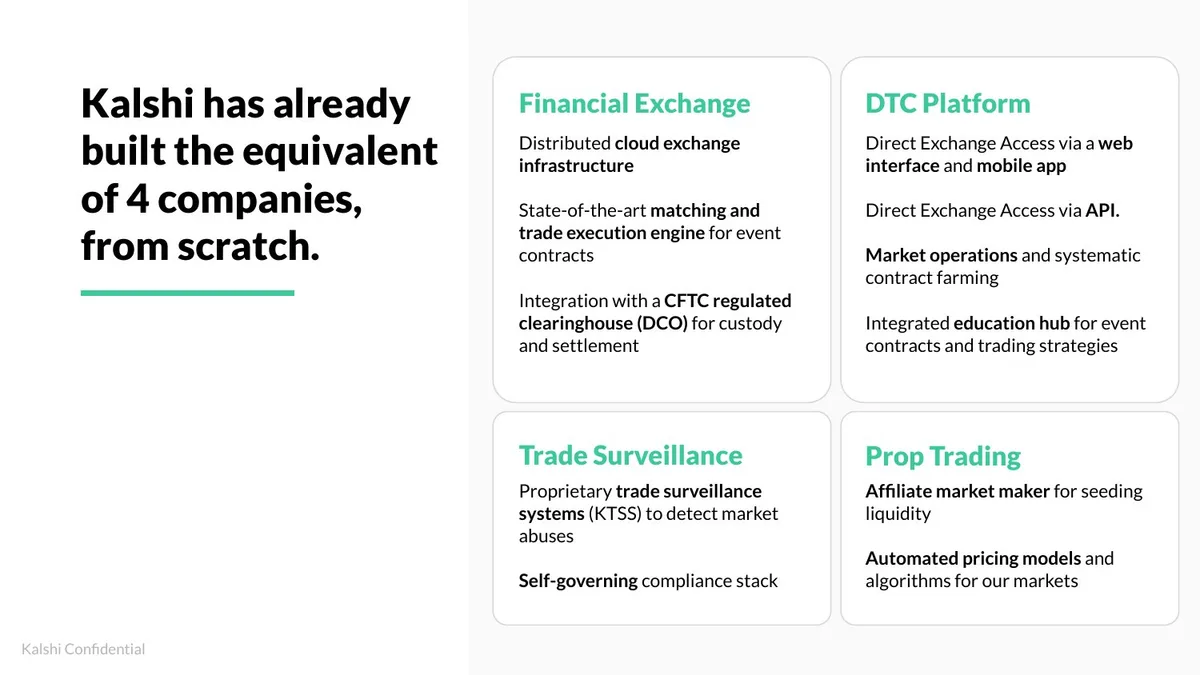
What exists already: an exchange with its own matching engine and a link to a CFTC-regulated clearinghouse, a web and mobile app with an API, trade-surveillance systems, and a prop-trading arm with an affiliate market maker and pricing models.
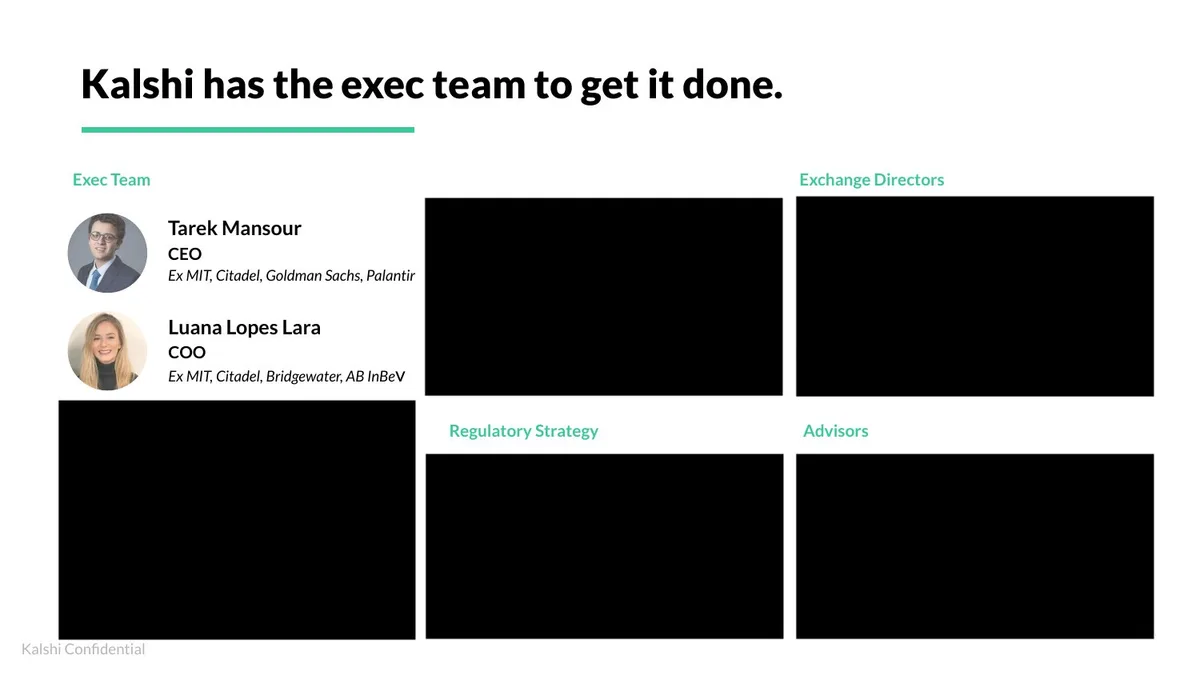
The two co-founders: CEO Tarek Mansour (MIT, Citadel, Goldman Sachs, Palantir) and COO Luana Lopes Lara (MIT, Citadel, Bridgewater, AB InBev). The other executives, exchange directors, regulatory strategy and advisors are blacked out in the published version.
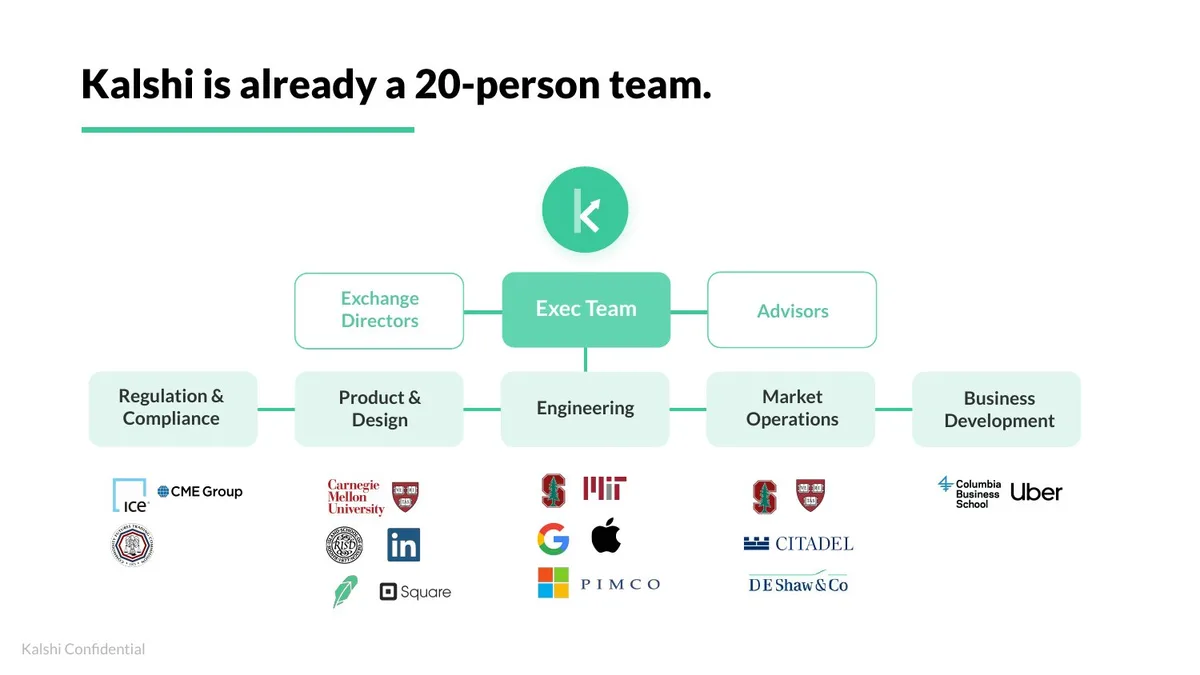
An org chart across regulation and compliance, product and design, engineering, market operations and business development, with the logos of where the team came from, among them ICE, CME Group, Google, Apple, Microsoft, Citadel, D. E. Shaw and Uber.
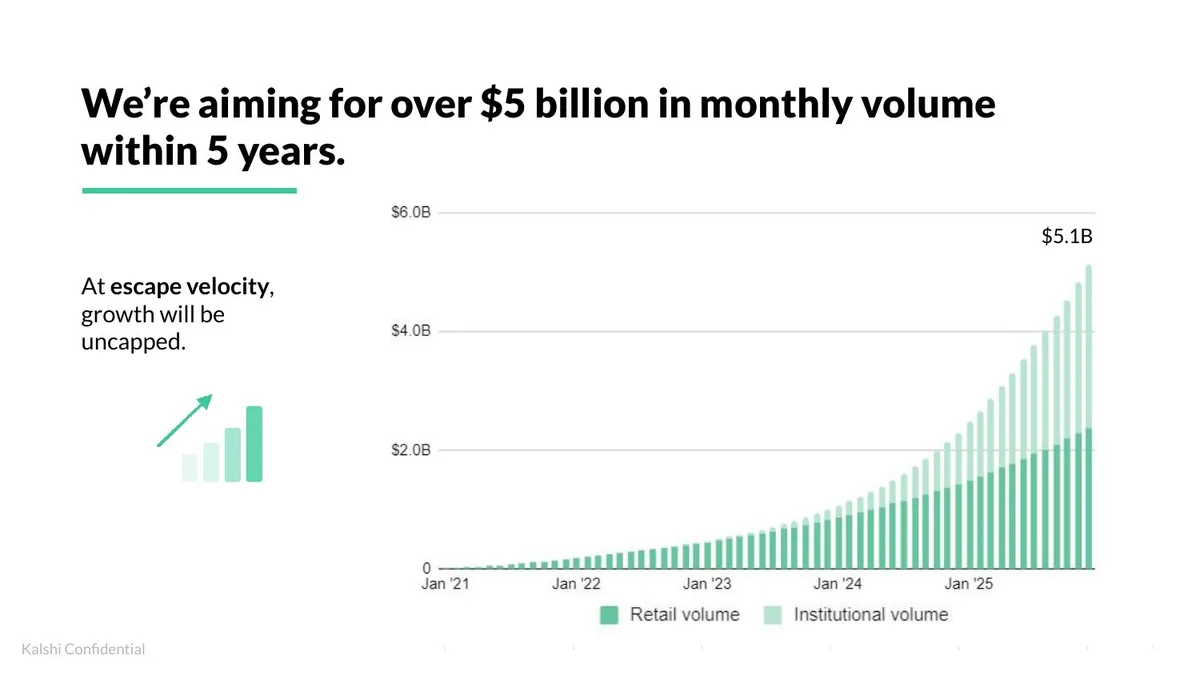
A projection from January 2021 to late 2025, split into retail and institutional volume and ending at $5.1B a month, under the line "At escape velocity, growth will be uncapped."
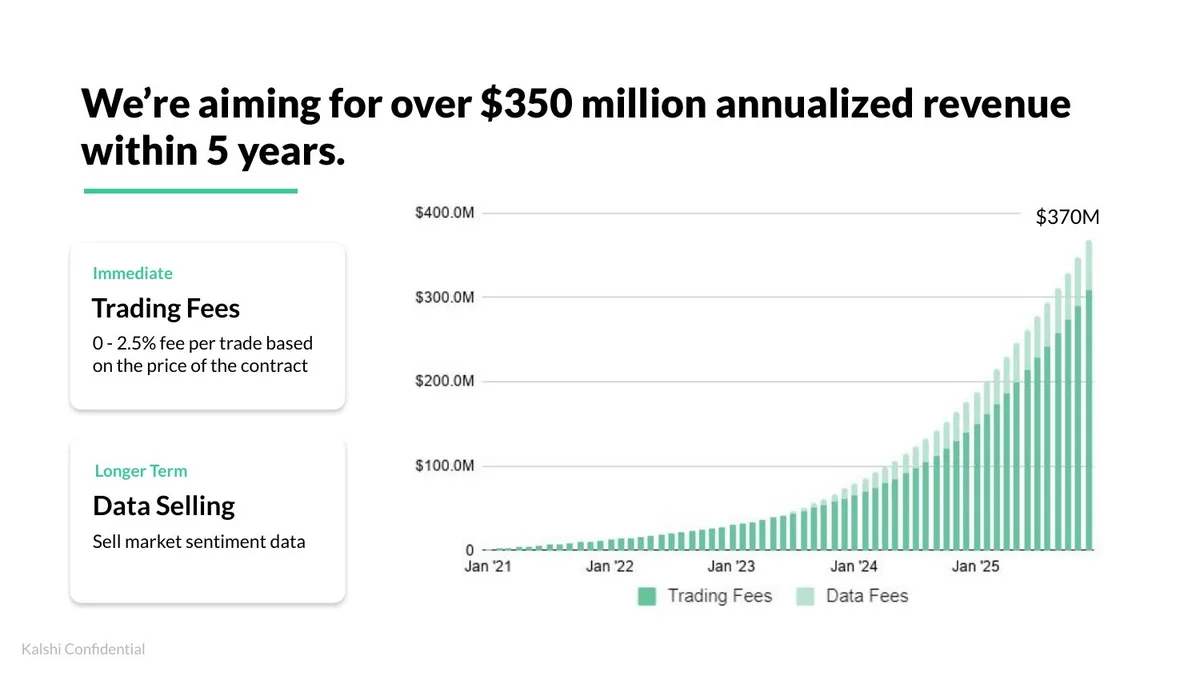
Revenue projected to $370M a year by late 2025, from trading fees of 0 to 2.5% per trade depending on the contract's price now, and from selling market sentiment data later.
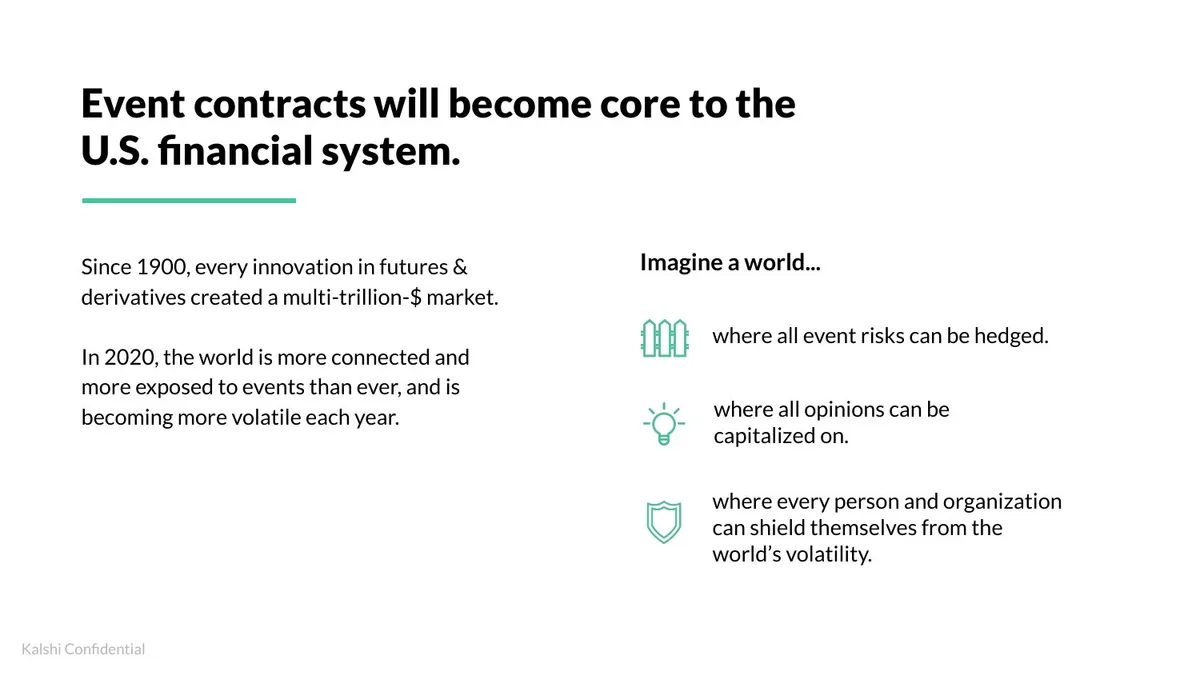
Since 1900, every futures and derivatives innovation created a multi-trillion-dollar market. The close imagines a world where all event risks can be hedged and every opinion can be traded.

A closing slide for questions. There's no ask slide: the amount raised isn't in the deck.
Before launch, the regulatory moat is the traction. With no product live and no revenue, slides 6 and 7 put the two-year CFTC timeline, and the 1 to 2 years any rival would need, where user numbers usually go.
The market is argued by precedent, not a TAM figure. Grain futures, commodity futures and interest rate swaps each became multi-trillion-dollar markets, so event contracts are pitched as the next entry in that line, with CME, ICE and CBOE as the exchanges that grew on them.
Four slides go on liquidity. The participants, the three-stage plan, the marketing channels and the contract-farming flywheel show that the founders treated getting traders, not building the exchange, as the real risk.
The hockey sticks came true. The deck projects $5.1B in monthly volume and $370M in annualized revenue within five years; Sequoia's Alfred Lin wrote in 2026 that Kalshi reached and exceeded that projection, on a much choppier path than planned.
There's no ask slide. The deck ends on Q&A, and the $30M only appears in the February 2021 announcement.
$30 million, in a Series A led by Sequoia Capital and announced on February 17, 2021. Charles Schwab, Henry Kravis and SV Angel joined, along with earlier investors Neo and YC Continuity.
18: the cover, the product, why now, the market, the contract framework, the regulatory timeline, competition, market participants, the liquidity plan, marketing, the flywheel, what's already built, two team slides, two projections, the vision and Q&A.
$5.1 billion in monthly trading volume and $370 million in annualized revenue within five years, from trading fees of 0 to 2.5% per trade and, later, selling market sentiment data. Sequoia's Alfred Lin wrote in 2026 that Kalshi exceeded that projection.
Sequoia's Alfred Lin published all 18 slides in an X article on November 1, 2026, with the founders' permission. They're shown at the top of this page.
Finance & Payments
Series B · $50M · 2018
Corporate cards, expense management and business accounts for startups and larger companies.
Finance & Payments
Series A · $7M · 2014
Cap table, equity management and fund administration software for private companies and investors.
Finance & Payments
Series D · $200M · 2022
Merchant of record for software companies: payments, sales tax, billing and subscriptions in one platform.
Finance & Payments
Series F · $55M · 2020
Subscription billing and revenue management software for businesses with recurring revenue.
Finance & Payments
Series C · $16.5M · 2013
Pay-by-bank payments API that lets businesses and platforms move money over ACH and instant rails.
Finance & Payments
Series A · $10M · 2021
Equity management for European companies: cap tables, employee share plans and investor reporting.
Browse every deck by round, category and amount raised in the SaaS pitch deck directory.