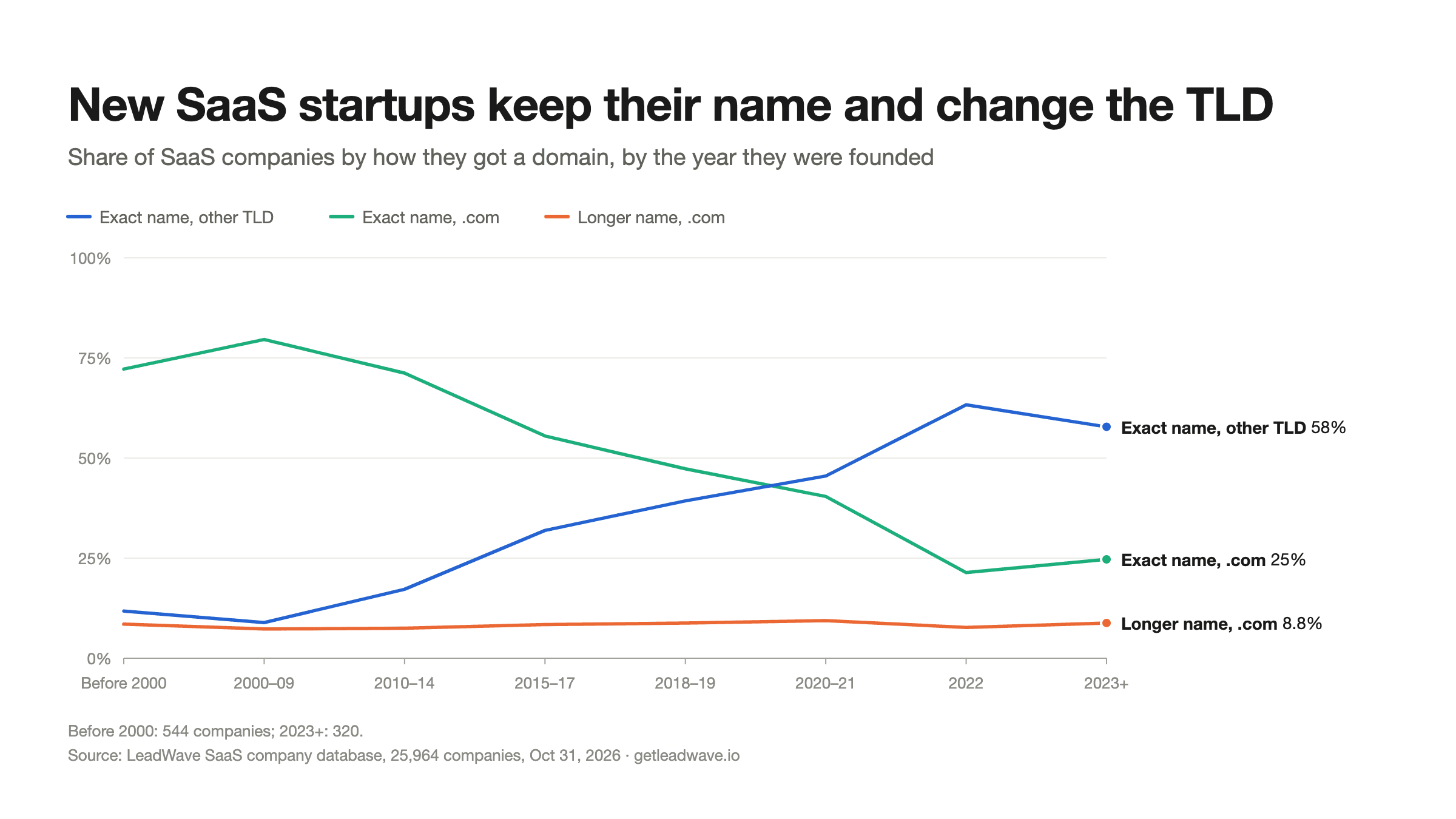
Most SaaS companies use their exact name as their domain: 82% of the 25,964 we checked. What has changed is the ending. Of the SaaS companies founded in the 2000s, 80% have their exact name on .com. Of those founded since 2022, about a quarter do, and 60% use their exact name on another extension instead: .ai, .io, .dev, .so. Only about one in twelve adds a word like get- or try- to land a .com.
We pulled the website domains of 25,964 SaaS and AI companies in the LeadWave database to see how SaaS domain names are built: exact name or not, which prefixes and suffixes, how long, which TLD, and how all of that changed by founding year. Then we ranked the domain extensions with prices and risks. Prices and policies are as of October 31, 2026.
SaaS domain names in numbers
82% use their exact company name: stripe.com, notion.so, mistral.ai.
67.5% are on .com, but only 32% of the companies founded since 2022.
The typical name before the dot is 8 characters long (the median), and 7 for companies founded since 2022.
2.3% add a prefix such as get-, go-, use- or try-. get- alone is 223 companies.
1.2% add a suffix, most often -app or -hq.
3.5% have a hyphen and 2.4% a digit, and both are getting rarer.
8.8% are a real English word. On .com that's 3.9%; on .so it's 61%.
How SaaS companies build their domain names
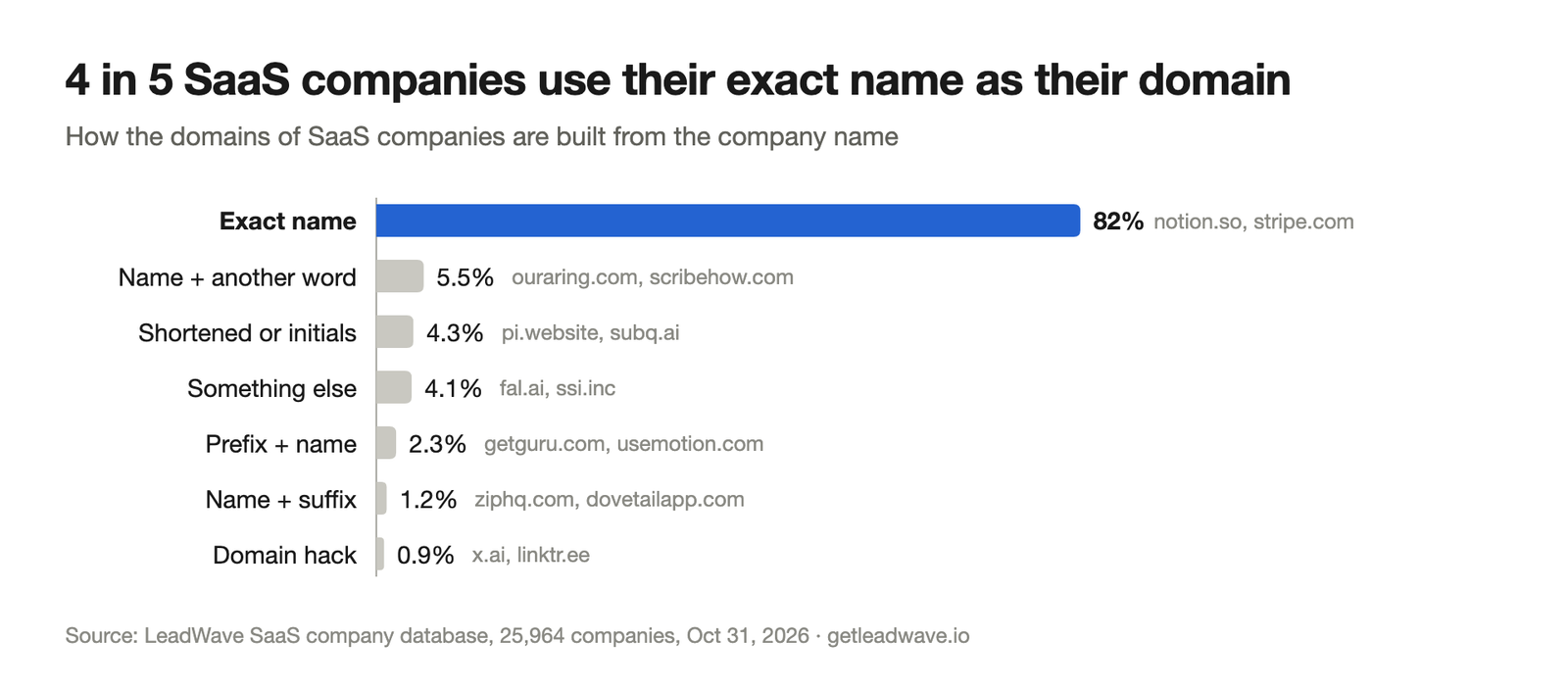
We compared each company's domain with its name. Four in five match exactly. We count the name without words like AI, Labs or Technologies, so Mistral AI on mistral.ai and Saronic Technologies on saronic.com are exact matches. The rest fall into a handful of patterns:
Pattern | Share | Of which on .com | Examples |
|---|---|---|---|
Exact name | 81.7% | 67% | stripe.com, notion.so, mistral.ai, linear.app |
Name + another word | 5.5% | 91% | ouraring.com, scribehow.com, glideapps.com, medusajs.com |
Shortened or initials | 4.3% | 51% | pi.website (Physical Intelligence), subq.ai (Subquadratic) |
Prefix + name | 2.3% | 82% | getguru.com, usemotion.com, tryprofound.com |
Name + suffix | 1.2% | 87% | ziphq.com, dovetailapp.com, sanalabs.com |
Domain hack | 0.9% | 1% | x.ai, linktr.ee, pola.rs |
Something else | 4.1% | 71% | fal.ai, ssi.inc, allenai.org |
The pattern is clear: when a company changes its name for the domain, it's almost always to get a .com. 91% of the name-plus-a-word domains, 82% of the prefixed ones and 87% of the suffixed ones are .com. Companies that keep their exact name are on .com only two times in three, because the other third took a different extension instead.
New SaaS startups keep their name and change the TLD
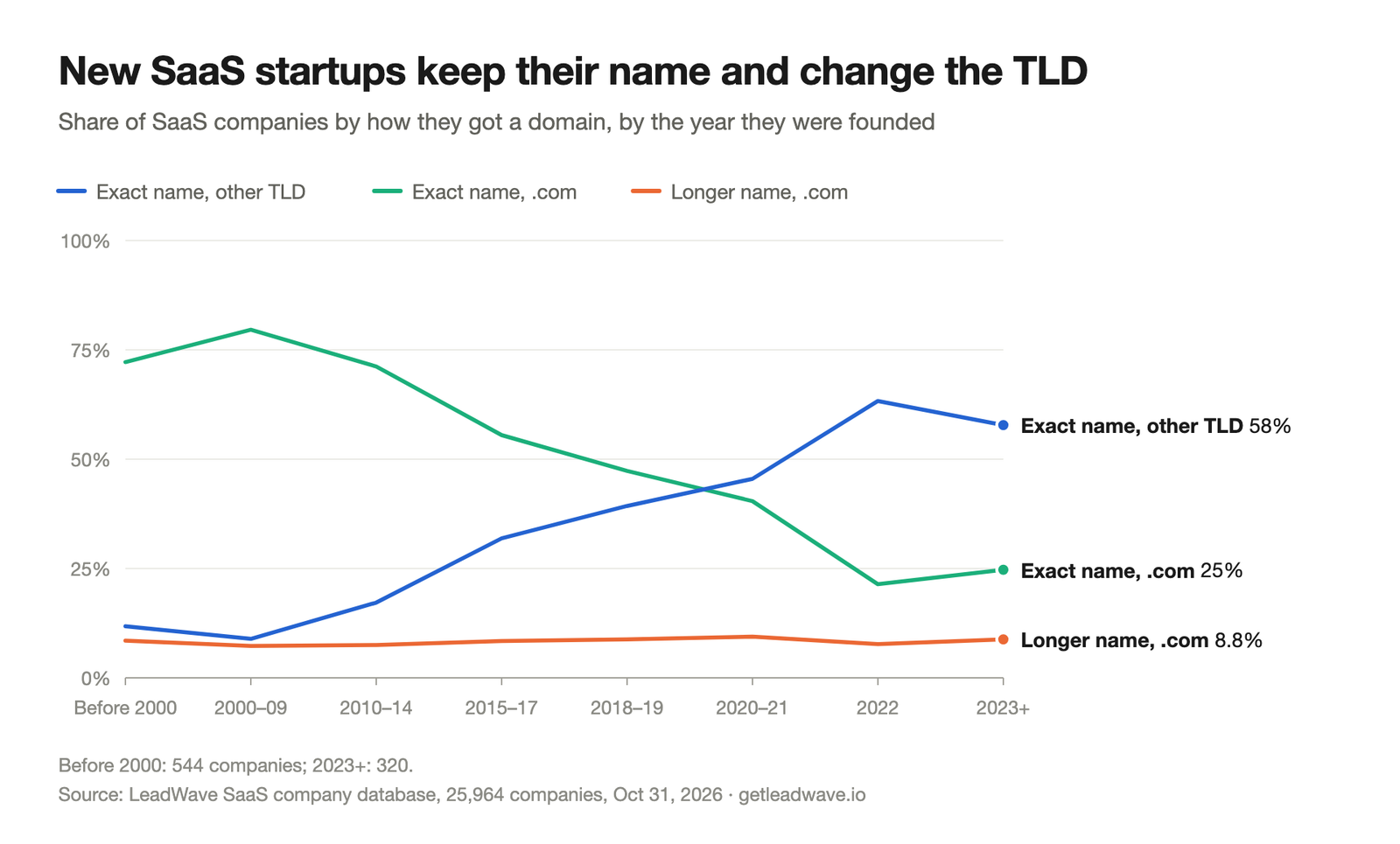
Sort the same companies by the year they were founded and the trade-off founders make becomes visible:
The exact name on .com went from normal to rare. 80% of the SaaS companies founded in 2000–2009 have it, 71% of those founded in 2010–2014, 40% in 2020–2021 and about a quarter of those founded since 2022.
The exact name on another extension took its place. 9% of the 2000s companies, 39% of those founded in 2018–2019, and 58–63% of those founded since 2022. The two lines crossed around 2020.
A longer .com never caught on. In every era, only 7–9% of SaaS companies added a word to their name to get a .com. What changed is how: descriptive words like ouraring.com gave way to prefixes like get- and try-.
It changes again as companies grow. The share with their exact name on .com rises from 49% of companies with 1–10 employees to 85% of those with more than 1,000, and the share using a prefix falls from 3.8% to 0.4%. Startups launch with the exact name on .ai or .io, or with getname.com, and buy the exact .com once they can afford it (examples below).
Keep in mind that these are the domains companies use today. Older companies that started on another domain and bought the .com later show up as exact-name .com, so the early years look tidier than they were at launch.
When the .com is taken: prefixes and suffixes
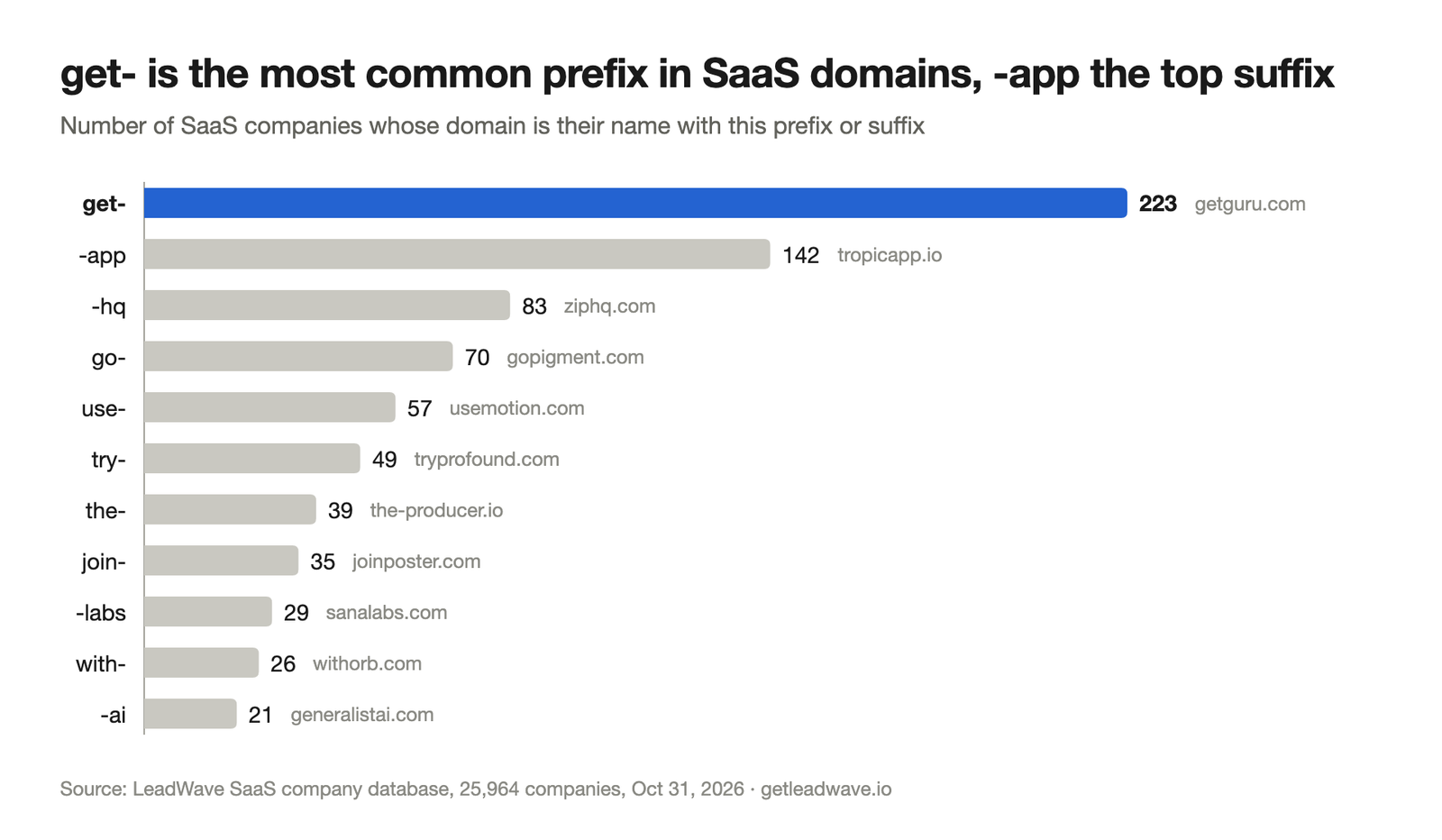
596 SaaS companies put a word in front of their name, and 324 after it. One prefix dominates: get- (223 companies, including getguru.com, getcensus.com and getlago.com) is used more than the next three combined: go- (70, gopigment.com), use- (57, usemotion.com, usepylon.com) and try- (49, tryprofound.com). After those come the-, join- (joinposter.com), with- (withorb.com) and hello- (helloalma.com).
The suffixes are -app (142, dovetailapp.com, motionapp.com), -hq (83, ziphq.com, tealhq.com), -labs (29, sanalabs.com, lumalabs.ai) and -ai (21, generalistai.com).
A prefix works best when it reads as an action a buyer would take, like get, try or use, and when your emails, ads and social profiles drop it. Treat it as a stage, not a destination: Loom launched on useloom.com and Front on frontapp.com, and both moved to the exact .com later. Our SaaS domain name generator tries these prefixes and suffixes for your name and shows which domains look free.
Shorter names and real words
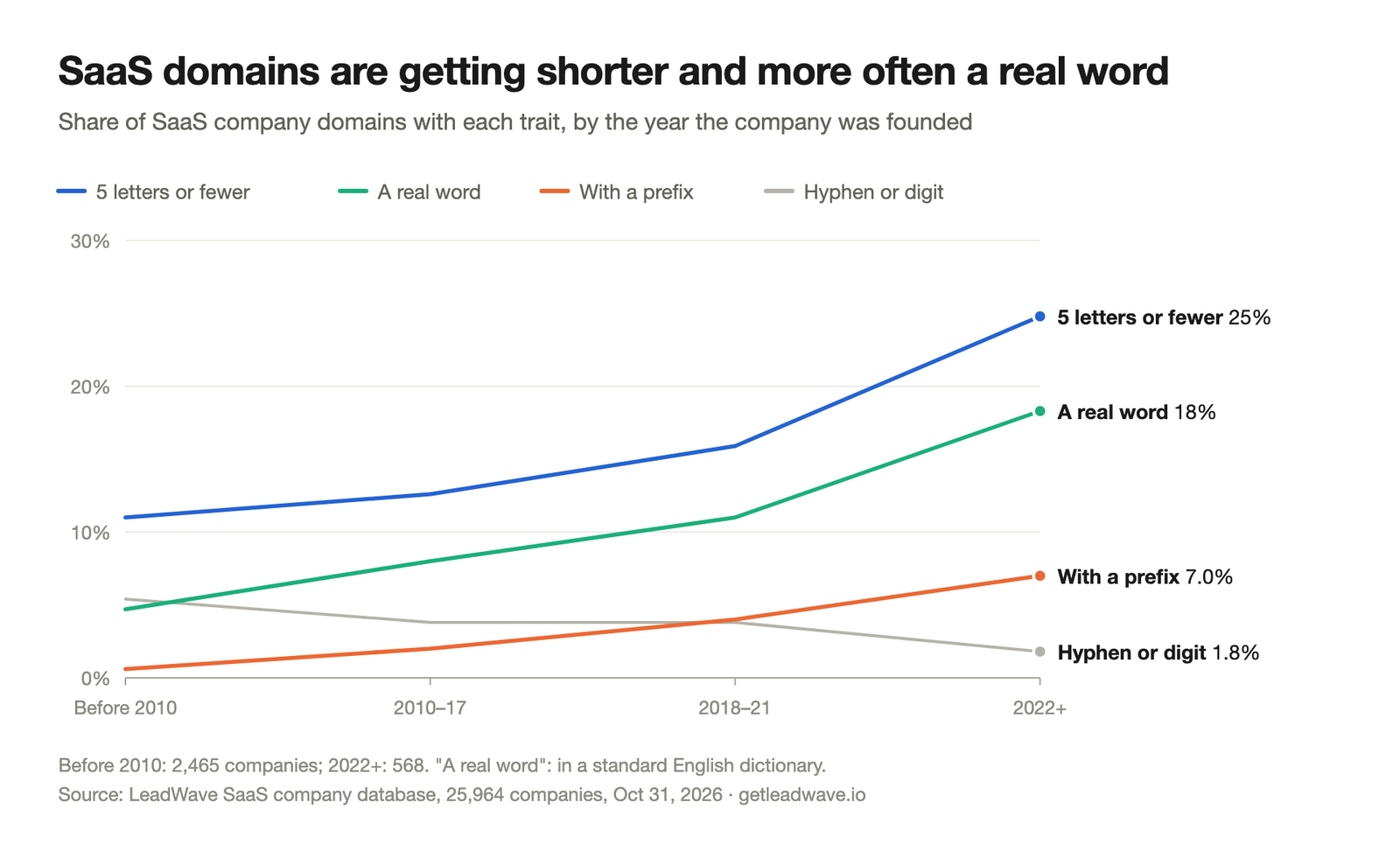
SaaS domain names are getting shorter, and more of them are real words:
Shorter. The median name before the dot fell from 9 characters (companies founded before 2010) to 7 (since 2022). A quarter of the companies founded since 2022 use five characters or fewer, against 11% of those founded before 2010.
Real words. 18% of the companies founded since 2022 use a plain English word as their domain, against 4.7% of those founded before 2010: factory.ai, together.ai, figure.ai, poolside.ai, magic.dev, plane.so.
Fewer hyphens and digits. 5.4% of the older companies have one or the other, and 1.8% of the newest. Digits work when they're part of the brand, as in 1password.com, n8n.io and h2o.ai, but a hyphen is something people have to be told.
Short words are why the new extensions exist for startups. Only 3.9% of SaaS domains on .com are a real word, because those .com names were taken long ago. On the newer extensions they're common: 24% of .ai domains, 30% of .app, 46% of .dev and 61% of .so domains are a word. The typical .com name is 8 characters long; the typical .so name is 5.
Domain hacks
0.9% of SaaS companies spell their name across the dot: xAI on x.ai, Linktree on linktr.ee, Polars on pola.rs, Roam on ro.am, Genially on genial.ly. A hack can give you a very short, memorable domain, but you'll spend your life spelling it out, and most hacks use a country code. Google treats a country code as a sign that you target that country unless it's on its short list of generic ones (see the SEO section below).
Which domain extension SaaS companies use
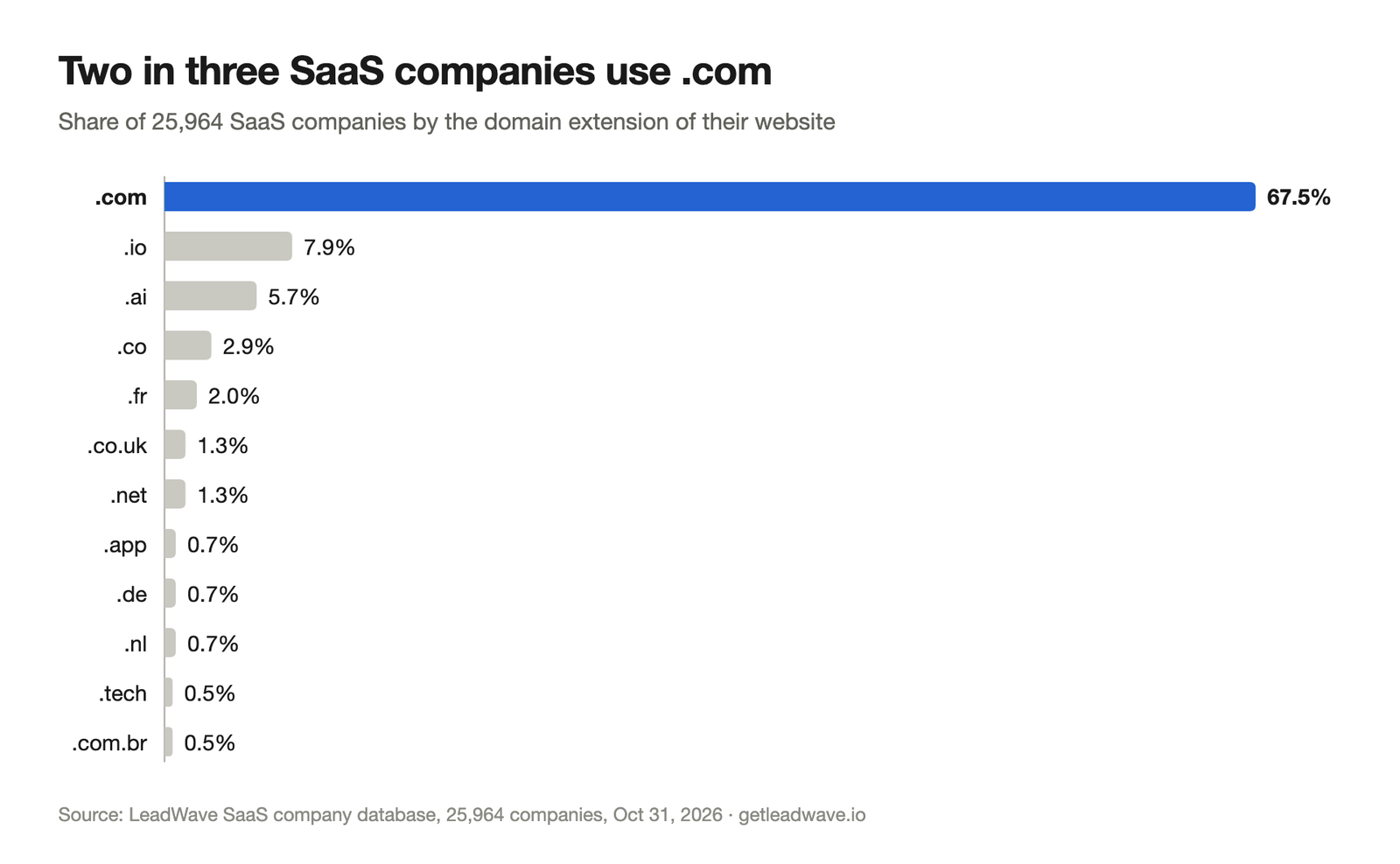
The 25,964 companies use 266 different extensions (TLDs), but four of them cover 84% of the companies: .com (67.5%), .io (7.9%), .ai (5.7%) and .co (2.9%). Next come the country domains of France, the UK, Germany and the Netherlands, each used mostly by companies from that country.
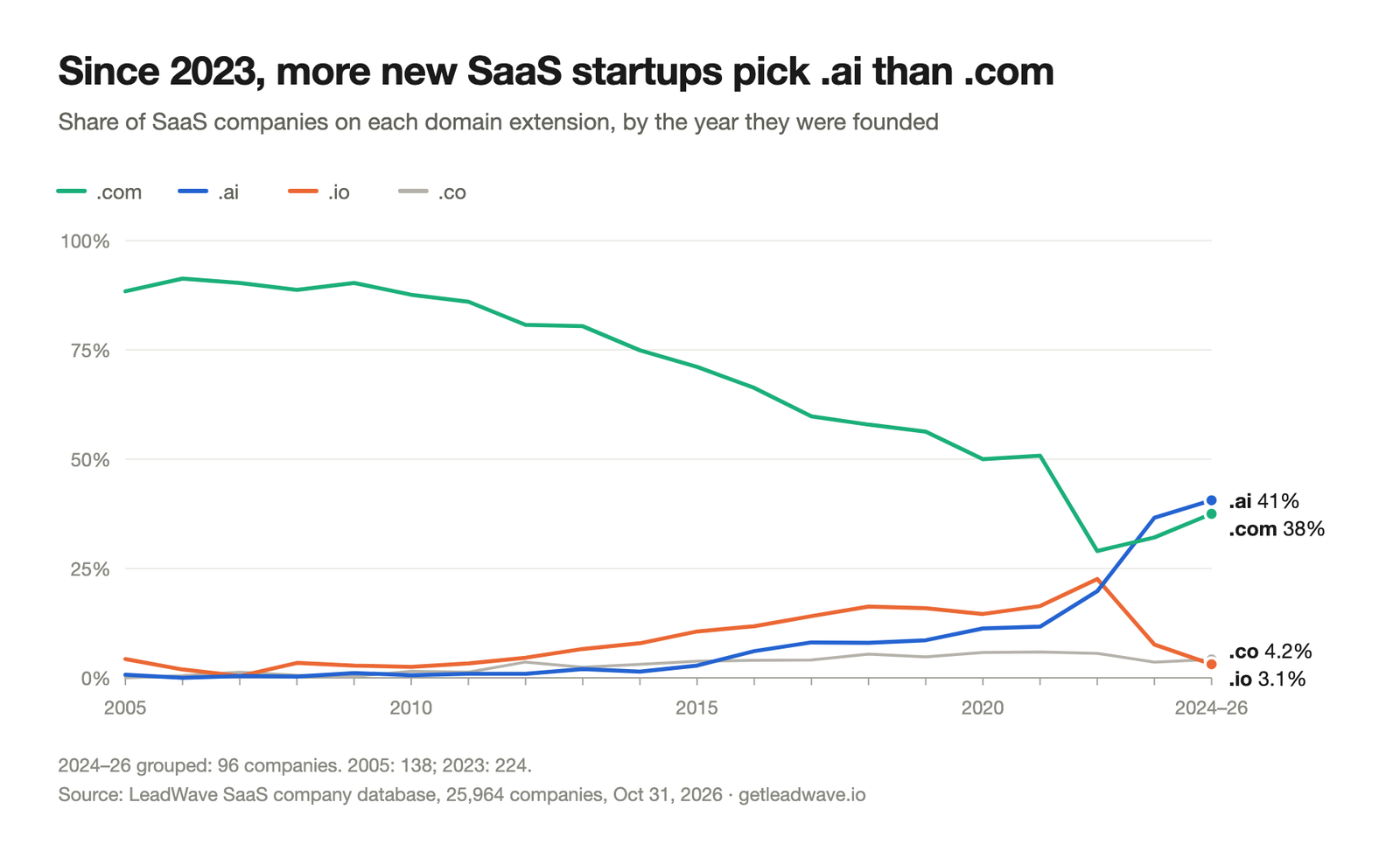
By founding year, three things stand out:
.com went from almost everyone to about a third. 90% of the SaaS companies founded in 2000–2009 are on .com, 75% of those founded in 2014, 50% in 2020 and 32% in 2023.
.io peaked in 2022, then collapsed. It grew steadily to 23% of the companies founded in 2022, then fell to 8% in 2023 and 3% in 2024–26.
.ai took over. Under 1% of the companies founded in 2010, 11% in 2020, 20% in 2022, then 37% in 2023 and 41% in 2024–26: ahead of .com in both years.
Most of the companies founded since 2023 in our data are AI companies (280 of 320), which flatters .ai. Y Combinator's full directory shows a smaller swing: in FundingWatcher's analysis of 5,962 YC companies, .com was 47.5% of the Summer 2026 batch and .ai 26.7%, down from a peak of 37.0% in Summer 2025.
The best TLDs for SaaS, ranked
We ranked each TLD on six things: how many SaaS companies use it, whether new startups are moving to it or away from it, how much buyers trust it, what it really costs once you renew, how much policy or registry risk it carries, and how Google treats it.
# | TLD | All SaaS companies | Founded 2022+ | Renewal per year | Best for |
|---|---|---|---|---|---|
1 | .com | 67.5% | 31.7% | about $11 | Any SaaS that can get it |
2 | .ai | 5.7% | 29.9% | about $83, 2-year minimum | AI products |
3 | .io | 7.9% | 13.4% | about $52 | Developer tools, B2B infrastructure |
4 | .co | 2.9% | 4.6% | about $31 | A short, cheaper stand-in for .com |
5 | .app | 0.7% | 3.5% | about $15 | Product-led and mobile apps |
6 | .dev | 0.3% | 3.7% | about $13 | Developer tools |
7 | .de, .co.uk, .com.br… | varies by country | varies by country | $4–10 | SaaS that sells in one country |
8 | .so, .sh, .inc | 0.3%, 0.1%, under 0.1% | 3.5%, 0.5%, 0.4% | about $65, $47, $2,060 | Very short names |
Renewal prices are Porkbun's list prices on October 31, 2026, and the .so price is Namecheap's, which is typical. First-year prices are often lower, which is why we list the renewal.
1. .com: the best TLD for SaaS, if you can get it
17,525 of the 25,964 companies use .com, and it's the default for established software: 93% of SaaS companies with more than 1,000 employees and 86% of those that raised $100–500 million are on .com. Buyers type it without thinking, emails don't get misdirected to it by accident, and nobody in a procurement review asks about it.
The domain itself is cheap. Verisign's wholesale price is $10.97 from November 1, 2026, up 7%, and its contract allows up to three more 7% increases in the current six-year cycle (Domain Name Wire). The exact name you want is a different story: it's almost always taken, and buying it can cost from thousands of dollars to six figures (see the upgrade stories below).
The usual workaround is a prefix or suffix on the .com. In our data, 82% of the domains with a prefix like get-, try- or use- are .com (more on those below).
2. .ai: the best TLD for an AI product
.ai is only 5.7% of all SaaS companies but 29.9% of those founded since 2022, six times its share among older companies. Among AI companies founded since 2023, 43% use it. It's also the TLD of the frontier: xAI (x.ai), Mistral (mistral.ai), Harvey (harvey.ai), Perplexity and Jasper all use it, and the 44 companies in our data that raised over $1 billion are 15.9% on .ai, against 4.0% of those that raised $100–500 million.
It's the most expensive of the common TLDs. The registry raised the wholesale price from $70 to $80 a year in March 2026, and every registration, renewal and transfer is for at least two years (Domain Name Wire), so expect about $165 every second year. Good short names cost far more: bot.ai sold for $1.2 million in February 2026, the largest public .ai sale so far (DN Journal).
.ai is Anguilla's country code. The island's government runs it with Identity Digital, which took over the registry in a five-year deal (Domain Name Wire), and the domain passed 1 million registrations in January 2026 (Domain Name Wire). It brought Anguilla EC$230.5 million (US$85.3 million) in 2025 (Anguilla Focus), which gives the government every reason to keep it stable. Google treats .ai as a generic TLD, not as a signal that you target Anguilla.
The catch: if your product isn't AI, .ai ties your brand to a trend and costs about seven times as much as a .com.
3. .io: still fine for developer tools, but new startups have left
.io was the startup TLD of the 2010s. It's 7.9% of all SaaS companies, and it grew to 23% of the companies founded in 2022. Then it fell to 8% in 2023 and 3% in 2024–26, as AI startups moved to .ai. Well-known users include Gong (gong.io), Snyk (snyk.io), Apollo.io, Pendo and ElevenLabs, which owns elevenlabs.com but sends it to elevenlabs.io.
It costs about $52 a year to renew, and the wholesale price rises from $50 to $56 on January 19, 2027 (Domain Name Wire). The bigger question is its future. .io is the code of the British Indian Ocean Territory, the Chagos Islands, which the UK agreed to hand to Mauritius in a treaty signed in May 2025. The treaty isn't in force: it stalled in April 2026 when the US withheld the consent it requires (Domain Incite, Al Jazeera). Even if the territory's code were withdrawn one day, IANA's rules give a ccTLD five years before it's removed, and up to ten with an extension (IANA), and ICANN has said the outcome for .io is not a foregone conclusion (ICANN). It's a risk to know about, not a reason to panic.
4. .co: short and familiar, with a typo problem
.co is 2.9% of SaaS companies and around 4–6% of every founding year since 2015. Hugging Face (huggingface.co), Elastic (elastic.co), MURAL (mural.co) and Affinity (affinity.co) use it. It renews for about $31 a year. It's Colombia's code, open to anyone worldwide, and its registry moved to a new operator in October 2025 (Domain Incite). Google treats it as generic. The downside is the missing m: people type .com from habit, and some of your email will go to whoever owns the .com.
5. .app: for product-led and mobile apps
.app is run by Google Registry, renews for about $15 a year, and is on the HSTS preload list, so every .app site must use HTTPS (Google Registry). It's 0.7% of all SaaS companies and 3.5% of those founded since 2022. Linear (linear.app) is the best-known example: linear.com belongs to Analog Devices. Gamma (gamma.app) and folk (folk.app) use it too, and Vercel moved its v0 product from v0.dev to v0.app in August 2025 when it opened it to non-developers (SiliconANGLE).
6. .dev: the fastest-growing TLD among developer tools
.dev is also Google's and also HTTPS-only (Google Registry). It's only 0.3% of all SaaS companies, but its share grew 18-fold: from 0.2% of companies founded before 2022 to 3.7% of those founded since. Lovable (lovable.dev, which also owns lovable.com and redirects it), Warp (warp.dev), Zed (zed.dev) and Merge (merge.dev) use it. It renews for about $13. It says "for developers", which is a strength for a dev tool and a limit if you later sell to non-technical buyers.
7. Your country's TLD: for SaaS that sells in one market
Most SaaS companies sell across borders, so most skip their country code: only 6.7% of UK SaaS companies use .co.uk or .uk, and 0.5% of US ones use .us. Brazil is the exception, with 51% of Brazilian SaaS companies on .com.br, followed by Australia (13%) and Germany (12%).
A country TLD makes sense when your buyers, invoices and support are in one country. Germans know their own: in a December 2025 survey, 79% of Germans recognised .de unprompted, against 67% for .com, and .de passed 18 million names in July 2026 (Domain Name Wire). Country TLDs are cheap ($4–10 a year), and Google uses them as a signal that you target that country. Register the .com too if you can, or at least redirect it, in case you expand. Note that .eu is only open to people and organisations in the EU, Iceland, Liechtenstein and Norway (EURid).
8. .so, .sh and .inc: short names at a price
These three buy you a short, exact name. Each has a catch.
.so (Somalia) grew from 0.2% of SaaS companies founded before 2022 to 3.5% of those founded since. Notion launched on notion.so and moved to notion.com in June 2026 after years of trying to buy it (createwith). Circle (circle.so) and Plane (plane.so) still use it. It costs about $65–70 a year, and it isn't on Google's list of country codes treated as generic, so Google assumes by default that a .so site targets Somalia (Google Search Central).
.sh (St Helena) is popular with command-line and developer tools: Polar (polar.sh) and Platform.sh. It's run by the same company as .io (IANA), costs about $47 a year, and is also missing from Google's generic list. Bun has since moved from bun.sh to bun.com.
.inc costs about $2,000 a year, on purpose: its registry prices it "for real businesses, not speculators" (get.inc). That buys rare short names: Safe Superintelligence is ssi.inc and Standard Intelligence is si.inc.
Rising stars: the TLDs gaining ground
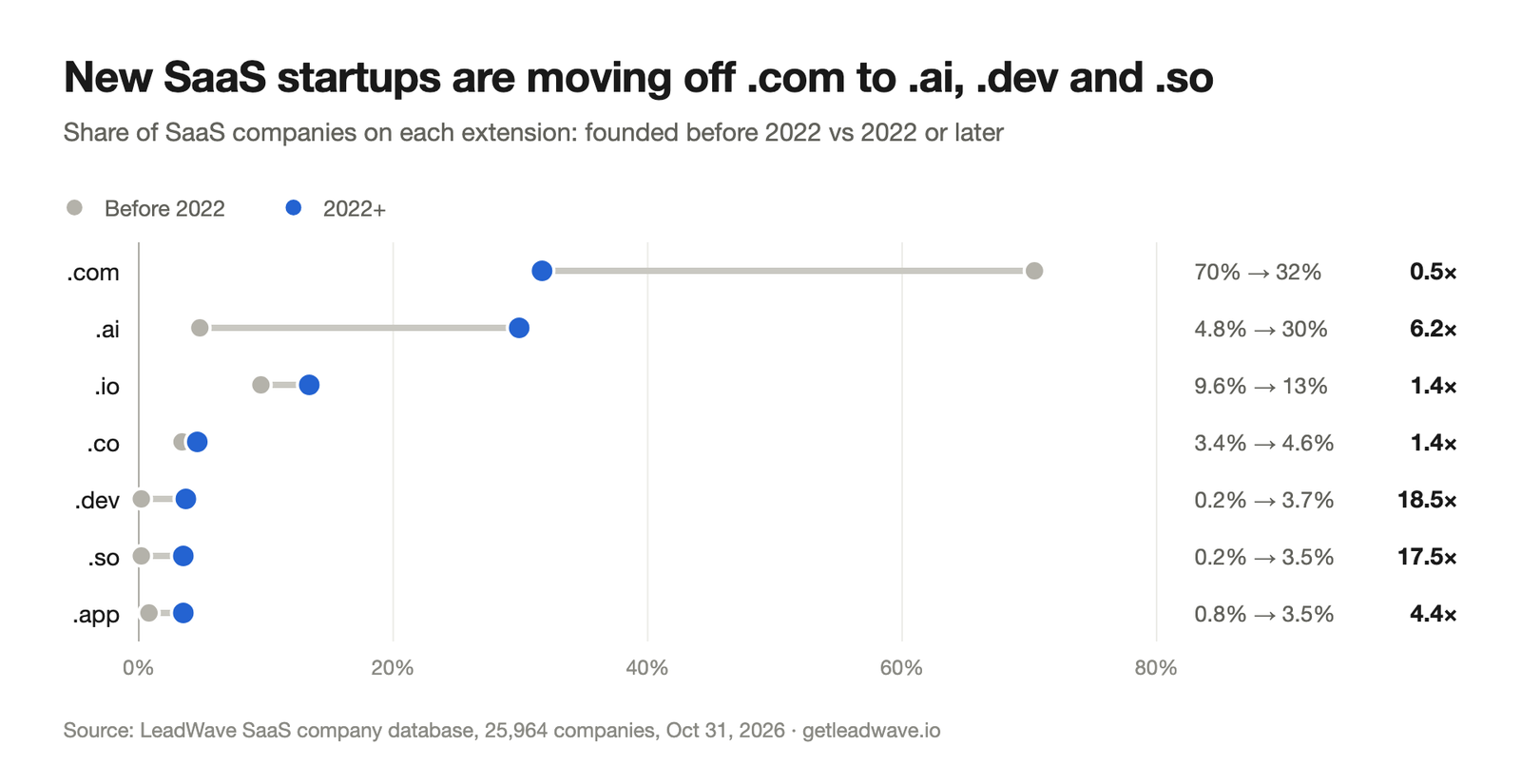
Compare the 568 companies founded since 2022 with the 13,721 founded before, and four TLDs stand out: .dev (18.5 times its old share), .so (17.5 times), .ai (6.2 times) and .app (4.4 times). .com fell from 70% to 32%. Smaller TLDs are appearing too, a few companies at a time: .inc (ssi.inc), .sh (polar.sh, cosine.sh), .computer (zo.computer) and .new (bolt.new).
.si: the "super intelligence" domain rush
Slovenia's .si is the newest rising star, and the least proven. On September 29, 2026, a US executive order told federal agencies to say "super intelligence" and "SI" instead of "AI". Registry SI reported a 2,199% rise in .si registrations in September, about 11,000 new .si domains on September 30 and 13,603 on October 1 (TechCrunch, The Next Web). A .si domain costs about $12 a year at Hostinger, against about $90 for a .ai, which also needs two years upfront. The rush continued into October (Euronews).
Treat it with care. The registry said the order wasn't the only cause, and Hostinger found only about 3% of its new .si domains were explicitly AI-related: much of the buying looks like speculation. None of the 25,964 companies in our data uses .si yet. Google treats .si as Slovenian, so a .si site starts with a country signal you probably don't want. Registering your name on .si to protect it is cheap; building your brand on it is a bet.
New TLDs from ICANN's 2026 round
ICANN's first new-TLD round since 2012 closed in August 2026 with 1,615 applications, 333 of them for brand TLDs like a company's own name (ICANN). None of them will be live for a while, and an application costs $227,000, so this matters to large brands, not to a startup picking its first domain.
Why bigger SaaS companies end up on .com
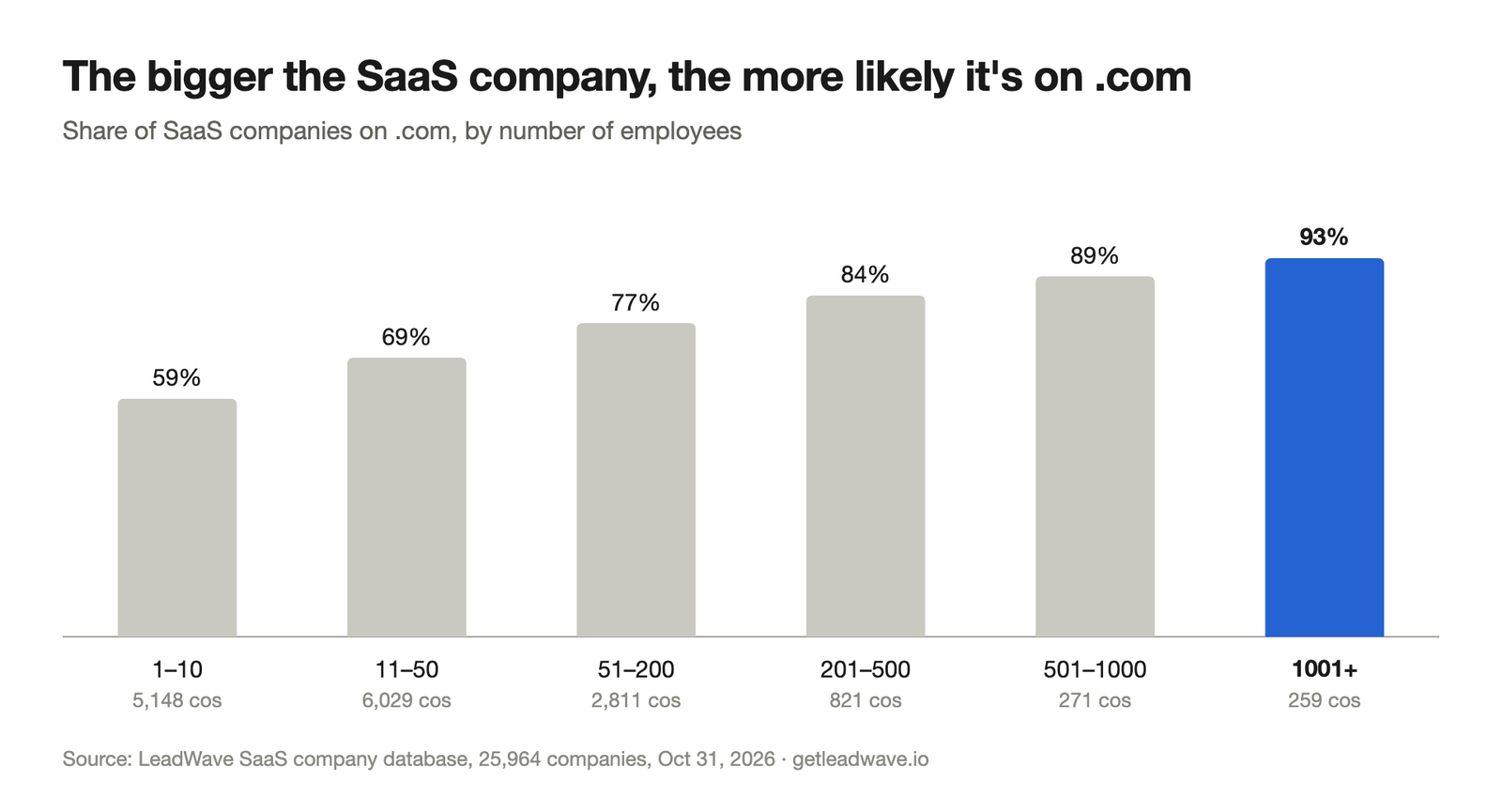
The share of SaaS companies on .com rises with every size band: 59% of companies with 1–10 employees, 77% of those with 51–200, and 93% of those with more than 1,000. The same holds for funding: 63% of the companies that raised under $1 million are on .com, against 86% of those that raised $100–500 million. .io goes the other way, from 13% of the smallest companies to under 1% of the largest.
Part of that is age: bigger companies are older, from the years when everyone used .com. The rest is the upgrade path. Startups launch on whatever they can get and buy the .com once they can afford it:
Company | From | To | Year | Reported price |
|---|---|---|---|---|
useloom.com | loom.com | 2018 | $150K, half of it to a rival startup to drop its claim | |
supabase.io | supabase.com | 2021 | Undisclosed | |
repl.it | replit.com | 2021 | Undisclosed | |
frontapp.com | front.com | 2021 | Undisclosed | |
clerk.dev | clerk.com | 2023 | Undisclosed | |
cursor.sh | cursor.com | 2024 | $399K, per the seller | |
railway.app | railway.com | 2024 | Undisclosed | |
notion.so | notion.com | 2026 | Undisclosed, cash and Notion equity |
Read more about two of them in our Cursor and Notion company profiles.
The opposite also happens. Once a brand is known by its alternative TLD, the .com becomes a redirect: Perplexity sends perplexity.com to perplexity.ai, Hugging Face sends huggingface.com to huggingface.co, and Lovable sends lovable.com to lovable.dev. Some never get the choice: Linear is on linear.app because linear.com belongs to Analog Devices.
Does your domain name affect SEO?
Not much, and less than many domain sellers suggest. Keywords in the domain give no ranking advantage: Google's John Mueller has said there's "no secret (or public) SEO-bonus for having your keywords in the domain name", and advised picking "a domain name you can build on for the long run" (Search Engine Journal). Google already turned against keyword domains in 2012, when an update cut low-quality exact-match domains, affecting 0.6% of US English searches (Search Engine Roundtable). That's why almost every successful SaaS company uses a brand name, not a keyword like bestcrmsoftware.com.
The extension doesn't matter much either. Google has said since 2015 that it treats new TLDs like .com and .org, and that keywords in a TLD give no advantage or disadvantage in search (Google Search Central). Country codes are the exception: Google treats them as a sign that you target that country, unless the code is on its list of ones it treats as generic. That list includes .ai, .io, .co, .me and .tv, but not .so, .sh or .si (Google Search Central). What a domain does change is the click and the memory: people trust and remember .com and short real words more, and a hard-to-spell name loses type-in visitors and email.
TLDs to avoid for a B2B SaaS
.xyz: the biggest new TLD, with over 11 million names, and a first year that can cost $2. That's the problem: cheap TLDs attract abuse. In Interisle's 2025 study, new TLDs held about five times more malicious registrations than their market share (Interisle). Only 0.1% of SaaS companies use .xyz.
.biz and .info: old, but associated with spam. In a 2019 survey of 1,500 people, .biz scored 2.9 out of 5 for trust against 3.5 for .com (GrowthBadger).
.online, .site and .club: cheap generic TLDs that read as low-effort to a business buyer.
.tech and .cloud: not bad, but watch the renewal. .tech costs $7–10 in the first year and about $50 after.
How to choose a domain name for your SaaS
Choose the name first, then the domain. 82% of SaaS companies use their exact name, so the name is the decision. If you don't have one yet, try our SaaS name generator.
Say it out loud. If you have to spell it, explain a hyphen or say "the number 2", pick something else. Short helps: a quarter of new SaaS startups use five letters or fewer.
Check the exact .com, and what its owner wants for it. Set a budget before you ask.
If it's taken, choose between the exact name elsewhere and a longer .com. An AI product: .ai. A developer tool: .dev or .io. A consumer or mobile app: .app. Selling to enterprises or non-technical buyers: a .com with get-, try- or use-.
Compare renewal prices, not first-year prices. .ai, .io, .tech and .inc all cost far more in year two than the offer suggests.
Check trademarks and handles. Search the USPTO's trademark search and TMview for the EU and beyond, and check the social handles you'll need.
Register the obvious variants and redirect them: your .com if you can, your country TLD and common misspellings. Use one domain for email from day one.
Plan the .com upgrade. If you grow, you'll probably want it. Loom, Supabase, Front, Clerk, Cursor, Railway and Notion all moved later.
Our free SaaS domain name generator runs these patterns for your name on the TLDs SaaS companies actually use and shows which look free.
FAQ
What is a good domain name for a SaaS company?
Your exact company name, short and easy to say, on .com if you can get it. 82% of SaaS companies use their exact name. If the .com is taken, most new startups keep the exact name on another extension, such as .ai, .io, .dev or .app, rather than add a word to it.
Should a SaaS domain be .com?
Ideally, yes: 67.5% of SaaS companies use .com, and 93% of those with more than 1,000 employees. But it's no longer the norm for new startups: only 32% of the SaaS companies founded since 2022 are on .com. For an AI product, .ai is now as common as .com.
Is it OK to use get-, try- or use- in a SaaS domain?
Yes. 596 SaaS companies in our data use a prefix, get- most of all (223), and 82% of them are on .com. It's the standard way to have a .com when the exact one is taken. Plan to buy the exact .com later, as Loom (useloom.com) did.
How long should a SaaS domain name be?
As short as you can make it while keeping it easy to say. The typical SaaS domain is 8 characters before the dot, and 7 for companies founded since 2022. A quarter of new startups use five characters or fewer, mostly on .ai, .dev, .app or .so.
Should my SaaS domain include keywords like CRM or software?
No. Google gives no ranking bonus for keywords in a domain, and a descriptive domain is harder to trademark and can box you in if the product changes. Use your brand name; at most, add a short prefix or suffix like get- or -hq.
Is .io still good for SaaS?
Yes for developer tools, but it's losing ground: 23% of the SaaS companies founded in 2022 chose .io, and 3% of those founded since 2024. The Chagos handover that could affect it is frozen, and a retired country code would get at least five years' notice. It costs about $52 a year.
Should a SaaS that isn't AI use .ai?
Usually not. Only 1.2% of the non-AI companies in our data use .ai. It costs about $80 a year, paid two years at a time, and it ties your brand to AI.
Is .si a good domain for an AI startup?
Not yet. It's cheap (about $12 a year), but the September 2026 rush is mostly speculation, no SaaS company in our data uses it, and Google treats it as Slovenian. Registering your name there to protect it costs little.
Should I buy the .com later?
Many companies do: Loom, Supabase, Front, Clerk, Cursor, Railway and Notion all moved to the .com after launching elsewhere, and the bigger a SaaS company is, the more likely it has its exact name on .com (85% of those with more than 1,000 employees). Use one domain for email from day one, so moving later is a redirect rather than a rebuild.
Methodology
The data is the LeadWave database of SaaS and AI companies, pulled on October 31, 2026: 28,984 records, which become 25,964 companies after merging records with the same website and leaving out a handful that aren't SaaS companies. Each company's TLD comes from its website's domain, with .co.uk and .com.br counted as one extension. Our separate TLD field agrees on 97.6% of the 13,038 companies where it's filled in.
To sort domains into patterns, we compared the part before the dot with the company name, ignoring spaces, punctuation and trailing words like AI, Labs, Inc or Technologies. Prefixes and suffixes come from a fixed list of 55 prefixes (get, try, use…) and 34 suffixes (app, hq, labs…). "A real word" means the name before the dot is a lower-case entry in the standard English word list that ships with macOS, so it includes some rare words. Length is the number of characters before the dot.
The founding year is known for 14,289 companies, so the by-year figures use those. The recent years are small samples (248 companies founded in 2022, 224 in 2023 and 96 in 2024–26), and they lean towards AI companies. The AI flag is our own classification. Every figure describes the domain a company uses today, not the one it launched with.
Want the companies behind these numbers? LeadWave's list of 15,000 SaaS companies includes each company's website, founding year, size, HQ and funding, and its CEO's verified email.