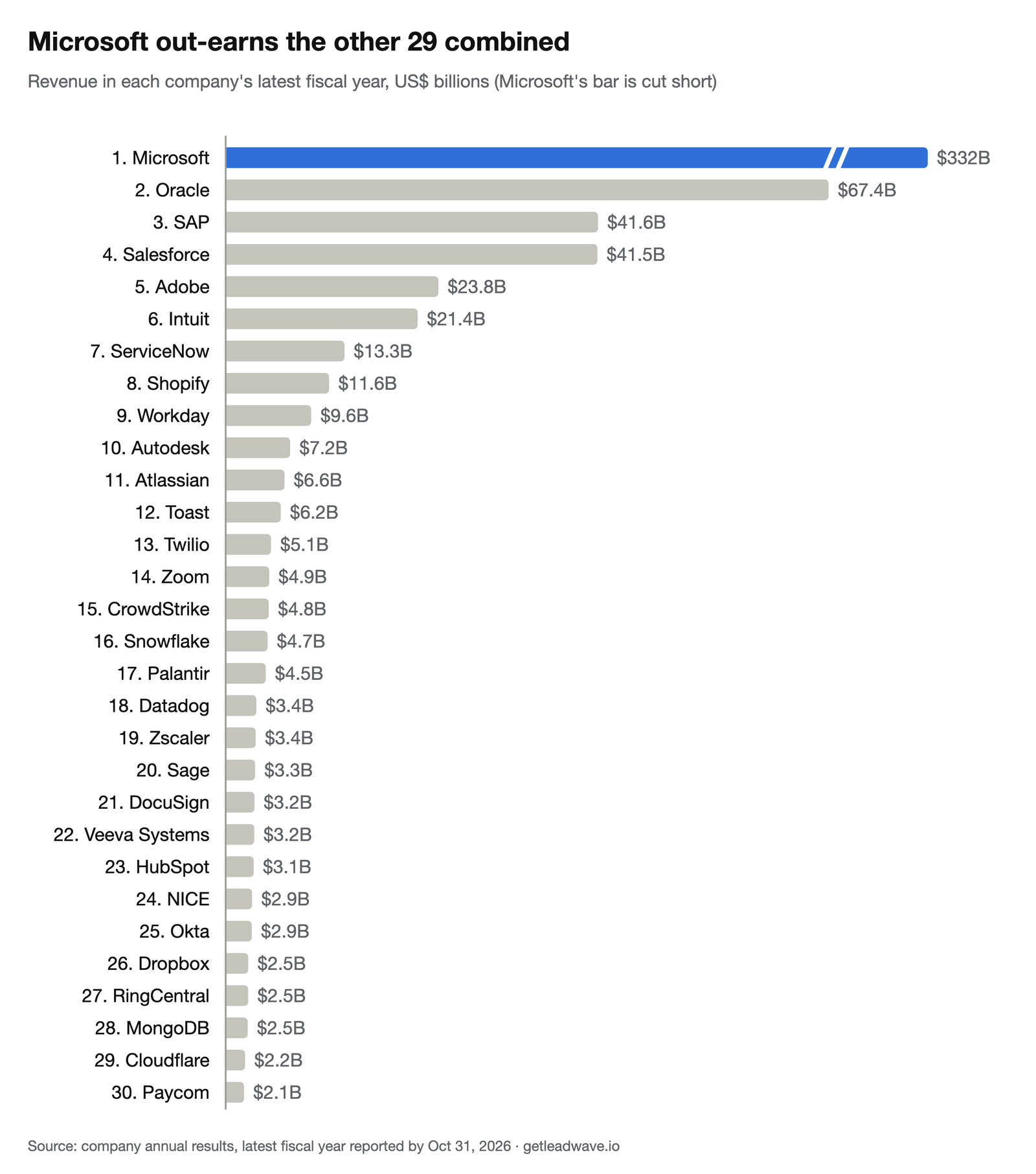
As of October 2026, the biggest SaaS company in the world is Microsoft, with $331.8 billion of revenue in its fiscal year to June 2026. Oracle, SAP and Salesforce follow, and Salesforce is the largest company that earns almost all of its revenue from subscriptions. This list ranks the 30 biggest SaaS companies by revenue, then the next 20, using each company's latest annual results.
A lot changed in a year. AI agents are now the main product story at nearly every company here. Software stocks fell into a bear market in early 2026 on fears that AI would replace software seats. Several familiar names were bought or taken private. And OpenAI and Anthropic, which sell AI models rather than classic SaaS, now bring in more annualized revenue than every company on this list except Microsoft and Oracle.
Below: the top 10 at a glance, the key numbers, the full ranking, a profile of each of the 30, the companies ranked 31 to 50, the biggest private SaaS companies, and how this list was built.
The 10 biggest SaaS companies in 2026
Ranked by revenue in each company's latest fiscal year:
Microsoft: $331.8 billion, fiscal 2026 (year to June 30, 2026)
Oracle: $67.4 billion, fiscal 2026 (year to May 31, 2026)
SAP: $41.6 billion (€36.8 billion), 2025
Salesforce: $41.5 billion, fiscal 2026 (year to January 31, 2026)
Adobe: $23.8 billion, fiscal 2025 (year to November 28, 2025)
Intuit: $21.4 billion, fiscal 2026 (year to July 31, 2026)
ServiceNow: $13.3 billion, 2025
Shopify: $11.6 billion, 2025
Workday: $9.6 billion, fiscal 2026 (year to January 31, 2026)
Autodesk: $7.2 billion, fiscal 2026 (year to January 31, 2026)
Key numbers
$643 billion combined. That is what the 30 companies below took in during their latest fiscal years.
Microsoft is bigger than the other 29 put together. Its $331.8 billion beats the $311 billion the rest of the top 30 earned. Microsoft Cloud alone brought in $214.4 billion, up 27%.
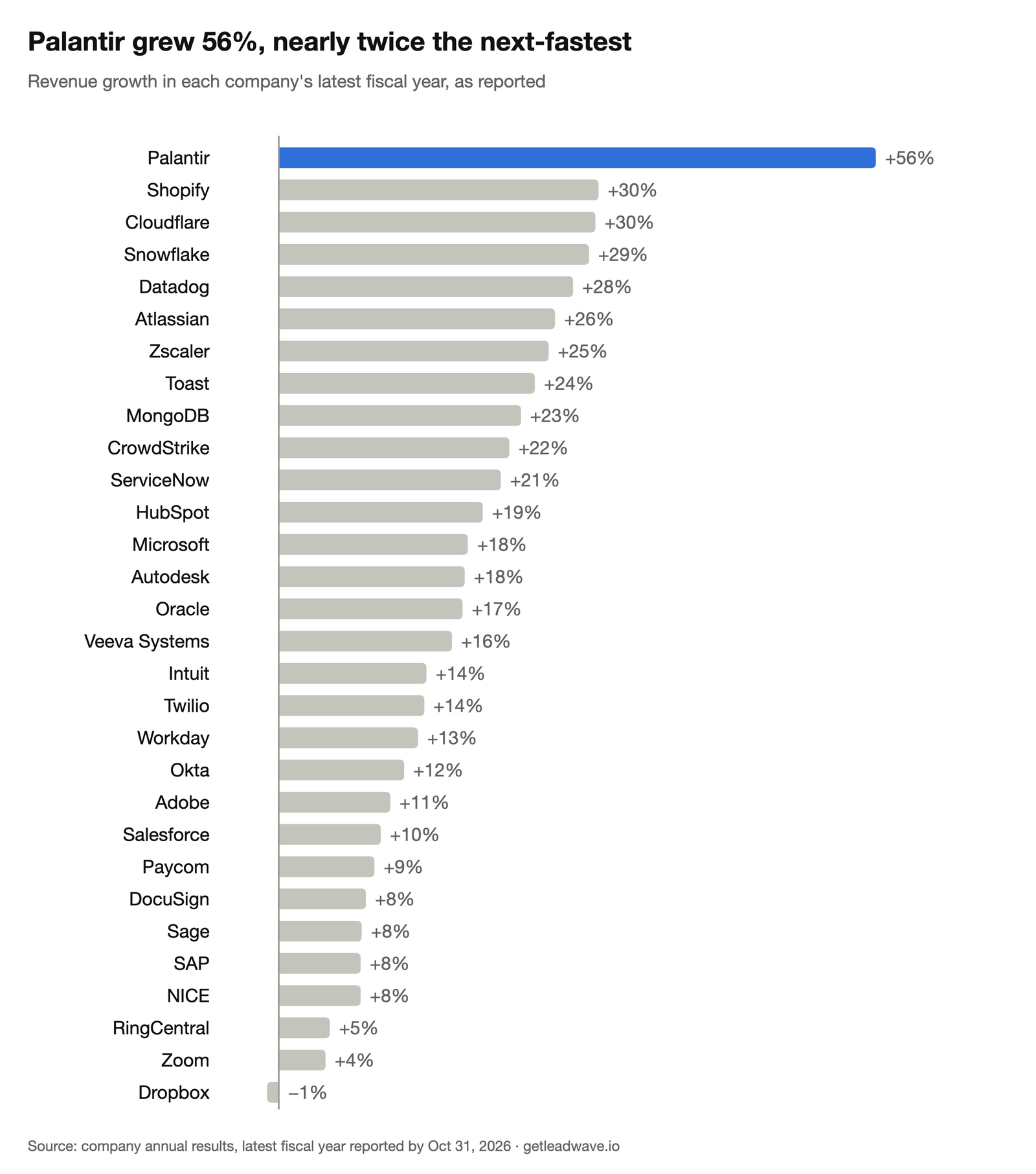
Median growth of 17%. Palantir grew fastest (56%), almost twice as fast as Shopify and Cloudflare (30% each). Dropbox was the only one whose revenue fell.
26 of 30 are American. The others are SAP (Germany), Shopify (Canada), Sage (UK) and NICE (Israel). Atlassian was founded in Sydney but now lists San Francisco as its main office.
Most of the money is subscriptions. Adobe, ServiceNow, DocuSign and Okta each earn 96% or more of their revenue from subscriptions, and Salesforce and CrowdStrike about 95%.
The software market keeps growing. Gartner expects worldwide software spending of $1.47 trillion in 2026, up 15.5% (Gartner, July 2026).
Top 30 SaaS companies by revenue
Revenue is each company's total in its latest full fiscal year; growth is the change from the year before, as reported. Fiscal years end in different months, so the table says which year each figure covers.
# | Company | Revenue | Growth | Fiscal year | Headquarters |
|---|---|---|---|---|---|
1 | Microsoft | +18% | Year to Jun 30, 2026 | Redmond, US | |
2 | Oracle | +17% | Year to May 31, 2026 | Austin, US | |
3 | SAP | +8% | 2025 | Walldorf, Germany | |
4 | Salesforce | +10% | Year to Jan 31, 2026 | San Francisco, US | |
5 | Adobe | +11% | Year to Nov 28, 2025 | San Jose, US | |
6 | Intuit | +14% | Year to Jul 31, 2026 | Mountain View, US | |
7 | ServiceNow | +21% | 2025 | Santa Clara, US | |
8 | Shopify | +30% | 2025 | Ottawa, Canada | |
9 | Workday | +13% | Year to Jan 31, 2026 | Pleasanton, US | |
10 | Autodesk | +18% | Year to Jan 31, 2026 | San Francisco, US | |
11 | Atlassian | +26% | Year to Jun 30, 2026 | San Francisco, US | |
12 | Toast | +24% | 2025 | Boston, US | |
13 | Twilio | +14% | 2025 | San Francisco, US | |
14 | Zoom | +4% | Year to Jan 31, 2026 | San Jose, US | |
15 | CrowdStrike | +22% | Year to Jan 31, 2026 | Austin, US | |
16 | Snowflake | +29% | Year to Jan 31, 2026 | Menlo Park, US | |
17 | Palantir | +56% | 2025 | Aventura, US | |
18 | Datadog | +28% | 2025 | New York, US | |
19 | Zscaler | +25% | Year to Jul 31, 2026 | Silicon Valley, US | |
20 | Sage | +8% | Year to Sep 30, 2025 | Newcastle, UK | |
21 | DocuSign | +8% | Year to Jan 31, 2026 | San Francisco, US | |
22 | Veeva Systems | +16% | Year to Jan 31, 2026 | Pleasanton, US | |
23 | HubSpot | +19% | 2025 | Cambridge, US | |
24 | NICE | +8% | 2025 | Ra'anana, Israel | |
25 | Okta | +12% | Year to Jan 31, 2026 | San Francisco, US | |
26 | Dropbox | −1% | 2025 | San Francisco, US | |
27 | RingCentral | +5% | 2025 | Belmont, US | |
28 | MongoDB | +23% | Year to Jan 31, 2026 | New York, US | |
29 | Cloudflare | +30% | 2025 | San Francisco, US | |
30 | Paycom | +9% | 2025 | Oklahoma City, US |
The fastest growers are the companies selling data, security and AI infrastructure: Palantir, Cloudflare, Snowflake, Datadog and Zscaler all grew 25% or more. The slowest sell products most of their customers already have: Zoom (4%), RingCentral (5%) and Dropbox, the only company in the top 30 to shrink.
The 30 biggest SaaS companies, ranked
1. Microsoft
Microsoft is the world's largest seller of SaaS through Microsoft 365, Dynamics 365 and LinkedIn, and its total also includes Azure, Windows and Xbox. Microsoft Cloud revenue reached $214.4 billion in fiscal 2026, about 65% of the total, and Azure passed $100 billion for the first time. Microsoft 365 Copilot ended the year with more than 30 million paid seats, and revenue grew 19% to $92.3 billion in the quarter to September 2026.
Revenue: $331.8 billion in fiscal 2026 (year to June 30, 2026), up 18%
Founded: 1975
Headquarters: Redmond, Washington, US
CEO: Satya Nadella
Employees: about 223,000 (June 30, 2026)
2. Oracle
Oracle sells its database, the Fusion and NetSuite cloud applications, and Oracle Cloud Infrastructure. Cloud revenue was $34.0 billion in fiscal 2026, about half the total: infrastructure grew 77% on AI demand and applications 11%. AI contracts lifted its remaining performance obligations to $664 billion by August 2026. Clay Magouyrk and Mike Sicilia replaced Safra Catz as co-CEOs in September 2025.
Revenue: $67.4 billion in fiscal 2026 (year to May 31, 2026), up 17%
Founded: 1977
Headquarters: Austin, Texas, US
CEO: Clay Magouyrk and Mike Sicilia (co-CEOs)
Employees: about 141,000 (May 31, 2026)
Similar companies: more ERP SaaS companies
3. SAP
SAP, Europe's largest software company, makes the ERP systems that run the finances and supply chains of many of the world's biggest companies. Cloud revenue rose 23% to €21.0 billion in 2025, 57% of the total, and in the third quarter of 2026 SAP passed €10 billion of quarterly revenue for the first time. Converted at SAP's own 2025 average rate ($1.1293 per euro), it edges out Salesforce by about $100 million.
Revenue: $41.6 billion (€36.8 billion) in 2025, up 8%
Founded: 1972
Headquarters: Walldorf, Germany
CEO: Christian Klein
Employees: 111,397 (December 31, 2025)
Similar companies: more ERP SaaS companies
4. Salesforce
Salesforce is the largest CRM company and the biggest company on this list that earns almost everything from subscriptions: 95% of revenue. It closed its $8 billion purchase of Informatica in November 2025, and its Agentforce AI agents passed $1.5 billion in annual recurring revenue in mid-2026. In October 2026 it agreed to buy Braze, the customer-engagement platform, for about $5.7 billion.
Revenue: $41.5 billion in fiscal 2026 (year to January 31, 2026), up 10%
Founded: 1999
Headquarters: San Francisco, California, US
CEO: Marc Benioff
Employees: 83,334 (January 31, 2026)
Similar companies: more CRM SaaS companies
5. Adobe

Adobe sells Creative Cloud (Photoshop, Premiere, Illustrator), Document Cloud (Acrobat) and marketing software, and 96% of its revenue is subscriptions. Its products passed 1 billion monthly active users in 2026, and its AI-first annual recurring revenue grew more than 150%. Shantanu Narayen, CEO since 2007, hands over to Anil Chakravarthy on December 1, 2026 and becomes executive chair.
Revenue: $23.8 billion in fiscal 2025 (year to November 28, 2025), up 11%
Founded: 1982
Headquarters: San Jose, California, US
CEO: Shantanu Narayen; Anil Chakravarthy takes over on December 1, 2026
Employees: 31,360 (November 28, 2025)
6. Intuit

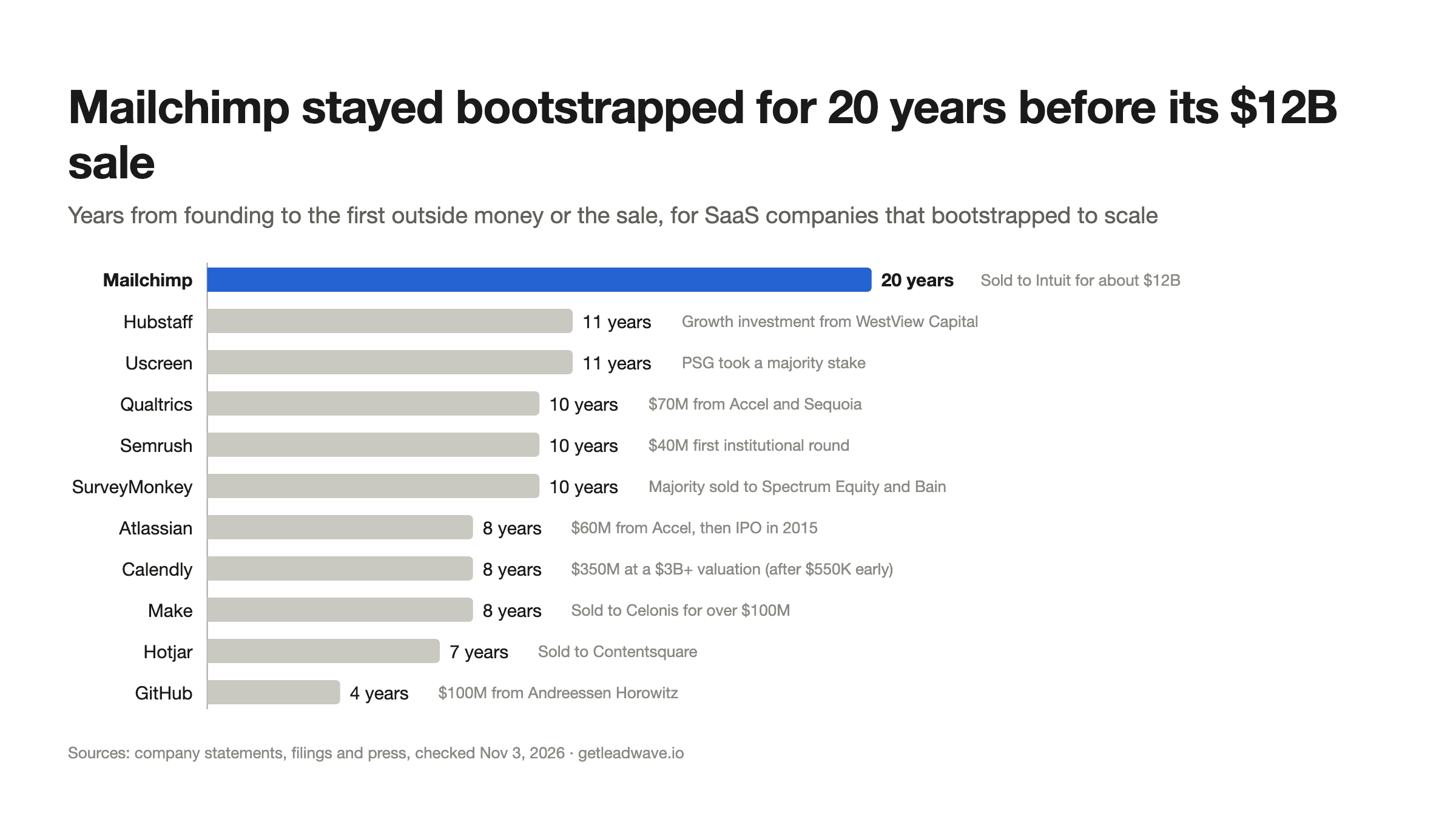
Intuit makes TurboTax, QuickBooks, Credit Karma and Mailchimp. Its online ecosystem, built around QuickBooks Online, grew 19% to $9.9 billion in fiscal 2026. From August 2026 Intuit runs Mailchimp as a separate segment, and it expects 9–10% growth in fiscal 2027.
Revenue: $21.4 billion in fiscal 2026 (year to July 31, 2026), up 14%
Founded: 1983
Headquarters: Mountain View, California, US
CEO: Sasan Goodarzi
Employees: about 18,600, plus seasonal staff (July 31, 2026)
Similar companies: more accounting SaaS companies
7. ServiceNow
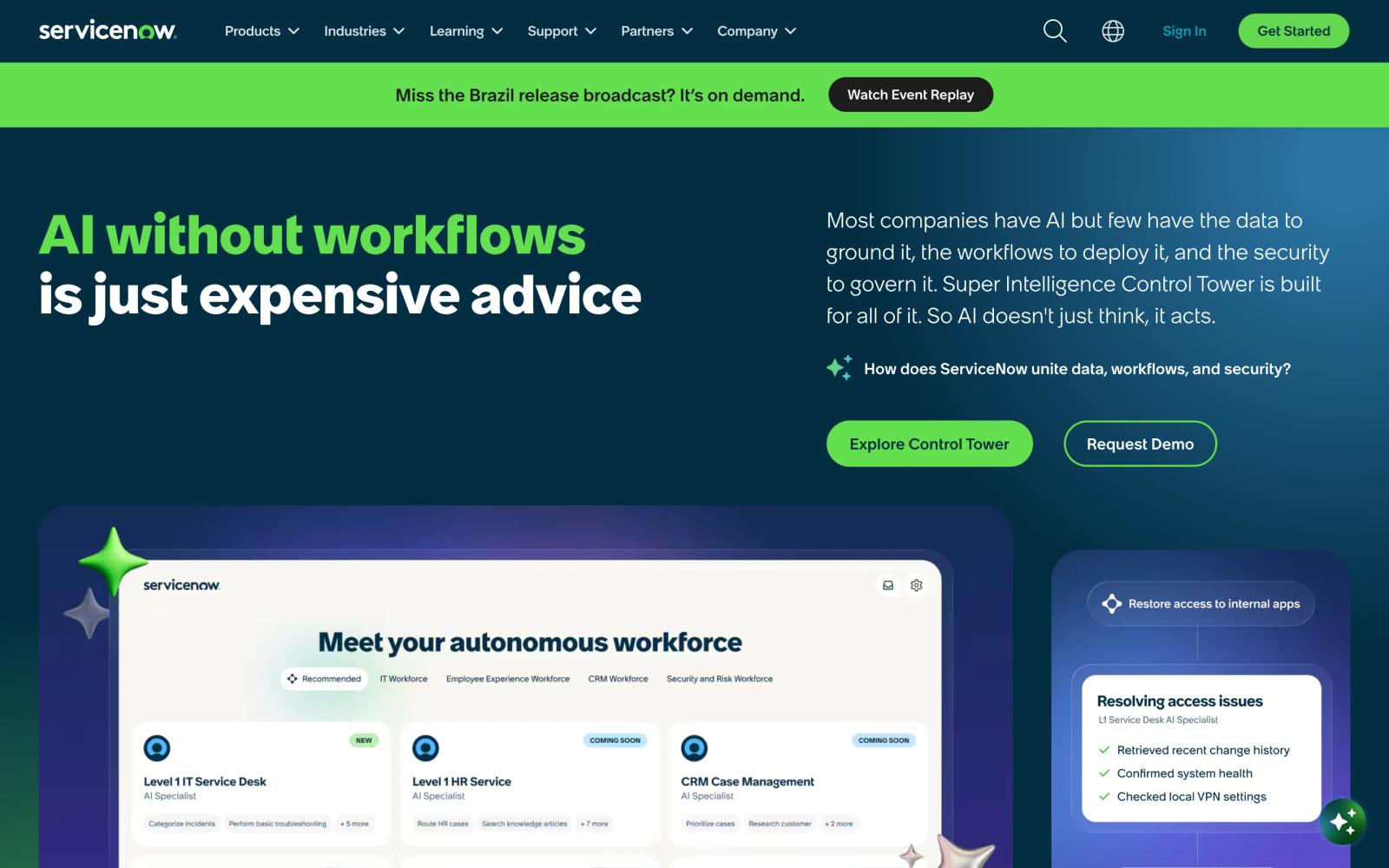
ServiceNow runs IT, HR and customer-service workflows for large enterprises, and 97% of its revenue is subscriptions. It spent heavily on AI agents and security in 2025–26, buying Moveworks, Veza and Armis, its biggest deal yet at $7.75 billion. Revenue rose 20.5% to $4.1 billion in the third quarter of 2026.
Revenue: $13.3 billion in 2025, up 21%
Founded: 2004
Headquarters: Santa Clara, California, US
CEO: Bill McDermott
Employees: 29,187 (December 31, 2025)
8. Shopify

Shopify runs online stores, checkout and point of sale for merchants of every size. Subscriptions are 24% of its revenue; the rest comes from payments and other services merchants buy through the platform, which this list counts (see how this list was built). Revenue grew 30% in 2025 and 34% in the second quarter of 2026, as Shopify pushed into AI shopping agents.
Revenue: $11.6 billion in 2025, up 30%
Founded: 2006
Headquarters: Ottawa, Canada
CEO: Tobi Lütke
Employees: about 7,600 (December 31, 2025)
Similar companies: more e-commerce SaaS companies
9. Workday

Workday makes cloud HR and finance software for large organizations, and 92% of its revenue is subscriptions. Co-founder Aneel Bhusri returned as CEO in February 2026, replacing Carl Eschenbach, after Workday bought the AI companies Paradox, Sana and Pipedream.
Revenue: $9.6 billion in fiscal 2026 (year to January 31, 2026), up 13%
Founded: 2005
Headquarters: Pleasanton, California, US
CEO: Aneel Bhusri
Employees: more than 21,000 (January 31, 2026)
Similar companies: more HR SaaS companies
10. Autodesk

Autodesk makes AutoCAD, Revit, Fusion and other design software for architects, engineers, builders and manufacturers, sold by subscription (94% of revenue). It bought the maintenance-management company MaintainX for about $3.6 billion in August 2026.
Revenue: $7.2 billion in fiscal 2026 (year to January 31, 2026), up 18%
Founded: 1982
Headquarters: San Francisco, California, US
CEO: Andrew Anagnost
Employees: about 14,300 (January 31, 2026)
11. Atlassian
Atlassian makes Jira, Confluence and Loom for software and business teams. Cloud revenue grew 28% to $4.4 billion in fiscal 2026, two-thirds of the total, and it is moving customers off self-hosted software: its Data Center products reach end of life in March 2029. It bought The Browser Company and DX in 2025, and cut about 10% of its staff in March 2026.
Revenue: $6.6 billion in fiscal 2026 (year to June 30, 2026), up 26%
Founded: 2002, in Sydney
Headquarters: San Francisco, California, US, and Sydney, Australia
CEO: Mike Cannon-Brookes
Employees: 13,301 (June 30, 2026)
Similar companies: more project management SaaS companies
12. Toast
Toast sells point-of-sale and management software to restaurants and, increasingly, retailers. Like Shopify, it earns most of its money from payments that run through its software; subscriptions are 15% of revenue. It added a record of about 9,500 net locations in the second quarter of 2026, lifting annual recurring revenue 25% to $2.4 billion.
Revenue: $6.2 billion in 2025, up 24%
Founded: 2011
Headquarters: Boston, Massachusetts, US
CEO: Aman Narang
13. Twilio
Twilio sells messaging, voice, email and identity APIs that developers build into their apps, priced mostly by usage. It posted a GAAP profit of $33.8 million in 2025 after a loss in 2024, bought the AI-agent identity platform Stytch, and grew 20% in the third quarter of 2026.
Revenue: $5.1 billion in 2025, up 14%
Founded: 2008
Headquarters: San Francisco, California, US
CEO: Khozema Shipchandler
Employees: 5,587 (December 31, 2025)
14. Zoom
Zoom is best known for video meetings and now sells phone, contact-center and AI agent products to businesses. It grew 4%, the slowest in the top 30 after Dropbox, but enterprise revenue (about 60% of the total) grew faster, and Zoom Virtual Agent customers more than tripled in a year.
Revenue: $4.9 billion in fiscal 2026 (year to January 31, 2026), up 4%
Founded: 2011
Headquarters: San Jose, California, US
CEO: Eric Yuan
Employees: 7,438 (January 31, 2026)
15. CrowdStrike
CrowdStrike's Falcon platform protects laptops, servers, cloud workloads and identities from attacks, sold as a cloud subscription (95% of revenue). Annual recurring revenue passed $5 billion at the start of 2026 and reached $5.84 billion by July, after a record $333 million of net new ARR in the quarter.
Revenue: $4.8 billion in fiscal 2026 (year to January 31, 2026), up 22%
Founded: 2011
Headquarters: Austin, Texas, US
CEO: George Kurtz
Employees: 10,698 (January 31, 2026)
Similar companies: more cybersecurity SaaS companies
16. Snowflake
Snowflake runs a cloud data platform that customers pay for by usage rather than by seat. Product revenue growth sped up for three quarters in a row, to 37% in mid-2026, and Snowflake bought Observe to move into observability.
Revenue: $4.7 billion in fiscal 2026 (year to January 31, 2026), up 29%
Founded: 2012
Headquarters: Menlo Park, California, US
CEO: Sridhar Ramaswamy
Employees: 9,060 (January 31, 2026)
17. Palantir
Palantir sells data and AI software (Foundry, Gotham and its AI Platform) to governments and companies. It is the fastest grower in the top 30: revenue rose 56% in 2025 and 93% in the second quarter of 2026, led by US commercial sales (up 149%), and it expects about $8.15 billion for 2026. Its filings now list Aventura, Florida, rather than Denver, as its main office.
Revenue: $4.5 billion in 2025, up 56%
Founded: 2003
Headquarters: Aventura (Miami area), Florida, US
CEO: Alex Karp
Employees: 4,429 (December 31, 2025)
18. Datadog
Datadog monitors cloud applications and infrastructure for engineering teams, and has added security and AI agent products. Growth sped up to 36% in the second quarter of 2026, and it expects $4.45–4.47 billion of revenue for the year.
Revenue: $3.4 billion in 2025, up 28%
Founded: 2010
Headquarters: New York, New York, US
CEO: Olivier Pomel
Employees: about 8,100 (December 31, 2025)
19. Zscaler
Zscaler sends companies' internet and app traffic through its cloud security platform instead of on-site firewalls. Annual recurring revenue reached $3.77 billion in July 2026, up 25%, helped by its purchase of Red Canary.
Revenue: $3.4 billion in fiscal 2026 (year to July 31, 2026), up 25%
Founded: 2007
Headquarters: San Jose, California, US (moving to Santa Clara in 2026)
CEO: Jay Chaudhry
Employees: more than 8,700 (July 31, 2026)
Similar companies: more cybersecurity SaaS companies
20. Sage
Sage makes accounting, payroll and HR software for small and mid-sized businesses, and 83% of its revenue comes from software subscriptions. Growth sped up to 12% at constant currency in the quarter to June 2026. Its revenue is converted at Sage's own average rate for the year ($1.31 per pound).
Revenue: $3.3 billion (£2.51 billion) in fiscal 2025 (year to September 30, 2025), up 8%
Founded: 1981
Headquarters: Newcastle upon Tyne, UK
CEO: Steve Hare
Similar companies: more accounting SaaS companies
21. DocuSign
DocuSign made e-signatures mainstream and is now built around Intelligent Agreement Management (IAM), its AI platform for contracts. IAM grew from 11% to 15% of annual recurring revenue in the first half of 2026.
Revenue: $3.2 billion in fiscal 2026 (year to January 31, 2026), up 8%
Founded: 2003
Headquarters: San Francisco, California, US
CEO: Allan Thygesen
Employees: 7,044 (January 31, 2026)
Similar companies: more e-signature SaaS companies
22. Veeva Systems
Veeva Systems makes cloud software for the life-sciences industry: CRM for drug sales teams, and systems for clinical trials, quality and regulatory work. It settled its long legal fight with IQVIA in August 2025 and is rolling AI agents into its products.
Revenue: $3.2 billion in fiscal 2026 (year to January 31, 2026), up 16%
Founded: 2007
Headquarters: Pleasanton, California, US
CEO: Peter Gassner
Employees: 7,928 (January 31, 2026)
23. HubSpot
HubSpot sells marketing, sales and customer-service software to small and mid-sized businesses, all on one CRM. Revenue grew 19% in 2025 and 20% in the second quarter of 2026. In October 2026 it cut about 7% of its staff to reorganize product teams around AI.
Revenue: $3.1 billion in 2025, up 19%
Founded: 2006
Headquarters: Cambridge, Massachusetts, US
CEO: Yamini Rangan
Employees: 8,882 (December 31, 2025)
Similar companies: more CRM SaaS companies
24. NICE
NICE runs CXone, cloud contact-center software for large customer-service operations. Cloud is 76% of its revenue, and AI annual recurring revenue reached $362 million in mid-2026 after NICE built in Cognigy, the conversational-AI company it bought in 2025.
Revenue: $2.9 billion in 2025, up 8%
Founded: 1986
Headquarters: Ra'anana, Israel
CEO: Scott Russell
Employees: 9,626 (December 31, 2025)
Similar companies: more customer support SaaS companies
25. Okta
Okta manages sign-in and access for employees and customers, and now pitches itself as the identity layer for AI agents. 98% of its revenue is subscriptions.
Revenue: $2.9 billion in fiscal 2026 (year to January 31, 2026), up 12%
Founded: 2009
Headquarters: San Francisco, California, US
CEO: Todd McKinnon
Employees: 6,366 (January 31, 2026)
Similar companies: more cybersecurity SaaS companies
26. Dropbox
Dropbox stores and syncs files for about 18 million paying users. It is the only company in the top 30 whose revenue fell. In May 2026 it named Ashraf Alkarmi co-CEO alongside founder Drew Houston, and in October it announced a 9% staff cut.
Revenue: $2.5 billion in 2025, down 1%
Founded: 2007
Headquarters: San Francisco, California, US
CEO: Ashraf Alkarmi and Drew Houston (co-CEOs)
Employees: 2,113 (December 31, 2025)
27. RingCentral
RingCentral sells cloud phone systems, video and contact-center software to businesses. Growth is about 5%, but it started paying a dividend in 2026, and customers using its paid AI products are close to 15% of annual recurring revenue.
Revenue: $2.5 billion in 2025, up 5%
Founded: 1999
Headquarters: Belmont, California, US
CEO: Vlad Shmunis
Employees: 7,378 including outsourced staff (December 31, 2025)
28. MongoDB
MongoDB makes the document database of the same name, and its Atlas cloud service is 73% of revenue. Growth sped up to 30% in mid-2026, but the CEO seat changed twice: CJ Desai, who took over in November 2025, left in September 2026, and former CEO Dev Ittycheria is back on an interim basis.
Revenue: $2.5 billion in fiscal 2026 (year to January 31, 2026), up 23%
Founded: 2007
Headquarters: New York, New York, US
CEO: Dev Ittycheria (interim)
Employees: 5,636 (January 31, 2026)
29. Cloudflare
Cloudflare runs a global network that speeds up and protects websites, apps and corporate networks, sold mostly by subscription. Growth sped up to 36% in the second quarter of 2026 as it positioned itself as infrastructure for AI agents.
Revenue: $2.2 billion in 2025, up 30%
Founded: 2009
Headquarters: San Francisco, California, US
CEO: Matthew Prince
Employees: 5,156 (December 31, 2025)
30. Paycom
Paycom sells payroll and HR software to mid-sized US companies, and recurring revenue is about 95% of the total. It is pushing automation and AI tools such as Beti and IWant, and expects about $2.2 billion of revenue in 2026.
Revenue: $2.1 billion in 2025, up 9%
Founded: 1998
Headquarters: Oklahoma City, Oklahoma, US
CEO: Chad Richison
Employees: 5,770 (December 31, 2025)
Similar companies: more HR SaaS companies
The next 20: SaaS companies ranked 31 to 50
Twenty more public SaaS companies with at least $950 million in revenue. Wix, Xero, monday.com, Box and GitLab, all in the top 30 of our 2025 edition, are here now.
# | Company | Revenue | Growth | Fiscal year | Headquarters |
|---|---|---|---|---|---|
31 | Dynatrace | +19% | Year to Mar 31, 2026 | Boston, US | |
32 | Wix | +13% | 2025 | Tel Aviv, Israel | |
33 | Paylocity | +11% | Year to Jun 30, 2026 | Schaumburg, US | |
34 | Elastic | +17% | Year to Apr 30, 2026 | Distributed | |
35 | BILL | +13% | Year to Jun 30, 2026 | San Jose, US | |
36 | Samsara | +30% | Year to Jan 31, 2026 | San Francisco, US | |
37 | Xero | $1.6B (NZ$2.75 billion) | +31% | Year to Mar 31, 2026 | Wellington, New Zealand |
38 | Bentley Systems | +11% | 2025 | Exton, US | |
39 | Guidewire | +23% | Year to Jul 31, 2026 | San Mateo, US | |
40 | Procore | +15% | 2025 | Carpinteria, US | |
41 | Rubrik | +48% | Year to Jan 31, 2026 | Palo Alto, US | |
42 | ZoomInfo | +3% | 2025 | Vancouver, US | |
43 | Klaviyo | +32% | 2025 | Boston, US | |
44 | monday.com | +27% | 2025 | Tel Aviv, Israel | |
45 | Box | +8% | Year to Jan 31, 2026 | Redwood City, US | |
46 | Five9 | +10% | 2025 | San Ramon, US | |
47 | Figma | +41% | 2025 | San Francisco, US | |
48 | SentinelOne | +22% | Year to Jan 31, 2026 | Mountain View, US | |
49 | GitLab | +26% | Year to Jan 31, 2026 | San Francisco, US | |
50 | AppFolio | +20% | 2025 | Santa Barbara, US |
Three to watch: Rubrik (data security) grew 48%, faster than anyone in the top 30 except Palantir; Figma, public since its August 2025 IPO, grew 41%; and Klaviyo and Xero grew more than 30%, with Samsara just behind. Just below the cut, Braze ($738 million) agreed in October 2026 to be bought by Salesforce.
The biggest private SaaS companies
Private companies don't publish audited results, so they aren't ranked above. Most disclose annual recurring revenue (ARR) or a run rate instead, which measures the current pace of sales, not a full year. On those figures, at least five would make the top 30. For the full set of billion-dollar private SaaS companies, see our list of SaaS unicorns.
Company | Headquarters | Revenue (what it measures) | Valuation |
|---|---|---|---|
Databricks | San Francisco, US | $7B+ run rate, up 80%+ (Aug 2026) | $190B (Aug 2026) |
UKG | Weston, US | $4.31B revenue (2023, the latest it publishes) | — |
Canva | Sydney, Australia | $4B ARR (end of 2025) | $42B (2025 share sale) |
Visma | Oslo, Norway | €2.80B revenue, about $3.2B (2025) | — |
Genesys | Menlo Park, US | Nearly $3B revenue (year to Jan 2026) | About $15B (2025, reported) |
Zendesk | San Francisco, US | About $2B ARR (Dec 2025) | — |
Deel | San Francisco, US | $1.5B+ ARR (H1 2026) | $17.3B (Oct 2025) |
Rippling | San Francisco, US | $1B+ ARR (2025) | $16.8B (May 2025) |
Gusto | San Francisco, US | $1B+ revenue (12 months to Feb 2026) | $9.3B (reported) |
Stripe, valued at $159 billion in a February 2026 share sale, isn't in the table because it doesn't disclose revenue; its billing, invoicing and tax software alone is on track for a $1 billion run rate. Smaller private companies we profile in depth include Notion ($500 million+ in annualized revenue), Lovable ($600 million+) and Linear ($100 million+ ARR).
OpenAI and Anthropic now out-earn almost every SaaS company
Neither is a SaaS company in the usual sense. Most of Anthropic's revenue is usage-based API sales: 80% in the first half of 2026, according to its IPO filing. But both sell software by subscription and by usage to the same businesses as the companies above, and their revenue has passed almost all of them. Our list of AI labs covers the rest of the field.
Company | Revenue | Valuation | Status |
|---|---|---|---|
Anthropic | $16.3B in H1 2026 (GAAP); $65B annualized (Jul 2026); $4.59B in 2025 | $965B (May 2026) | Filed to go public Oct 26, 2026 (Nasdaq: ANT) |
OpenAI | About $50B annualized (Sep 2026); about $13.1B in 2025 (reported) | $852B (Mar 2026) | Private; filed confidentially for an IPO in June 2026 |
Cursor (Anysphere) | $608M in its first seven weeks at SpaceX (Aug 14–Sep 30, 2026), a pace of more than $4B a year | $60B (SpaceX purchase) | Part of SpaceX since Aug 14, 2026 |
On these numbers Anthropic and OpenAI would rank third and fourth, behind Microsoft and Oracle. They aren't ranked with the others because annualized run rates and audited annual revenue measure different things, and the two count revenue differently: Anthropic includes sales made through cloud partners, OpenAI doesn't.
What changed since the 2025 edition
This is a full rewrite. Every figure now comes from the company's own annual results, with the fiscal year shown, and the list follows one stated rule (below).
New in the top 30: Oracle, SAP, Adobe, Intuit, Autodesk, Toast, CrowdStrike, Snowflake, Palantir, Datadog, Zscaler, Sage, Veeva, NICE, MongoDB, Cloudflare and Paycom.
Removed: Amazon Web Services (cloud infrastructure, part of Amazon); NetSuite (part of Oracle, now ranked as Oracle); Splunk (part of Cisco since March 2024); Stripe and Canva (private, now in the private table, as is Zendesk); HighRadius, Intercom, Automattic and BambooHR (private, with no verified revenue above $1 billion); Asana and Freshworks (revenue below $1 billion).
Moved down: Wix (32), Xero (37), monday.com (44), Box (45) and GitLab (49).
The biggest deals of the past year took several names off the public market or into bigger companies:
SpaceX bought Cursor for $60 billion in stock, closed August 14, 2026.
Google bought Wiz, the cloud security company, for $32 billion, closed March 11, 2026.
Palo Alto Networks bought CyberArk for about $25 billion, closed February 11, 2026.
Schneider Electric agreed to buy PTC, the industrial design software company, for $22.6 billion, announced October 2026.
Thoma Bravo took Dayforce private for $12.3 billion, closed February 4, 2026. Dayforce had $1.76 billion of revenue in 2024 and would have ranked in the 30s.
IBM bought Confluent, the data-streaming company with $1.17 billion of 2025 revenue, for about $11 billion, closed March 17, 2026.
Salesforce bought Informatica for about $8 billion, closed November 18, 2025, and agreed to buy Braze in October 2026.
ServiceNow bought Armis for $7.75 billion, closed April 20, 2026.
Software stocks had a rough start to 2026. By late January the iShares software ETF (IGV) was 22% below its high, in bear-market territory, on fears that AI agents would replace the per-seat software these companies sell (CNBC). By mid-April it was down 24% for the year (CNBC). Revenue kept growing anyway: 29 of the top 30 grew in their latest fiscal year.
How this list was built
Ranked by revenue in each company's latest full fiscal year reported by October 31, 2026, taken from annual reports, 10-K and 20-F filings and earnings releases. Each revenue figure in the tables links to its source.
Growth is reported growth against the year before, not constant-currency growth.
Currencies: SAP (euros), Sage (pounds) and Xero (New Zealand dollars) are converted at each company's own average rate for that year: $1.1293 per euro, $1.31 per pound and $0.587 per NZ dollar.
What counts as SaaS: most of the company's revenue is recurring and comes from software it sells by subscription or runs in its own cloud, mainly for businesses. We count the whole company's revenue, including payments processed through its software (Shopify, Toast, BILL, AppFolio) and, for Microsoft and Oracle, their cloud infrastructure and other businesses.
Close calls we left out: AWS and Google Cloud (cloud infrastructure, and parts of Amazon and Alphabet); Palo Alto Networks and Fortinet (security platforms built around hardware firewalls); Tyler Technologies and Manhattan Associates (most revenue still comes from maintenance, licenses or services); Gen Digital (consumer security software).
Public companies only in the ranked 50. Private and AI companies report run rates rather than audited revenue, so they have their own tables.
Checked October 31, 2026. A dash means the company doesn't disclose the figure.
FAQ
What is the biggest SaaS company in the world? Microsoft, with $331.8 billion of revenue in its fiscal year to June 30, 2026. Microsoft Cloud alone, which includes Azure and the business versions of Microsoft 365 and Dynamics 365, brought in $214.4 billion: more than three times the total revenue of Oracle, the next-biggest company on this list.
What is the largest pure SaaS company? Salesforce: it is the biggest company that earns nearly all of its revenue from subscriptions (95% of $41.5 billion). SAP is about the same size ($41.6 billion) but still sells software licenses and support alongside its cloud business.
What are the top 10 SaaS companies by revenue? Microsoft, Oracle, SAP, Salesforce, Adobe, Intuit, ServiceNow, Shopify, Workday and Autodesk, in that order, based on each company's latest fiscal year.
Which SaaS company is growing the fastest? Among the 50 biggest, Palantir: revenue grew 56% in 2025 and it expects about 82% growth in 2026. Rubrik (48%) and Figma (41%) come next.
What is the biggest SaaS company in Europe? SAP, based in Walldorf, Germany, with €36.8 billion ($41.6 billion) of revenue in 2025. Sage in the UK is the next biggest on this list, and Visma in Norway is the largest private one.
Is Microsoft a SaaS company? Partly. Microsoft 365, Dynamics 365 and LinkedIn make it the biggest seller of SaaS in the world, and its cloud business is about 65% of revenue. It also sells Windows, Xbox and Surface devices, which are included in its total here.
Are OpenAI and Anthropic SaaS companies? Not in the classic sense: most of their revenue comes from usage of AI models, not from per-seat subscriptions. On annualized revenue (about $50 billion for OpenAI and $65 billion for Anthropic), both would rank behind only Microsoft and Oracle.
How many SaaS companies are there? There is no official count. LeadWave's SaaS companies database tracks more than 15,000, from the giants on this page to early-stage startups.
Selling to SaaS companies?
The 50 companies on this page are the top of a much bigger market. LeadWave's list of SaaS companies covers more than 15,000 of them, hand-researched, with verified CEO emails and 25+ data points for each company, ready for outreach. You can also browse SaaS companies by industry, such as CRM, cybersecurity, HR and accounting, or by country: the USA, the UK, Europe and Canada.
About this list
Compiled by LeadWave from company filings and announcements, checked October 31, 2026. First published in January 2025 and fully rewritten in October 2026.