The most valuable physical AI companies in November 2026 are Skild AI, worth more than $14 billion, and Physical Intelligence, valued at $11.5 billion and reportedly in talks at about $20 billion. Both build robot "brains": foundation models meant to control many kinds of robots, the way large language models handle many kinds of text. Behind them come Bedrock Robotics ($4.1 billion), Mind Robotics and Generalist (about $3 billion each), and two Chinese companies, X Square Robot and Galaxea AI.
This list ranks the 20 most valuable startups whose main product is the AI that runs robots, compares their models and funding, and covers the robot models from Google DeepMind, NVIDIA, Tesla and other big companies, the few public benchmarks, and the best open-source robot models. Every valuation, model and date was checked on November 2, 2026. For the wider field, see our list of AI companies.
Top 10 physical AI companies in 2026, ranked by valuation
Ranked by each startup's latest disclosed valuation. Funding talks that haven't closed don't count, and Chinese valuations are converted from yuan.
Skild AI (Pittsburgh): over $14 billion. One model, the Skild Brain, for any robot body; more than $100 million in annual recurring revenue.
Physical Intelligence (San Francisco): $11.5 billion, reportedly negotiating at about $20 billion. Its open π models are widely used as baselines, and it now sells API access.
Bedrock Robotics (San Francisco): $4.1 billion. An AI operator that lets excavators dig on their own, in paid use since August 2026.
Mind Robotics (Palo Alto): over $3 billion. A Rivian spin-out building AI and robots for car factories.
Generalist (San Mateo): $3 billion. GEN models that give robot hands skills like folding and assembly, trained on data from people wearing sensors.
X Square Robot (Shenzhen): above RMB 20 billion (about $2.8 billion). Robot models and robots for homes, industry and logistics, with open-source WALL-OSS models.
Galaxea AI (Beijing): above RMB 20 billion. Dual-arm robots and the open G-series models.
FieldAI (Irvine): $2 billion at its last closed round; a term sheet at about $10 billion was reported in October. Robot brains for construction and industrial sites.
Rhoda AI (Palo Alto): $1.7 billion. Robot models pre-trained on hundreds of millions of internet videos.
Spirit AI (Hangzhou): above RMB 10 billion (about $1.4 billion). Spirit vision-language-action models and Moz humanoid robots.
Not ranked: humanoid makers that mainly sell a robot body, such as Tesla, Figure, 1X and AI² Robotics (covered under big companies below), and companies whose world models aren't mainly for robots, such as General Intuition ($2.3 billion in June 2026), which trains on video games.
Key numbers
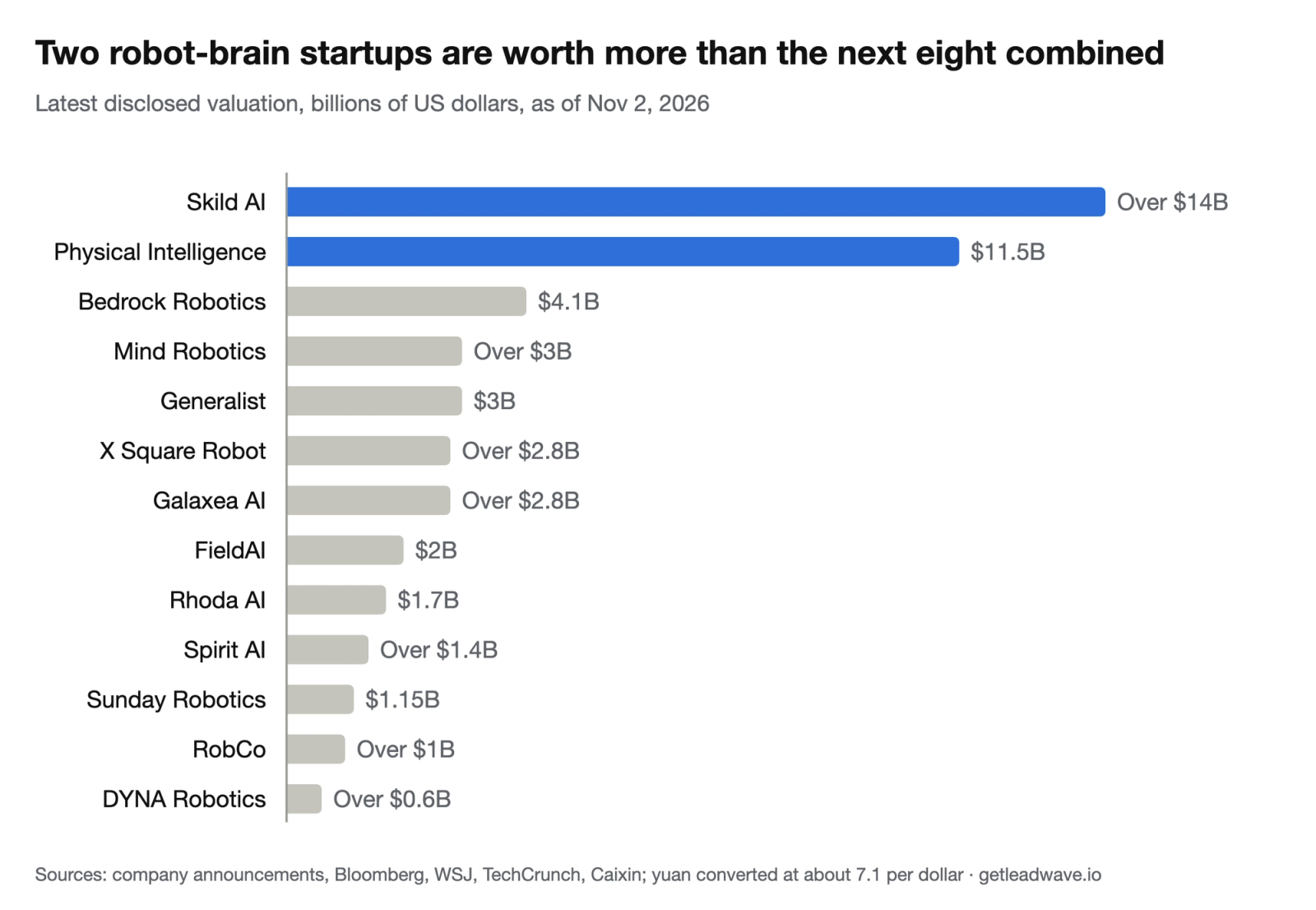
Two leaders. Skild AI and Physical Intelligence are worth about $25 billion together, more than the next eight startups combined (about $21 billion).
Valuations doubled in months. Skild went from $4.7 billion in May 2025 to over $14 billion in January 2026; Physical Intelligence from $5.6 billion in November 2025 to $11.5 billion; Bedrock from $1.75 billion in February to $4.1 billion in October.
Revenue is still rare. Skild reports more than $100 million in annual recurring revenue from 60+ paying customers. Bloomberg's sources say Physical Intelligence has none yet.
China is close behind. Three of the top 10 are Chinese (X Square Robot, Galaxea AI and Spirit AI), and Chinese labs release many of the open robot models.
Human video replaces robot data. Generalist trains on 500,000+ hours recorded by people wearing sensors, Sunday on a data glove, DYNA on 1 million+ hours of first-person video and Rhoda on internet video, instead of slow robot teleoperation.
No single scoreboard. Unlike chatbots, robot models have no widely used public arena. NVIDIA's models top RoboArena and PhAIL's everyday-tasks test, and most startups' newest models aren't on either.
The 20 physical AI companies compared
Latest valuation and total funding as of November 2, 2026. "Reported" means a major outlet reported it and the company hasn't confirmed it.
# | Company | HQ | Founded | Flagship model | Focus | Valuation | Total raised |
|---|---|---|---|---|---|---|---|
1 | Skild AI | Pittsburgh, US | 2023 | Skild Brain, S1 | One model for any robot body | Over $14B (Jan 2026) | About $2.2B |
2 | Physical Intelligence | San Francisco, US | 2024 | π0.7; open π0 and π0.5 | General robot models, API | $11.5B (2026, reported) | About $1.1B to 2025, plus a 2026 round |
3 | Bedrock Robotics | San Francisco, US | 2024 | Bedrock Operator | Autonomous excavators | $4.1B (Oct 2026, reported) | Nearly $1B |
4 | Mind Robotics | Palo Alto, US | 2025 | Not named | Factory robots, Rivian | Over $3B (May 2026, reported) | Over $1B |
5 | Generalist | San Mateo, US | 2024 | GEN-1.5 | Dexterous hands and arms | $3B (Aug 2026, reported) | About $700M |
6 | X Square Robot | Shenzhen, China | 2023 | WALL-B; open WALL-OSS | Home, industry, logistics | Above RMB 20B (Jun 2026) | Not disclosed |
7 | Galaxea AI | Beijing, China | 2023 | G0.5 (open) | Dual-arm robots | Above RMB 20B (Apr 2026, reported) | Nearly RMB 5B |
8 | FieldAI | Irvine, US | 2023 | Field Foundation Models | Construction and industrial sites | $2B (Aug 2025, reported) | Over $400M |
9 | Rhoda AI | Palo Alto, US | 2024 | Direct Video Action | Factories and logistics | $1.7B (Mar 2026, reported) | $450M |
10 | Spirit AI | Hangzhou, China | 2024 | Spirit v1.6 | Humanoids, factory lines | Above RMB 10B (Feb 2026, reported) | Nearly RMB 5B in 2026 |
11 | Sunday Robotics | California, US | 2023 | ACT-2 | Memo home robot | $1.15B (Mar 2026) | $200M |
12 | RobCo | Munich and San Francisco | 2020 | Own AI stack | Industrial robot arms | Over $1B (Oct 2026) | Over $160M |
13 | DYNA Robotics | Redwood City, US | 2024 | Dyna-2.1 | Hotels, laundry, logistics | Over $600M (Sep 2025, reported) | About $143M |
14 | TARS | China | 2025 | AWE 3.0 | Factory assembly | Not disclosed | About $697M |
15 | Sereact | Stuttgart, Germany | 2021 | Cortex 2.6 | Warehouse picking, returns | Not disclosed | Over $140M |
16 | Dexmal | Beijing, China | 2025 | DM0.5 | Logistics robots | Not disclosed | About RMB 1B plus a strategic round |
17 | Genesis AI | Paris and San Carlos, US | 2025 | GENE-26.5 | Dexterous two-arm robot | Not disclosed | $105M seed |
18 | microagi | Munich, Germany | 2025 | Atlas platform (no own model) | Robots for factory tasks | Not disclosed | At least $55M |
19 | Perceptron | Bellevue, US | 2024 | Isaac 0.5 (open) | Vision and robot control | Not disclosed | $21M |
20 | Mimic | Zurich, Switzerland | 2024 | FLUX-mimic | Robot hands for factories | Not disclosed | Over $20M |
Companies without a disclosed valuation are ordered by total funding.
The top 10 in detail
1. Skild AI
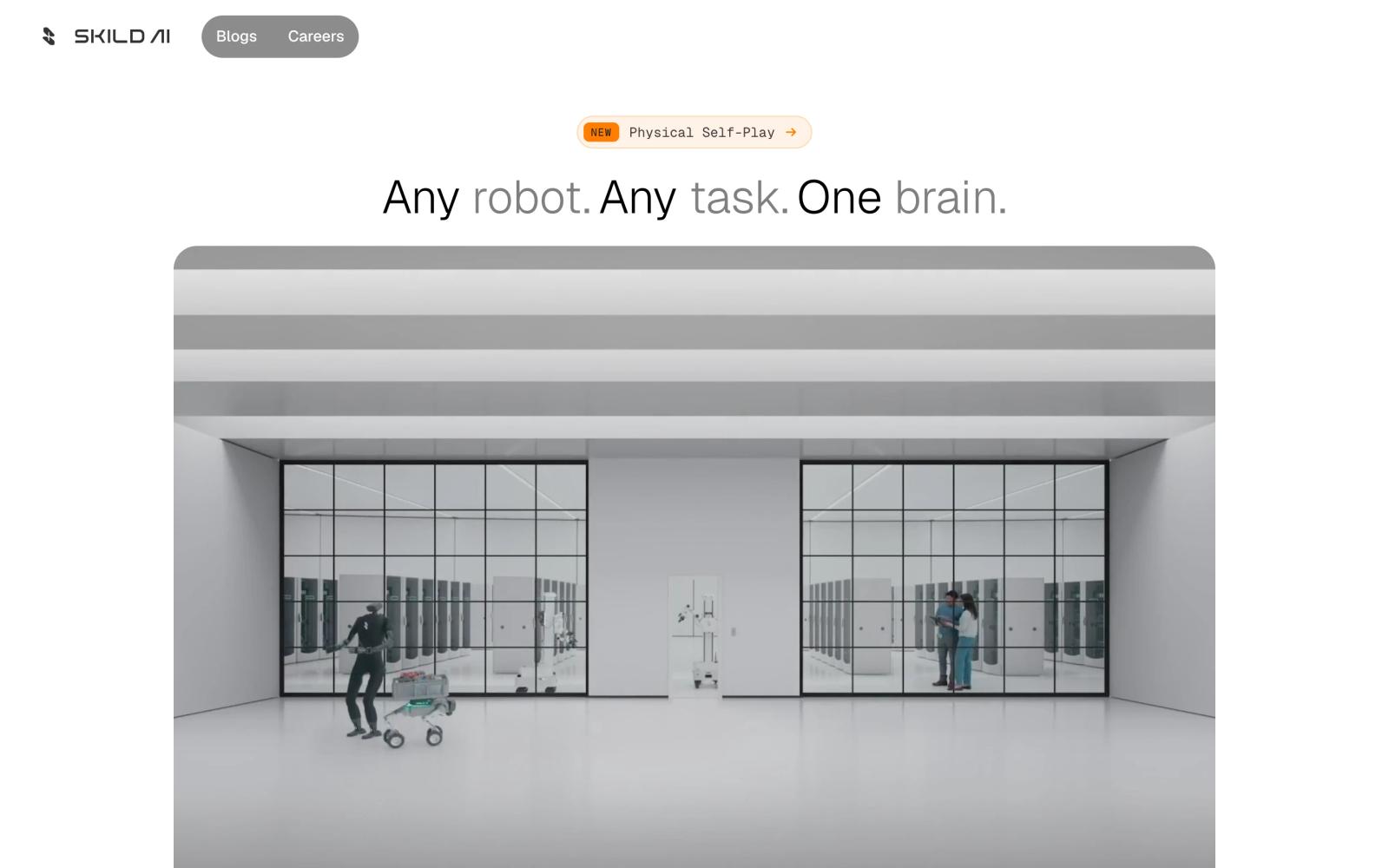
Skild AI, founded in 2023 in Pittsburgh by CEO Deepak Pathak, builds the Skild Brain, one robot foundation model meant to control any body: four-legged robots, humanoids, arms and mobile manipulators. Its S1 model (August 2026) learns a task from a single video demonstration. Skild is one of the few companies here with a revenue figure: in September 2026 it said it had passed $100 million in annual recurring revenue with more than 60 paying customers. Robot makers ABB Robotics, Universal Robots and MiR are building its model into their machines.
Valuation: over $14 billion after a Series C of about $1.4 billion led by SoftBank (January 2026); about $2.2 billion raised in total
Deployments: dual-arm robots assembling NVIDIA Blackwell systems with Foxconn; kitchen pilots with Mitsui
2. Physical Intelligence
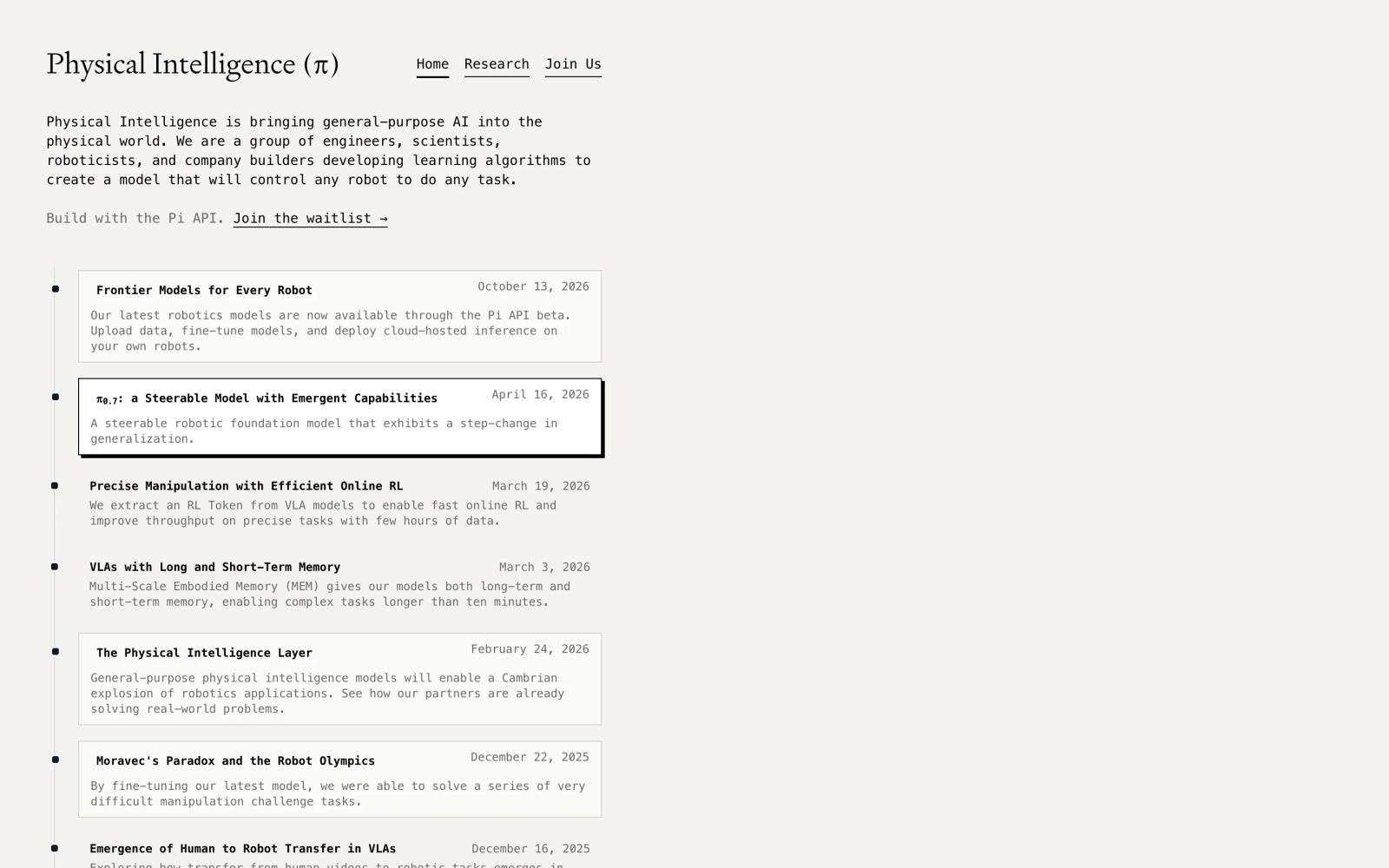
Physical Intelligence (π), founded in 2024 in San Francisco and led by CEO Karol Hausman, builds general-purpose vision-language-action models: models that take camera images and an instruction and output robot movements. Its π0 and π0.5 models are open source under Apache 2.0 and widely used as baselines on public benchmarks; its newest, π0.7 (April 2026), is closed. On October 13, 2026 it opened a beta API so robot makers can fine-tune and run its newest models on their own machines; early users include Weave (laundry folding), Ultra (warehouse packing) and Chef Robotics.
Valuation: $11.5 billion in a 2026 round, and in talks to raise at least $1 billion at about $20 billion (Bloomberg via TNW); about $1.1 billion raised through 2025
Benchmarks: π0.5 leads PhAIL's pick-and-place test and is second on RoboArena
3. Bedrock Robotics
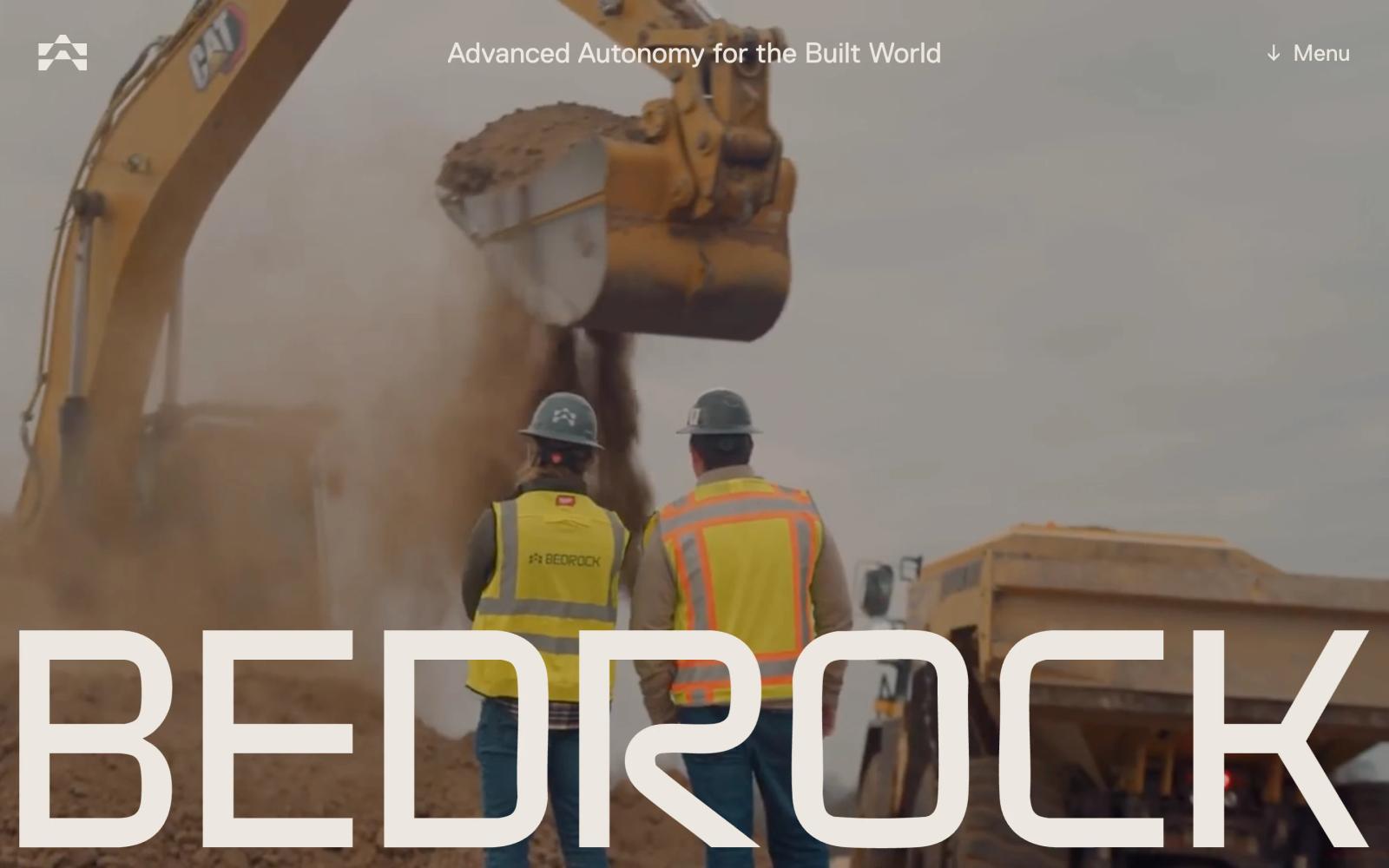
Bedrock Robotics, founded in 2024 in San Francisco by CEO Boris Sofman, who led Waymo's self-driving truck work, makes a retrofit kit and AI operator that lets excavators and other construction machines dig on their own. It began paid autonomous work in August 2026, on sites including a Zachry Construction project and a Nevada water treatment plant.
Valuation: $4.1 billion after a $600 million Series C led by CapitalG and Emergence Capital (TechCrunch, October 26, 2026), up from $1.75 billion in February; nearly $1 billion raised
4. Mind Robotics
Mind Robotics spun out of Rivian in November 2025 to build AI models and purpose-built robots, not humanoids, for factory work such as fastening, sorting and plugging in connectors. It trains on data from Rivian's vehicle lines, and Rivian, its first customer, owned 32.1% of it in June 2026. It hasn't published a named model. Doug Field became president in October 2026.
Valuation: over $3 billion (WSJ, May 2026) after raising $900 million in two rounds this year: $500 million in March and $400 million led by Kleiner Perkins in May; over $1 billion raised in total
5. Generalist
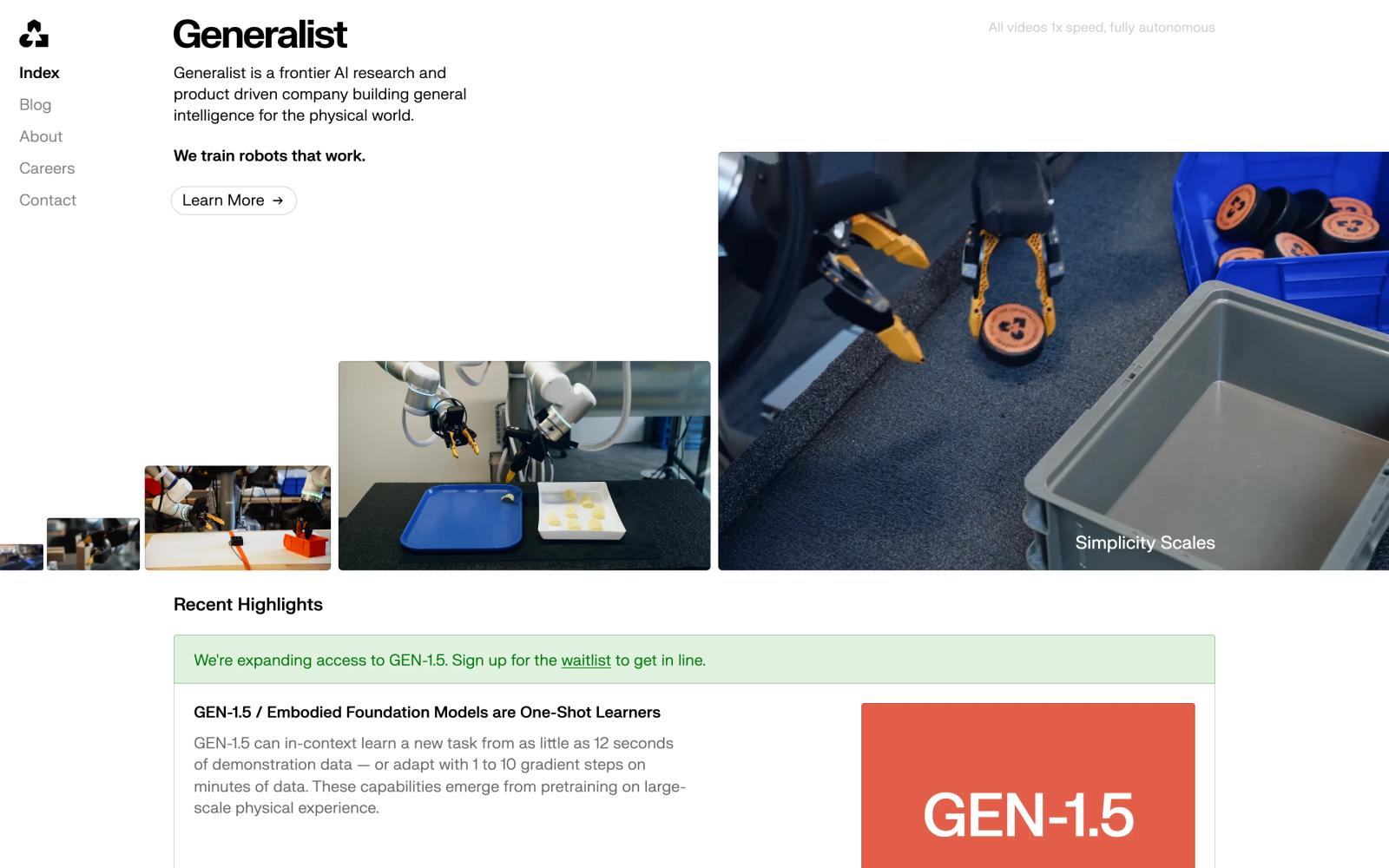
Generalist, founded in 2024 and led by CEO Pete Florence, trains the GEN family of models that give robot arms and hands skills like folding, packing and assembly. They learn mostly from more than 500,000 hours of data recorded by people wearing low-cost devices rather than from robots. GEN-1.5 (August 2026) can pick up a new task from as little as 12 seconds of demonstration. The models are closed and offered to early-access partners.
Valuation: $3 billion, reported by TechCrunch in August 2026 after nearly $200 million led by 8VC, following a $400 million Series B at $2 billion in June
6. X Square Robot
X Square Robot, founded in 2023 in Shenzhen and led by CEO Wang Qian, builds robot foundation models and its own robots for homes, industry and logistics. Its WALL-B model (April 2026) handles perception, language, action and physical prediction in one network, and its WALL-OSS-0.5 model is open source. It runs a cleaning service with 58.com in Shenzhen and Beijing.
Valuation: above RMB 20 billion (about $2.8 billion) after a Series C in June 2026, per the company; earlier backers include Meituan, Alibaba, ByteDance and Xiaomi
7. Galaxea AI
Galaxea AI, founded in 2023 in Beijing and led by CEO Jiyang Gao, makes wheeled dual-arm R1 robots, sold to labs including Physical Intelligence and Fei-Fei Li's team, and the G-series vision-language-action models. Its open-weight G0.5 is the best-placed Chinese model on PhAIL's everyday-tasks test (fourth).
Valuation: above RMB 20 billion after an April 2026 round (Caixin); nearly RMB 5 billion (about $700 million) raised by August 2026
8. FieldAI
FieldAI, founded in 2023 in Irvine, California by CEO Ali Agha, builds Field Foundation Models, a robot brain that lets other makers' legged robots, wheeled robots and construction machines find their way and work on messy outdoor and industrial sites without GPS. Caterpillar named it a physical AI partner in September 2026, and Big-D Construction has used its robots for more than two years.
Valuation: $2 billion at its last closed round ($405 million, August 2025, as reported). Business Insider reported in October 2026 that it signed a term sheet to raise about $700 million at about $10 billion; the company hasn't confirmed it. Over $400 million raised
9. Rhoda AI
Rhoda AI came out of 18 months in stealth in March 2026, led by CEO Jagdeep Singh. Its Direct Video Action model is pre-trained on hundreds of millions of internet videos, predicts what should happen next and turns that into robot movements, then needs only 1 to 10 hours of robot data per task. It's in production trials in manufacturing, logistics returns and an automotive line, and added touch sensing in October.
Valuation: $1.7 billion (Bloomberg) at a $450 million Series A led by Premji Invest, March 2026
10. Spirit AI
Spirit AI, founded in 2024 and based in Hangzhou, builds the Spirit series of vision-language-action models and Moz humanoid robots, with partners including CATL, JD.com, Bosch and Schaeffler. It open-sourced Spirit v1.5 in January 2026. Spirit v1.6 tops RoboArena's all-policies view, though on few evaluations.
Valuation: above RMB 10 billion (about $1.4 billion) after its February 2026 rounds (Caixin); nearly RMB 5 billion raised in 2026
10 more physical AI companies to watch
Sunday Robotics
Sunday Robotics makes Memo, a home robot that clears tables, loads dishwashers and folds socks, trained on data from people wearing its Skill Capture Glove rather than on teleoperation. CEO Tony Zhao; ACT-2 preview in July 2026; beta deliveries to homes from fall 2026.
Funding: $165 million Series B led by Coatue at $1.15 billion (March 2026); $200 million in total
RobCo
RobCo, founded in Munich in 2020 and now also based in San Francisco, rents out modular industrial robot arms with its own AI stack for machine tending, palletizing and welding; customers include BMW. CEO Roman Hölzl.
Funding: $100 million Series C in January 2026; valued above $1 billion in October 2026, per the company
DYNA Robotics
DYNA Robotics, founded in 2024 in Redwood City by CEO Lindon Gao, builds robot models and the Taku robot for hotels, restaurants, laundromats and warehouses. Dyna-2 (August 2026) is pre-trained on more than 1 million hours of first-person human video.
Funding: $120 million Series A in September 2025 at a reported valuation above $600 million; about $143 million in total
TARS
TARS is a Chinese embodied AI company led by Chen Yilun, formerly CTO of Huawei's autonomous driving unit. Its AWE 3.0 model targets factory work such as wire-harness assembly.
Funding: a $455 million Pre-A round led by Hillhouse and HSG in April 2026, the largest single round in China's embodied AI; about $697 million in total
Sereact
Sereact, founded in Stuttgart in 2021 and led by CEO Ralf Gulde, runs its Cortex vision-language-action model on warehouse picking and returns-handling robots. It has 200+ systems live, with customers including BMW, Daimler Truck, PepsiCo and Zalando; Cortex 2.6 (October 2026) improves from its own practice runs.
Funding: $110 million Series B led by Headline (April 2026), grown to $116 million when Zalando joined; over $140 million in total
Dexmal
Dexmal, founded in Beijing in 2025, builds the DM0 and DM0.5 robot models (DM0 with StepFun) and open-source robot-learning tools, and merged with logistics robot maker Atomix in June 2026.
Funding: nearly RMB 1 billion (about $140 million) in 2025, plus a strategic round in 2026 with Zhipu AI, StepFun, SenseTime and Alibaba
Genesis AI
Genesis AI, founded in 2025 in Paris and San Carlos, California and led by CEO Zhou Xian, builds GENE, a robot model for dexterous work that can run other makers' robots (GENE-26.5, May 2026), plus Eno, a wheeled two-arm robot unveiled in June 2026.
Funding: $105 million seed led by Eclipse and Khosla Ventures (2025); reported in July 2026 to be in talks at a $3 billion valuation
microagi
microagi, founded in Munich in 2025 and led by CEO Bercan Kilic, doesn't build its own robots or models: its Atlas platform records first-person video of workers, fine-tunes other companies' robot models on it and rents robots that customers pay for only if they work.
Funding: $55 million seed led by Hummingbird (July 2026), which it calls the largest seed round in German history
Perceptron
Perceptron, founded in late 2024 in Bellevue, Washington by former Meta researchers and led by CEO Armen Aghajanyan, released Isaac 0.5 in August 2026: a 36-billion-parameter open-weight model (Apache 2.0) that combines video understanding, reasoning and robot control. It also sells closed Mk1 models by API.
Funding: $21 million (PitchBook, via TechCrunch), with another round reportedly closing
Mimic
Mimic, an ETH Zurich spin-out from 2024 led by CEO Stefan Weirich, makes the M1 dexterous robot hand and FLUX-mimic (July 2026), a video-action model built with Black Forest Labs that Audi is testing on production tasks.
Funding: $16 million seed (November 2025); over $20 million in total
Robot models from big tech
Google DeepMind launched Gemini Robotics 2 on July 30, 2026, adding whole-body control of humanoids (shown on Apptronik's Apollo 2) and multi-finger dexterity. Gemini Robotics-ER 2, the reasoning model, is open to developers in Google AI Studio; Gemini Robotics 2 and the On-Device 2 version are limited to early-access partners. Listed partners include Agile Robots, Apptronik and Boston Dynamics.
NVIDIA releases open robot models: GR00T N1.7 for humanoids (weights on Hugging Face) and Cosmos 3 world models (June 2026). Its DreamZero tops RoboArena and Cosmos3 Nano tops PhAIL's everyday tasks; GR00T N2 is expected by the end of the year. It is also an investor in Skild, Generalist, FieldAI and DYNA.
Tesla said in its October 21, 2026 update that Optimus production had begun on its Fremont lines; Elon Musk expects deliveries to outside customers around the end of 2027.
Figure's Helix 2.5 (September 2026) tidied rooms, folded towels and made beds in 30 homes it had never seen.
1X has used its world model as the control system of its NEO home robot since January 2026.
Meta released the open V-JEPA 2.1 world model in March 2026 and bought humanoid-model startup Assured Robot Intelligence in May.
Amazon licensed Covariant's models and hired its founders in 2024, and bought Fauna Robotics in March 2026.
Microsoft offers Rho-alpha, a robot model built on its Phi models, in early access on Foundry. OpenAI is building a humanoid; Sam Altman told Fortune to expect "a cool demo in 2027".
Chinese robot makers publish their own models: Unitree open-sourced UnifoLM-WLA-1.0 in September 2026, and AgiBot released GO-2 in April.
Robot model benchmarks
Robot models are hard to compare: tests need real robots, and most leading companies don't submit their models. These are the public boards that exist.
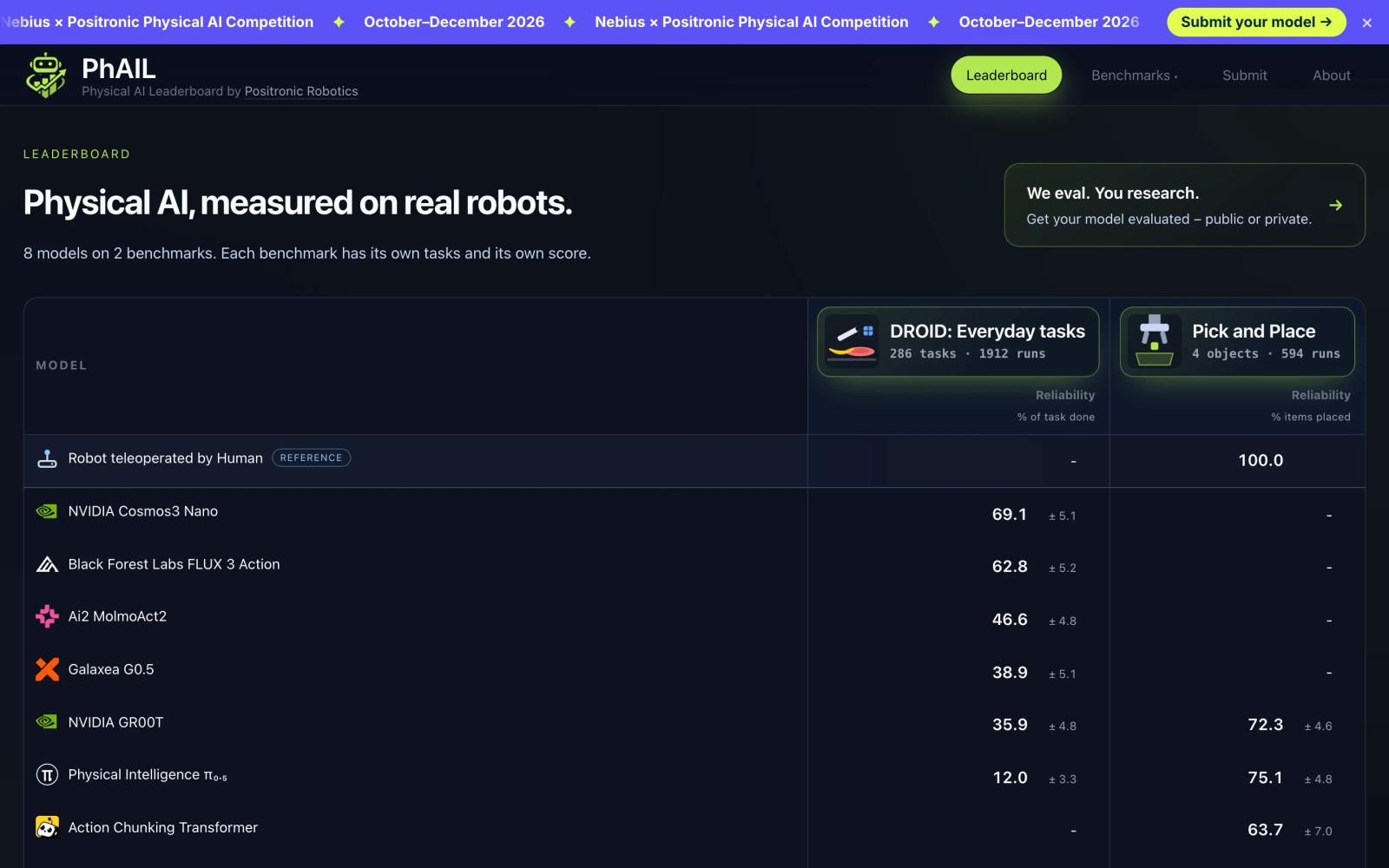
PhAIL (Positronic Robotics, updated October 29, 2026) runs models on the same real Franka robot arm. On everyday tasks, NVIDIA Cosmos3 Nano leads with 69.1, ahead of Black Forest Labs' FLUX 3 Action (62.8) and Ai2's MolmoAct2 (46.6). On pick-and-place, Physical Intelligence's π0.5 leads with 75.1%, ahead of NVIDIA GR00T N1.6 (72.3%).
RoboArena compares robot policies head to head on real robots in many labs. On its official view (policies with at least 100 evaluations), NVIDIA's DreamZero leads with 1735, ahead of π0.5 (1608) and π0-FAST (1582), as of November 2, 2026.
roboticscenter.ai ranks 104 model companies on published benchmarks, open weights, GitHub use, releases and funding (October 19, 2026). NVIDIA, Alibaba DAMO Academy, the OpenVLA team and Physical Intelligence lead; closed labs score low by design.
Humanoid Guide rates 74 robot models editorially, out of 10. Skild Brain and Generalist's GEN-1 share the top score (9) with Robotera's ERA-42 and Highlanders' KEPLER.
Best open-source robot models
π0 and π0.5 (Physical Intelligence): Apache 2.0, widely used as baselines on public benchmarks.
GR00T N1.7 (NVIDIA): a 3-billion-parameter humanoid model under NVIDIA's open model license.
Isaac 0.5 (Perceptron): a 36-billion-parameter model for video understanding and robot control, Apache 2.0.
UnifoLM-WLA-1.0 (Unitree): an open humanoid foundation model from September 2026.
WALL-OSS-0.5 (X Square Robot) and G0.5 (Galaxea AI): open models from two of China's most valuable robot startups.
SmolVLA (Hugging Face): a small model in the LeRobot library, which now also distributes many of the models above.
OpenVLA and Octo: earlier academic models, still used as baselines but no longer updated.
FAQ
What is physical AI? AI that senses and acts in the physical world: robots, autonomous machines and the models that control them. Most companies on this list build robot foundation models, single models meant to handle many tasks on many kinds of robots.
What is the most valuable physical AI company? Among startups, Skild AI, valued above $14 billion in January 2026. Physical Intelligence was valued at $11.5 billion and is reportedly in talks at about $20 billion.
What is a vision-language-action (VLA) model? A model that takes camera images and an instruction such as "fold the towel" and outputs the robot's movements. Physical Intelligence's π models, Google's Gemini Robotics and NVIDIA's GR00T are VLA models.
What is the best robot foundation model? There's no agreed ranking. NVIDIA's models lead the two public real-robot leaderboards, PhAIL and RoboArena, and Physical Intelligence's π0.5 leads PhAIL's pick-and-place test. Skild, Generalist and Google DeepMind don't submit their newest models to these boards.
Which robot models are open source? Physical Intelligence's π0 and π0.5, NVIDIA's GR00T N1.7, Perceptron's Isaac 0.5, Unitree's UnifoLM-WLA, X Square Robot's WALL-OSS, Galaxea's G0.5 and Hugging Face's SmolVLA.
Can I use Google's Gemini Robotics? Gemini Robotics-ER 2, the reasoning model, is available to developers in Google AI Studio. Gemini Robotics 2, which controls robots directly, is limited to early-access partners.
Which Chinese companies build robot brains? X Square Robot, Galaxea AI and Spirit AI are the most valuable, each worth over RMB 10 billion. TARS and Dexmal are well funded, and Unitree and AgiBot publish their own models.
How this list was built
The list: companies tagged as physical or robotics AI in LeadWave's database, plus the best-funded robot-model startups in 2025 and 2026 funding news. It includes startups whose main product is the AI that runs robots or autonomous machines, including those that build their own robots to deploy it. It leaves out humanoid makers that mainly sell a body, big companies (covered separately), world-model companies not focused on robots, and simulation or data tools.
The ranking: latest disclosed valuation as of November 2, 2026, from company announcements or major outlets (Bloomberg, The Wall Street Journal, TechCrunch, Caixin). Valuations a company hasn't confirmed are marked as reported; talks that haven't closed don't count. Yuan are converted at about 7.1 per dollar. Companies without a disclosed valuation are ordered by total funding.
The facts: models, dates, funding and leaders checked on November 2, 2026 against each company's own pages or a major news outlet.
Selling to robotics companies?
LeadWave's list of AI companies covers 9,000 AI companies with CEO details. See also our list of AI labs.
About this list
Compiled by LeadWave from company announcements, funding news and public robot benchmarks, checked November 2, 2026.