A bootstrapped SaaS company grows on its customers' money instead of investors'. Most lists of bootstrapped SaaS companies mix in companies that raised venture capital, sold years ago or never published a number. This one doesn't. We checked the funding history of every company below against its own statements, filings and the press, and added the latest revenue, revenue per employee and what the founders say about not raising.
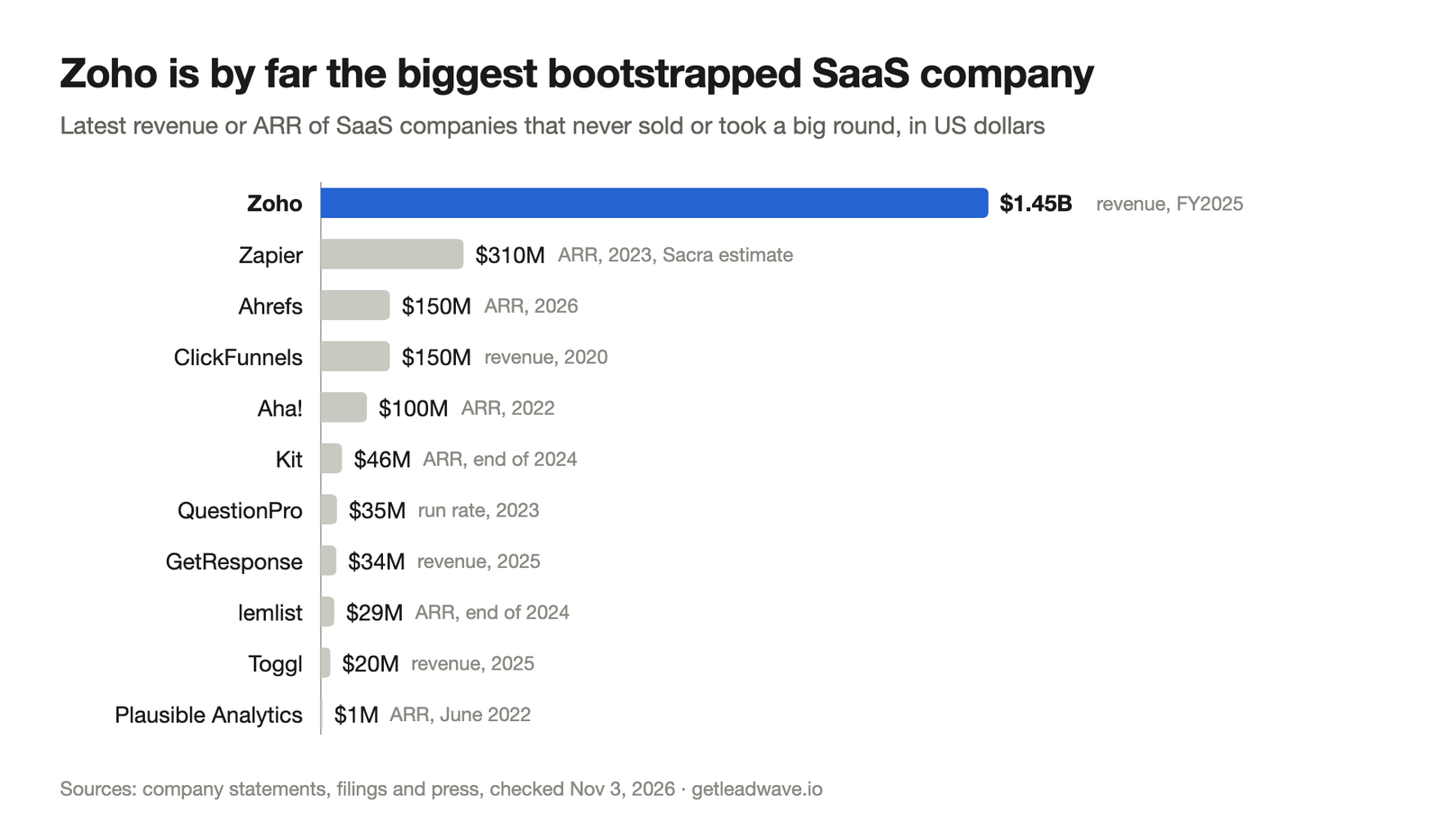
The short version: Zoho is the biggest bootstrapped SaaS company, at about $1.45 billion in revenue. Bootstrapped companies run lean: 12 of the 15 we could measure bring in more revenue per employee than the private SaaS median. And many of the famous names, from Mailchimp to Atlassian, bootstrapped for years and then sold or raised. They're in a separate section.
Top bootstrapped SaaS companies in 2026
Still bootstrapped, ranked by their latest revenue:
Zoho: business software suite, about $1.45B revenue, never raised
Zapier: workflow automation, several hundred million in ARR on a $1.3M seed
Ahrefs: SEO tools, $150M+ ARR, never raised
ClickFunnels: sales funnels, $150M+ revenue, never raised
Aha!: product roadmaps, $100M+ ARR, never raised
Kit (formerly ConvertKit): email for creators, about $46M ARR
QuestionPro: surveys and research, $35M run rate
GetResponse: email marketing, about $34M revenue
lemlist: cold email, about $29M ARR
Toggl: time tracking, €18M revenue
Plausible Analytics: privacy-friendly web analytics, $1M+ ARR
BambooHR, 37signals, AWeber and ChartMogul: bootstrapped and profitable, revenue not published
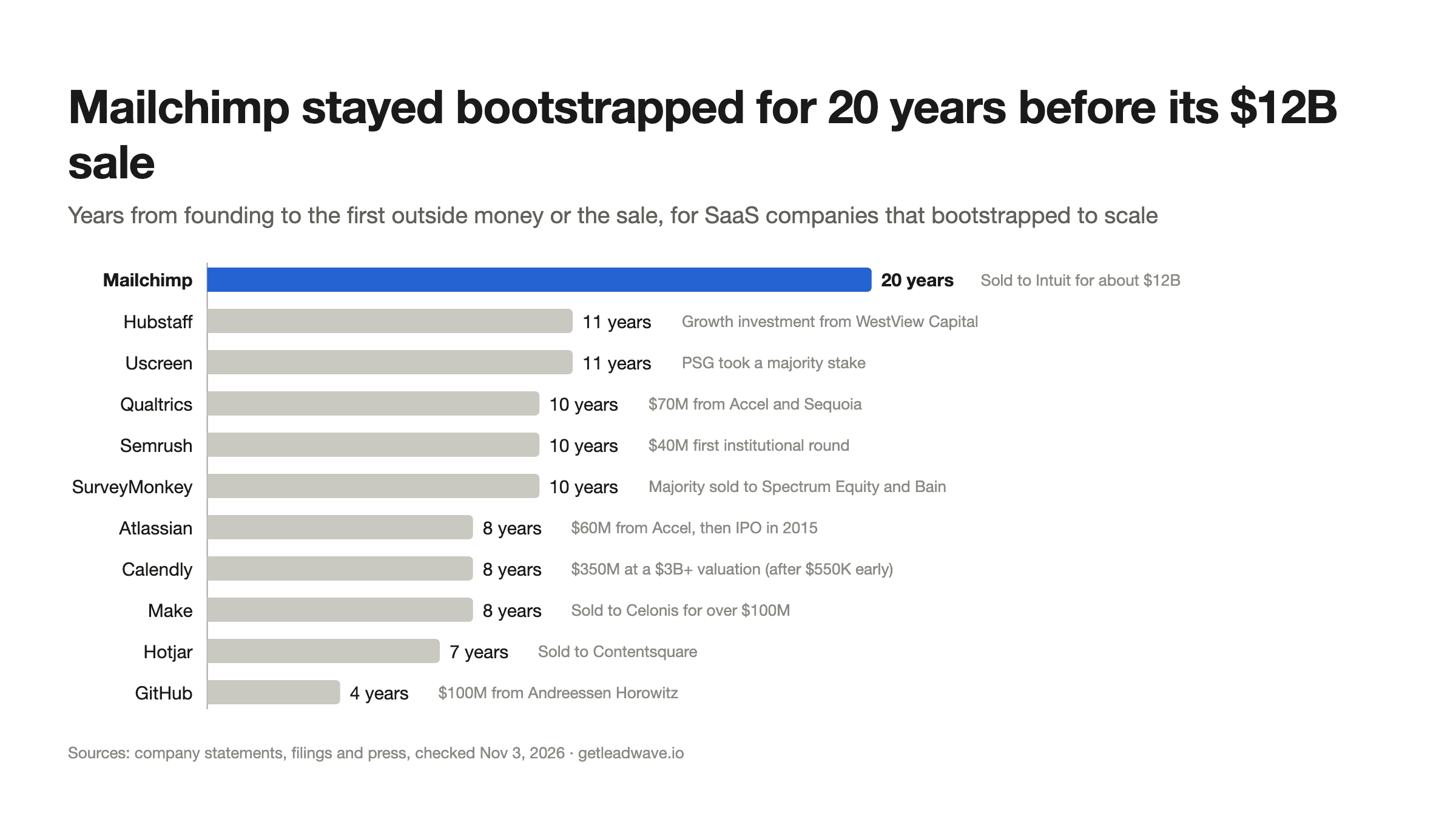
Bootstrapped to scale, then sold or raised: Mailchimp, Atlassian, Hotjar, Hubstaff, SurveyMonkey, Uscreen and Make.
Key numbers
Biggest: Zoho made ₹12,313 crore (about $1.45 billion) in the year to March 2025, with no outside investors in 30 years.
Leanest: Ahrefs made about $100 million in 2023 with 110 people, roughly $909,000 per employee. The private SaaS median is $141,125.
Longest bootstrapped: Mailchimp went 20 years without outside money, then sold to Intuit for about $12 billion in 2021.
More profitable: 83% of bootstrapped SaaS companies are profitable or close to break-even, against 52% of equity-backed ones (SaaS Capital, 2026).
Slightly slower: their median growth in 2025 was 20%, against 25% for equity-backed companies.
Bootstrapped SaaS companies compared
Company | Founded | Outside money | Latest revenue | Employees | Revenue per employee |
|---|---|---|---|---|---|
Zoho | 1996 | None | $1.45B (FY2025) | 19,000 | $76K |
Zapier | 2011 | $1.3M seed (2012) | Several hundred million ARR (2026) | 800 | $375K+ |
Ahrefs | 2010 | None | $150M+ ARR | 148 | $909K (2023) |
ClickFunnels | 2014 | None | $150M+ (2020) | Not published | n/a |
Aha! | 2013 | None | $100M+ ARR (2022) | 120 | $833K |
Kit | 2013 | None | $46M ARR (2024) | 95+ | $474K |
QuestionPro | 2005 | None | $35M run rate (2023) | 300 | $117K |
GetResponse | 1998 | None | About $34M (2025) | 206 | $90K (2019) |
lemlist | 2018 | None into the company | $29M ARR (2024) | 90 | $322K |
Toggl | 2006 | None | €18.0M (2025) | 90 | $227K |
Plausible Analytics | 2018 | None | $1M ARR (2022) | 10 | n/a |
BambooHR | 2008 | Small stake, Sorenson Capital (2012) | Not published | 1,200+ | n/a |
37signals | 1999 | Bezos minority stake (2006) | Not published | Under 80 | n/a |
AWeber | 1998 | None | Not published | About 100 | n/a |
ChartMogul | 2014 | $3.7M seed (2015–2017) | Not published | About 60 | n/a |
Mailchimp | 2001 | None, then sold to Intuit (2021) | $800M (2020) | 1,200+ | $667K |
Atlassian | 2002 | $60M from Accel (2010) | $59M (FY2010) | 225 | $262K |
Hotjar | 2014 | None, then sold to Contentsquare (2021) | About $40M ARR (2021) | 190 | $211K |
Hubstaff | 2012 | WestView Capital (2023) | $33M ARR (2025) | 130 | $254K |
SurveyMonkey | 1999 | Majority sold (2009) | About $30M (2008) | 32 | n/a |
Uscreen | 2014 | PSG majority stake (2025) | $20M ARR (2023) | 140 | $143K |
Make | 2012 | None, then sold to Celonis (2020) | $10M (2020) | 60 | $167K |
For the companies that sold or raised, revenue and headcount are from the end of their bootstrapped years. Revenue per employee divides the two from the nearest dates available.
Revenue per employee: bootstrapped companies run lean
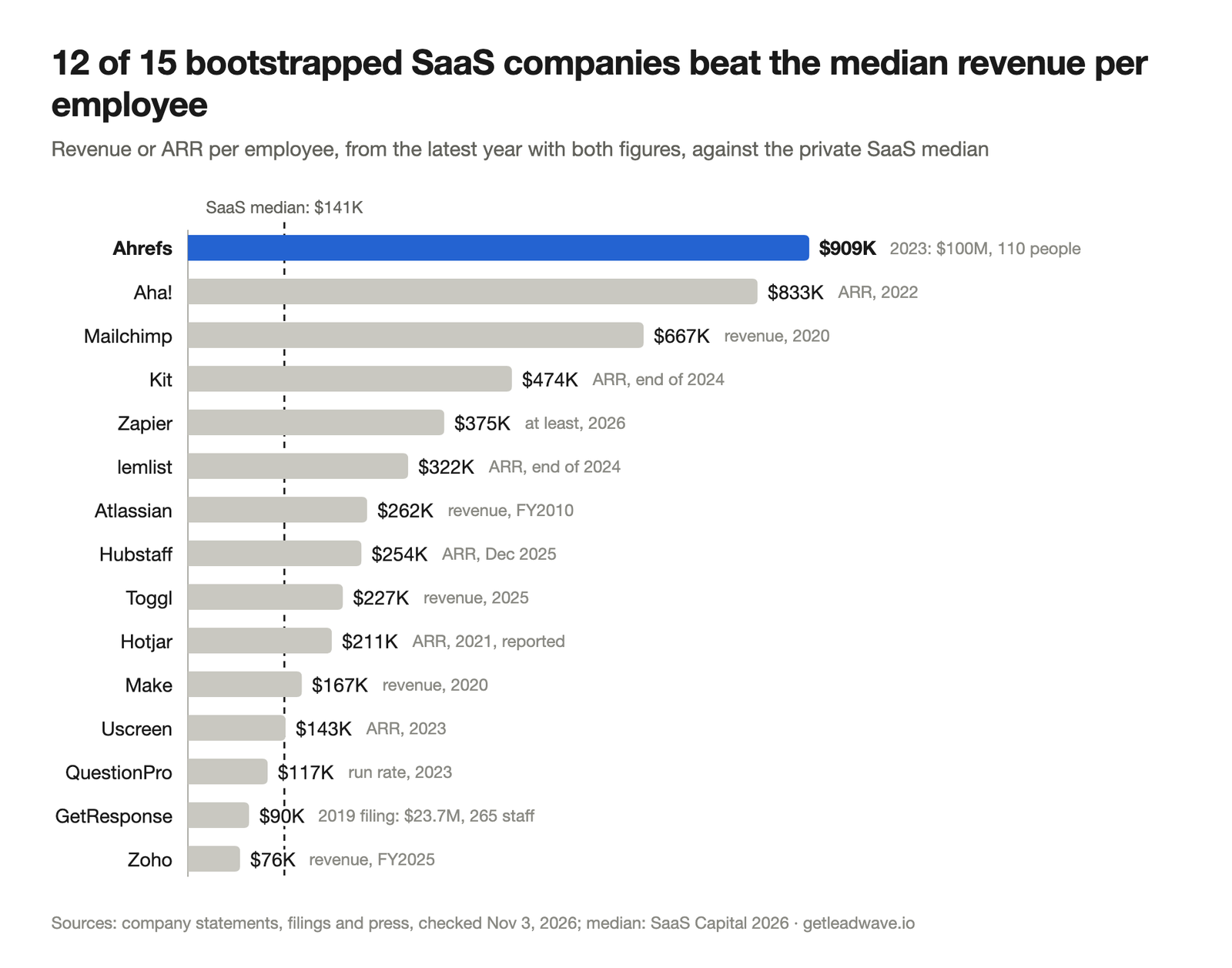
Without investors' money, a bootstrapped company can only hire what its revenue pays for, and it shows. 12 of the 15 companies we could measure beat the $141,125 median for private SaaS companies in SaaS Capital's 2026 benchmark. Ahrefs and Aha! bring in more than $800,000 per person. SaaS Capital sees the same pattern: at every revenue level, bootstrapped companies have higher revenue per employee than equity-backed ones ($177,240 against $152,295 between $5 million and $10 million in ARR).
The three below the median employ many of their people in countries with lower salaries than the US. More than half of QuestionPro's team is in India, GetResponse is in Poland, and Zoho, based in Chennai, has the lowest figure here: about $76,000 per employee, while still making about $380 million in profit a year.
15 SaaS companies that are still bootstrapped
Ranked by their latest published revenue. The last four don't publish revenue.
1. Zoho
Zoho is the biggest bootstrapped SaaS company in the world. Sridhar Vembu and Tony Thomas founded it in 1996 as AdventNet, and it now sells dozens of business apps, from CRM to accounting, plus ManageEngine's IT management tools. Revenue reached ₹12,313 crore (about $1.45 billion) in the year to March 2025, up 17.8%, with a profit of ₹3,191 crore (Medianama). It passed one million paying customers in February 2026 and has about 19,000 employees (Business Wire). Shailesh Kumar Davey became CEO in 2025; Vembu is now chief scientist.
Funding: none. "Since we have never taken money from investors, we have always been able to focus on what is best for the customer" (Zoho)
In their words: "I truly don't care about valuations." Sridhar Vembu, Business Today, May 2023
2. Zapier
Zapier connects thousands of apps so work moves between them automatically. Wade Foster, Bryan Helmig and Mike Knoop started it as a side project in Columbia, Missouri, in 2011. It took a $1.3 million seed round in 2012 and never raised again: it was profitable by 2014. In 2021, Sequoia and Steadfast bought shares from early investors at about a $5 billion valuation; the company itself raised nothing. Foster said in April 2026 that Zapier has "several hundred million in ARR" and about 800 employees (Madrona); Sacra estimated $310 million at the end of 2023.
Funding: $1.3M seed (2012), led by Bessemer and DFJ
Revenue per employee: at least $375,000
In their words: "I don't like raising money. Being from the Midwest, we have this, like, skepticism of VC." Wade Foster, First Round, October 2023
3. Ahrefs
Ahrefs makes SEO and marketing tools built on its own web crawler. Dmytro Gerasymenko started it in Ukraine in 2010 with about $400,000 of his own money and moved it to Singapore in 2012. It crossed $40 million in ARR in 2018 (AIN) and about $100 million in 2023 with 110 people, according to its head of PR (dev.ua), which makes it the leanest company on this list. Its CMO now puts ARR at $150 million or more (Tim Soulo), with a team of 148 (Ahrefs). It has been profitable from its first year and pays the team a yearly bonus worth 5% of ARR (Scroll).
Funding: none: "stayed profitable without a dollar of outside funding" (Ahrefs)
In their words: "There was a lot of interest from investors, but I was in no hurry to grow and rejected all investment offers, preferring to focus on product development." Dmytro Gerasymenko, AIN, 2019
4. ClickFunnels
ClickFunnels lets marketers build sales funnels without a developer. Russell Brunson, Todd Dickerson and Dylan Jones launched it in Idaho in 2014 and funded it with their credit cards. It made $12 million in its first year and passed $100 million in 2018 (Mixergy); a podcast with its then CEO put annual revenue above $150 million in 2020. That year the founders turned down a sale that Brunson says would have paid him and Dickerson more than $110 million each, to rebuild the product as ClickFunnels 2.0 (The Russell Brunson Show).
Funding: none
Profit: a 40–50% margin "pretty consistently" in 2016
In their words: "We've been profitable since day one and we've never not been profitable, which has been awesome. We bootstrapped the whole thing, didn't take any money." Russell Brunson, Mixergy, 2016
5. Aha!
Aha! makes roadmap and product management software. Brian de Haaff and Chris Waters founded it in 2013 after two venture-backed startups of their own. It passed a $40 million run rate in 2018 and $100 million in ARR at the end of 2021 with about 120 people, so roughly $833,000 per employee (Aha!). It has been profitable since about 2014, is fully remote, and shares profits with every employee.
Funding: none: "accepting venture capital (which we never have)"
In their words: "Most venture capitalists want a 10x return in six years. This can force a growth-at-all-costs mentality which is not in my DNA." Brian de Haaff, Aha! blog, 2018
6. Kit (formerly ConvertKit)
Kit is email marketing for creators. Nathan Barry started it as a side project in 2013 and went full-time in 2014 at $1,000 a month in revenue. He publishes the numbers every year: $33.5 million in ARR at the end of 2022, $41 million in 2023 and about $46 million at the end of 2024 (Nathan Barry), with 95 or more people. In 2021 he turned down an acquisition offer from Spotify; a small sale of team shares that year valued the company at $200 million (Nathan Barry). He still owns 85%.
Funding: none into the company. Databases list a "$1.8 million angel round" in 2016, but that was a joke post
In their words: "Our mission to serve creators is more important to me than the return from an acquisition, even to a company as cool as Spotify." Nathan Barry, 2021 review
7. QuestionPro
QuestionPro makes survey, research and customer experience software. Vivek Bhaskaran built it in Seattle in 2005; it reached $4 million in revenue by 2009 and $20 million in 2019. In 2023 he put it at a $35 million run rate with 300 employees, 160 of them in India (Practical Founders). Instead of raising, QuestionPro grows by buying smaller companies with its own cash, and runs at about a 20% EBITDA margin.
Funding: none
Why: Bhaskaran says he didn't know at first that he could raise money. By the time revenue reached $3–4 million the company was already profitable, so it decided not to (SaaS Scaling Secrets, 2025)
8. GetResponse
GetResponse is an email marketing and automation platform from Gdańsk, Poland. Simon Grabowski started it in 1998 with PLN 1,000, about $200, and still owns 95% of it. Its filed accounts are the most transparent on this list: PLN 91.1 million in sales and PLN 8.1 million in net profit in 2019, with 265 staff (Wirtualnemedia), and about PLN 125 million (around $34 million) in 2025, according to its registry filings.
Funding: none, and it has been profitable in every year with filed accounts
In their words (translated from Polish): "The moment you let an investor into the company, the focus suddenly shifts to growth charts." Simon Grabowski, Antyweb, 2016
9. lemlist
lemlist is a cold email and outbound platform from Paris. Guillaume Moubeche and two co-founders started it in 2018 with $1,000 after investors turned them down. It reached $1 million in ARR in 2020 and about $28 million six years after launch, with 90 people and a 40% EBITDA margin (Growth Unhinged), and was reported to have crossed $40 million in 2026 (ColdIQ). The founders sold part of their shares to an investor at a $150 million valuation, but no money went into the company. Moubeche has moved to chairman; Charles Tenot, the former COO, now runs it.
Funding: none into the company
In their words: "We are fully bootstrapped with 40% EBITDA and 30% year-over-year growth, proving that to build a profitable SaaS, you don't necessarily need to raise funds." Charles Tenot, Growth Unhinged, 2024
10. Toggl
Toggl makes time tracking and planning tools. It began in 2006 as an in-house timer at a consultancy in Tallinn, Estonia, run by Alari Aho, and is still owned by its founders. Estonia's company register shows €18.0 million in revenue and €1.4 million in net profit for 2025 (e-Business Register), with a team of about 90. It has been profitable every year since 2009, though its margin fell from 37% in 2019 to 8% in 2025.
Funding: none: "bootstrapped and privately owned since 2006" (Toggl), apart from small early government grants
In their words: "It has been a long and not an easy process, but has given us a lot of flexibility and control of our growth." Alari Aho, Estonian World, 2013
11. Plausible Analytics
Plausible is an open source, privacy-friendly alternative to Google Analytics. Uku Täht started it at the end of 2018 and Marko Saric joined in 2020. It reached $500,000 in ARR in October 2021 and $1 million in June 2022, with no paid marketing, and now has a team of 10 and more than 22,000 paying subscribers (Plausible).
Funding: none: "We are self-funded and profitable, with no outside investors and no plans to sell"
In their words: "We haven't taken anyone's money, so we fully control where we take Plausible next." Marko Saric, Plausible blog, 2021
12. BambooHR
BambooHR makes HR software for small and mid-sized companies. Ben Peterson and Ryan Sanders founded it in Utah in 2008 with their savings and took no pay for three years. In 2012 they let a small local firm, Sorenson Capital, invest, and they have never raised venture capital. By 2023 it had more than 1,200 employees and 30,000 customers, and Sanders calls it "a profitable SaaS company". Brad Rencher, formerly of Adobe, has been CEO since 2019. BambooHR doesn't publish revenue.
Funding: a small minority investment from Sorenson Capital (2012)
In their words: "Our decision not to seek external funding allowed us to control our destiny." Ryan Sanders, Utah Business, 2023
13. 37signals (Basecamp, HEY)
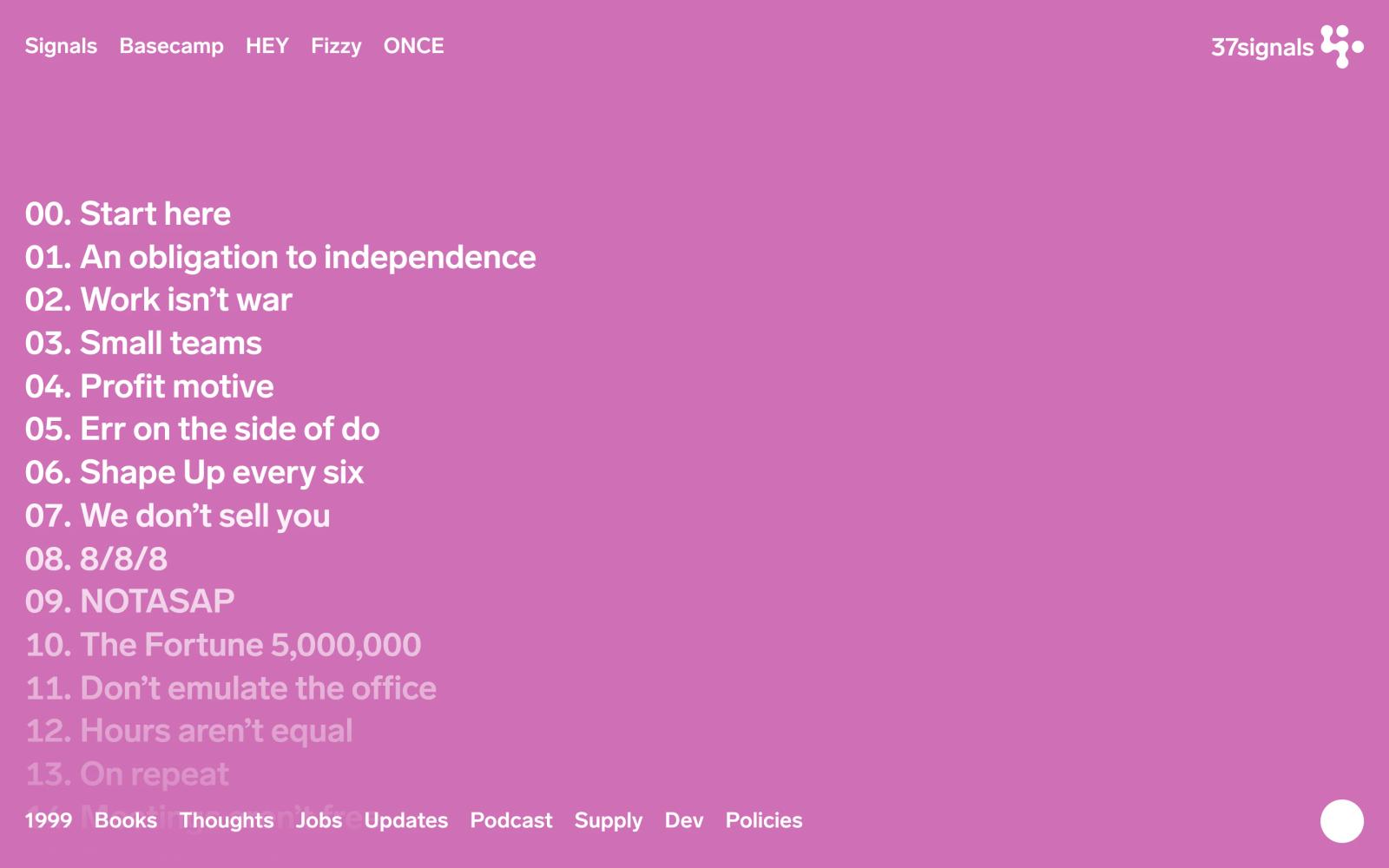
37signals makes the project management tool Basecamp and the email service HEY. Jason Fried started it in 1999 as a web design firm, and Basecamp, built with David Heinemeier Hansson, launched in 2004. Its one outside shareholder is Jeff Bezos, who bought a minority stake in 2006. With fewer than 80 employees and more than 100,000 customers, it makes "tens of millions of dollars in profit each year" (Lenny's Podcast, 2023). Its founders' books and essays are where much of the modern case for bootstrapping comes from.
Funding: a minority stake held by Jeff Bezos (2006)
In their words: "Money with strings attached isn't really yours, it's someone else's property that you're renting on their terms." 37signals
14. AWeber
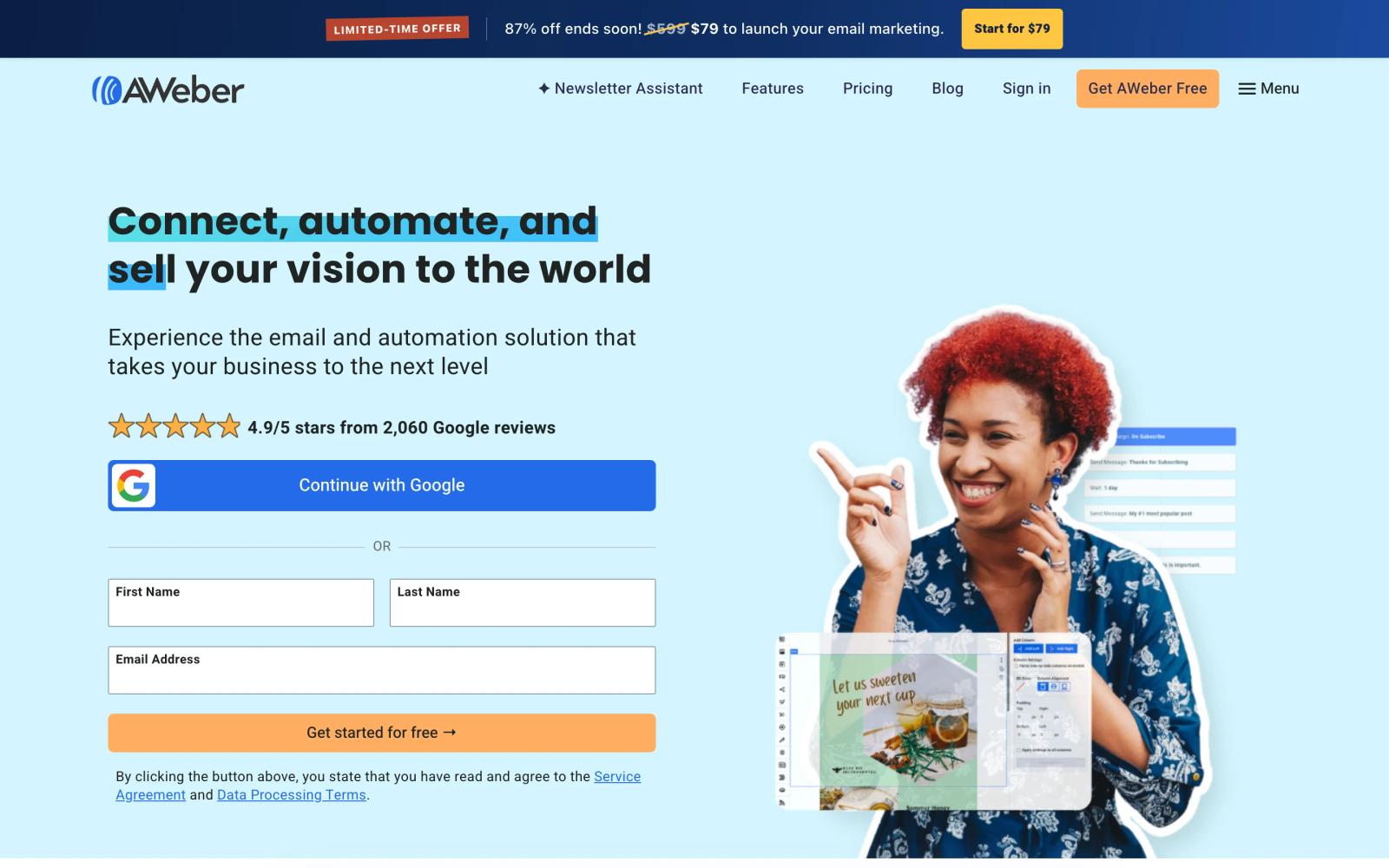
AWeber is one of the oldest email marketing services. Tom Kulzer launched it near Philadelphia in 1998 and is still CEO. It had its first $1 million year in 2004 (Mixergy), has about 100 employees, and says it has served more than a million customers "all without public or venture funding" (AWeber). It doesn't publish revenue.
Funding: none
In their words: "we're through and through a bootstrap company, so we've never raised outside funding." Tom Kulzer, eCommerce Podcast, 2023
15. ChartMogul
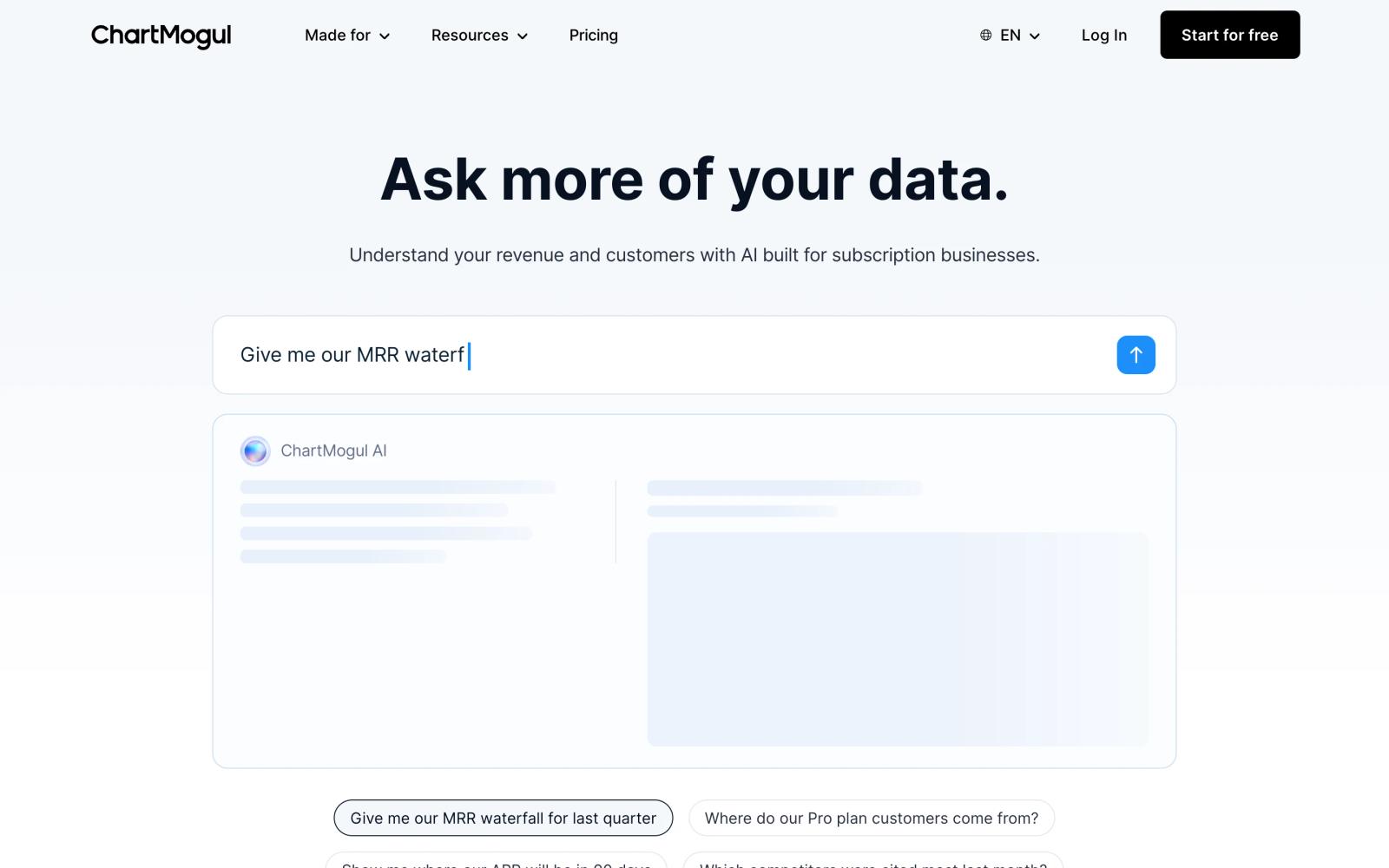
ChartMogul is subscription analytics for SaaS companies. Nick Franklin, Zendesk's ninth employee, started it in Berlin in 2014. Strictly, it isn't bootstrapped: it raised $3.7 million in three seed rounds from 2015 to 2017, led by Point Nine Capital and Alven. It hasn't raised since, and calls itself "independent, seed-strapped, profitable", with a team of about 60 (ChartMogul). It doesn't publish revenue.
Funding: $3.7M in seed rounds (2015–2017)
In their words: "We raised a total of $3.7M (around 4 years ago now), but have been growing the company profitably along with revenues for the past couple of years." Nick Franklin, Indie Hackers, 2021
7 SaaS companies that bootstrapped to scale, then sold or raised
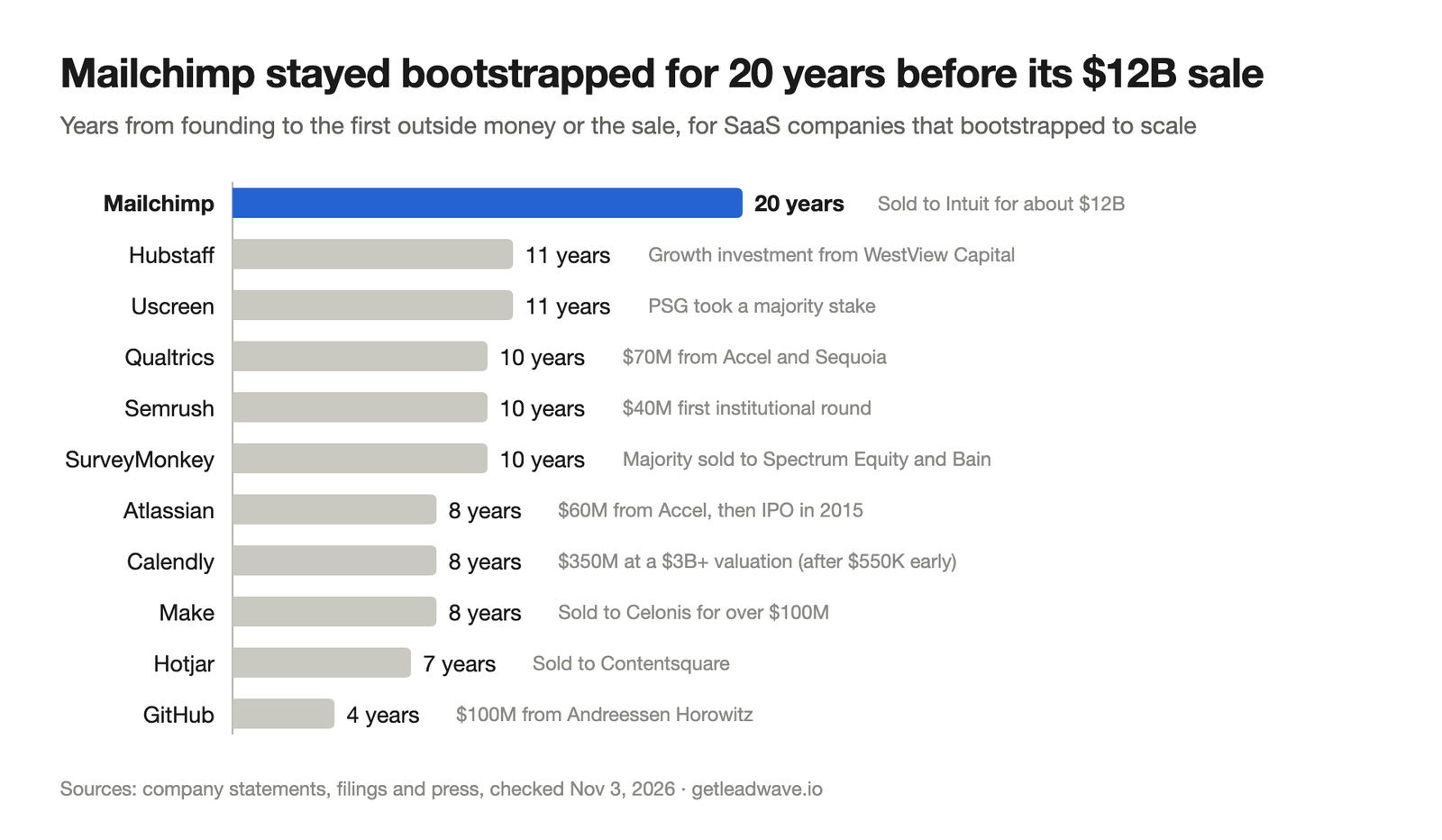
Bootstrapping is often a phase, not a forever choice. The companies below grew for 7 to 20 years on their own revenue, then sold or brought in investors on their own terms. Others outside this list followed the same path: GitHub took its first outside money after four years, and Qualtrics and Semrush after ten.
Mailchimp
Mailchimp is the biggest bootstrapped SaaS success story. Ben Chestnut and Dan Kurzius started it in Atlanta in 2001 and never raised a dollar. It made $700 million in 2019 (TechCrunch) and $800 million in 2020 (Euronews), with about 1,200 employees, then sold to Intuit for about $12 billion in cash and stock in 2021 (TechCrunch). Under Intuit it makes about $1.27 billion a year (The Next Web).
Bootstrapped for: 20 years, until the Intuit sale
In their words: "I can think of no greater hell than being a public company." Ben Chestnut, TechCrunch, 2019
Atlassian
Atlassian, maker of Jira and Confluence, started in Sydney in 2002 on about A$10,000 of credit card debt. Mike Cannon-Brookes and Scott Farquhar ran it profitably for eight years and reached $59 million in revenue with 225 people before taking $60 million from Accel in 2010 (Atlassian). It listed on Nasdaq in 2015 and made $6.57 billion in its 2026 fiscal year, with 13,301 employees.
Bootstrapped for: 8 years
In their words: "We were bootstrapped for eight years – we didn't raise any money for the first eight years." Mike Cannon-Brookes, iTnews, 2012
Hotjar
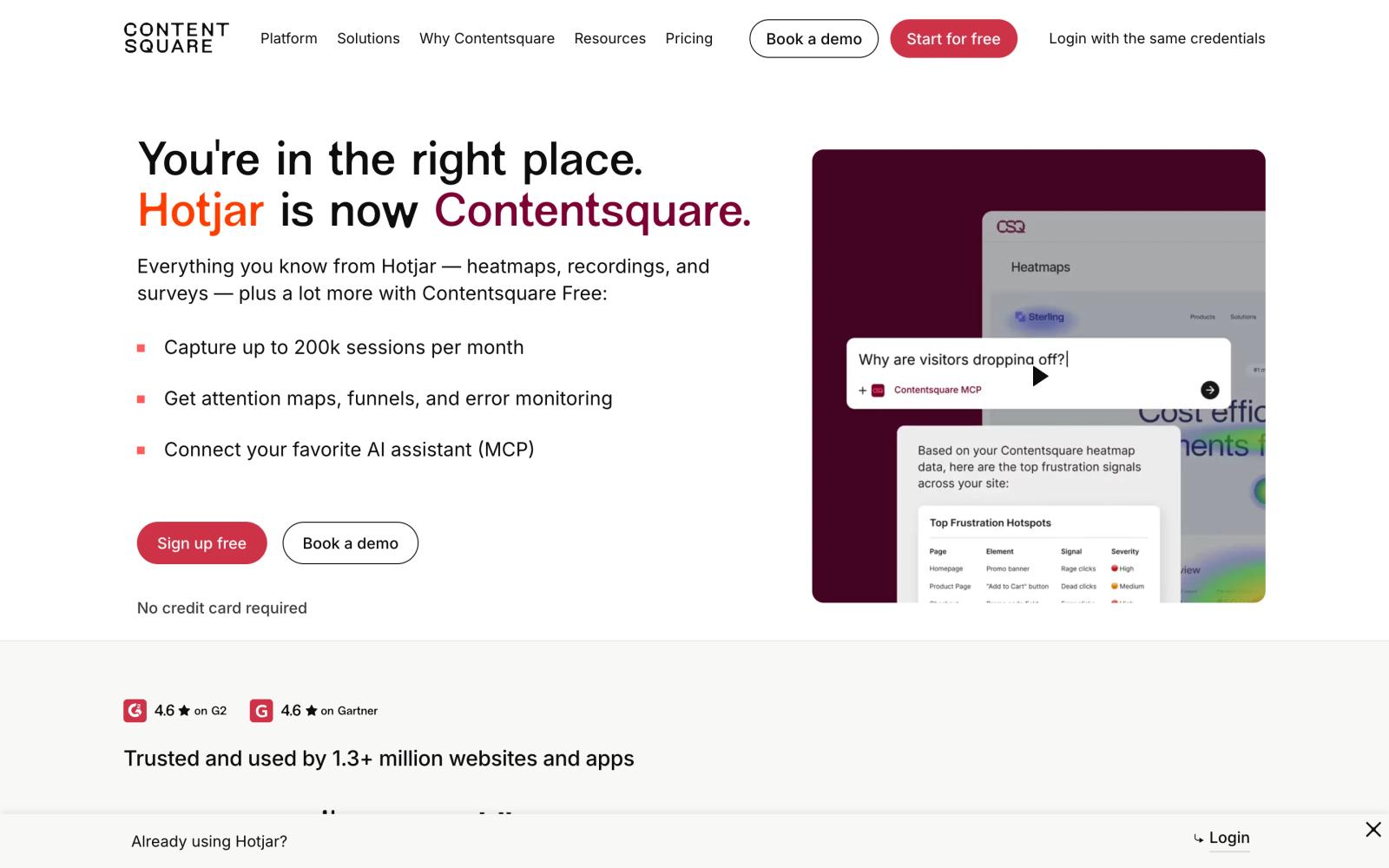
Hotjar, the heatmap and session recording tool, was founded in Malta in 2014 by David Darmanin and a group of co-founders who funded it themselves. It was profitable almost immediately, reached €8 million in ARR by mid-2017, and was bought by Contentsquare in 2021, when it had more than 190 people and, by a podcast host's estimate, about $40 million in ARR. Its website now opens on Contentsquare.
Bootstrapped for: 7 years, until the Contentsquare sale (price not disclosed)
In their words: "We've grown without raising any capital or incurring any debt. While we are running a profitable business, we have chosen to invest heavily back into product and the business itself." David Darmanin, Hotjar blog, 2017
Hubstaff
Hubstaff makes time tracking and workforce analytics for remote teams. Dave Nevogt and Jared Brown started it in 2012 with $52,000 of their own money and were funded by customers for 11 years. It reached $22 million in ARR in early 2024 (SaaS Club) and about $33 million by the end of 2025, with about 130 people. In August 2023 it took a growth investment from the private equity firm WestView Capital (WestView).
Bootstrapped for: 11 years
In their words: "Looking for investment takes a lot of time and focus away from growing the business. We would rather spend that time and focus on growing Hubstaff rather than looking for investors." Dave Nevogt, Hubstaff blog
SurveyMonkey
SurveyMonkey started in 1999 in Ryan Finley's apartment in Madison, Wisconsin. It took no outside money and was always profitable (Fortune); in 2009 it had about 32 employees and an estimated $30 million in yearly revenue (TechCrunch). That year Spectrum Equity and Bain Capital Ventures bought a majority stake. It went public in 2018 and was taken private by STG for about $1.5 billion in 2023.
Bootstrapped for: 10 years
Uscreen
Uscreen lets creators sell video memberships and run their own streaming apps. PJ Taei founded it in Washington, DC, in 2014, putting in more than $1 million of his own money. It reached $20 million in ARR with 140 people in 2023 (Growth Unhinged). In February 2025 the growth investor PSG put in $150 million and took a majority stake, "our first institutional capital, secured on our own terms after a decade of profitable growth" (Uscreen).
Bootstrapped for: about 11 years
In their words: "it was seriously a constant uphill battle of saying no to investors." PJ Taei, Nathan Barry podcast, 2023
Make (formerly Integromat)
Make is a visual workflow automation platform from Prague. Six co-founders, including Ondřej Gazda, built it as Integromat from 2012 on about CZK 25 million of their own money and turned down an offer from Salesforce. When Celonis bought it in 2020 it had about $10 million in revenue, 11,000 customers and 60 people; the price was "over $100 million" (TechCrunch). Renamed Make in 2022, it now has more than 380 employees.
Bootstrapped for: 8 years, until the Celonis sale
In their words (translated from Czech): "Bootstrapping is, to me, the most valuable thing. Once you manage your own money, you think completely differently." Ondřej Gazda, CzechCrunch, 2026
Why they stay bootstrapped, in the founders' words
Read enough founder interviews and the same five reasons keep coming back.
They didn't need the money. Most of these companies were profitable within a year or two. "We have never needed the funding because there was just a big need for small businesses to have something like this," said Mailchimp's Ben Chestnut (TechCrunch). Zapier's founders kept asking whether money was what held them back, and the answer was always something else.
Control, and no board. "Our decision not to seek external funding allowed us to control our destiny," wrote BambooHR's Ryan Sanders. Mailchimp's Chestnut put it as "two constituents to worry about: customers and employees."
Focus. "Raising money is a protracted distraction. Even after you are done raising, you have to keep investors informed of progress," wrote Aha!'s Brian de Haaff (Aha!).
Growth on their own terms. Ahrefs' Dmytro Gerasymenko: "Lots of startup founders want to avoid climbing this ladder and would rather take the elevator. The ticket to that elevator is sold by VCs, and is being paid for with your company's equity, loss of full control, and smaller chances of success" (Vulcan Post).
Sometimes, no choice. Atlassian's founders were "lucky enough not to have a snowball's chance in hell of attracting venture money" in Sydney in 2002 (StartupSmart). lemlist only bootstrapped after investors turned it down, and QuestionPro's founder didn't know raising was an option.
The trade-offs are real too. Hotjar wrote in 2019 that "as a bootstrapped and capital-efficient business, we've moved a little slower than we had hoped for." BambooHR's founders went three years without a paycheck. And founders who never sell have no easy way to cash out, which is why Kit, lemlist and Zapier all let investors buy existing shares without putting money into the company.
Bootstrapped vs VC-backed SaaS: the benchmarks
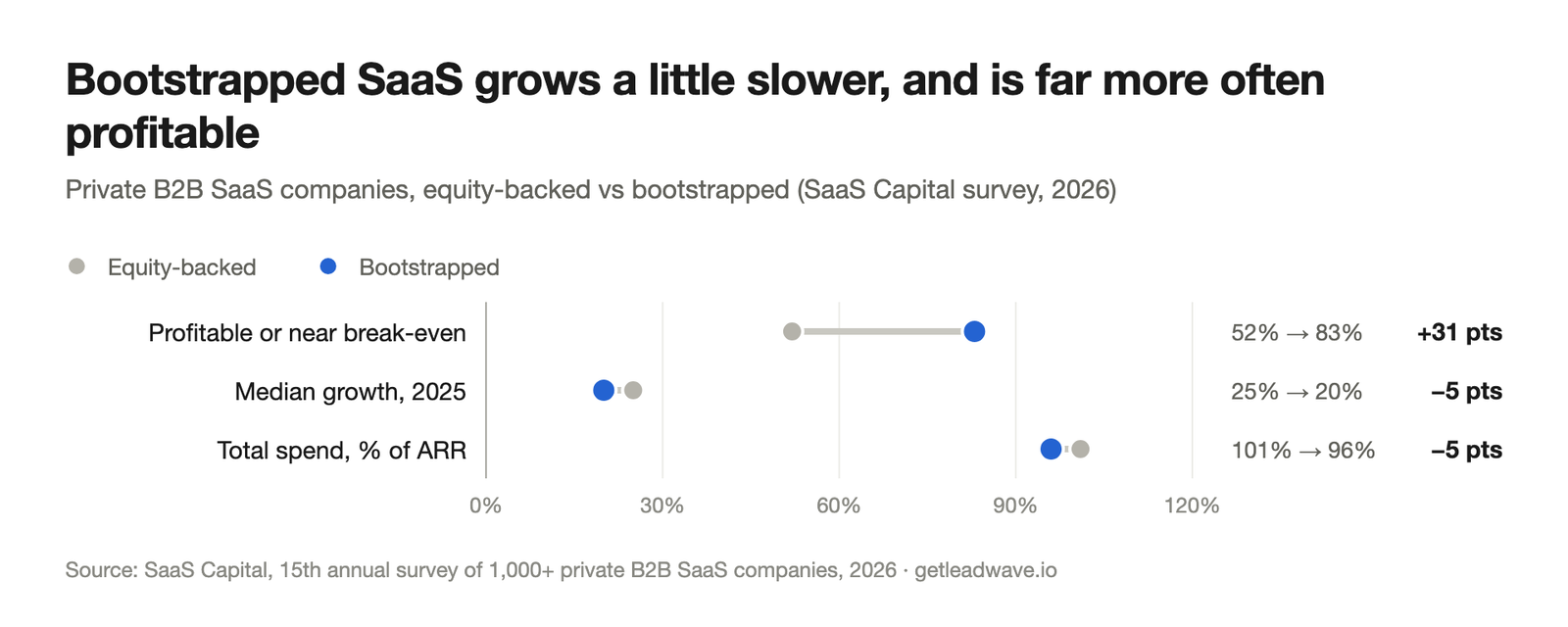
SaaS Capital's 2026 survey of more than 1,000 private B2B SaaS companies puts numbers on the trade-off:
Growth: bootstrapped companies grew 20% at the median in 2025, against 25% for equity-backed ones (SaaS Capital).
Profit: 83% of bootstrapped companies are profitable or within two points of break-even, against 52% of equity-backed ones. Equity-backed companies spend about twice as much on marketing and customer success (SaaS Capital).
Retention: bootstrapped companies between $3 million and $20 million in ARR keep 91% of their revenue before upsells and 103% after them, at the median (SaaS Capital). Check your own with our SaaS churn rate calculator.
Speed to $1M ARR: the top quarter of bootstrapped companies get there in two years, only four months slower than VC-backed ones (ChartMogul and Dealroom, 2024).
FAQ
What is a bootstrapped SaaS company?
A software-as-a-service company that grows on its own revenue and its founders' money instead of venture capital. Some accept a small seed round or let founders sell shares later; strictly, a bootstrapped company has never taken outside money into the business.
What is the biggest bootstrapped SaaS company?
Zoho, with about $1.45 billion in revenue in the year to March 2025 and no outside investors since 1996. Mailchimp reached about $800 million a year before it sold to Intuit in 2021, so it no longer counts.
Is Zapier bootstrapped?
Nearly. Zapier raised a $1.3 million seed round in 2012, became profitable in 2014 and has not raised since. A 2021 deal valued it at about $5 billion, but the money went to early shareholders, not the company.
Was Atlassian bootstrapped?
For its first eight years. It took $60 million from Accel in 2010 and went public in 2015.
Are bootstrapped SaaS companies profitable?
Mostly. In SaaS Capital's 2026 survey, 83% of bootstrapped SaaS companies were profitable or within two points of break-even, against 52% of equity-backed ones.
Can a bootstrapped company become a unicorn?
Yes. Mailchimp sold for about $12 billion without ever raising, and Zapier was valued at about $5 billion on a $1.3 million seed. See our list of SaaS unicorns for the rest.
How long does it take a bootstrapped SaaS company to reach $1M ARR?
About two years for the fastest quarter of bootstrapped companies, and more than three at the median, according to ChartMogul and Dealroom.
How this list was built
We started from the bootstrapped SaaS companies tagged in LeadWave's database and checked each one's funding history against its own announcements, filings and interviews, and against the press. We removed Maximizer: as Multiactive Software it raised money and was listed on the Toronto Stock Exchange from 1999 to 2009. We added Zoho, 37signals and Plausible, which any list of bootstrapped SaaS companies should include. Companies that took a small seed or a minority investment and then never raised again are included, and labelled.
Revenue is company-reported, from filings or from reputable press, with the year shown. A few figures come from third parties and are marked as such: Zapier's 2023 ARR (Sacra), Hotjar's ARR at its sale and SurveyMonkey's 2008 revenue. Revenue in złoty, rupees and euros is converted to dollars at the average rate of that year. Revenue per employee pairs revenue and headcount from the nearest dates available. Everything was checked on November 3, 2026.
Selling to bootstrapped SaaS companies?
At a bootstrapped company, the founder usually still decides and pays out of revenue, so a good pitch reaches the person who signs. LeadWave's list of 15,000 SaaS companies includes each company's funding data, so you can find the ones that never raised, along with the CEO's verified email, company size and founding year.