A sovereign LLM is a large language model built by or for a country or region, so its government, companies and citizens don't have to depend on American or Chinese AI. In 2026 almost every large economy has one. We tracked 43 sovereign LLMs from 29 countries and regions, from France's Mistral Large 4 and India's Sarvam-105B to Korea's K-EXAONE 2.0 and the UAE's K2 Horizon, with who built each one, how big it is, whether it was trained from scratch or built on someone else's model, and who paid for it.
Everything was checked on November 8, 2026 against model cards, Hugging Face, the makers' announcements and government releases.
What is sovereign AI?
NVIDIA, which sells the chips most of these models run on, popularised the term. It defines sovereign AI as "a nation's capabilities to produce artificial intelligence using its own infrastructure, data, workforce and business networks" (NVIDIA). A sovereign LLM is the model layer of that stack: trained on local data, in local languages, on compute the country controls, by a team it can hold to its own laws.
Countries give four main reasons:
Language and culture: the big US and Chinese models are weaker in Hindi, Arabic, Korean, Thai or Basque, and reflect other cultures' norms.
Data and law: governments, banks and hospitals want data processed in the country, under its own laws.
Dependence: "No country–not even America's closest allies–will accept that level of dependence," the Center for a New American Security wrote in August 2026 (CNAS).
Security and defence: France's armed forces signed a framework agreement with Mistral in January 2026, and Korea's SK Telecom is adapting its model for defence.
Key numbers
184 sovereign AI projects in 67 countries plus the EU, 41 of them new in the first half of 2026, by CNAS's count. About 40% of the models are built from scratch.
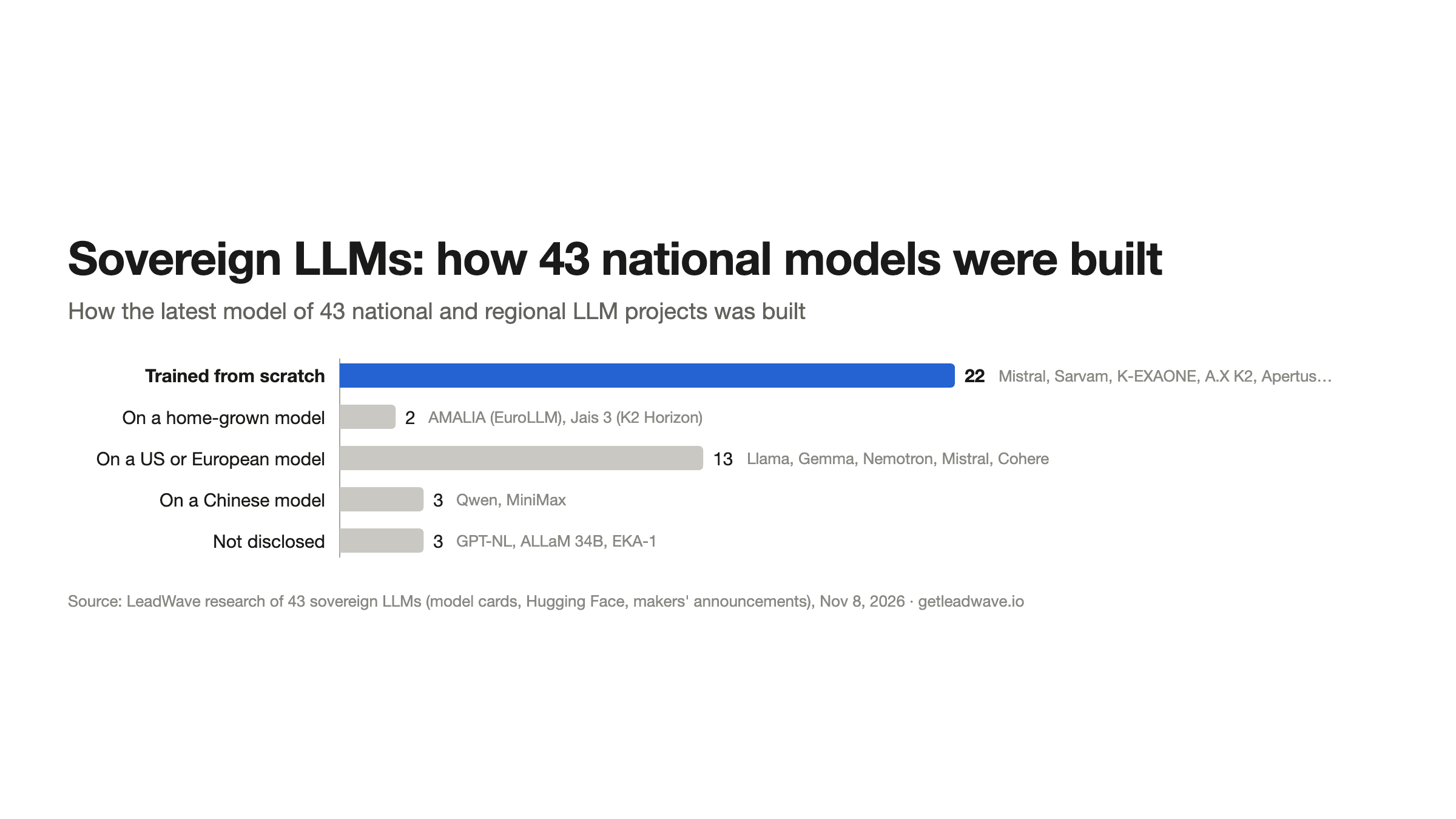
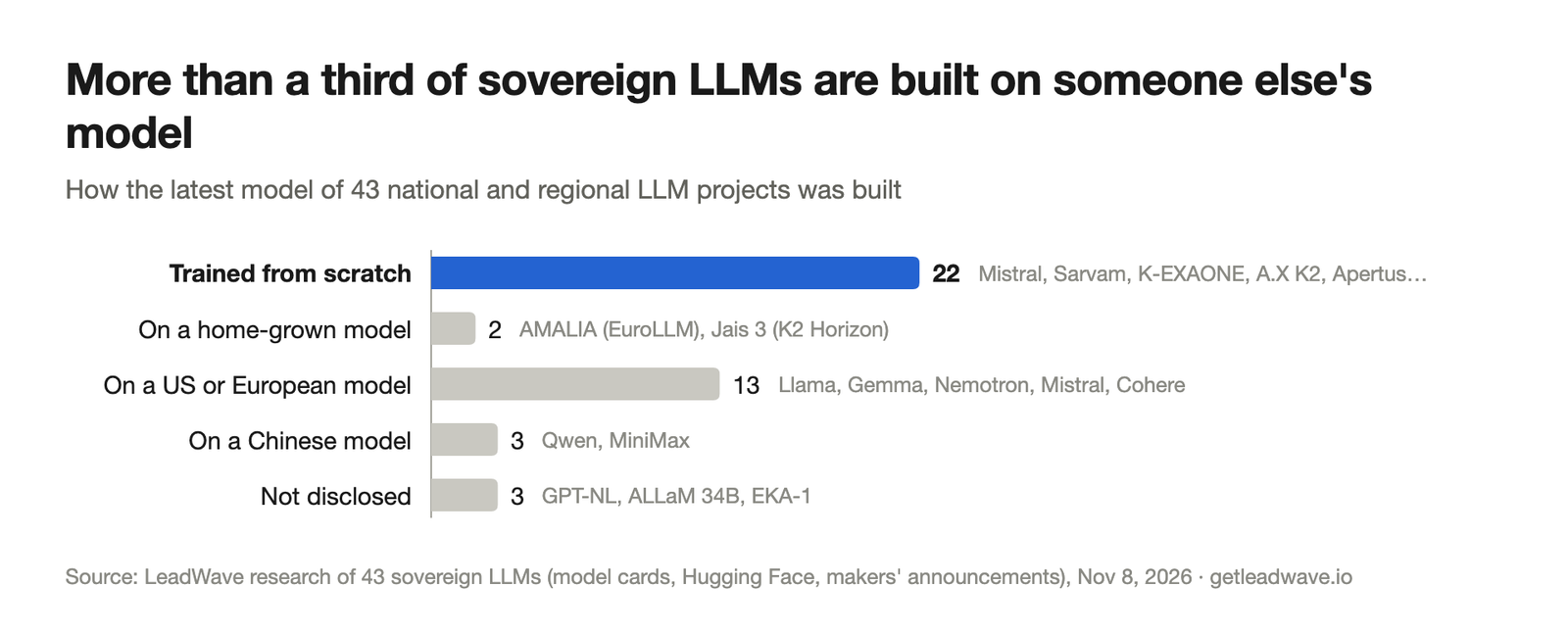
More than a third of the 43 models we tracked are built on another company's model: 13 on American or European models such as Llama, Gemma and Nemotron, and 3 on Chinese ones.
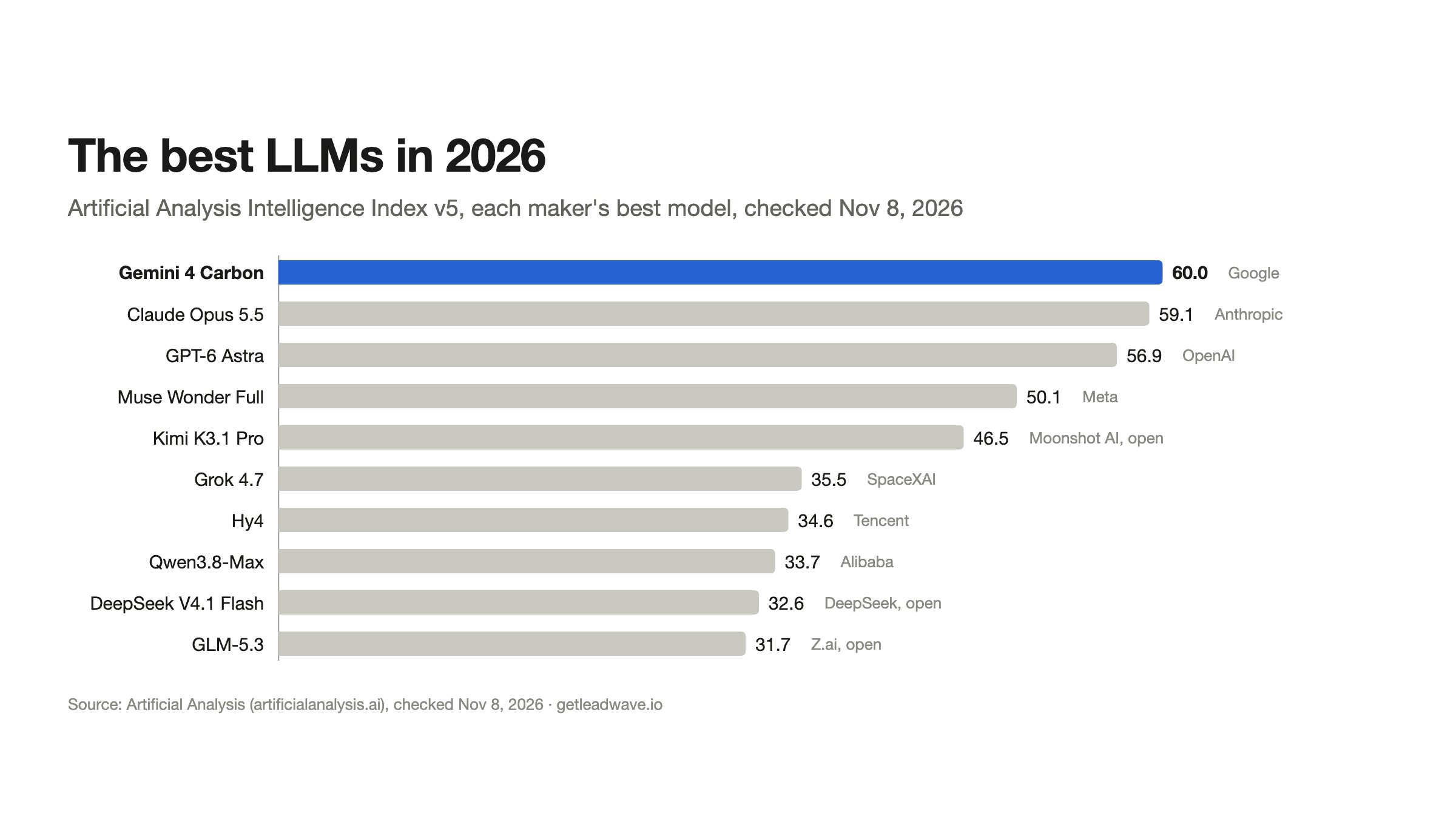
Only one sovereign model is near the top of a public leaderboard: Mistral Large 4 scores 26.1 on the Artificial Analysis Intelligence Index, against 60.0 for Google's Gemini 4 Carbon.
Over $30 billion: NVIDIA's sovereign AI revenue in its 2026 fiscal year, more than triple the year before (earnings call).
Governments are buying in: Canada committed up to C$1.6 billion for a stake in Cohere in October 2026, and Luxembourg invested in Mistral's €3 billion round in September.
Sovereign LLMs by country
The latest model of each national or regional project, checked November 8, 2026. "From scratch" means the maker trained its own base model; otherwise the base model is named. Sizes are total parameters.
Country | Model | Maker | Size | Built | Weights | Released |
|---|---|---|---|---|---|---|
France | Mistral Large 4 | Mistral AI | About 1T | From scratch | Open, Mistral license | Oct 2026 |
Italy | Domyn Edge | Domyn | 4B | From scratch | Apache 2.0 | Oct 2026 |
EU | Prelude 9B | OpenEuroLLM | 9B | From scratch | Apache 2.0 | Jul 2026 |
EU | EuroLLM-22B | EuroLLM consortium | 22B | From scratch | Apache 2.0 | Dec 2025 |
Portugal | AMALIA-9B | Portuguese universities | 9B | On EuroLLM | Apache 2.0 | Jul 2026 |
Switzerland | Apertus 1.5 | Swiss AI Initiative | 70B | From scratch | Apache 2.0 | Jul 2026 |
Spain | ALIA-40b | Barcelona Supercomputing Center | 40B | From scratch | Apache 2.0 | Jun 2026 |
Germany | Kolibri 1 | Aleph Alpha (Cohere) | 78B | From scratch | Apache 2.0 | Oct 2026 |
Germany | Soofi-S | Soofi consortium | About 32B | From scratch | Closed beta | Jun 2026 |
Latvia | TildeOpen-30b | Tilde | 30B | From scratch | CC-BY-4.0 | Aug 2025 |
Netherlands | GPT-NL | TNO, SURF, NFI | Not disclosed | Not disclosed | Controlled license | Beta, Feb 2026 |
Poland | PLLuM | Ministry of Digital Affairs, NASK | 4B–70B | On Llama 3.1 and Mistral-Nemo | Open | 2026 |
Finland | Poro 2 | AMD Silo AI | 8B | On Llama | Llama license | Jun 2026 |
Greece | Krikri 8B | ILSP, Athena Research Center | 8B | On Llama 3.1 | Llama license | Nov 2025 |
Canada | Command A+ | Cohere | 218B | From scratch | Apache 2.0 | May 2026 |
Latin America | LatamGPT | CENIA (Chile) | 70B | On Llama 3.1 | Llama license | Feb 2026 |
UAE | K2 Horizon | MBZUAI | 375B | From scratch | Apache 2.0, open data | Sep 2026 |
UAE | Jais 3 | MBZUAI, Inception42 | Up to 375B | On K2 Horizon | Apache 2.0 | Oct 2026 |
UAE | Falcon-H1R-7B | Technology Innovation Institute | 7.6B | From scratch | Falcon license | Jan 2026 |
Saudi Arabia | humain-m3 | HUMAIN | 428B | On MiniMax-M3 (China) | Promised | Sep 2026 |
Saudi Arabia | ALLaM 34B | HUMAIN, SDAIA | 34B | Not disclosed | Closed | 2025 |
India | Sarvam-105B | Sarvam AI | 106B | From scratch | Apache 2.0 | Mar 2026 |
India | Param2-17B | BharatGen (IIT Bombay) | 17B | From scratch | Non-commercial | Feb 2026 |
India | EKA-1 | Soket AI | About 26B | Not disclosed | Not released | Nov 2026 |
India | Krutrim-2 | Krutrim (Ola) | 12B | On Mistral-Nemo | Custom | Feb 2025 |
Japan | LLM-jp-4.1 | National Institute of Informatics | 33B | From scratch | Apache 2.0 | Sep 2026 |
Japan | PLaMo 3 | Preferred Networks | 31B | From scratch | PLaMo license | 2026 |
Japan | tsuzumi 2 | NTT | 30B | From scratch | Commercial | Oct 2025 |
Japan | Takane 32B | Fujitsu | 32B | On Cohere | Commercial | 2026 |
South Korea | K-EXAONE 2.0 | LG AI Research | 749B | From scratch | Apache 2.0 | Jul 2026 |
South Korea | A.X K2 | SK Telecom | 692B | From scratch | Apache 2.0 | Jul 2026 |
South Korea | Solar Open 2 | Upstage | 250B | From scratch | Custom | Jul 2026 |
South Korea | Motif-3 | Motif Technologies | 315B | From scratch | MIT | Aug 2026 |
Singapore | SEA-LION v4.8 | AI Singapore | 120B | On NVIDIA Nemotron | MIT | Sep 2026 |
Indonesia | GoTo-AI 27B (Sahabat-AI) | GoTo | 27B | On Gemma 3 | Gemma license | Dec 2025 |
Malaysia | ILMU-Nemo-30B | YTL AI Labs | 30B | On NVIDIA Nemotron | Closed | Mar 2026 |
Thailand | ThaiLLM-8B | National project | 8B | On Qwen3 (China) | Apache 2.0 | Dec 2025 |
Vietnam | VAI-LLM | Viettel | 120B | On NVIDIA Nemotron | Not released | Jul 2026 |
Taiwan | TAIDE 12B | National Science and Technology Council | 12B | On Gemma 3 | Custom | Feb 2026 |
Kazakhstan | Qwen3.5-35B-Kazakh | ISSAI | 35B | On Qwen3.5 (China) | Apache 2.0 | Aug 2026 |
Israel | DictaLM 3.0 | Dicta | 24B | On Mistral Small | Apache 2.0 | Dec 2025 |
Nigeria | N-ATLaS | NCAIR, Awarri | 8B | On Llama 3 | Gated | Sep 2025 |
South Africa | InkubaLM | Lelapa AI | 0.4B | From scratch | Non-commercial | May 2024 |
How good are sovereign models?
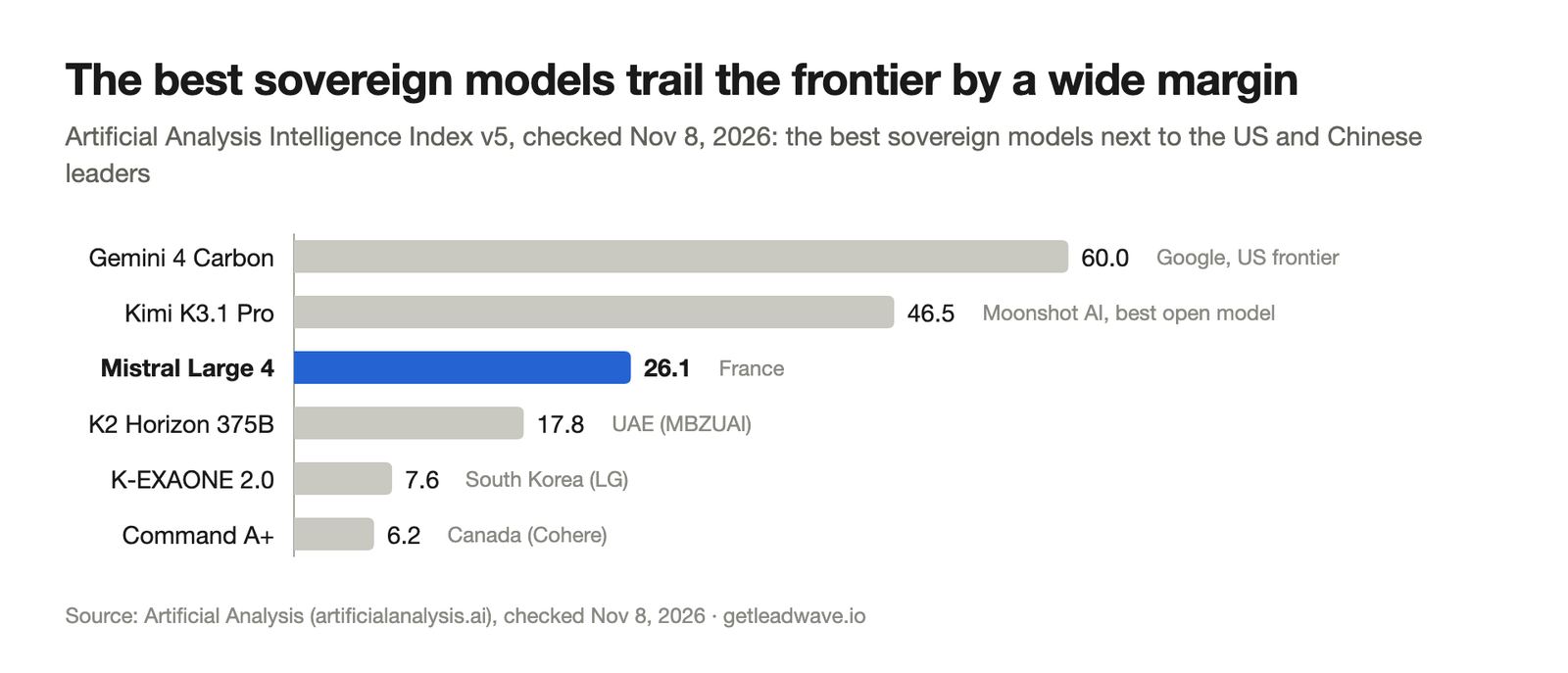
Not as good as the frontier, and that isn't usually the point. On the Artificial Analysis Intelligence Index, Mistral Large 4 is the best sovereign model at 26.1, about 34 points behind Gemini 4 Carbon and 20 behind the best Chinese open model, Kimi K3.1 Pro. MBZUAI's K2 Horizon (17.8), LG's K-EXAONE 2.0 (7.6) and Cohere's Command A+ (6.2) follow. No sovereign model besides Mistral appears in the top 150 of Arena's text leaderboard, where Mistral Large 4 is #133.
Sovereign models compete on other things: how well they handle a national language, whether they can run inside a ministry's own data centre, and who controls them. Sarvam-105B covers 22 Indian languages; Apertus covers more than 1,800; Jais 3 raised a 7B model's Arabic score from 56.4 to 79.6 in its makers' own tests. For the general leaders, see our best LLMs in 2026.
Europe
Mistral AI (France)
Mistral AI is Europe's sovereign AI champion and the only sovereign maker near the frontier. Mistral Large 4, previewed on October 6, 2026 with open weights later that month, has about 1 trillion parameters (49 billion active per token) and was trained from scratch on 3,800 NVIDIA Grace Blackwell GPUs in Mistral's own European data centres. In September Mistral raised €3 billion at more than €21 billion, led by Samsung, with the EU-backed Scaleup Europe Fund and the Grand Duchy of Luxembourg among the investors (CNBC).
Government deals: a framework agreement with France's Ministry of the Armed Forces, deployed on the ministry's own infrastructure (January 2026), and a strategic partnership with Luxembourg
License: open weights under the Mistral Ecosystem Open-Weight License; companies that resell it as a service need a commercial license
In their words: "Long term, the plan is to fully rely on capacity that we are building ourselves." Arthur Mensch, CEO (CNBC)
Domyn and the EU's frontier model (Italy, EU)
On June 19, 2026 the European Commission picked the EUROPA consortium, led by Italy's Domyn (formerly iGenius), to build an open frontier model of more than 400 billion parameters covering all 24 EU languages, with up to 2.5% of Europe's EuroHPC supercomputing capacity for a year (European Commission). It isn't out yet. Domyn's own Domyn Edge, a 4-billion-parameter model trained from scratch, came out in October.
In their words: "This is about strengthening Europe's ability to shape AI's future with openness, trust and strategic autonomy at its core." Henna Virkkunen, EU Executive Vice-President for Tech Sovereignty
Apertus (Switzerland)
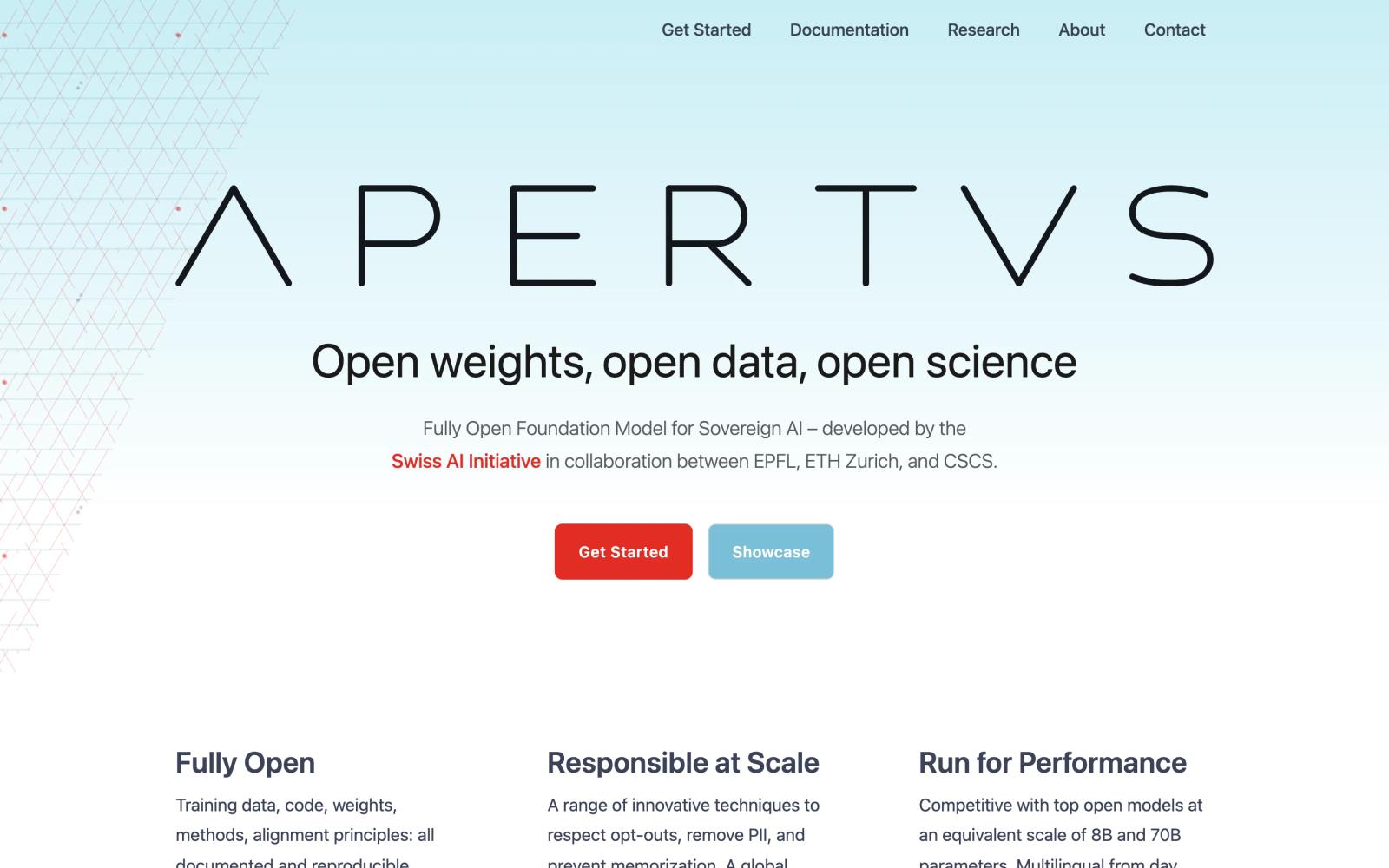
Apertus, from ETH Zurich, EPFL and the Swiss National Supercomputing Centre, is the most open sovereign model: weights, code and training data are all public. Apertus 1.5 (July 2026) comes in 8B and 70B sizes, reads images and audio, has a 262,000-token context and was trained on the Alps supercomputer (CSCS). The Canton of Ticino uses it to translate government documents.
Other European models
OpenEuroLLM: an EU-funded consortium of about 20 partners (€37.4 million budget, €20.6 million from the Digital Europe Programme) building open models in all EU languages. Its first model, the experimental Prelude 9B, came out in July 2026 (OpenEuroLLM).
EuroLLM: a Portugal-led university consortium; EuroLLM-22B covers 35 languages under Apache 2.0, and Portugal's AMALIA is built on it.
ALIA (Spain): the Barcelona Supercomputing Center's 40B model, trained from scratch in 35 European languages and tuned for Spanish, Catalan, Basque and Galician.
Aleph Alpha (Germany): released the open Kolibri 1 in October 2026 and is merging into Cohere.
Soofi (Germany): a €20 million federally funded consortium; its Soofi-S model is in closed beta.
TildeOpen (Latvia): a 30B open model for Nordic, Baltic and Eastern European languages.
GPT-NL (Netherlands): €13.5 million from the government; in beta with five pilot organisations.
Poland, Finland and Greece fine-tune existing models: PLLuM on Llama and Mistral, Poro 2 and Krikri on Llama.
The UK has no national model. It set up a £500 million Sovereign AI Unit in April 2026 to invest in British AI startups instead (GOV.UK).
The Americas
Cohere (Canada)
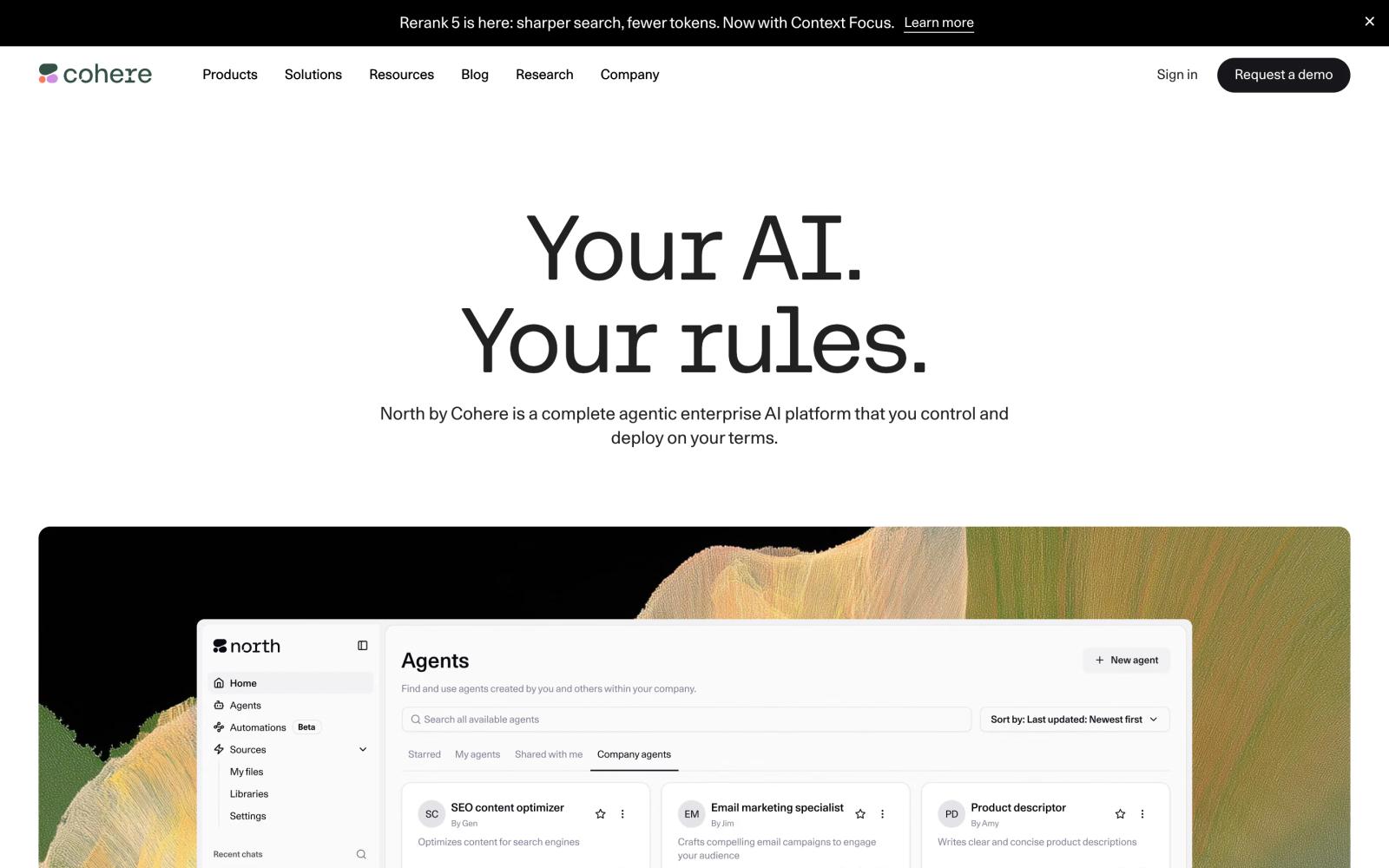
Cohere is Canada's sovereign AI company, built around private, on-premises deployments for governments and banks. Its Command A+ (May 2026) is a 218-billion-parameter open model under Apache 2.0, covering 48 languages. On October 29, 2026, Ottawa committed up to C$1.6 billion for a stake in Cohere, as part of a $7 billion round, on the condition that Cohere stays headquartered in Canada and spends $1.7 billion on Canadian compute by 2030 (The Globe and Mail). Cohere is also merging with Germany's Aleph Alpha.
In their words: "Under this agreement, Cohere will stay Canadian." Prime Minister Mark Carney
LatamGPT and Brazil
LatamGPT, led by Chile's CENIA with partners across the region, launched in February 2026: a 70B model built on Meta's Llama 3.1 for Spanish and Portuguese, made for about $550,000 (Euronews). Brazil has no national LLM yet; its AI plan budgets R$23 billion to 2028, and the state IT company Serpro is building Portuguese models it will own.
The United States doesn't need a sovereign model, but it sells sovereignty: OpenAI for Countries builds national data centres such as Stargate UAE and Stargate UK.
The Middle East
K2 Horizon and Jais 3 (UAE)
Abu Dhabi's MBZUAI released K2 Horizon in September 2026: six fully open models from 0.9B to 375B parameters, with weights, code and training data public under Apache 2.0, and a 512,000-token context. The 375B version scores 17.8 on the Artificial Analysis index, the second-best sovereign model after Mistral. In October, MBZUAI and G42's Inception42 released Jais 3, an Arabic and English version of K2 Horizon that powers the Jais chat app (MBZUAI). The Technology Innovation Institute's Falcon models are the UAE's other line; its latest LLM is the small Falcon-H1R-7B reasoning model.
HUMAIN (Saudi Arabia)
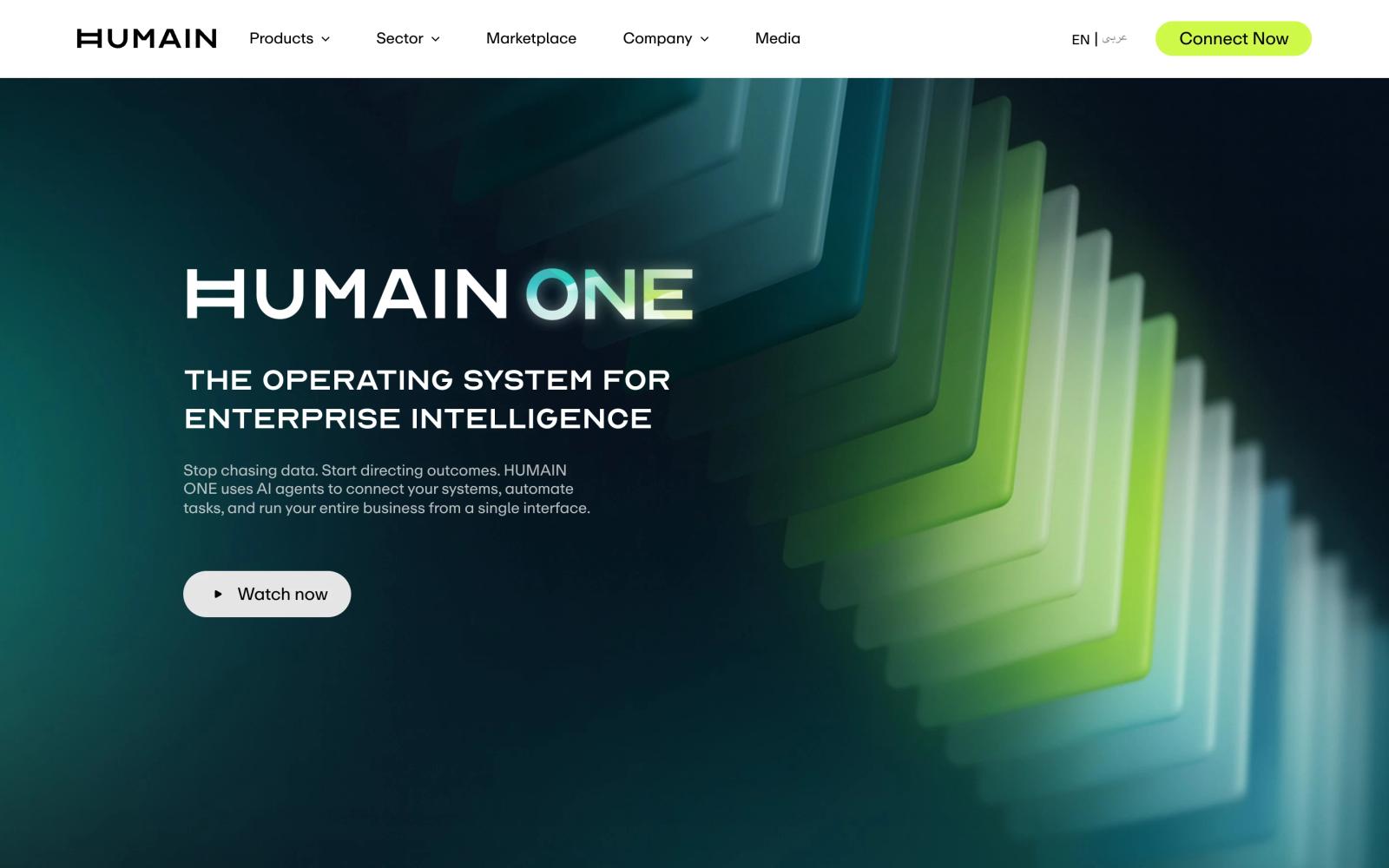
HUMAIN, owned by Saudi Arabia's Public Investment Fund, runs the ALLaM Arabic models and the HUMAIN Chat app. Its newest model is a twist on sovereignty: humain-m3 (September 2026), a 428-billion-parameter Arabic model built on MiniMax-M3 from China, trained further on more than a trillion tokens of Arabic text and delivered by MiniMax. HUMAIN is also buying compute at national scale, with deals for Nvidia, AMD and AWS chips.
In their words: "Arabic is spoken by hundreds of millions of people, yet it remains significantly underrepresented at the frontier of artificial intelligence." Tareq Amin, CEO
Asia
Sarvam AI and the IndiaAI Mission (India)
India's IndiaAI Mission, with a budget of more than ₹10,300 crore, has funded 12 large and 8 small model builders. The best known is Sarvam AI: its Sarvam-105B and Sarvam-30B, trained from scratch in India on government-subsidised GPUs, cover 22 Indian languages and are open under Apache 2.0 (Sarvam). BharatGen, an IIT Bombay-led consortium, received the largest grant, ₹1,058.52 crore, and released Param2-17B in February. Soket AI's EKA-1 launched on November 3.
South Korea's national model project
South Korea runs the strictest sovereign AI program: a government contest in which companies get GPUs to build national foundation models, and lose their place if they rely on foreign weights. In January 2026 the science ministry cut Naver Cloud because its model reused weights from Alibaba's Qwen. After the second round in August, three teams remain: LG AI Research (K-EXAONE 2.0, 749B), SK Telecom (A.X K2, 692B) and Upstage (Solar Open 2, 250B), all trained from scratch and mostly open. Motif Technologies was eliminated despite its open Motif-3. The government has proposed ₩4.7 trillion for a separate frontier AI program in 2027.
In their words (translated from Korean): "Even when using open source, taking over already-trained weights as-is is, in a sense, free-riding on someone else's work." Ryu Jae-myeong, Vice Minister of Science and ICT
Japan
Japan's government AI service, Gennai, picked seven domestic models in March 2026, including NTT's tsuzumi 2, Preferred Networks' PLaMo, SoftBank's Sarashina, NEC's cotomi and Fujitsu's Takane (built on Cohere). The National Institute of Informatics releases the fully open LLM-jp series, most recently LLM-jp-4.1 in September 2026. The METI program GENIAC subsidises compute for domestic model builders.
Southeast Asia, Taiwan and Central Asia
Singapore: AI Singapore's SEA-LION v4.8 (September 2026), a 120B model built on NVIDIA Nemotron for Southeast Asian languages, funded by a S$70 million national programme.
Indonesia, Malaysia and Vietnam: GoTo's Sahabat-AI on Gemma 3, YTL's ILMU and Viettel's VAI-LLM on NVIDIA Nemotron.
Thailand and Kazakhstan: national models built on Alibaba's Qwen, ThaiLLM-8B and ISSAI's Kazakh Qwen3.5.
Taiwan: TAIDE, built on Gemma 3, partly to keep Chinese content out of government AI.
Israel: Dicta's Hebrew DictaLM 3.0, built on Mistral Small.
Africa
Nigeria's N-ATLaS (September 2025), built on Llama 3 for Yoruba, Hausa, Igbo and Nigerian English, is the best-known national model. South Africa's Lelapa AI trained InkubaLM, a small model for five African languages, from scratch. Tanzania is preparing a Swahili model for government with Italy's Almawave.
From scratch or built on someone else's model?
This is the main fault line in sovereign AI. Training a model from scratch costs far more but gives a country full control; building on Llama, Gemma, Nemotron or Qwen is fast and cheap but leaves it dependent on an American or Chinese company's license and choices. Of the 43 models above, 22 were trained from scratch, 2 more on a home-grown base (Portugal's AMALIA on EuroLLM, the UAE's Jais 3 on K2 Horizon), and 16 on another company's model, 3 of them Chinese. Across all projects, Meta's Llama is still the most-used base model, with Mistral and Google's Gemma tied for second (CNAS), and Counterpoint Research, which tracks more than 170 sovereign models, puts the share of adapted models at 56%. Korea is the only country that has written the line into its rules.
Government sovereign AI programs
Country | Program | Money |
|---|---|---|
EU | InvestAI, including AI gigafactories | €200 billion to mobilise, €20 billion for gigafactories |
EU | OpenEuroLLM | €37.4 million |
UK | Sovereign AI Unit | £500 million |
Germany | Soofi | About €20 million |
Netherlands | GPT-NL | €13.5 million |
Canada | Sovereign AI Compute Strategy; Cohere stake | C$2 billion; up to C$1.6 billion |
India | IndiaAI Mission | More than ₹10,300 crore |
South Korea | National foundation model project; frontier AI program | About 1,000 B200 GPUs per team; ₩4.7 trillion proposed for 2027 |
Singapore | National Multimodal LLM Programme | S$70 million |
Saudi Arabia | HUMAIN (Public Investment Fund) | Chip deals with Nvidia, AMD (about $10 billion) and AWS |
Latin America | LatamGPT | About $550,000 |
Sources: European Commission, Government of Canada, PIB India, Korea JoongAng Daily and the makers above.
FAQ
What is a sovereign LLM?
A large language model built by or for a country or region, trained on its languages and data, on compute it controls, so it doesn't depend on foreign AI companies. Examples are France's Mistral Large 4, India's Sarvam-105B and Korea's K-EXAONE 2.0.
Which countries have their own LLM?
We tracked 43 sovereign models from 29 countries and regions, including France, Germany, Italy, Spain, Switzerland, the EU, Canada, the UAE, Saudi Arabia, India, Japan, South Korea and Singapore. CNAS counts 184 sovereign AI projects in 67 countries.
Does Europe have its own LLM?
Yes. Mistral Large 4 from France is the strongest, and the EU is funding OpenEuroLLM and a 400-billion-parameter frontier model led by Italy's Domyn. Switzerland's Apertus, Spain's ALIA and the EuroLLM models are fully open.
Is Mistral sovereign AI?
Mistral is the main European sovereign AI company: French, trained on its own European data centres, with open weights, and working with the French and Luxembourg armed forces. Its investors include Samsung, NVIDIA and ASML as well as European funds and Luxembourg.
What is India's sovereign LLM?
Sarvam AI's Sarvam-105B, trained from scratch in India under the IndiaAI Mission and released in March 2026, covering 22 Indian languages. BharatGen's Param2 is the government-led alternative.
What is the largest sovereign LLM?
Mistral Large 4, with about 1 trillion parameters, followed by Korea's K-EXAONE 2.0 (749 billion) and A.X K2 (692 billion).
Is a sovereign LLM the same as an open-source LLM?
No. Many sovereign models are open, but sovereignty is about who controls the model and where it runs. A ministry running an open Chinese model on its own servers controls the deployment, not the model's training.
How this list was built
The list: national and regional LLM projects that are built by or for a government, publicly funded, or positioned by their maker as sovereign, plus the companies tagged "Sovereign AI" and "Large Language Model" in LeadWave's database. One row per project, showing its latest model. US and Chinese labs are left out, as are companies that only compress or fine-tune other labs' models for sale, such as Spain's Multiverse Computing and France's H Company.
The facts: sizes, licenses, dates and base models come from each model's card on Hugging Face and the makers' own announcements; funding from government releases and major news outlets; scores from Artificial Analysis and Arena. Checked November 8, 2026.
Selling to AI companies?
LeadWave's list of AI companies covers 9,000 AI companies with CEO details. See also our list of AI labs and the best LLMs in 2026.
About this list
Compiled by LeadWave from model cards, government announcements and public leaderboards, checked November 8, 2026.