Mistral AI raised €3 billion on September 8, 2026 at a post-money valuation of more than €21 billion, about $24.39 billion at that day’s exchange rate. It is the company’s latest closed round. Its annualized revenue run rate passed $400 million in February 2026. In September its CFO was reported both as saying ARR was slightly above $1 billion and as saying it was on track for $1 billion by year-end.
Mistral AI at a glance
Question | Answer | As of |
|---|---|---|
Valuation | More than €21 billion post-money (about $24.39 billion) | Sep 8, 2026 |
Latest round | €3 billion Series D led by Samsung Electronics | Sep 8, 2026 |
Funding | About €5.8 billion in five rounds, plus $830 million of debt | Nov 2026 |
Revenue | Over $400 million annualized run rate | Feb 2026 |
ARR | Reported as slightly above $1 billion, or on track for $1 billion by year-end | Sep 8, 2026 |
Who owns it | Private: its founders, ASML, Samsung and other investors | Nov 2026 |
ASML’s stake | 11% on a fully diluted basis after the Series C; not updated since | Sep 2025 |
CEO | Arthur Mensch, co-founder | Nov 2026 |
Founders | Arthur Mensch, Guillaume Lample, Timothée Lacroix | April 2023 |
Customers | 125+ enterprises; operates in 20 countries, the company says | Sep 2026 |
Employees | About 1,200, reportedly | Sep 2026 |
Headquarters | Paris; registered at 15 rue des Halles, 75001 | Nov 2026 |
Legal entity | Mistral AI SAS, number 952 418 325 | Nov 2026 |
Website | mistral.ai | 2026 |
Mistral builds AI models and sells the full stack around them: the models, the Vibe assistant and coding agent, the Studio developer platform and Mistral Compute, its own GPU cloud. It sells mainly to large companies and governments that want to run AI under their own control, and names Airbus, ASML and HSBC among its customers. This page covers the Paris AI lab at mistral.ai, not other businesses with Mistral in their names.
Mistral AI valuation and funding history
The €3 billion Series D valued Mistral at more than €21 billion after the money, up from €11.7 billion a year earlier. Samsung Electronics led it, with the EQT-managed Scaleup Europe Fund and existing investor PSG Equity as co-leads. The company calls it the largest equity round ever completed by a European technology company. Advent, BlackRock funds and the Grand Duchy of Luxembourg joined as new investors; a16z, ASML, Bpifrance, General Catalyst, Index Ventures, Lightspeed, NVIDIA and Salesforce Ventures were among those who invested again. Microsoft did not take part.
Date | Round | Amount | Led by or investors | Valuation |
|---|---|---|---|---|
Sep 8, 2026 | Series D | €3B (about $3.48B) | Samsung Electronics; Scaleup Europe Fund, PSG Equity | More than €21B (about $24.39B) |
Mar 30, 2026 | Debt (not equity) | $830M | Seven banks, including BNP Paribas, HSBC and MUFG | n/a |
Sep 9, 2025 | Series C | €1.7B | ASML (€1.3B) | €11.7B ($13.8B) |
Jun 11, 2024 | Series B (equity and debt) | €600M | General Catalyst | €5.8B |
Feb 26, 2024 | Microsoft investment | $16M | Microsoft | Not disclosed |
Dec 10, 2023 | Series A | €385M | Andreessen Horowitz, BNP Paribas, Salesforce | Over €2B |
Jun 2023 | Seed | €105M | Lightspeed, Eric Schmidt, Xavier Niel, JCDecaux | About €240M (press estimate) |
The five main rounds add up to about €5.8 billion (our sum: €105M + €385M + €600M + €1.7B + €3B), and that total includes the debt portion of the Series B. The $830 million data-center loan is on top. Dollar figures are the conversions published with each round. CFO Johan Bergqvist said in September 2026 that an IPO is possible but that there’s “nothing imminent in that aspect.”
ASML’s stake in Mistral AI
ASML invested €1.3 billion of the €1.7 billion Series C in September 2025, which gave it an 11% stake on a fully diluted basis. It invested again in the Series D, and neither company has published its stake since then. ASML is also a Mistral customer.
Who owns Mistral AI?
Mistral AI is private and no single owner has been disclosed as controlling it. Each of the three founders held at least 8% in September 2025. ASML held 11% at that point. Samsung Electronics, the Series D lead, has not disclosed its share. Other shareholders include a16z, General Catalyst, Lightspeed, NVIDIA, Salesforce Ventures, the French public bank Bpifrance and, since 2026, the Grand Duchy of Luxembourg. These percentages all predate the Series D, which diluted earlier holders unless they bought more.
What is Mistral AI’s revenue?
Mistral doesn’t publish its accounts, so every figure comes from its executives or the press, and the wording matters. In February 2026 Arthur Mensch put the annualized revenue run rate at over $400 million, up from about $20 million a year earlier. Reports of what CFO Johan Bergqvist said on September 8, 2026 differ: The Wall Street Journal wrote that ARR “was slightly above $1 billion”, while Reuters reported that Mistral was on track for $1 billion in ARR by the end of the year. Mistral hasn’t published a figure that settles it. About 40% of its revenue came from the US and other clients outside Europe in August 2026.
Date | Figure | Exact metric | Said by |
|---|---|---|---|
Sep 8, 2026 | Slightly above $1B | ARR (disputed: Reuters says on track by year-end) | CFO Johan Bergqvist |
Feb 2026 | Over $400M | Annualized revenue run rate | CEO Arthur Mensch |
Sep 2025 | €300M | Annualized revenue | Mistral AI |
About Feb 2025 | About $20M | Annualized revenue run rate | CEO Arthur Mensch, looking back |
Targets, not results: at Davos in January 2026 Mensch said Mistral should pass a billion in revenue by the end of the year (reports differ on dollars or euros). In February the stated goal was more than $1 billion in annual recurring revenue by year-end. The year isn’t over, and Mistral hasn’t published a result.
Mistral AI ARR (annual recurring revenue)
The last figure that all sources agree on is the run rate of over $400 million from February 2026. For September 2026, one report says ARR was slightly above $1 billion and another says $1 billion was still the year-end goal.
Mistral AI MRR (monthly recurring revenue)
Mistral doesn’t publish MRR. The $400 million run rate works out to about $33 million a month in February 2026 (our calculation: $400M ÷ 12).
Mistral AI data centers and compute investments
Mistral is building its own AI infrastructure in Europe, with a goal of 200 megawatts by the end of 2027 and up to 1 gigawatt by 2030. Its first site is at Bruyères-le-Châtel, near Paris, financed by an $830 million loan that buys 13,800 Nvidia GB300 chips and brings capacity to 44 megawatts. In July 2026 Microsoft made a multibillion-dollar commitment to use part of Mistral’s European GPU capacity.
Date | Investment | Detail |
|---|---|---|
Aug 24, 2026 | HUMAIN (Saudi Arabia) | A collaboration worth hundreds of millions of euros; Mistral will explore using HUMAIN’s data centers |
Aug 11, 2026 | European Compute Units | Multi-year capacity commitments from large companies; plan for up to 1 GW by 2030 |
Jul 21, 2026 | Microsoft | Multibillion-dollar commitment to use Mistral’s European capacity |
Mar 30, 2026 | Bruyères-le-Châtel, France | $830M of debt from seven banks; 13,800 Nvidia GB300 chips; 44 MW |
Feb 11, 2026 | Borlänge, Sweden | €1.2B with EcoDataCenter; first site outside France; opening in 2027 |
Jun 2025 | Mistral Compute | Its GPU cloud for companies and governments |
Sovereign AI and defense deals
Mistral’s main sales argument is sovereignty: governments and companies keep control of their data, models and compute. On January 8, 2026 France’s Ministry of the Armed Forces awarded it a framework agreement that lets the armed forces and public bodies such as the Atomic Energy Commission use its models and software, overseen by the ministry’s defense AI agency, AMIAD. It builds on a cooperation deal from March 2025.
Helsing: a partnership with the German defense company, announced in February 2025, on vision-language-action models for defense systems
Germany: a multiyear partnership with SAP (November 2025) and a Munich hub for physics and industrial AI (September 28, 2026)
Luxembourg: the Grand Duchy became a shareholder in the Series D
Saudi Arabia: the HUMAIN collaboration of August 2026, covering cybersecurity and Arabic-language models
Other governments: Mistral says it works with public bodies in France, Luxembourg, Singapore, the Netherlands, England and Switzerland (July 2025)
Military use of AI is contested, and critics including the pope have warned about AI in battlefield decisions. Mensch calls the technology dual-use; his answer is on the CEO page.
Which Mistral AI models are open source?
Some are, and the license differs by model. Open-weight means anyone can download the model; it doesn’t always mean unrestricted use. Mistral Large 4, the flagship, is free to use and modify, but businesses that run a model-as-a-service offering need a separate commercial license. Mistral’s newest OCR and speech models are commercial, labelled Premier in its documentation.
Model | Released | Weights | License |
|---|---|---|---|
Mistral Large 4 (Le Chonk) | Oct 2026 | Open | Mistral Ecosystem Open-Weight License (modified MIT) |
Mistral Medium 3.5 | May 2026 | Open | Modified MIT |
Mistral Small 4 | Mar 2026 | Open | Apache 2.0 |
Ministral 3 (3B, 8B, 14B) | Dec 2025 | Open | Apache 2.0 |
Voxtral Small | Jul 2025 | Open | Apache 2.0 |
OCR 4.1 | 2026 | Closed | Commercial (Premier) |
Voxtral TTS 3 and Transcribe 3 | Oct 2026 | Closed | Commercial (Premier) |
Codestral | Jul 2025 | Closed | Commercial (Premier) |
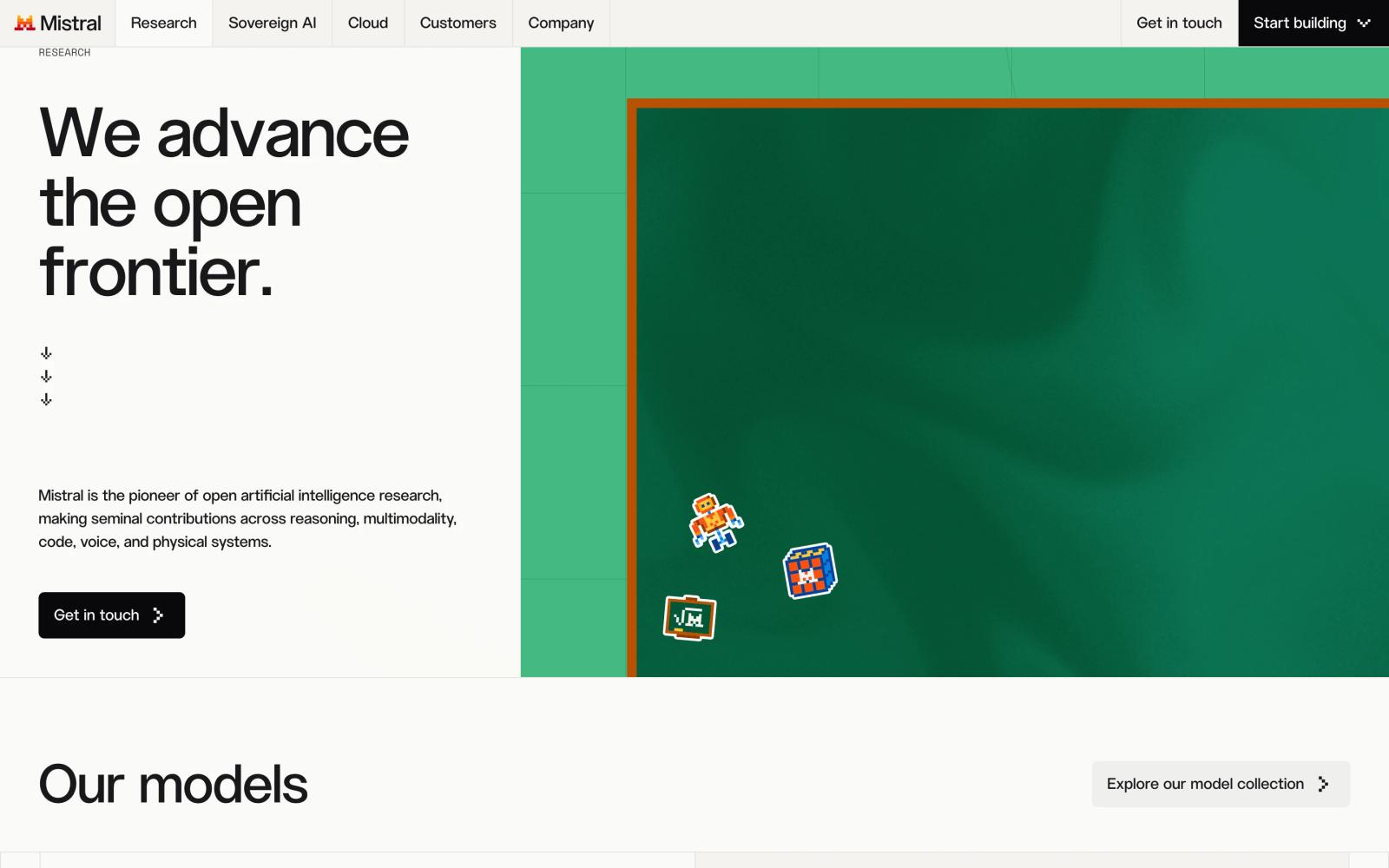
Mistral’s models page, November 2026.
What does Mistral AI sell? Products and pricing
Vibe: its assistant and coding agent, on web, mobile, terminal and IDE. It was called Le Chat until May 28, 2026
Mistral Studio: the developer platform for the Mistral API, agents and workflows
Mistral Compute: GPU infrastructure, from bare-metal servers to managed services
Specialist models: OCR for documents, Voxtral for speech, Robostral Navigate for robots and Shieldstral for AI security
Custom work: models and agents built with large customers, often run on their own servers
Vibe has a free plan. Pro is $14.99 a month ($5.99 for verified students), Team is $24.99 per user a month, and Enterprise is priced by sales, before taxes. The API is priced per million tokens; Medium 3.5 launched at $1.5 for input and $7.5 for output.
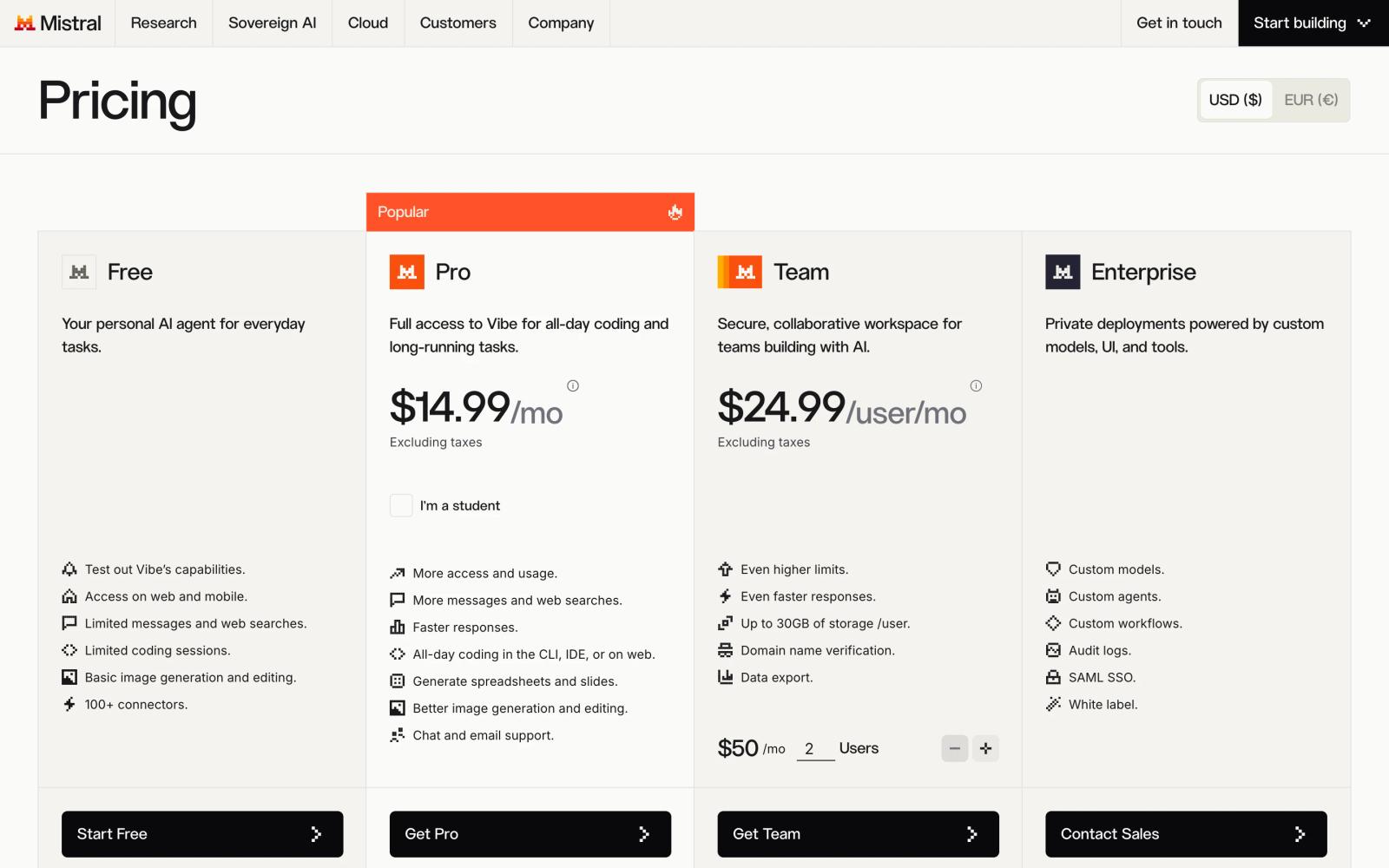
Mistral’s plans, November 2026.
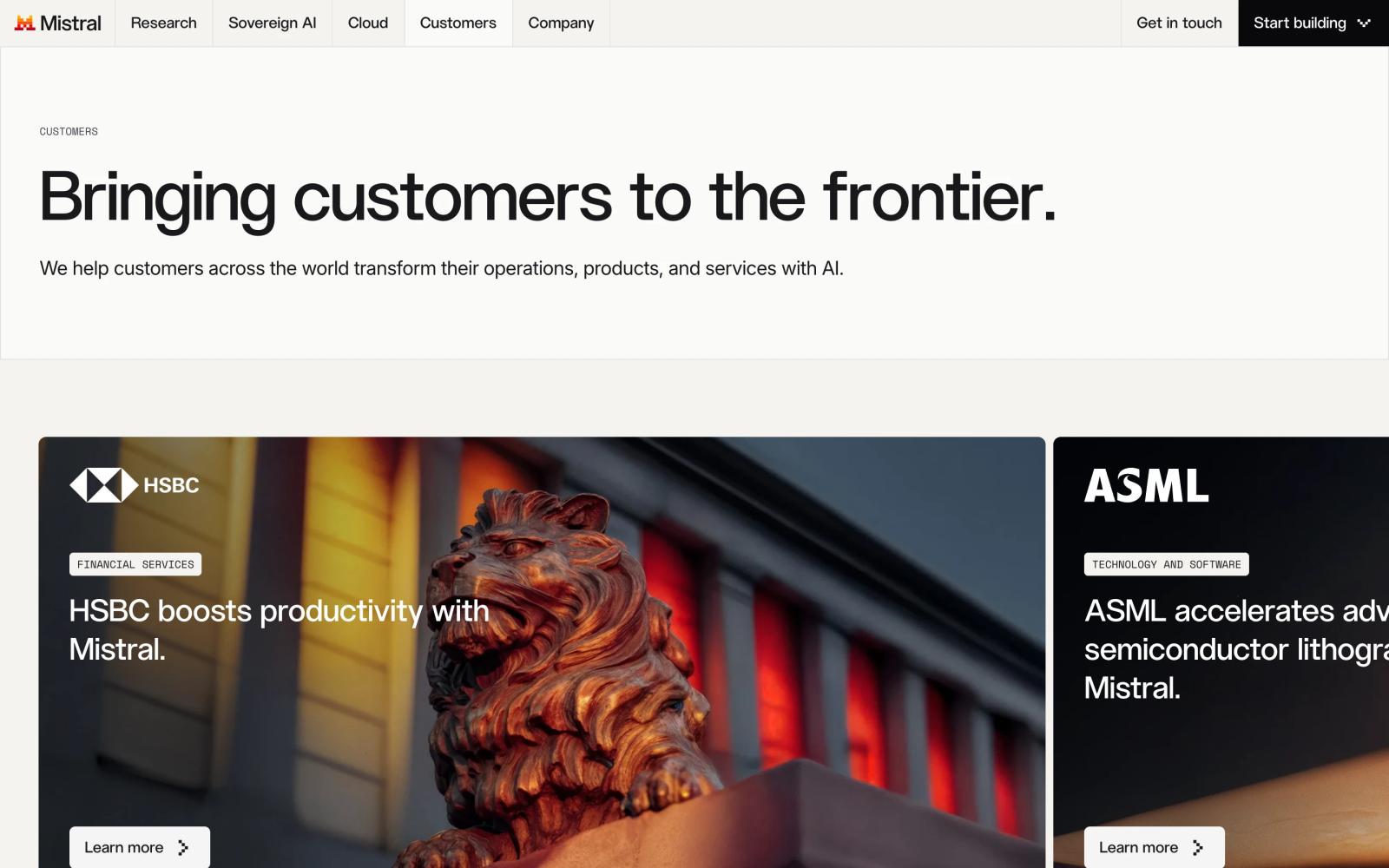
Mistral’s customer page, which features HSBC and ASML.
Copyright and regulatory disputes
Publishers. In February 2026 French publisher Nouveau Monde Éditions asked Mistral to compensate authors, saying more than 200 of its books were used for training without permission. Mistral disputes this and says it trains on public information, licensed datasets and content it generates itself. A group of about ten independent publishers, Adepia, is preparing legal action against AI companies, with first formal notices expected before the end of 2026. We found no lawsuit filed against Mistral as of November 22, 2026.
Mediapart’s tests. On February 23, 2026 the French outlet reported that Mistral Large 3 reproduced 35% of the first Harry Potter book, 58% of The Little Prince and 25% of The Hobbit when prompted paragraph by paragraph, and that Mistral’s bots visited sites that had opted out. Mistral replied that popular works are copied widely across the internet and that those bots serve users’ answers, not training. In December 2025 Mediapart reported, citing a 2022 email from the US case Kadrey v. Meta, that co-founder Guillaume Lample, then at Meta, favored using the pirate library LibGen for exploratory work. Meta won that case on fair use. In October 2026 Lample said Mistral now talks with publishers and licenses data.
French copyright bill. The Senate adopted a bill on April 8, 2026 that would presume AI providers used protected works unless they prove otherwise; it is now before the National Assembly. In March 2026 Mensch proposed a revenue-based levy on AI providers operating in Europe to fund the cultural sector. Some critics say that would let AI companies buy their way out of liability.
Competition and the EU AI Act. Mistral’s 2024 partnership with Microsoft drew criticism from EU lawmakers. The UK’s competition regulator decided on May 17, 2024 that it did not qualify for a merger investigation. Mensch has lobbied to loosen the EU AI Act’s compliance thresholds. Former minister Cédric O, an early adviser, drew scrutiny for lobbying on the Act for Mistral; France’s transparency authority found no issue with his move from government to the private sector.
Mistral AI vs OpenAI, Anthropic and other AI labs
Mistral competes with OpenAI, Anthropic and Google DeepMind for enterprise AI, and with open-weight developers such as DeepSeek and Z.ai. Its difference is mostly in how it sells: downloadable models, deployment on the customer’s own servers and European infrastructure. It still relies on American partners, including NVIDIA for chips and Microsoft for distribution, and its platform also hosts open models from DeepSeek and Z.ai.
Who is the CEO of Mistral AI?
Arthur Mensch, who co-founded Mistral in April 2023 with Guillaume Lample and Timothée Lacroix. Mensch worked at DeepMind in Paris; Lample and Lacroix were researchers at Meta. His bio and contact routes are on the Mistral AI CEO page.
Person | Role |
|---|---|
Arthur Mensch | Co-founder and CEO; previously at DeepMind |
Guillaume Lample | Co-founder and Chief Science Officer; previously at Meta |
Timothée Lacroix | Co-founder and CTO; previously at Meta |
Johan Bergqvist | Chief financial officer; joined in 2026 |
Marjorie Janiewicz | Chief revenue officer |
Where is Mistral AI based, and how many employees does it have?
Mistral is based in Paris, with a German hub in Munich since September 2026. It had about 1,200 employees, including 300 researchers, in September 2026, reportedly; it doesn’t publish a regular count, and other 2026 estimates range from just over 700 to nearly 1,400. A hiring tracker counted 168 open roles in the summer of 2026, a third of them in enterprise sales.
Key events
Date | Event |
|---|---|
Oct 29, 2026 | Releases the weights of Mistral Large 4 |
Sep 28, 2026 | Opens a hub in Munich |
Sep 8, 2026 | €3B Series D at more than €21B |
Aug 24, 2026 | HUMAIN collaboration in Saudi Arabia |
Jul 21, 2026 | Multibillion-dollar compute deal with Microsoft |
May 28, 2026 | Le Chat becomes Vibe |
May 2026 | Buys Emmi AI, an Austrian industrial AI company |
Apr 8, 2026 | French Senate adopts the AI copyright bill |
Mar 30, 2026 | $830M of debt for the Bruyères-le-Châtel data center |
Feb 23, 2026 | Mediapart publishes its copyright tests |
Feb 17, 2026 | Agrees to buy Koyeb, its first acquisition |
Feb 11, 2026 | €1.2B data-center investment in Sweden |
Jan 8, 2026 | French armed forces framework agreement |
Sep 9, 2025 | €1.7B Series C; ASML takes 11% |
Jun 11, 2024 | €600M Series B |
Dec 10, 2023 | €385M Series A |
April 2023 | Founded in Paris |
More on Mistral AI
Mistral AI CEO Arthur Mensch: bio, net worth and how to reach him
AI SaaS companies: companies building with AI
Paris SaaS companies: software companies based in Paris
France SaaS companies: the French software list
European SaaS companies: Europe’s software companies
List of SaaS unicorns: private software companies worth $1B or more
Other European AI companies: Black Forest Labs, Synthesia and Wayve
Need verified CEO emails at scale? The LeadWave AI companies email list has verified emails of the CEOs and founders of 9,000+ AI companies.