
Black Forest Labs was valued at $3.25 billion in a $300 million Series B announced on December 1, 2025, and has raised more than $450 million in all. The Freiburg-based company behind the FLUX image and video models doesn’t publish its revenue; its ARR was reportedly $96.3 million in August 2025.
Black Forest Labs at a glance
Question | Answer | As of |
|---|---|---|
Who owns it? | Private: its founders, staff and investors including a16z, AMP, Salesforce Ventures and NVIDIA. Stakes aren’t disclosed | Nov 2026 |
Revenue | Not published; reportedly $96.3 million ARR | Aug 2025 |
Valuation | $3.25 billion post-money | Dec 1, 2025 |
Funding | Over $450 million | Dec 2025 |
Employees | 90 | Jun 2026 |
CEO | Robin Rombach, co-founder | Nov 2026 |
Founded | March 2024, by Robin Rombach, Andreas Blattmann, Patrick Esser and seven other researchers | 2024 |
Headquarters | Freiburg im Breisgau, Germany, with a second base in San Francisco | Nov 2026 |
Legal entities | Black Forest Labs Inc. (Delaware) and BFL GmbH (Germany) | Nov 2026 |
Main product | FLUX models, sold by API and license, with some open weights | Nov 2026 |
Website | bfl.ai | 2026 |
What does Black Forest Labs do?
Black Forest Labs trains AI models that generate and edit images and video. Its FLUX family is sold to developers and large companies through an API, through licenses to run the model on their own servers, and through custom work. Its latest generation, FLUX 3, launched in early access on July 23, 2026, and handles images, video with sound and robot control in one model family.
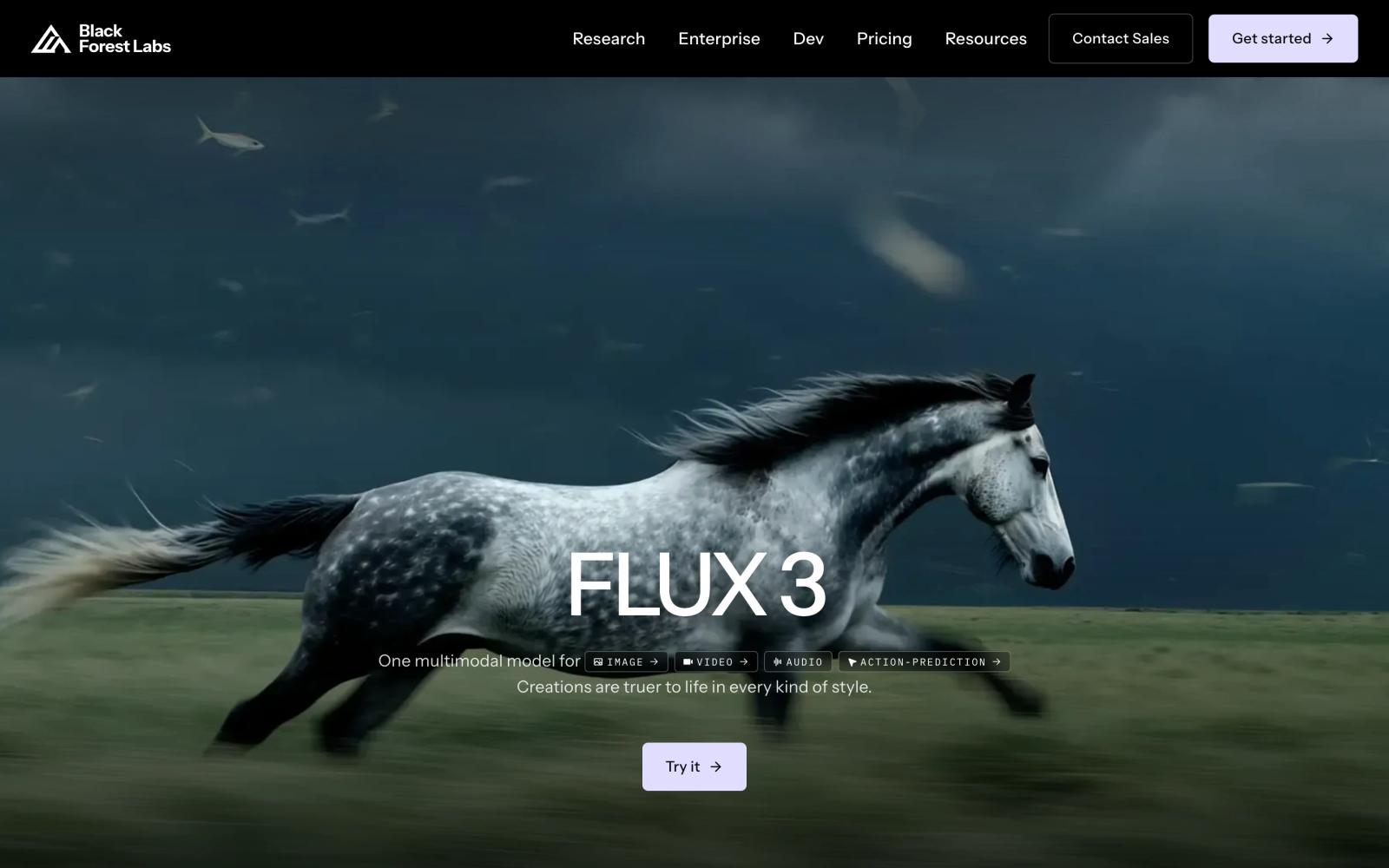
The Black Forest Labs homepage in November 2026, built around FLUX 3.
Date | Release | What it added |
|---|---|---|
Oct 15, 2026 | FLUX 3 Image Klein | 5.6B-parameter open-weight image model |
Sep 23, 2026 | FLUX 3 Action | Open-weight model for robot control |
Aug 4, 2026 | FLUX 3 Video | Clips of up to 20 seconds with native audio |
Jul 23, 2026 | FLUX 3 | Multimodal model, in early access |
Jan 15, 2026 | FLUX.2 [klein] | Smaller, faster models for local use |
Nov 25, 2025 | FLUX.2 | Image generation and editing with multiple references |
May 29, 2025 | FLUX.1 Kontext | Image editing that keeps a character consistent |
Oct 2, 2024 | FLUX1.1 [pro] and the BFL API | The company’s own paid API |
Aug 1, 2024 | FLUX.1 | First models: [pro], [dev] and [schnell] |
Is FLUX open source? Open weights vs commercial licenses
Only partly. Black Forest Labs publishes the weights of many FLUX models, but many of them aren’t free for business use. FLUX 3 Image Klein, for example, is free for commercial use only for “individuals and companies with annual revenue under $5M”. The full FLUX 3 Image and FLUX 3 Video models are offered through the API. As co-founder Andreas Blattmann put it to Fortune: “Open source is just a very good way of extending a funnel.”
License | Models | Business use |
|---|---|---|
Apache 2.0 | FLUX.1 [schnell], FLUX.2 [klein] 4B | Allowed |
FLUX Kommunity License | FLUX 3 Image Klein | Free under $5M annual revenue; larger companies need a paid option |
FLUX [dev] Non-Commercial License | FLUX.1 [dev], FLUX.2 [dev] and other [dev] models | Non-commercial, non-production use only |
Commercial Weights License | Builder, Platform, Professional and Enterprise tiers | Paid self-hosting and fine-tuning |
API | All hosted FLUX models | Pay per image or per second of video |
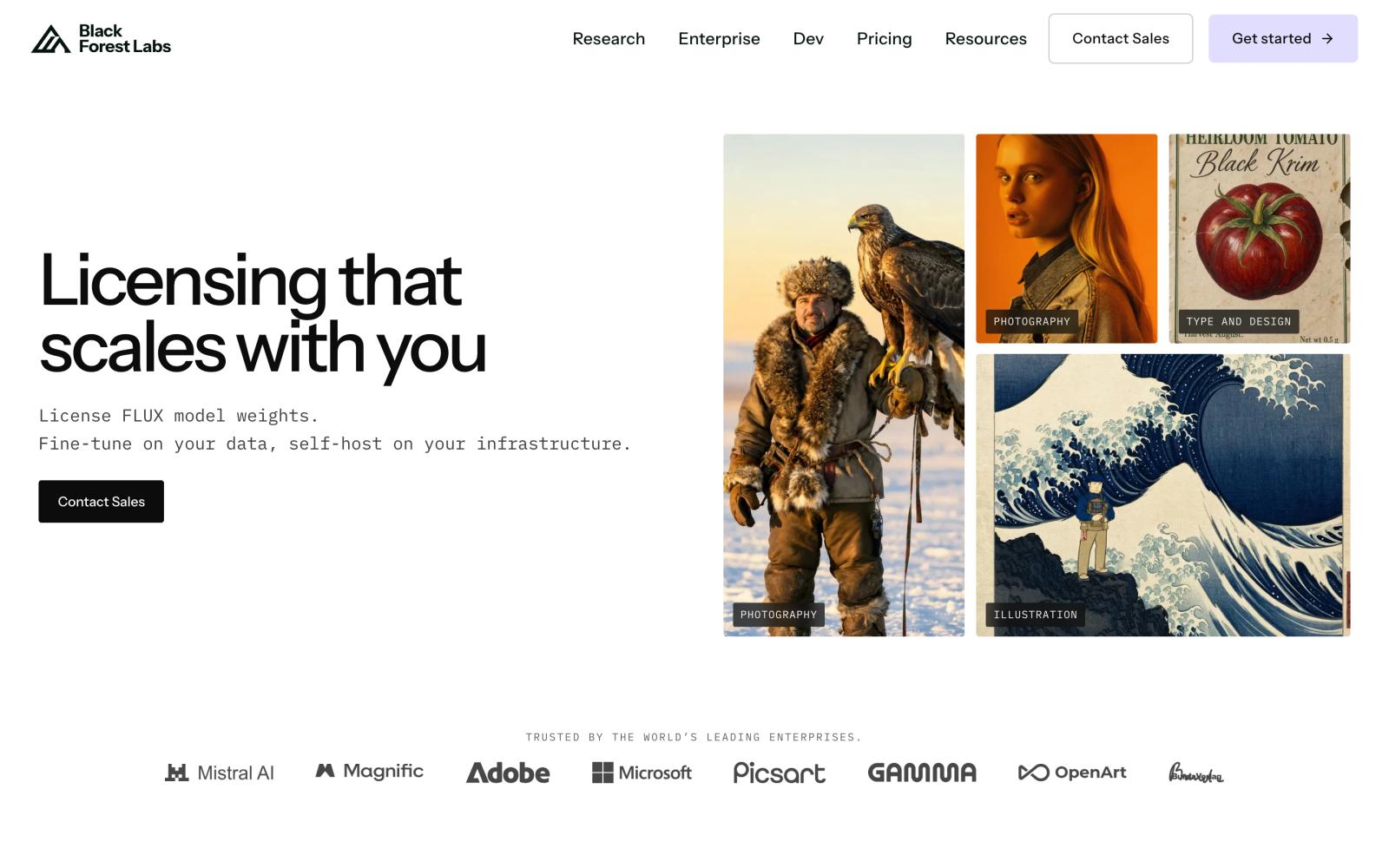
The open-weights licensing page, with the customers the company names.
Black Forest Labs pricing
API prices are pay as you go, with no subscription. In November 2026, FLUX 3 Image costs $0.048 per 1K image and FLUX 3 Image Klein $0.009. FLUX 3 Video costs $0.15 per second in HD and $0.41 in 4K, with a Draft mode at $0.06 in HD. Self-hosting licenses start with the Builder tier (10,000 images a month, one domain); Platform and Professional include 100,000 images a month, and Enterprise is custom.
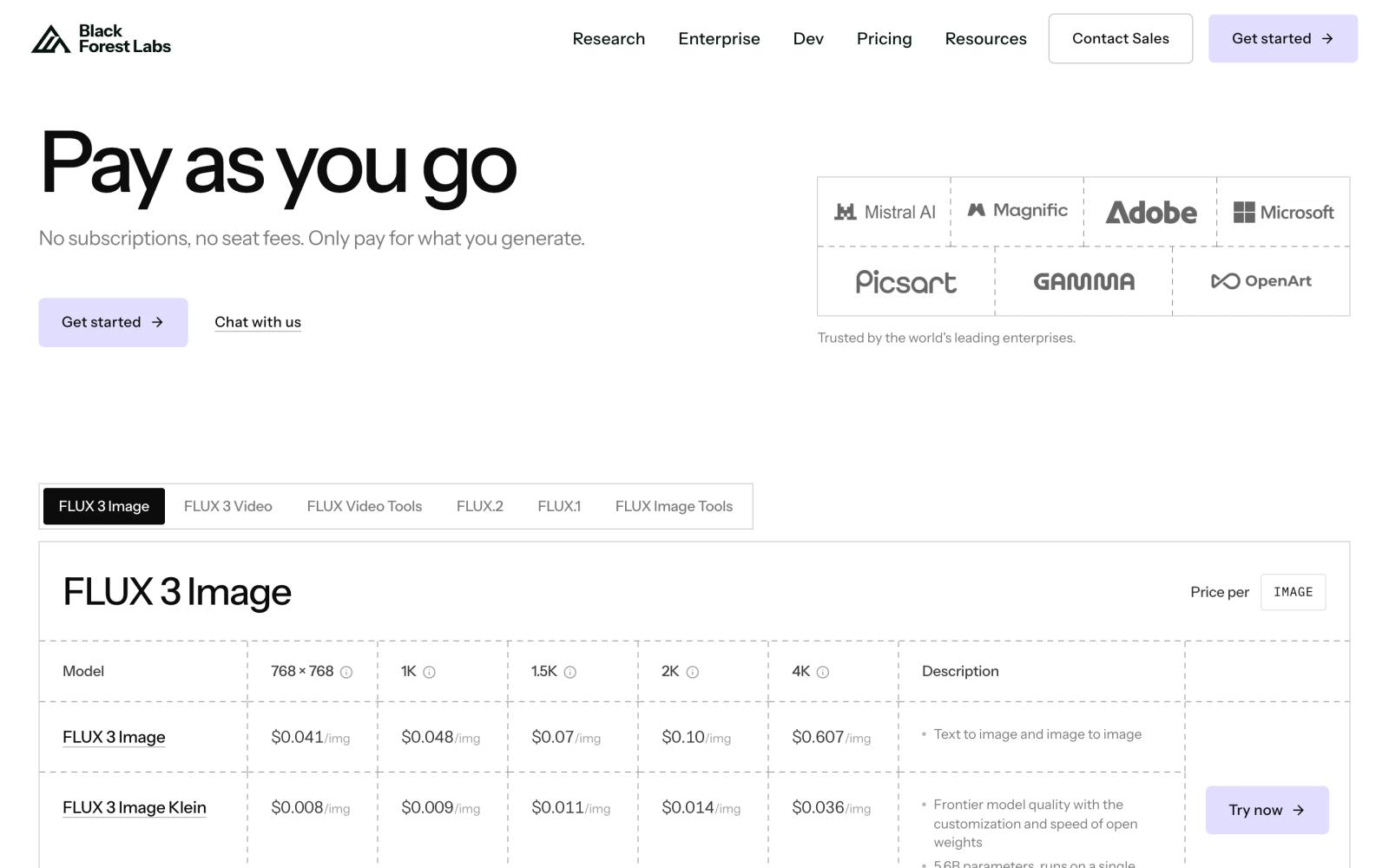
FLUX 3 Image API prices by resolution, November 2026.
What is Black Forest Labs’ revenue?
Black Forest Labs doesn’t publish revenue. It declined to give Fortune exact numbers in February 2026 and chose “Decline to Disclose” for revenue on its June 2026 SEC filing. The latest reported figure is $96.3 million in ARR as of August 2025. Rombach told Fortune the business is roughly half usage-based products and half enterprise licensing.
Its best-known contract is with Meta: a multi-year deal reported in September 2025, with $35 million in the first year and $105 million in the second. With Adobe, Canva and Snap, contracted value reportedly came to about $300 million at the time. The company reportedly expected ARR to reach $300 million in fiscal 2026. That was a forecast, and no 2026 result has been reported.
Black Forest Labs ARR (annual recurring revenue)
Date | ARR | Status |
|---|---|---|
Aug 2025 | $96.3M | Reported by the press; not confirmed by the company |
Black Forest Labs MRR (monthly recurring revenue)
Black Forest Labs doesn’t publish MRR. The reported $96.3 million in ARR works out to about $8 million a month in August 2025 (our calculation).
How much has Black Forest Labs raised? Funding and valuation
More than $450 million across three rounds. The latest closed valuation is $3.25 billion, and the company’s careers page still showed that figure in November 2026. We found no new round as of November 22, 2026.
Date | Round | Amount | Led by | Valuation |
|---|---|---|---|---|
Dec 1, 2025 | Series B | $300M | AMP, Salesforce Ventures | $3.25B post-money |
Nov 2024 (announced Dec 2025) | Series A | Not disclosed | a16z | Not disclosed |
Aug 1, 2024 | Seed | $31M | a16z | Reportedly $150M post-money |
Two figures in the press were talks, not closed valuations: $100 million at $1 billion in September 2024, and up to $4 billion in October 2025. The SEC filing, made on June 3, 2026, shows $307.6 million sold to 36 investors from a $343.3 million equity offering, with the first sale on November 21, 2025 and $35.7 million still unsold at filing.
Series B investors also include Temasek, Bain Capital Ventures, Air Street Capital, Visionaries Club, Canva, Figma Ventures, Adobe Ventures, Samsung Next and Deutsche Telekom’s T.Capital. Returning backers include NVIDIA, General Catalyst, Northzone, Creandum, Earlybird and BroadLight. Angels include Nico Rosberg, Clem Delangue of Hugging Face and ElevenLabs CEO Mati Staniszewski.
Who owns Black Forest Labs?
It is privately held by its founders, employees and investors, and no stakes have been published. The June 2026 SEC filing lists four directors: Robin Rombach, Andreas Blattmann, Patrick Esser and Anjney Midha, whose firm AMP co-led the Series B. Several customers are also shareholders, including Adobe, Canva and Deutsche Telekom.
Who founded Black Forest Labs? The Stable Diffusion history
Robin Rombach, Andreas Blattmann and eight other researchers founded the company in March 2024. Rombach, Blattmann, Patrick Esser and Dominik Lorenz were four of the five authors of the 2021 latent diffusion paper, written with Professor Björn Ommer’s group, which moved to LMU Munich. That method became Stable Diffusion, released in 2022 by the CompVis group at LMU, Runway and Stability AI, which donated the computing power.
Rombach, Blattmann, Esser and Lorenz later worked at Stability AI, where the team built newer versions of the model. Rombach, Blattmann and Lorenz left in March 2024, shortly before Stability’s CEO, Emad Mostaque, resigned. Black Forest Labs came out of stealth on August 1, 2024, with FLUX.1 and $31 million in seed funding.
Black Forest Labs customers and partners
Meta: the multi-year image deal reported in September 2025
Adobe: FLUX.1 Kontext [pro] inside Photoshop’s Generative Fill (beta) since September 25, 2025
Microsoft: FLUX models on Azure AI Foundry since August 5, 2025; Azure also supplied early training clusters
Canva and Deutsche Telekom: named by the company as partners that have integrated FLUX
Mercedes, Netflix and Samsung: named among its corporate customers in 2026
ASUS and NVIDIA: FLUX.2 [klein] to ship preloaded on ASUS ProArt laptops, announced in June 2026
Mistral AI, Picsart, Gamma, OpenArt and Magnific: shown as customers on its pricing page in November 2026
mimic robotics and Audi: a FLUX 3 video-action model running on robots tested and deployed at Audi, July 2026
Martin Scorsese: became an advisor in June 2026 after using FLUX for storyboards
Its first famous user was Elon Musk’s xAI, whose Grok chatbot used FLUX.1 for image generation from August 2024. Grok moved to xAI’s own Aurora model that December, and a source close to Black Forest Labs later said the partnership had ended.
Black Forest Labs lawsuits, copyright and deepfake concerns
Copyright. On October 20, 2026, Poseidon Wave Media sued Black Forest Labs Inc. in the US District Court for the Eastern District of New York (case 1:26-cv-06737). Poseidon, which owns 236 recordings and compositions, alleges its music was copied to train FLUX and that its licensing revenue fell by nearly 80% after FLUX launched. It claims copyright infringement, trade secret violations and breaches of the Digital Millennium Copyright Act, and seeks up to $150,000 per work. These are unproven allegations, and we found no response or ruling as of November 22, 2026. Earlier suits over Stable Diffusion, such as Getty Images v. Stability AI, were brought against Stability AI.
Misuse. Open weights can’t be recalled, as the company acknowledges: “it is not possible to fully withdraw all copies of the affected model.” In February 2026 it described its safeguards against synthetic intimate images and child sexual abuse material, including filtering training data with the Internet Watch Foundation and pre-release testing by an outside firm, Cinder. The company says FLUX.2 showed more than 10 times fewer vulnerabilities than other leading open-weight image models, in tests it commissioned.
Grok. When Grok’s image feature launched on FLUX.1 in August 2024, it was criticized for having few safeguards, as fake images of public figures spread on X.
Transparency. The company publishes training data disclosures under California’s AB 2013 and the EU AI Act on a page last updated on August 1, 2026.
Black Forest Labs competitors
In image and video models it competes with closed systems from Google, OpenAI and Midjourney, and with open models such as Stable Diffusion, Qwen and Wan. In video it also meets Runway. Rankings move quickly: in mid-December 2025, FLUX.2 [pro] placed second on Artificial Analysis’s text-to-image list, behind Google’s Nano Banana Pro.
Who is the CEO of Black Forest Labs?
Robin Rombach, a co-founder, who signed the company’s June 2026 SEC filing as Chief Executive Officer. He was born in Freiburg and studied physics at Heidelberg before his doctoral research at LMU Munich.
Person | Role |
|---|---|
Robin Rombach | Co-founder, CEO and director; managing director of BFL GmbH |
Andreas Blattmann | Co-founder, executive officer and director; managing director of BFL GmbH |
Patrick Esser | Co-founder, executive officer and director |
Axel Sauer | Managing director of BFL GmbH |
Anjney Midha | Director; his firm AMP co-led the Series B |
Martin Scorsese | Advisor since June 2026 |
His bio and contact routes: Black Forest Labs CEO Robin Rombach: email, LinkedIn and bio.
Where is Black Forest Labs based, and how many employees does it have?
Its headquarters are in Freiburg im Breisgau, at Ingeborg-Krummer-Schroth-Straße 18, and it has a San Francisco office in SoMa. There are two main legal entities. Black Forest Labs Inc. is a Delaware corporation formed in 2024. BFL GmbH is the German company, listed in Munich’s commercial register under HRB 291820, with Rombach, Blattmann and Axel Sauer as managing directors.
Rombach described a 90-person company at the G7 in June 2026; German reports around the start of the year put the team at about 50. It is a different business from similarly named firms such as Black Forest Games, a video game studio, and Black Forest Supplements.
Key events
Date | Event |
|---|---|
Oct 20, 2026 | Poseidon Wave Media files a copyright suit |
Oct 15, 2026 | Releases FLUX 3 Image Klein with open weights |
Jul 23, 2026 | Launches FLUX 3 and FLUX-mimic for robots |
Jun 2026 | Rombach speaks at the G7; Martin Scorsese becomes an advisor |
Feb 24, 2026 | Publishes its safeguards against AI misuse |
Dec 1, 2025 | $300M Series B at $3.25B |
Nov 25, 2025 | Launches FLUX.2 |
Sep 2025 | Meta deal reported; FLUX arrives in Photoshop (beta) |
May 29, 2025 | Launches FLUX.1 Kontext |
Dec 2024 | Grok moves to xAI’s Aurora model |
Aug 2024 | Launches with FLUX.1 and a $31M seed; powers Grok’s images |
Mar 2024 | Founded after the team leaves Stability AI |
More on Black Forest Labs and similar companies
Black Forest Labs CEO Robin Rombach: from Stable Diffusion to FLUX
AI image generator companies: the companies making image models and apps
AI video companies: AI video generators and tools
Video SaaS companies: software for making and hosting video
German SaaS companies: software companies based in Germany
DACH SaaS companies: Germany, Austria and Switzerland
Need verified CEO emails for outbound? The LeadWave AI companies email list has verified emails of the CEOs and founders of 9,000+ AI companies.