You apply to the Thiel Fellowship through one online form, open year round with no deadline, if you are 22 or younger and have no university degree. The Fellowship hasn’t published an applicant count since 2016, when it picked 29 fellows from more than 6,000 applications: an acceptance rate under 0.5%. That is the latest official figure as of November 26, 2026.
Fellows receive $250,000 over two years, and the Fellowship takes no equity. For what past fellows went on to build, see the companies founded by Thiel Fellows. This page covers getting in: who can apply, what the form asks, what happens after you submit, and the odds.
Thiel Fellowship application: key facts
Question | Answer (November 26, 2026) |
|---|---|
Who can apply | Anyone 22 or younger without a university degree, undergraduate or graduate |
Students | Can apply, but must drop out to accept the Fellowship |
Where to apply | The online form at thielfellowship.org/apply |
Deadline | None: applications are accepted year round |
Team or solo | Individuals only; you don’t need a co-founder |
Company needed? | No, but you must show meaningful progress toward a concrete vision |
Must you move? | No. Thiel Fellows are based all over the world |
Equity | None taken: it is a grant |
Latest published acceptance rate | 29 of more than 6,000 applications in 2016, under 0.5% (our calculation) |
Latest class | 12 fellows, announced in April 2026 |
Contact | team@thielfellowship.org |
Thiel Fellowship requirements: who can apply
Anyone 22 or younger who has no university degree. The Fellowship’s FAQ puts it in one line: “Anyone aged 22 or younger (and without a university degree) is eligible to apply.” A degree of any kind rules you out: the FAQ answers no to applicants who hold an undergraduate or graduate degree. In 2023 the same question mentioned only an undergraduate degree.
Students: high school and university students can apply, “though if you’re selected you’ll need to drop out in order to accept the Fellowship.”
Progress, not a company: “You don’t need to have incorporated a company or built a full product yet, but at a minimum you’ll need to demonstrate meaningful progress toward a concrete vision.”
No team needed: the Fellowship reviews and accepts applicants as individuals.
Not only engineers: the FAQ says fellows have also started nonprofits, consumer products and media companies, and built hardware.
Full time: the 2026 class announcement says fellows “must commit to working full-time on their projects, companies, or ideas”.
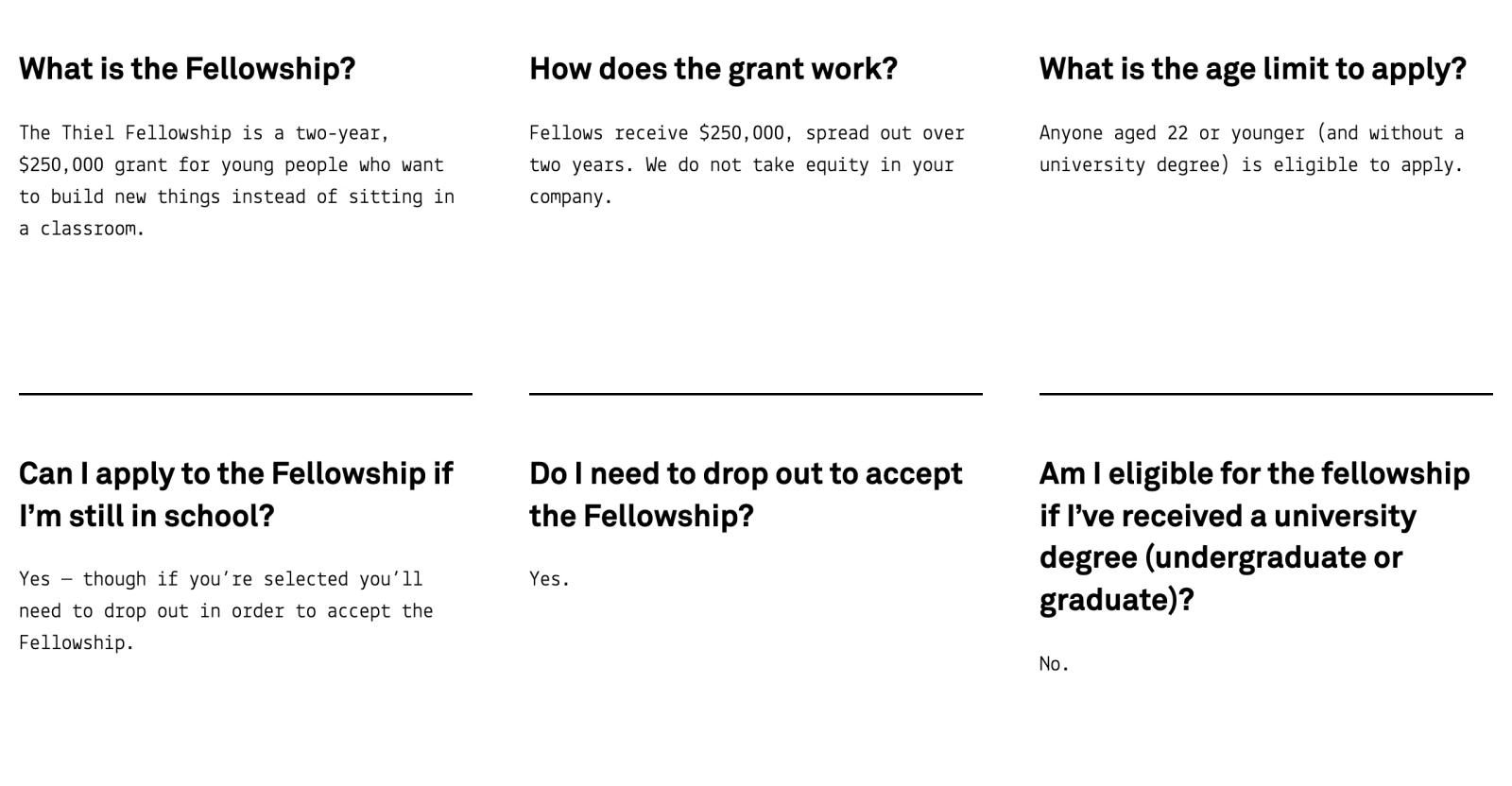
The Fellowship’s FAQ on November 26, 2026: 22 or younger, no university degree, and students must drop out if selected.
Thiel Fellowship age limit: maximum and minimum age
The maximum age is 22. The limit was under 20 for the first classes, when the program was called 20 Under 20, and the Thiel Foundation raised it in June 2015: “beginning with this year’s class the program will be open to anyone 22 or younger.” The FAQ sets no minimum age. The form asks for your date of birth and your education, with options from currently in high school to dropped out of university, and a question on whether you were homeschooled. The 2025 class announcement says all its fellows “were 22 or younger when applying”.
Can international students apply?
Yes. The form asks for your country of residence, and the FAQ says you don’t need to move to San Francisco: “Thiel Fellows are based all over the world.” The 2026 class lists hometowns in Brazil, India, Poland and Ireland as well as the US. The Fellowship publishes nothing about visas or relocation, so ask team@thielfellowship.org if that matters to you.
How to apply to the Thiel Fellowship: the application questions
You fill in one form at thielfellowship.org/apply. The form has no fee or payment step, and you can attach a deck. On November 26, 2026 it asked:
About you: name, email, date of birth, links to your profiles, how you heard about the Fellowship, country, city, whether that is your hometown, your educational status and whether you were homeschooled.
Your project: what you are working on now, its industry, a link, any files that describe it (a deck, for example) and whether you have eligible co-founders.
Eight short questions: What cool stuff have you worked on in the past? What is the most important problem facing your field? What is the most important problem facing another field of work? What are you currently obsessed with that is totally unrelated to your project? How do you feel about money? What are you scared of? Tell us something tangible you want.
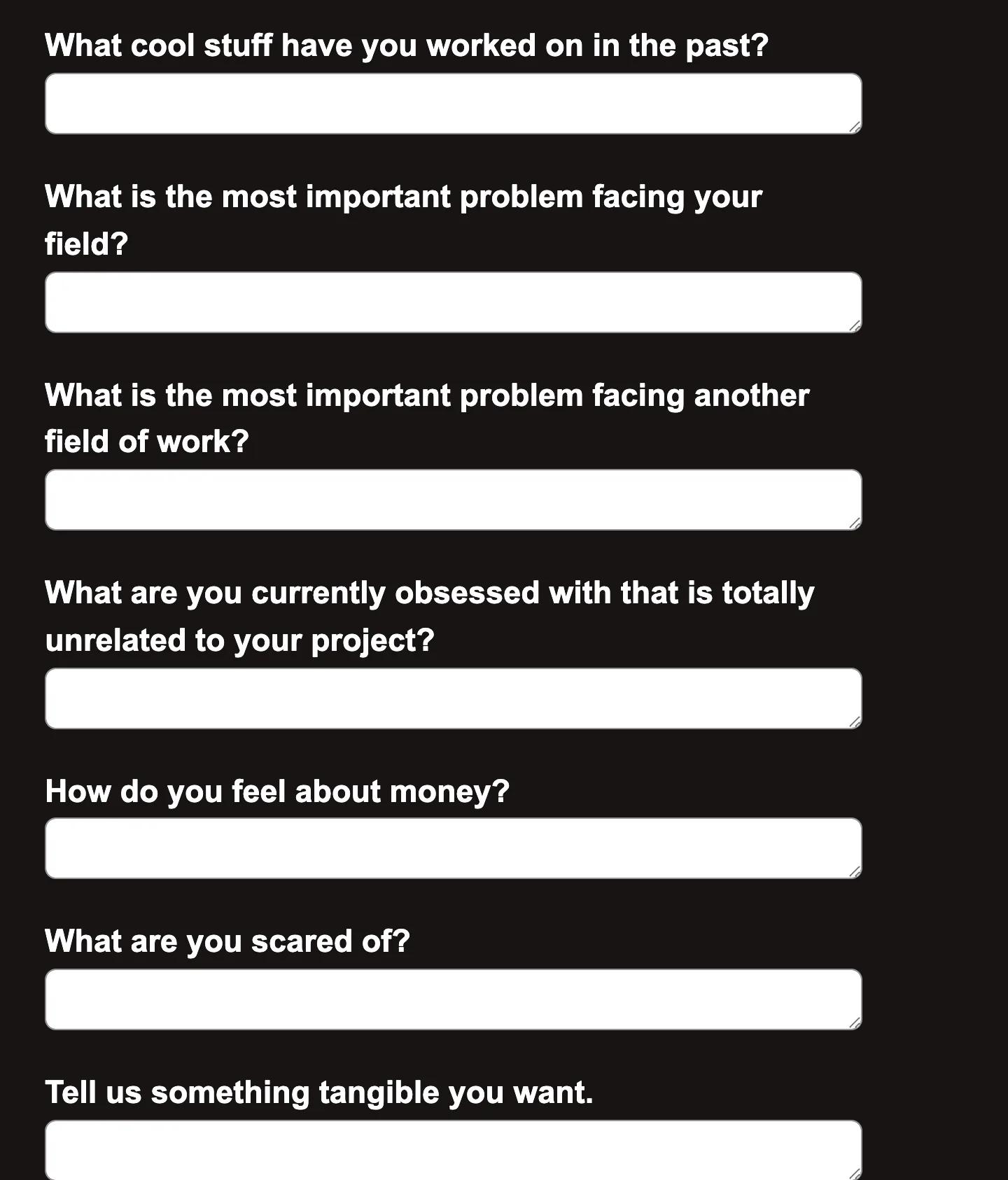
The application form on November 26, 2026 (answer boxes shortened for the screenshot).
The questions have changed over time. The early forms carried Peter Thiel’s best-known interview question, “Tell us something about the world that you think is true that most people think is not true.” Danielle Strachman, the Fellowship’s early program director, told First Round Review in October 2026 that early applicants also answered three questions on what they wanted to accomplish in ten years, two years and the next three months, and that staff checked the three-month answer during the cycle.
Thiel Fellowship application process: interviews and finalist weekend
The Fellowship doesn’t describe its current stages on its site. Its FAQ and form stop at submission. What has been published comes from earlier years:
Stage | What was published | When |
|---|---|---|
Review | Several reviewers read each application; promising applicants were asked to update it, and mentors and fellows read it too | Early years, described by Danielle Strachman |
Phone screen | “We do a phone screening with people where there's both a technical interview as well as a community interview” | Same |
Finalist weekend | About 40 finalists flown to San Francisco: an interview with Foundation staff, a two-minute pitch to mentors and fellows, and coffee-shop-style mentor interviews | 2011 to 2014 |
Decision | Foundation staff deliberated for about a week; in 2014, 20 fellows were picked from 40 finalists | 2014 |
The 2014 class announcement describes that year’s finalist weekend in San Francisco: “team building challenges, their individual lightning round pitches, and café-style mentor interviews.” In the 2011 weekend, Strachman told First Round, the formal interview with Foundation board members was one of the largest inputs to the decision.
A later fellow describes a similar path. Claire Coder, a 2019 Thiel Fellow and founder of Aunt Flow, wrote in 2020 that her first interview was a trip to San Francisco, that she wasn’t chosen that time, and that she kept applying until a later interview led to a phone call offering her the Fellowship.
Thiel Fellowship application deadline: is it still open in 2026?
There is no deadline, and the Fellowship is still running. The FAQ says “No - we accept applications year round.” The form was open on November 26, 2026, and the 2026 class of 12 fellows was announced in April 2026. Reviews have run on a rolling basis since June 2015, when the Foundation said it would “begin reviewing Fellowship applications on a rolling basis”, instead of one cycle tied to the school year. The 2023 FAQ added: “You can continue to update your application after you submit.” The Fellowship hasn’t said when it will announce the next class.
Thiel Fellowship acceptance rate: how competitive is it?
Very competitive: under 0.5% in 2016, the last year the Fellowship published how many people applied. The 2016 announcement says 29 fellows were selected from more than 6,000 applications. No count has been published since. These are the years with both numbers:
Class | Applications | Fellows | Acceptance rate (our calculation) |
|---|---|---|---|
2011 (first class) | 438 | 24 | About 5.5% |
2015 | 2,800 | 20 | About 0.7%, or 1 in 140 |
2016 | More than 6,000 | 29 | Under 0.5%, fewer than 1 in 200 |
2017 to 2026 | Not published | 12 to 24 in the announcements we checked | Not published |
Three caveats. The rate isn’t the whole story of who gets in: First Round Review reports that about 60% of the 2016 fellows hadn’t applied at all but were recruited by Foundation leaders. Classes have also been smaller since the grant rose: 20 fellows in 2023 and 2024 then 15 in 2025 and 12 in 2026 (our counts of the names in each announcement). And the 2011 applicant figure comes from Strachman’s account; TechCrunch reported “more than four hundred” at the time. First Round Review put the rate today “below 1%”, an estimate, since the Fellowship gives no figure.
The 2024 class, one of the 20-fellow years, included the founders of Mercor and Walden Yan of Cognition. The 2026 class page lists this year’s fellows and their projects.
Successful Thiel Fellowship applications: what fellows have published
Few fellows have published their applications. The best known is Figma co-founder Dylan Field, a 2012 fellow, who later shared his full application on LinkedIn. Asked what most people got wrong, he answered “Chocolate is repulsive,” with an essay to back it up, an answer he called “meta-contrarian”, Figma’s blog recounts. The project wasn’t Figma yet: “So I applied to the Thiel Fellowship with a drones idea,” he told Stratechery in 2026, before he and Evan Wallace turned to graphics in the browser.
Claire Coder applied for years before she was selected. Her summary: “What worked for me was persistence.”
“You don’t get the fellowship for applying to the fellowship. You get it for making progress on your work.”
The 1517 Fund, started by Danielle Strachman and Mike Gibson, who ran the early Fellowship, April 18, 2019
The same 2019 post advised applicants to keep their application updated as the project changes, and to ask a current Thiel Fellow about the latest process, since its authors no longer run it.
Is the Thiel Fellowship free? Cost and terms
Yes on both counts. Applying costs nothing: the form has no fee or payment step. The money is a grant, not an investment: “We do not take equity in your company.” The conditions are that you leave school if you are enrolled and work full time on your project. Beyond the grant, the Fellowship offers its network: “We can help connect you — to investors, partners, prospective customers”. Its site also runs a Thiel Fellow job board. First Round Review reports that fellows now keep staff updated on revenue, expenses and cash flow.
Where is the Thiel Fellowship located?
It has no campus, and fellows don’t have to move. The FAQ says Thiel Fellows are based all over the world. The Thiel Foundation runs it with Peter Thiel as chairman, and finalist weekends in the early years were held in San Francisco. Its 2026 announcement carried a Miami dateline. For how the grant compares with an accelerator that does ask you to move, see Thiel Fellowship vs Y Combinator.
More on the Thiel Fellowship
Want to reach these founders? Start with the companies founded by Thiel Fellows, then get verified CEO emails for thousands of AI startups in the LeadWave list of AI companies.