The Thiel Fellowship gives one person aged 22 or younger a $250,000 grant over two years and takes no equity; Y Combinator invests $500,000 in a startup for 7% of the company plus a stake fixed at its next funding round, in exchange for a three-month batch in San Francisco. Those are both programs’ published terms as of November 26, 2026. The Fellowship backs individuals who must leave university, 12 of them in its 2026 class; YC backs companies of any founder age, nearly 190 in its Winter 2026 batch alone. The people the Fellowship has backed, and what they went on to build, are in our list of companies founded by Thiel Fellows.
Thiel Fellowship vs Y Combinator: the terms side by side
Thiel Fellowship | Y Combinator | |
|---|---|---|
Money | $250,000 grant, spread over two years ($200,000 for the 2025 class, $100,000 before that) | $500,000 investment: $125,000 on a post-money SAFE plus $375,000 on an uncapped SAFE with a most-favored-nation (MFN) clause |
Equity taken | None | 7%, plus what the $375,000 SAFE converts into at the next priced round, plus a right to invest in later rounds |
Fees | Not applicable: the money is a grant | None: YC says it doesn’t charge companies any fees |
Who it backs | Individuals; no team needed | Companies; solo founders are accepted |
Who can apply | Anyone 22 or younger without a university degree; students must drop out to accept | Any startup, anywhere in the world; founders must work full-time on the company during the batch |
Stage | No company needed, but you must show meaningful progress toward a concrete vision | Mostly the earliest stage: on average 40% of each batch is just an idea, and YC says it can probably help any startup that hasn’t raised a Series A |
Length | Two years | A three-month batch, four times a year; office hours and the alumni network continue after |
Class or batch size | 12 fellows in 2026, 15 in 2025, 20 in 2024 | Nearly 190 companies in the Winter 2026 batch |
Acceptance rate | 20 picked from 2,800 applications in 2015, about 0.7% (the latest count the Foundation published; our calculation) | Typically 1%, with over 10,000 companies applying every three months (YC, 2026) |
Location | Anywhere: fellows are based all over the world | In person in San Francisco |
Demo Day | None listed; the Fellowship introduces fellows to investors, partners and customers | Yes, at the end of each batch, for invited investors |
Deadlines | None: applications are reviewed year round | Four batches a year; the Winter 2027 batch’s on-time deadline was November 2, 2026, and late applications are still read |
Backed so far | Over 300 fellows before the 2026 class | Over 5,000 companies since 2005 |
The Fellowship’s terms are in its official FAQ: “Fellows receive $250,000, spread out over two years. We do not take equity in your company.” It counts the money as a grant, and the age rule is strict: “Anyone aged 22 or younger (and without a university degree) is eligible to apply.” How to apply, and what the application asks, is on our page on how to apply to the Thiel Fellowship.
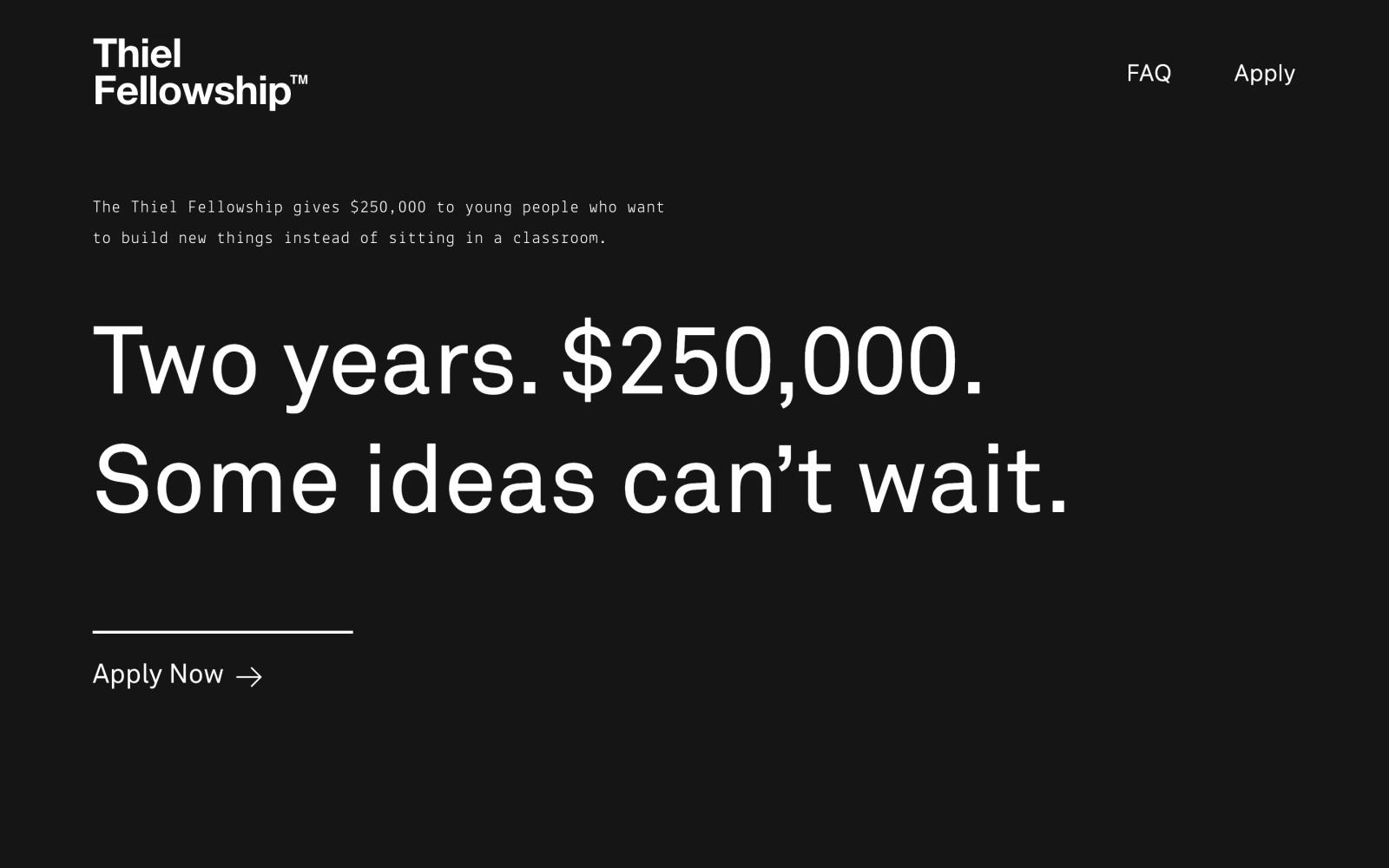
The Fellowship’s home page on November 26, 2026. The grant rose to $250,000 with the class announced in April 2026.
What the Y Combinator deal works out to
YC sets out its standard deal in one line: “We invest $500,000, and our investment gives YC 7% of your company plus an incremental equity amount that will be fixed when you raise money from other investors.” $125,000 for 7% puts a post-money value of about $1.79 million on that part (our calculation). The other $375,000 converts at the terms of the cheapest SAFE the company sells around the batch: in YC’s own example, a $15 million cap, it becomes 2.5% of the company, so YC would hold 9.5% before the next round dilutes everyone (our calculation).
YC frames the trade itself: many companies join after raising at higher valuations, and its FAQ tells founders to “ask yourself if you believe joining YC can improve your startup’s outcome by at least 7%.” The Fellowship asks for no shares, but it asks students to leave school: “if you’re selected you’ll need to drop out in order to accept the Fellowship.”
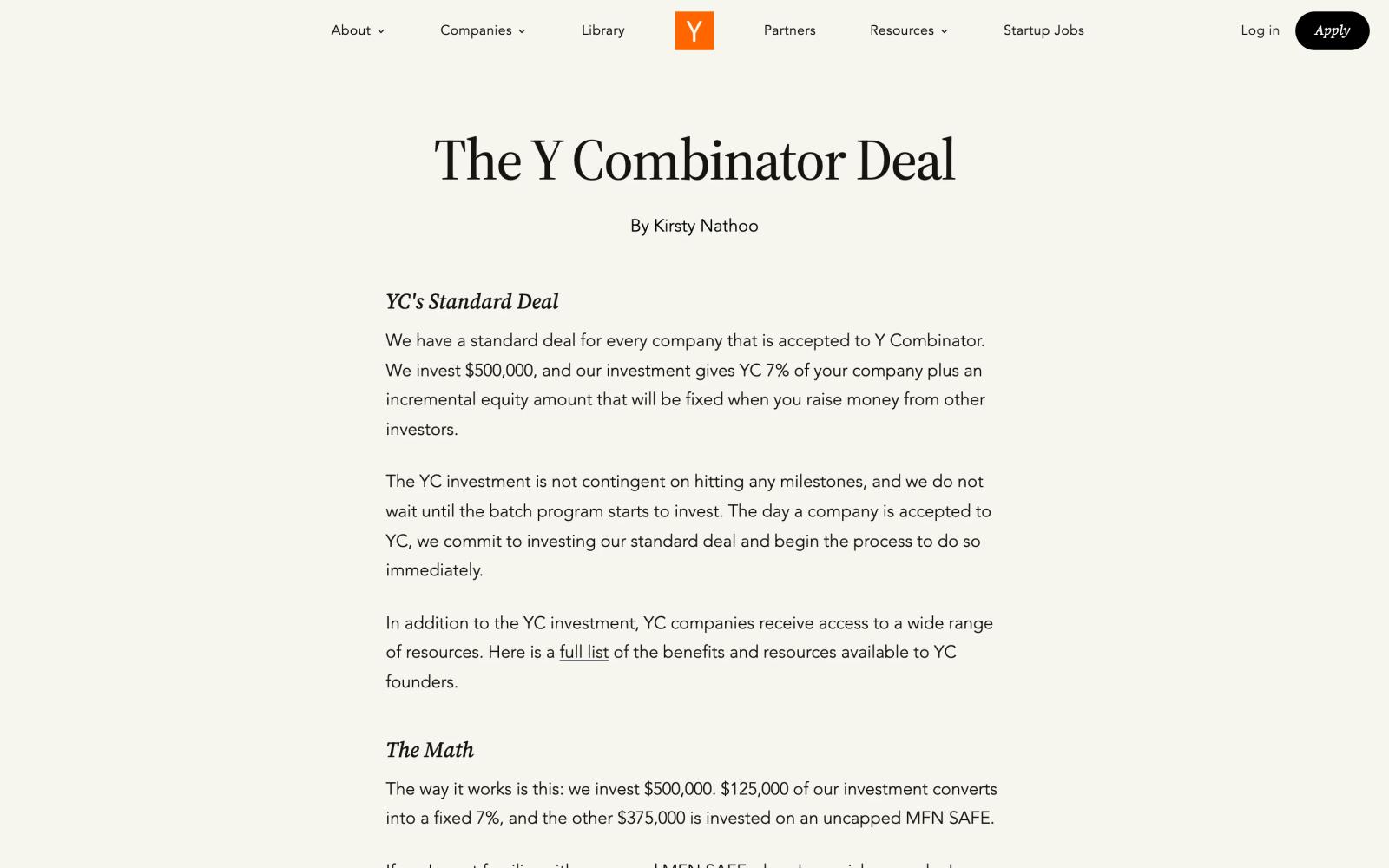
YC’s standard deal page on November 26, 2026: $500,000, of which $125,000 buys a fixed 7%.
Is the Thiel Fellowship worth it?
There’s no single answer, but the published terms show the trade: the Fellowship gives half as much money as YC and keeps no shares, while asking fellows to leave university for two years and work full-time on their project. What each side offers, in its own words:
Thiel Fellowship: the grant, and introductions “to investors, partners, prospective customers — in Silicon Valley and beyond”. How fellows spend the two years is theirs to decide: “we’re here to help, but we won’t get in the way.”
Y Combinator: the investment, a dedicated general partner, weekly dinners with a small group of companies, talks, Demo Day, and “$12M+ in free credits and deals from top partners”. YC says “B2B and consumer companies often get their first 40-50 paying customers from the YC community.”
Is the Thiel Fellowship prestigious?
By its published numbers it is one of the most selective programs for young founders: the Thiel Foundation picked 20 fellows from 2,800 applications in 2015 and named 12 in its 2026 class, against YC’s “typically” 1% acceptance rate. A 2023 industry analysis called it the best accelerator in the world not called Y Combinator, while noting that it “doesn’t consider itself an accelerator.”
The Foundation’s April 2026 announcement says earlier classes include founders of Anthropic, Cognition, Etched, Ethereum, Figma, Fluidstack, Mercor and Positron. Who was picked in 2026, and what they are building, is on our page on the Thiel Fellowship 2026 class.
Results: what each program has published
Neither program publishes a success rate for its people. What they and one outside count have published:
Measure | Thiel Fellowship | Y Combinator |
|---|---|---|
Backed so far | Over 300 fellows before the 2026 class (April 2026) | Over 5,000 companies and over 7,000 founders since 2005 (2026) |
Official result | Fellows founded companies or projects “collectively worth hundreds of billions of dollars” (April 2026); no count of companies | More than 100 companies valued over $1B and more than 400 valued over $100M (2026) |
Outside count, September 2023 | 11 companies valued over $1B, 7.7% of the nearly 150 recipients it tracked | Just over 100 companies at $1B or more out of 4,500+ backed, about 2% (our calculation) |
The two rates measure different things: the Fellowship’s is per person and YC’s per company, and that 2023 count noted that the classes from 2020 on were still too young to count, which pulls the Fellowship’s rate down. YC’s own investor page puts its current share at roughly 2% too: more than 100 companies over $1B out of over 5,000 (our calculation).
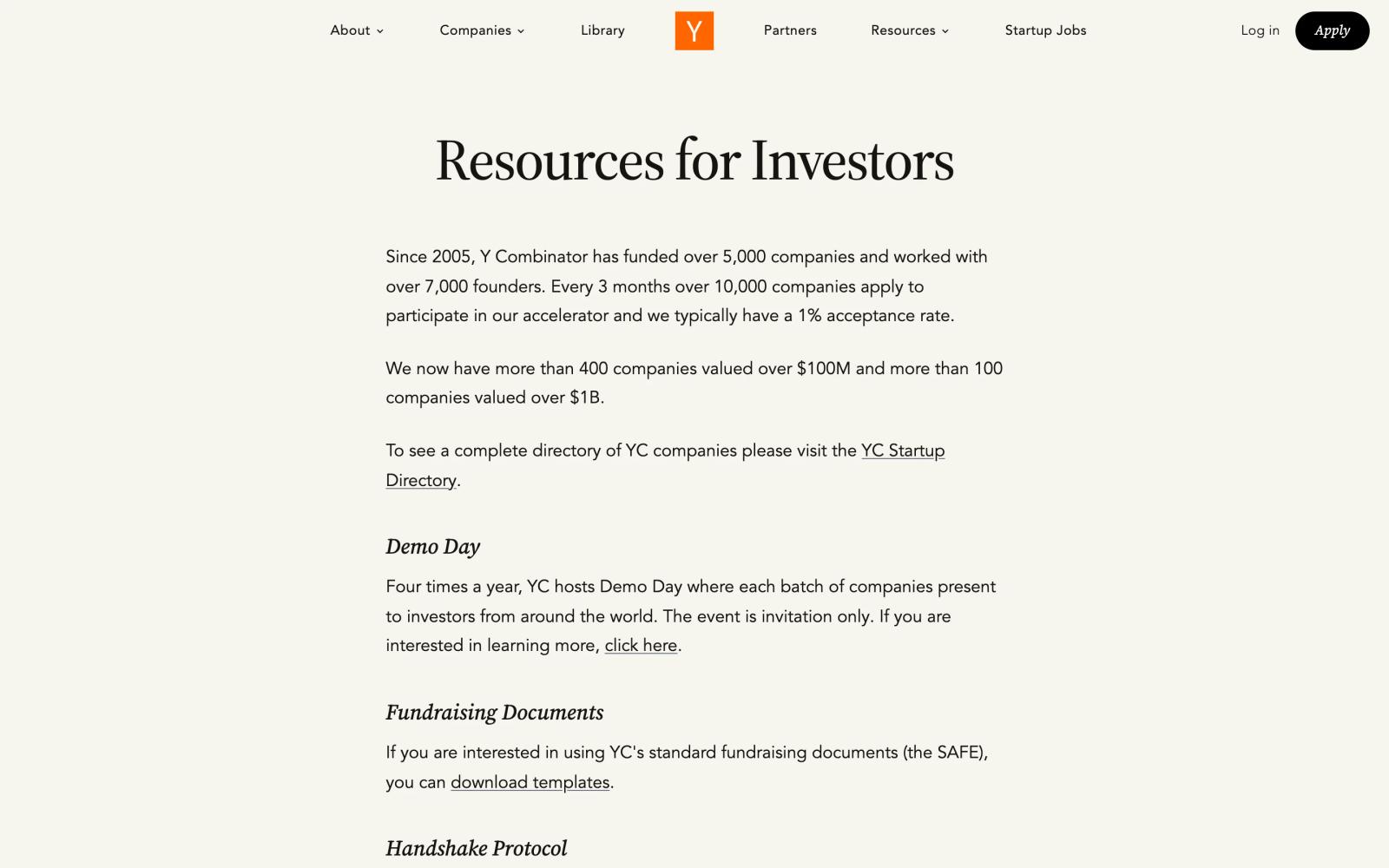
YC’s page for investors, November 26, 2026: over 5,000 companies, a typical 1% acceptance rate, more than 100 companies valued over $1B.
Thiel Fellowship success rate
The Foundation publishes no percentage: it says more than 300 people have been fellows and that their companies are worth hundreds of billions of dollars, and the latest outside count, from September 2023, is 7.7%. Our list of companies founded by Thiel Fellows names each one with its source.
Thiel Fellowship alternatives
Four programs for young founders publish their terms: the 1517 Fund, Emergent Ventures, Z Fellows and Neo Scholars. Each one’s terms below are from its own page, as of November 26, 2026.
Program | What it gives | Who can apply | Official page |
|---|---|---|---|
1517 Fund | Medici Program grants from $1,000; first investments from $50,000 to $1,000,000, on average a $400,000 pre-seed check | Founders without an undergraduate degree, high school and university students, and deep tech scientists | 1517fund.com |
Emergent Ventures | Fellowships and grants for “zero to one” ideas; no set amount is published | Anyone worldwide aged at least 13 | mercatus.org/emergent-ventures |
Z Fellows | A one-week program with ten builders and founders as mentors; an optional $10,000 investment at a $1B valuation cap | No age limit: high school dropouts, students and people with full-time jobs | zfellows.com |
Neo Scholars | Mentoring, startup jobs, and a guaranteed place in Neo Residency: a $40K equity-free grant for a 14-week program in San Francisco | Undergraduates graduating Winter 2026 or later, mainly in the US or Canada | neo.com/scholars |
The 1517 Fund is the closest relative. Danielle Strachman and Michael Gibson, who helped design and run the Fellowship, started it in 2015, and its site says: “We cofounded the Thiel Fellowship with Peter Thiel in 2010.” Unlike the Fellowship, its larger checks are investments, not grants. Neo Scholars doesn’t ask anyone to leave school: Neo describes its residency as “a better option for those who want to build or explore ideas full time, without pressure to drop out, found, or fundraise.”
Thiel Fellowship criticism
Two prominent critics were Larry Summers, the former Harvard president, who in October 2013 called it “the single most misdirected bit of philanthropy in this decade”, and the academic Vivek Wadhwa, who argued the same year that most dropouts do better finishing a degree. Summers said the program was “meretricious in its impact and the signals that it sends to a broader society.”
“I think the single most misdirected bit of philanthropy in this decade is Peter Thiel’s special program to bribe people to drop out of college.”
Larry Summers, at the Nantucket Project conference, October 2013
Wadhwa had opposed the idea since 2011, when he wrote “Friends don’t let friends take education advice from Peter Thiel.” Three years in, he wrote for PBS NewsHour: “three years later, I’m not amazed at any Thiel startups,” and “for the vast majority of college dropouts, the opportunities are sparse.” Jacob Weisberg, then the editor of Slate, called the program a “nasty idea.”
The Fellowship’s answer
The Fellowship’s case is on its home page: “College can be good for learning about what’s been done before, but it can also discourage you from doing something new.” Its 2026 announcement adds the results claim, that fellows have founded companies or projects “collectively worth hundreds of billions of dollars.” Michael Gibson, one of its early organizers, put the argument against college this way in 2023: “How to live, how to love, how to become a better person, how to think for yourself. I think college isn’t a place to do this anymore, or maybe it never was.”
Thiel Fellowship review: what a fellow wrote
Days after Summers spoke, Dan Friedman, a fellow from the first class of 2011, and Darrell Silver, a Fellowship mentor, answered him in TechCrunch. They called his critique “predictable and thick with vested interest” and described the two years as a time when “every fellow tries ideas in the real world secure in the knowledge that failure at age 22 is a low-consequence setback.” They also wrote: “We do believe in the value of a liberal arts education.”
Is the Thiel Fellowship legit?
Yes. It is a grant program of the Thiel Foundation, which Peter Thiel chairs, and it has named classes of fellows since 2011. Applications go through thielfellowship.org, with no deadline, and the Fellowship lists team@thielfellowship.org as its contact. The Foundation announces each class in a press release; the 2026 class of 12 was announced in April 2026.
More on the Thiel Fellowship
Want to reach these founders? Start with the companies founded by Thiel Fellows, then get verified CEO emails for thousands of AI startups in the LeadWave list of AI companies.