Community-Led Growth for SaaS: Strategy and 12 Examples
Build a place where your users teach, help and recruit each other, so growth comes from members instead of ads.
Impact
High
Effort
High
Time to results
Quarters
Budget
None needed
Team
Marketing
Tools for this growth idea
LinkedInFind and invite members, and share what the community makes
ClayEnrich members to see which companies they work at
HubSpotSee which members become customers
What community-led growth is, and why it compounds
Community-led growth (CLG) means a group of your users and would-be users becomes a growth channel: they answer each other's questions, make templates and tutorials, run events, and bring in colleagues. You host and fuel it; the members do most of the work.
It compounds because every member adds value for the next one. A question answered in public helps everyone who searches for it later. A template one member makes is a reason for the next person to sign up. That is why CLG sits on top of product-led or sales-led growth as a multiplier rather than replacing them.
The two best-known cases show the shape:
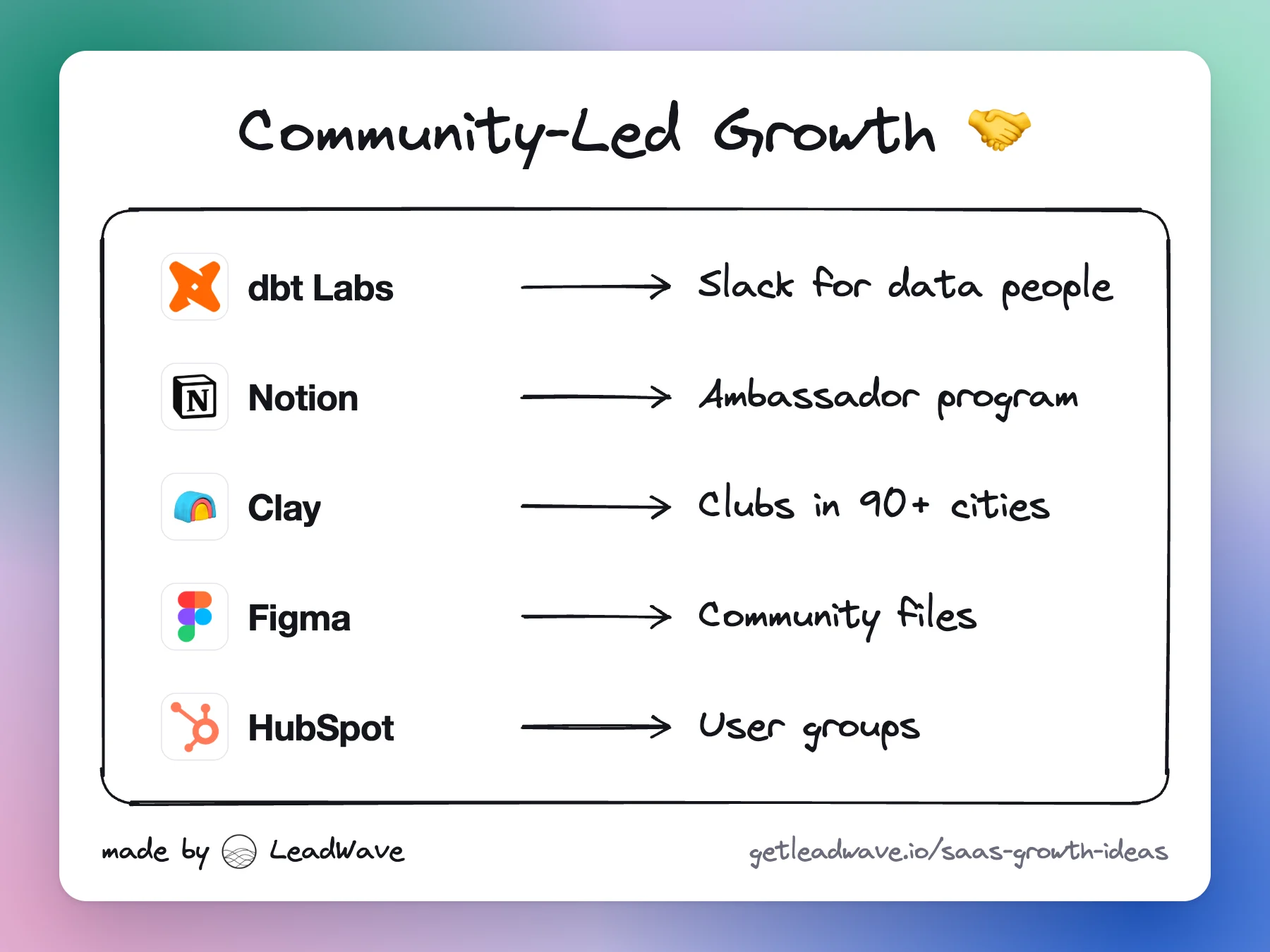
dbt Labs. The founders started a Slack to talk with their consulting clients before dbt was even a software company. By 2022 it had 38,000 members; today the dbt Community connects 100,000+ data professionals. The community is where analytics engineers learn the job, and dbt is the tool the job runs on.
Notion. Its head of community tweeted a form asking fans to become ambassadors and about a thousand people applied in the first few weeks. Today 300+ volunteers run Notion groups and events, there is a community-led Notion event almost every day somewhere in the world, and the template gallery is overwhelmingly made by users.
Neither company bought that reach. Members created it because the community helped them do their own work better.
The three types of community, and which one to build
Community of product: built around your tool. Figma Community (files, plugins, widgets) and Notion's ambassadors. Powerful, but it needs a big, passionate user base first.
Community of practice: built around a job or skill. dbt for analytics engineers, Clay for GTM engineers, Pocus's 10x GTM Community for sellers, tl;dv's anonymous Productherapy for product managers, Tango's Change Enablers for the people who roll out software. This is the best starting point for most B2B SaaS: you don't need thousands of users, only a group of people who share a problem your product solves.
Community of interest: built around a hobby or identity. Rare in B2B, and hard to connect to revenue.
A quick test before you build anything:
Can you name the one job your members share?
Would they get value from each other even if your product didn't exist?
Is there a place where they already gather (a Facebook group, a subreddit, a Slack) that you could join first?
Who on your team will show up every day for the first six months?
If you can't answer all four, start with content or a branded newsletter and come back to community later.
Community-led growth examples
dbt LabsSlack for data people
Started as the founders' Slack for consulting clients; 38,000 members by 2022 and 100,000+ data professionals today, plus local meetups. People join to learn the job; dbt is the tool the job runs on.
A tweeted form drew about 1,000 ambassador applicants in a few weeks; 300+ volunteers now run Notion groups and events, nearly one community event a day worldwide. Its template gallery, with tens of thousands of templates, is overwhelmingly community-made.
Clay Clubs meet in 90+ cities across 50 countries, with 250+ community events a year and a 35,000-member Slack. Clay presents it as the GTM ecosystem around 16,000+ teams building on Clay.
A go-to-market approach where a community of users and practitioners drives acquisition, activation and retention: members help each other, create content and templates, and bring in colleagues. The company hosts and supports it.
Product-led growth uses the product itself to acquire and convert users, through free plans and self-serve onboarding. Community-led growth uses the people around the product. They work best together: the community brings people to the product and helps them succeed with it.
dbt Labs' Slack community for data professionals, Notion's volunteer ambassador program, Clay's Clay Clubs in 90+ cities, Figma Community's user-made files and plugins, and HubSpot User Groups.
Pick the job your members share, join the places they already gather, seed your own space with hand-picked members, show up daily, create rituals, hand over to volunteer leaders, and connect the community to sign-ups and your CRM so you can measure it.
Expect to spend the first year on health and contribution (active members, answers, member-made content). Measurable revenue usually shows up in the second year.