Build in Public: How SaaS Founders Turn Their Numbers Into Distribution (10 Examples)
Share revenue, decisions and mistakes in public so the founder's audience becomes your first channel. Best for founder-led, self-serve SaaS.
Impact
High
Effort
Medium
Time to results
Quarters
Budget
None needed
Team
Marketing
Tools for this growth idea
LinkedInWhere B2B founders' posts reach buyers, peers and investors
StripeThe source of the revenue numbers you share
CanvaTurn milestones and metrics into images people repost
LinearA public changelog and roadmap to post from
Why building in public works
Building in public means sharing how the company is really doing while you build it: revenue, user counts, pricing experiments, hiring, what broke. It works for three reasons.
Numbers are proof. Anyone can say their product is growing. A monthly MRR post, or a live dashboard, is evidence, and evidence earns trust faster than a landing page.
A story brings people back. A single launch post gets one look. A founder who posts every month gives followers a reason to come back for the next episode, and each episode is another impression of the product.
The audience is often the buyer. If you sell to founders, marketers or developers, the people who follow a founder's journey are the same people who buy tools like yours.
The effect is slow but real. Plausible, the privacy-friendly analytics tool, grew to $1M ARR as a bootstrapped team of four without paying for ads, and its blog lists the MRR at every milestone along the way. Andrew Gazdecki says building in public was how Acquire.com started: by the time the MVP shipped, his founder audience on Twitter was big enough to carry it to #1 Product of the Day on Product Hunt.
What to share (and what travels)
Not every update is worth posting. The formats that get shared have something the reader can use:
Revenue and user milestones, with what got you there. “$10K MRR” is a brag; “$10K MRR, and here are the three channels that did it” is a lesson.
Decisions with the reasoning. A pricing change, a feature you killed, why you said no to investors. Plausible turned exactly these into blog posts that still get read.
Failures. Pieter Levels' projects page lists every project he has launched, including the ones he shut down and why. Failures are more believable than wins, and they get more replies.
Open dashboards. Buffer's open page shows live MRR, ARR, users and every salary. Plausible and Simple Analytics make their own analytics dashboards public, so the transparency doubles as a product demo.
What's coming next. Roadmap hints and sneak peeks give people a reason to stay tuned. Launch teasers are a tactic of their own: see feature teasers.
Pick the channel your buyer reads
X is where indie hackers and developer-tool founders build in public: short updates, screenshots of Stripe dashboards, launch threads. Tony Dinh and Pieter Levels grew there.
LinkedIn is the better home for B2B sales, marketing and HR buyers. lemlist's founder Guillaume Moubeche built his audience there while bootstrapping, and Lovable's ARR milestones spread there.
Your blog is where the story lasts. A milestone post like Plausible's “How we built a $1M ARR open source SaaS” keeps ranking and getting linked years later, long after the tweet is gone.
A public dashboard is the proof everything else points to.
Post from the founder's personal account. People follow people; a company page sharing its MRR reads like a press release.
What the best open startups do differently
They keep a cadence. Monthly numbers, every month, including the flat ones. The consistency is the credibility.
They make it checkable. Buffer publishes a dashboard and shareholder updates; TrustMRR lists startups whose revenue is verified through Stripe and other payment providers. Screenshots of real dashboards beat round numbers.
They tie every post back to the product. A screenshot of the feature that moved the number, a link in the profile, a sign-up page that matches the story.
They build the audience before they need it. Gazdecki had followers before he had an MVP. Starting the day you launch is late.
They share the lesson, not just the result. The best posts are useful to someone who will never buy your product, which is why they get shared to people who will.
When building in public backfires
Copycats. Public revenue proves a market exists. Tony Dinh says it plainly: building in public grows your audience, but “it attracts copycats though.” He once had to report a word-for-word copy.
Bad months. If you post the good months and go quiet on the bad ones, followers notice. Decide up front that you will post the dips too, or don't post revenue at all.
Peers instead of buyers. Founders love founder content. If your buyer is a VP of Finance at a bank, an audience of indie hackers will not buy, however many likes the posts get.
Things you can't take back. Customer names, security details, runway and anything your investors or acquirer would object to. Set the line before you start.
Build in public examples
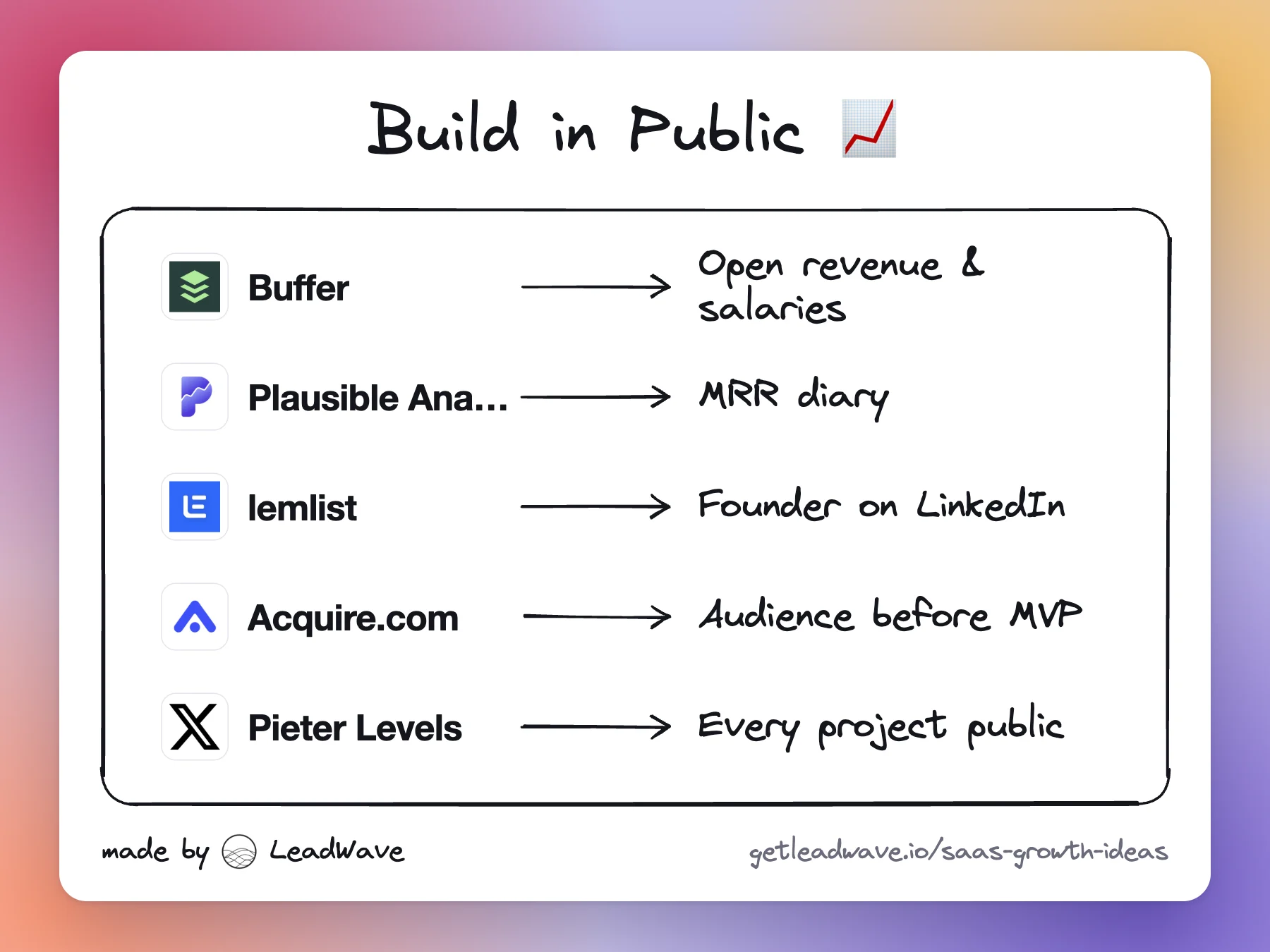
BufferOpen revenue and salaries
Buffer has published its finances and team salaries since 2013. Its open page shows MAU, MRR ($2.4M), ARR ($28.3M), monthly shareholder updates and every salary, the CEO's included.
Plausible logged its MRR at each step, from $64 when paid plans launched in May 2019 to $1M ARR in June 2022, as a self-funded team of four that never paid for ads. Its own analytics dashboard is public too.
His projects page lists every project he has made, with revenue per year and the stories of the ones that failed, such as an AI video app he says would have cost about $200,000 a month to run without a sponsor.
Tony Dinh, who makes TypingMind, started building in public on Twitter in April 2021; one viral build brought him 4,000+ followers in under 48 hours. He also warns that it attracts copycats.
Guillaume Moubeche built lemlist in public from day one, from a $1,000 start in 2018 to $1M ARR in 2020 and $28M ARR, fully bootstrapped. A single post in a Facebook sales community brought almost 300 beta sign-ups.
Andrew Gazdecki built MicroAcquire (now Acquire.com) in public on Twitter; the audience took it to #1 Product of the Day, and he names organic social and word of mouth as its main growth drivers since. It has helped 1,000+ founders exit for $500M+ in total.
Lovable published “Zero to $10M ARR in 2 months” on its own blog in January 2025, crediting community and content on X, TikTok and YouTube. A milestone post doubles as a press release and a growth case study.
Baremetrics, a subscription metrics tool, hosts a directory of companies that publish their live revenue metrics. Every open startup on it is also a public demo of the product.
A database of startup revenues verified through Stripe, RevenueCat and other payment providers, refreshed hourly. It shows where building in public is heading: from screenshots to numbers anyone can check.
Like Plausible, Simple Analytics makes the dashboard for its own website public, so visitors see real traffic numbers and the product at the same time.
From LeadWave’s own collection, saved as we found them since 2022. Some of these pages have changed since.
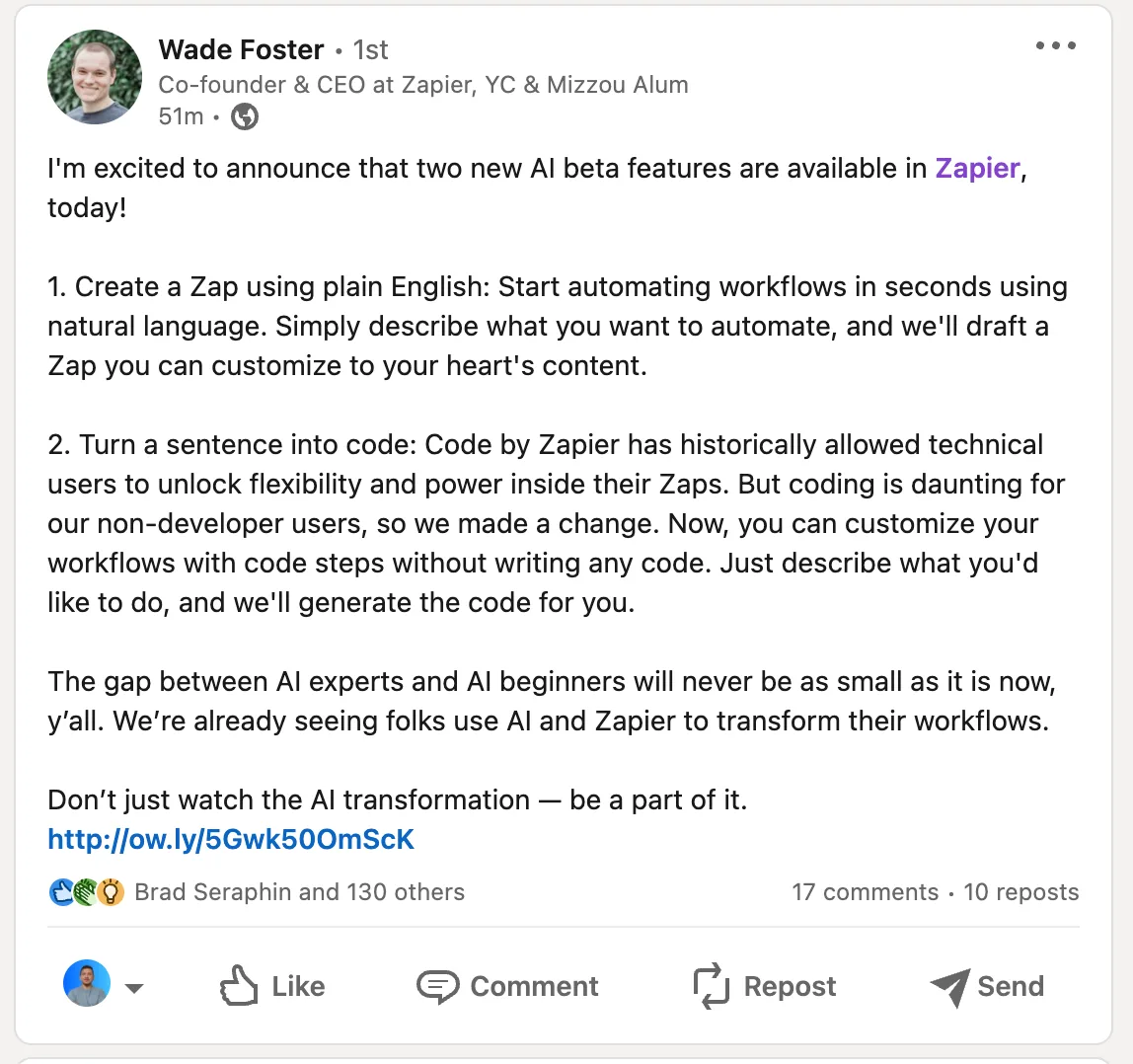
Wade Foster, Zapier's CEO, announcing two AI beta features on LinkedIn in his own words
How to run it: the playbook
Draw the line first.Write down what you will share (MRR, users, experiments, hiring) and what you never will (customer names, runway, security). Agree it with co-founders and investors.
Pick one channel and one voice.Choose X or LinkedIn based on where your buyers are, and post from the founder's personal account, not the company page.
Set a cadence you can keep.A monthly numbers post plus one or two behind-the-scenes posts a week is enough. Missing months hurts more than posting less often.
Publish one durable artifact.A public dashboard or a milestone blog post gives every social post something to link to, and it keeps working in search.
Teach in every post.Pair each number with the decision or channel behind it, so the post is useful to people who will never buy.
Connect it to the product.Show the product in screenshots, keep a sign-up link in the profile, and add “How did you hear about us?” to sign-up so you can see the effect.
Review every quarter.Check which posts drove profile visits, site visits and sign-ups, and do more of those.
What to measure
Sign-ups that answer “founder's posts”, “X” or “LinkedIn” to “How did you hear about us?”
Profile visits and link clicks per post, not likes
Follower growth among your ideal customers (job titles, company types), not total followers
Inbound you didn't ask for: partners, candidates, investors, press
Traffic and backlinks to your milestone posts and public dashboard
Pitfalls
Posting only the wins, then going silent in a bad month
Sharing revenue in a market where it mainly helps competitors size the opportunity
Building an audience of fellow founders when your buyer is someone else
Running it from the company account, where it reads like marketing
Publishing customer data, runway or anything you can't take back
Frequently asked questions
It means sharing how your company is doing while you build it: revenue, user numbers, decisions, launches and mistakes, usually on X, LinkedIn or a public dashboard. The goal is to earn trust and an audience that becomes your first customers.
Yes when your buyers follow founders online, such as founders, marketers, salespeople and developers. lemlist and Acquire.com both grew this way. It matters much less when you sell to large enterprises or regulated industries.
Only if you will keep sharing it when it dips. Revenue posts get the most attention, but they also show competitors and copycats that the market is real. Many founders share growth rates or milestones instead of exact monthly figures.
X suits indie hackers and developer tools; LinkedIn suits B2B sales, marketing and HR buyers. Pick the one your buyers read and post there consistently before adding a second.
Buffer's open revenue and salaries page, Plausible's MRR milestones on the way to $1M ARR, Pieter Levels' public project list, lemlist's founder on LinkedIn, and Tony Dinh's updates on X.