
OpenEvidence, the AI medical search app for doctors at openevidence.com, was valued at $12 billion in its last announced round, a $250 million Series D on January 21, 2026, and says its revenue passed $100 million in 2025. A further $250 million round at a $15 billion valuation was reported in September 2026 but not announced by the company. OpenEvidence is based in Miami, was founded by Daniel Nadler (CEO) and Zachary Ziegler (CTO), and is free for verified U.S. clinicians: it makes its money from advertising.
OpenEvidence at a glance
Question | Answer | As of |
|---|---|---|
What is OpenEvidence? | An AI search and clinical decision-support app for doctors and other healthcare professionals | Nov 2026 |
Revenue | More than $100 million in 2025, the company says | Jan 2026 |
Business model | Free for verified U.S. clinicians; paid for by advertising | Nov 2026 |
Valuation | $12 billion (Series D); $15 billion reported in a later round | Jan 2026; Sep 2026 |
Last announced round | $250M Series D co-led by Thrive Capital and DST Global | Jan 21, 2026 |
Total funding | About $760 million announced through the Series D; more than $1 billion with the reported September round | Sep 2026 |
Owner | Private; Forbes estimates Daniel Nadler owns nearly 60% | Mar 2026 |
Stock | Not public; no ticker, and shares can’t be traded without the company’s consent | Nov 2026 |
CEO | Daniel Nadler, founder and CEO | Nov 2026 |
Founders | Daniel Nadler, Zachary Ziegler | 2021 |
Users | Used daily, on average, by the majority of U.S. physicians, the company says | Nov 16, 2026 |
Legal entity | OpenEvidence Inc., a Nevada corporation | Sep 2026 |
Headquarters | Miami, Florida (moved from Cambridge, Massachusetts, in 2025) | Nov 2026 |
What is OpenEvidence?
OpenEvidence is an AI app that answers doctors’ clinical questions with answers drawn from medical journals and guidelines, each with citations to the papers behind it. It has content agreements with publishers and societies including the New England Journal of Medicine, JAMA, Nature, NCCN and Cochrane. Users register with a National Provider Identifier or another professional license number, and its terms say the service is for healthcare professionals, not patients, and is provided for educational and informational purposes only, not as a diagnostic service.
Beyond search, it now offers DeepConsult, a research agent (July 2025); Visits, which transcribes patient visits and drafts notes (August 2025); Coding Intelligence for billing codes (March 2026); a HIPAA-secure Dialer for calling patients; Learn, a medical education platform (November 4, 2026); and Access Intelligence, for drug costs, assistance programs and prior authorizations (November 11, 2026).
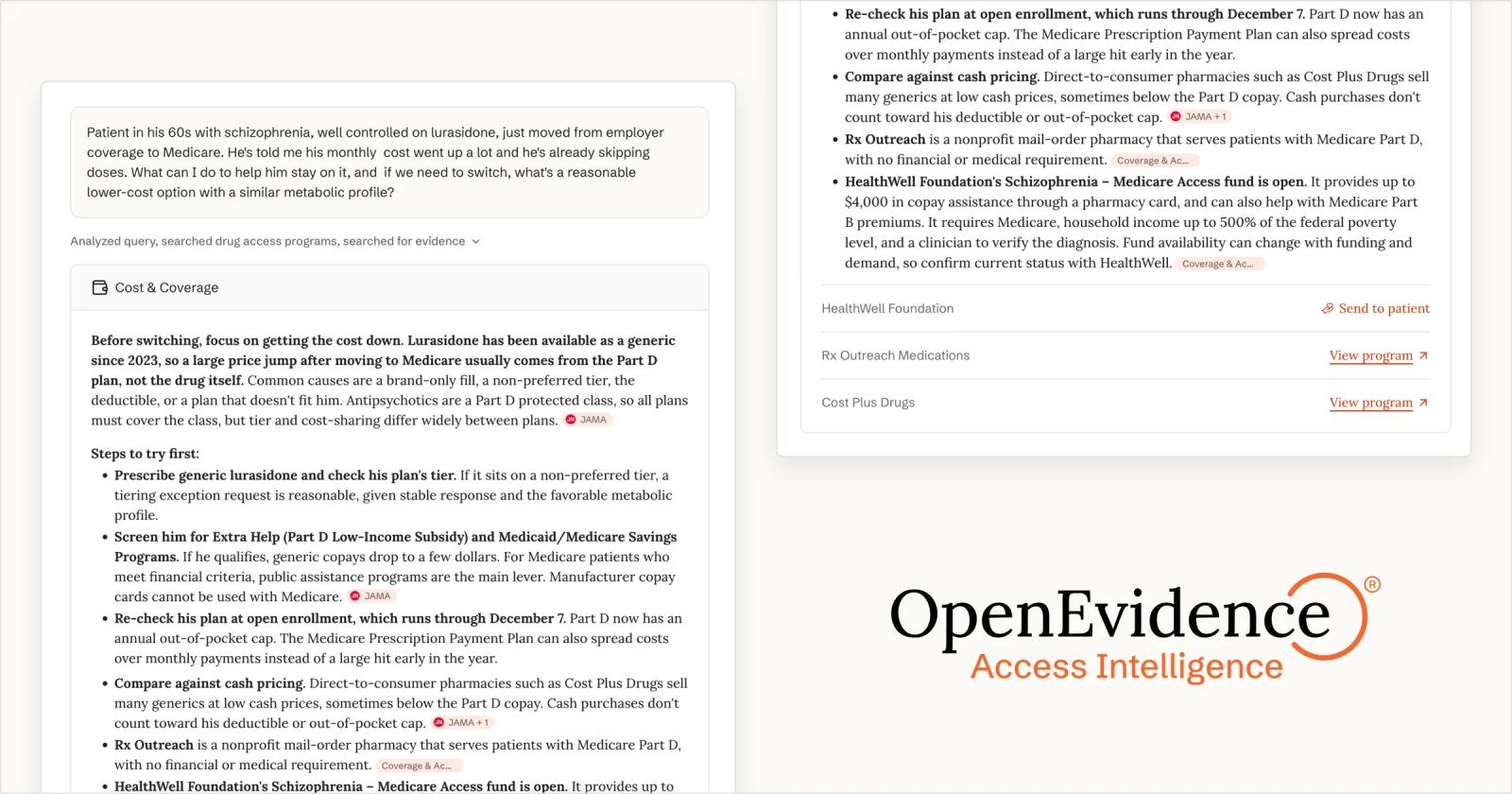
OpenEvidence’s image for Access Intelligence, launched on November 11, 2026, with a synthetic patient question.
What is OpenEvidence’s revenue?
OpenEvidence says its revenue passed $100 million in 2025, less than a year after it built out its sales team. It doesn’t publish detailed figures. Its revenue comes from advertising shown to doctors inside the free app, much of it from pharmaceutical companies. Its advertising policy says ads are kept separate from the medical content. Press figures are estimates of an annualized rate, not reported results.
| Date | Figure | Type |
|---|---|---|
| Jul 17, 2026 | $300M | Annualized revenue |
| Dec 15, 2025 | $150M | Annualized revenue |
Date | Figure | Who says so |
|---|---|---|
2025 (stated Jan 21, 2026) | More than $100 million in revenue | The company |
Dec 2025 | $150 million annualized ad revenue | A press report (reportedly) |
Jul 2025 | About $50 million annualized ad revenue | A Forbes estimate |
OpenEvidence ARR (annual recurring revenue)
OpenEvidence has no ARR in the usual sense: it sells advertising, not subscriptions, and doctors pay nothing. The closest figure is an annualized ad-revenue rate, reportedly $150 million in December 2025. The company hasn’t published a run-rate figure.
OpenEvidence MRR (monthly recurring revenue)
Not disclosed. OpenEvidence earns its money from advertising, not subscriptions, and hasn’t published a monthly figure, so there is no recurring revenue to divide into months.
What is OpenEvidence’s valuation?
$12 billion is the latest valuation the company has announced, set by its Series D on January 21, 2026. In September 2026 a $250 million round at a $15 billion valuation was reported, reportedly led by hospital systems and Andreessen Horowitz; OpenEvidence hasn’t announced it. In July 2026 the company was reported to be weighing a $200 million raise at $20 billion; no round at that price has been announced.
Date | Valuation | Round | Status |
|---|---|---|---|
Sep 2026 | $15 billion | $250M | Reported, not announced |
Jul 2026 | $20 billion | $200M | Reported talks only |
Jan 21, 2026 | $12 billion | $250M Series D | Announced |
Oct 2025 | $6 billion | $200M Series C | Announced |
Jul 15, 2025 | $3.5 billion | $210M Series B | Announced |
Feb 19, 2025 | $1 billion | $75M Series A | Announced |
How much funding has OpenEvidence raised?
About $760 million in announced rounds through January 2026 (our sum: more than $100 million through the Series A, then $210 million, $200 million and $250 million), and more than $1 billion if the reported September 2026 round is included. Nadler put in about $10 million of his own money before any venture funding, and a friends-and-family round followed in 2023. Sequoia led the Series A in February 2025, the first institutional round; GV and Kleiner Perkins co-led the Series B in July 2025; GV led the Series C in October 2025; and Thrive Capital and DST Global co-led the Series D.
Date | Round | Amount | Investors named |
|---|---|---|---|
Sep 2026 | Reported round | $250M | Hospital systems and Andreessen Horowitz, reportedly |
Jan 21, 2026 | Series D | $250M | Thrive Capital and DST Global (co-leads); many earlier investors followed on |
Oct 2025 | Series C | $200M | GV (lead) |
Jul 15, 2025 | Series B | $210M | GV and Kleiner Perkins (co-leads); Sequoia, Coatue, Conviction, Greycroft, Thrive |
Feb 19, 2025 | Series A | $75M | Sequoia Capital |
2021–2023 | Founder money, then friends and family | About $10M from Nadler | Nadler; early backers Jim Breyer and Ken Moelis |
Who owns OpenEvidence? Does it have stock?
OpenEvidence is private. Daniel Nadler is its largest owner: Forbes estimates his stake at nearly 60% (March 2026) and estimated co-founder Zachary Ziegler’s at about 10% (July 2025). The rest belongs to employees and investors, which the company lists as including Sequoia, Kleiner Perkins, GV, Nvidia, Thrive, Andreessen Horowitz, Coatue, Blackstone, DST and Mayo Clinic.
There is no OpenEvidence stock price or ticker, and the company hasn’t announced plans for an IPO. In a public notice, OpenEvidence says all of its shares are subject to transfer restrictions, that any sale without its consent is void, and that third-party funds or tokens offering exposure to its stock may be worthless.
Who founded OpenEvidence, and who is the CEO?
Daniel Nadler and Zachary Ziegler founded OpenEvidence. Nadler, a Harvard PhD who had sold his first AI company, Kensho, to S&P Global in 2018, self-funded it in 2021 and teamed up with Ziegler, then a Harvard PhD student in machine learning. Nadler is founder and CEO and Ziegler is co-founder and CTO; we found no change of CEO in the past 12 months.
Person | Role |
|---|---|
Daniel Nadler | Founder and CEO |
Zachary Ziegler | Co-founder and CTO |
Travis Zack, MD, PhD | Chief Medical Officer |
Ania Bilski, MD | VP of Clinical AI |
Nadler’s bio, net worth and contact routes: OpenEvidence CEO Daniel Nadler.
How many doctors use OpenEvidence?
Every usage figure comes from the company, and its wording has changed over time. Its most recent claim (November 16, 2026) is that the platform is used daily, on average, by the majority of U.S. physicians; its enterprise page says 70% of doctors. In January 2026 the claim was more than 40%. Forbes counted more than 758,000 doctors signed up in March 2026.
Date | Company claim |
|---|---|
Nov 2026 | Over 200 million clinical consultations from U.S. clinicians to date; more than 100 million Americans will be treated this year by a clinician using it |
Nov 16, 2026 | Used daily, on average, by the majority of U.S. physicians |
May 2026 | About 650,000 U.S. physicians use it actively |
Jan 21, 2026 | About 18 million clinical consultations in December 2025; more than 40% of U.S. physicians use it daily |
Jul 15, 2025 | 8.5 million consultations a month; 65,000 new verified clinicians a month; 10,000+ hospitals and medical centers |
Feb 19, 2025 | Hundreds of thousands of verified doctors at 10,000+ care centers |
OpenEvidence pricing
OpenEvidence is free for verified U.S. healthcare professionals, and there is no public price list or pricing page. The DeepConsult research agent and the Dialer are also free for verified U.S. clinicians, the company says. OpenEvidence Enterprise, for health systems that want it inside their electronic health record, is also free of license or integration fees, the company says. It is open only to organizations that deliver patient care, and other businesses aren’t eligible. We found no public API or price list. The company earns its money from advertisers instead.
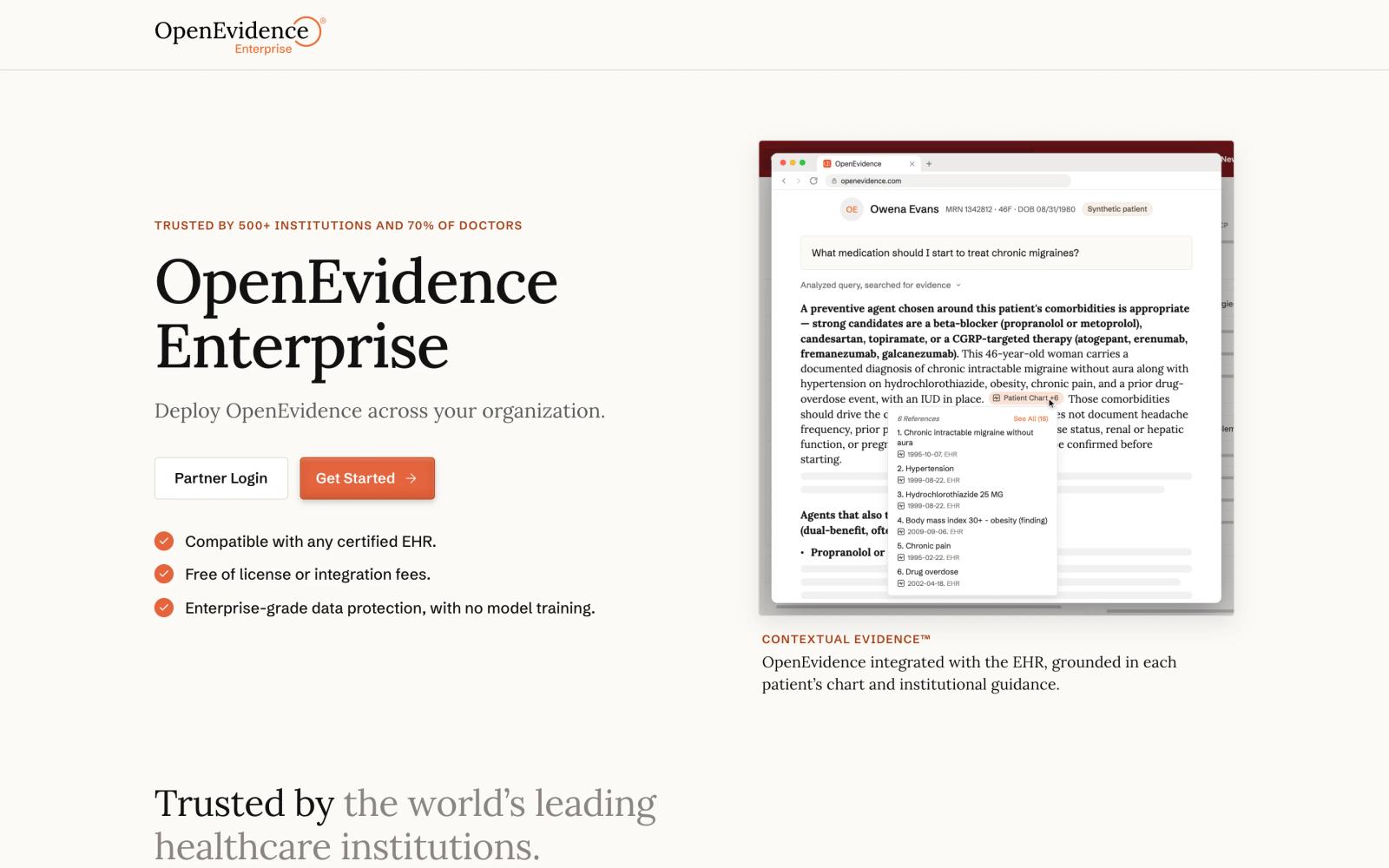
OpenEvidence’s Enterprise page on November 26, 2026.
OpenEvidence models and accuracy claims
On September 3, 2026, OpenEvidence released its own family of medical models: Osler (about five seconds per answer, the default), Sackett (about 30 seconds), Snow (about five minutes) and Darwin. The company says Darwin leads three medical benchmarks and scored 100% on MedQA, a test of board-style questions; in 2025 it said an earlier system scored 100% on the U.S. Medical Licensing Examination. These are the company’s own results. Outside researchers have tested it too: OpenEvidence points to a Mayo Clinic study that found it performed comparably to physicians on common chronic conditions in primary care. Critics note that citations don’t make an answer right, since some published research turns out to be wrong. Because it isn’t considered a diagnostic tool, it doesn’t need FDA approval.
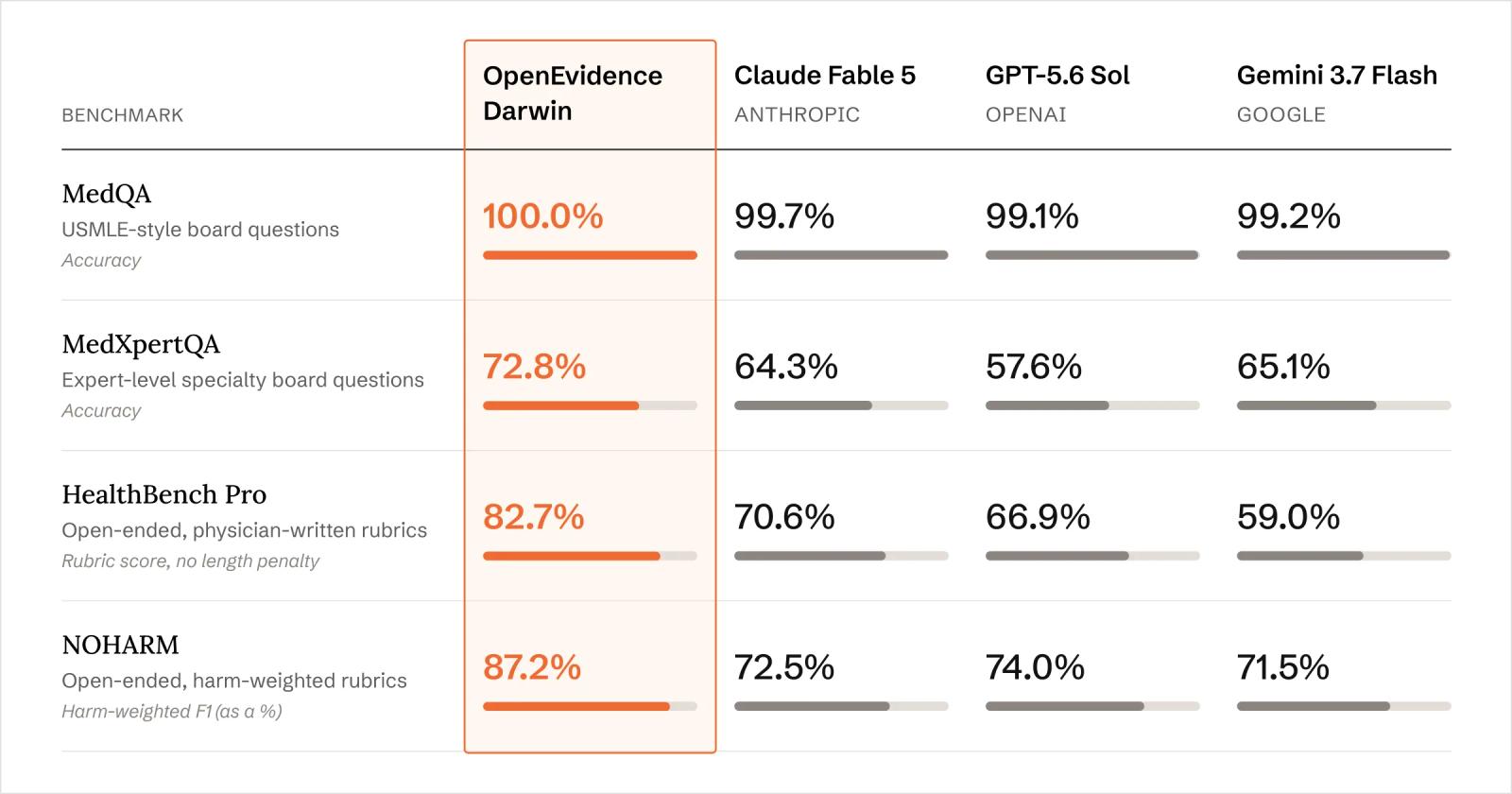
OpenEvidence’s own benchmark chart from its September 3, 2026 model announcement.
OpenEvidence competitors
OpenEvidence competes with other clinical AI and reference tools, including Doximity, whose AI assistant is also free for verified U.S. physicians, and Wolters Kluwer’s UpToDate. General AI companies have health products too: Anthropic’s Claude for Healthcare and OpenAI’s ChatGPT Health. Its Visits note-taker overlaps with ambient scribes such as Abridge and Microsoft’s Dragon Copilot. OpenEvidence also partners with some of them: it works with Microsoft on Dragon Copilot and, since September 2026, with Anthropic on clinical support in nearly 100 low- and middle-income countries.
Lawsuits: Doximity, Pathway and Veracity Health
In 2025 OpenEvidence sued three rivals, alleging they misused its platform to try to extract how it works, including through prompt injection. All three cases have ended without a ruling on the merits.
Case | Filed | Outcome |
|---|---|---|
OpenEvidence v. Pathway Medical (D. Mass.) | Feb 2025 | Dropped without prejudice on Oct 23, 2025, after Doximity bought Pathway |
OpenEvidence v. Veracity Health (N.D. Cal.) | Jun 2025 | Settled; the court was told on Oct 31, 2025; terms not disclosed |
OpenEvidence v. Doximity (D. Mass.) | Jun 2025 | Settled; dismissed with prejudice on Oct 16, 2026; each side pays its own fees |
The Doximity case was the largest. OpenEvidence alleged that Doximity staff posed as doctors, using National Provider Identifier numbers, to probe its system. Doximity denied it and countersued for defamation, false advertising and harassment, citing an OpenEvidence chart that called Doximity a loser in the AI race. OpenEvidence dropped its trade-secret claims, and on January 22, 2026, the judge let most of its remaining claims and Doximity’s counterclaims go forward. The case settled in October 2026; other terms weren’t disclosed.
Where is OpenEvidence based, and how many employees does it have?
OpenEvidence’s headquarters is at 215 NW 24th Street, Suite 300, Miami, Florida. It moved there from Cambridge, Massachusetts, in the summer of 2025. It doesn’t publish a headcount. Its About page lists a research and engineering team drawn largely from Harvard and MIT PhD programs, a clinical team and a commercial team, and notes two acquired startups, Amaro and Vocode, whose founders joined.
Key events
Date | Event |
|---|---|
Nov 16, 2026 | Every Cure drug-repurposing partnership |
Nov 11, 2026 | Access Intelligence launches |
Nov 4, 2026 | Learn, a medical education platform, launches |
Oct 29, 2026 | NYU Langone puts OpenEvidence into its Epic record system |
Oct 16, 2026 | Doximity lawsuit dismissed after a settlement |
Sep 2026 | A $250M round at $15B reported; Anthropic partnership |
Sep 3, 2026 | OpenEvidence model family released |
Mar 24, 2026 | Coding Intelligence launches in Visits |
Jan 21, 2026 | $250M Series D at $12B; revenue passed $100M in 2025 |
Oct 2025 | $200M Series C at $6B; Microsoft and Veeva partnerships |
Aug 21, 2025 | Visits launches |
Jul 15, 2025 | $210M Series B at $3.5B; DeepConsult released |
Summer 2025 | Headquarters moves from Cambridge, Massachusetts, to Miami |
Jun 2025 | Sues Doximity and Veracity Health |
Feb 19, 2025 | $75M Series A at $1B led by Sequoia; NEJM content deal |
Feb 2025 | Sues Pathway Medical |
Early 2023 | Joins the Mayo Clinic Platform accelerator; platform launches |
2021 | Nadler self-funds the company and teams up with Ziegler |
More on OpenEvidence and similar companies
OpenEvidence CEO Daniel Nadler: net worth, career and how to reach him
SaaS companies past $100M ARR: OpenEvidence and other companies past $100 million
List of SaaS unicorns: private software companies valued at $1 billion or more
Healthcare SaaS companies: software companies in OpenEvidence’s market
Miami SaaS companies: software companies in OpenEvidence’s home city
Florida SaaS companies: software companies across the state
SaaS startups: venture-backed software startups
Selling to AI companies like OpenEvidence? The AI companies email list has their CEOs and decision makers in one file.