
Workday doesn’t publish US prices, but its UK public-sector price list does: core HCM costs £163.22 (about $214) per employee a year for 750 to 1,500 employees, falling to £59.35 (about $78) above 50,000, in Workday’s January 2026 list (Workday G-Cloud price list). Everyone else gets a private quote. Across 378 purchases in Vendr’s data, the median buyer pays $51,616 a year, with deals from $18,738 to $548,687 (Vendr). Contracts usually run three years or longer, generally can’t be cancelled and are invoiced once a year in advance.
The big change in 2025 and 2026 is AI, which Workday prices by use instead of by employee. The company, which “historically operated on an employee-based model”, now sells its AI agents through Flex Credits: an annual pool of credits that the UK list prices at £7,556 per 10,000, about £0.76 ($0.99) a credit (our calculation). AI drove more than 25% of Workday’s new annual contract value in the quarter to July 31, 2026. Dollar figures on this page convert pounds at $1.3125, the ECB reference rates of November 20, 2026 (our calculation). Everything below was checked on November 20, 2026.
Workday pricing in 2026 at a glance
Option | Price | What you get |
|---|---|---|
Workday HCM, core | £59.35 to £163.22 ($78 to $214) per employee a year on the UK list; quote only elsewhere | Core HR, compensation, benefits and absence, plus Global Payroll Connect for outside payroll providers |
HCM with UK payroll, time tracking and expenses | £107.44 to £295.46 ($141 to $388) per employee a year | One of 14 published bundles; others add recruiting, talent, learning or finance |
Largest HCM and finance suite | £402.21 to £1,084.24 ($528 to $1,423) per employee a year | HCM, payroll, talent, recruiting, time, scheduling, financials, procurement, projects, analytics and learning |
Workday Financial Management | £91.29 to £251.04 ($120 to $329) per employee a year | Core financials, expenses and procurement |
Adaptive Planning | £21.86 to £60.12 ($29 to $79) per employee a year for workforce planning; £32.79 to £90.17 ($43 to $118) with financial planning | Budgeting, forecasting and workforce planning models |
Flex Credits for AI agents | £7,556 ($9,917) per 10,000 credits a year | Agent actions at 1 to 750 credits each, plus complimentary credits based on company size |
Workday GO (midsize) | Quote only; fixed-fee deployment packages | HR, payroll and finance packaged for midsize companies, live in as few as 60 business days |
Implementation | Often 1 to 2 times the yearly subscription; Workday’s consultants charge £225 to £390 ($295 to $512) an hour | Deployment by Workday or a partner, billed separately |
Prices on the UK list are for public-sector buyers, exclude VAT and fall as headcount rises; the band is set by your number of employees.
What companies actually pay for Workday
Workday’s quotes are private, so the numbers come from three places:
Vendr: a median of $51,616 a year across 378 purchases, from $18,738 to $548,687, with buyers saving 15% on average (last updated February 2026). Teams with 5,000+ employees often got 20–35% lower per-employee pricing.
Workday’s own UK price list: per-employee rates by headcount band for public-sector buyers on the G-Cloud 15 framework, dated January 29, 2026. It adds that “Minimum deal values will apply.”
Public bodies: Washington University in St. Louis pays a $5.7 million annual licensing fee, the University of Washington budgets $3.9 million in ongoing Workday fees for HR and payroll in fiscal 2027, and Hull City Council estimated £700,000 a year for the software (details below).
The two benchmarks measure different things. Vendr’s median spans every Workday purchase it has handled, from $18,738 up, while the UK list is a full subscription price per employee: core HCM for 1,000 people comes to £163,220 ($214,222) a year at list (our calculation). Workday has more than 11,500 customers and more than 75 million users under contract (Workday 10-K).
Workday cost per employee and per month
Workday charges per employee per year, not per login. On the UK list, core HCM works out to £13.60 ($17.85) per employee per month at 750 to 1,500 employees and £4.95 ($6.50) above 50,000; the largest suite is £90.35 ($118.58) per employee per month at the smallest band (our calculation). There is no monthly billing: subscriptions are invoiced annually in advance.
Not every worker counts as a full employee. The University of Washington’s Workday contract (2013) counts full-time employees at 100%, part-time employees at 25%, temporary staff and contractors at 12.5%, and former workers who keep access at 2.5%. Workday calls the result FSE, full service equivalents.
Workday cost per user
Most Workday products have no per-user price. Its contract FAQ says pricing is based on the number of employees, users, other size metrics and, for some applications, usage. The per-user exceptions on the UK list are training and extras: Learn On-Demand courses cost £2,155 ($2,828) a year for 10 named users, and Learning for outside learners costs £15,570 per 1,000 seats a year.
What Workday costs for a company your size
Employees | UK list rate, core HCM | Per year (our calculation) |
|---|---|---|
750 | £163.22 | £122,415 ($160,666) |
2,000 | £137.41 | £274,820 ($360,694) |
10,000 | £116.79 | £1,167,900 ($1,532,838) |
Add payroll, time tracking, recruiting or finance and the rate per employee roughly doubles or more; see the bundles above. These are list prices before any negotiation.
Workday pricing for small business
Workday isn’t sold to very small companies. The smallest band on its UK list starts at 500 employees for some bundles and 750 for core HCM. Its midsize package, Workday GO, is aimed at organizations of typically 500–1,500 employees, though Workday’s comparison pages also pitch it to companies under 3,500. Workday doesn’t publish GO prices: it says it sells “packages designed to fit their business and budget” and asks buyers to speak with sales. Workday GO comes with fixed-fee deployment and, Workday says, go-live in as few as 60 business days.
Workday implementation cost
Implementation is billed separately and is often the biggest surprise. Vendr puts it at 1–2 times the annual subscription, more for global or multi-entity rollouts. At that ratio, a 1,000-employee core HCM deployment would cost £163,000 to £326,000 to implement (our calculation). Workday’s own consultants list at £225 an hour (£1,687.50 a day) for a consultant up to £390 an hour for a project director, and £120 to £180 an hour offshore.
Large institutions pay far more. Washington University in St. Louis spent $81 million on Workday HCM and finance, and the University of Wisconsin system spent $51 million implementing Workday between 2019 and 2023. Hull City Council estimated £3 million over 1.5 years for implementation.
What customers say they pay
Companies rarely post their Workday price, and Workday’s standard contract makes the negotiated pricing confidential. Public bodies are the exception, because they publish what they spend:
“The University is also spending $23.8 million in fiscal year (FY) 2026 for Workday support teams and operations and pays a $5.7 million annual licensing fee.”
— Student Life, Washington University in St. Louis’s student newspaper, reporting figures from the university’s CFO, December 2025
“Software Provision and Implementation Services … estimated value of £700,000 per annum”
— Hull City Council’s Workday contract notice, as quoted by The Stack, October 2024. The council awarded Workday a £10.7 million, seven-year contract to replace Oracle
“The Workday Financial and Human Capital Management system represents a $45M information technology investment by NSHE.”
— the Nevada System of Higher Education, in papers for its Board of Regents, February 2022
The University of Washington’s cost sheet for fiscal 2027, revised June 10, 2026, charges its departments $3,901,200 in ongoing Workday solution fees for HR and payroll (University of Washington). In the UK, Workday’s share of a 10-year deal for nine government departments is £64 million.
Together they show the range: about £700,000 a year for a city council, $3.9 million to $5.7 million a year in licensing at large universities, and implementation bills that run to tens of millions. They sit far above Vendr’s median because these are large, multi-module deployments.
Workday’s products and what each one includes
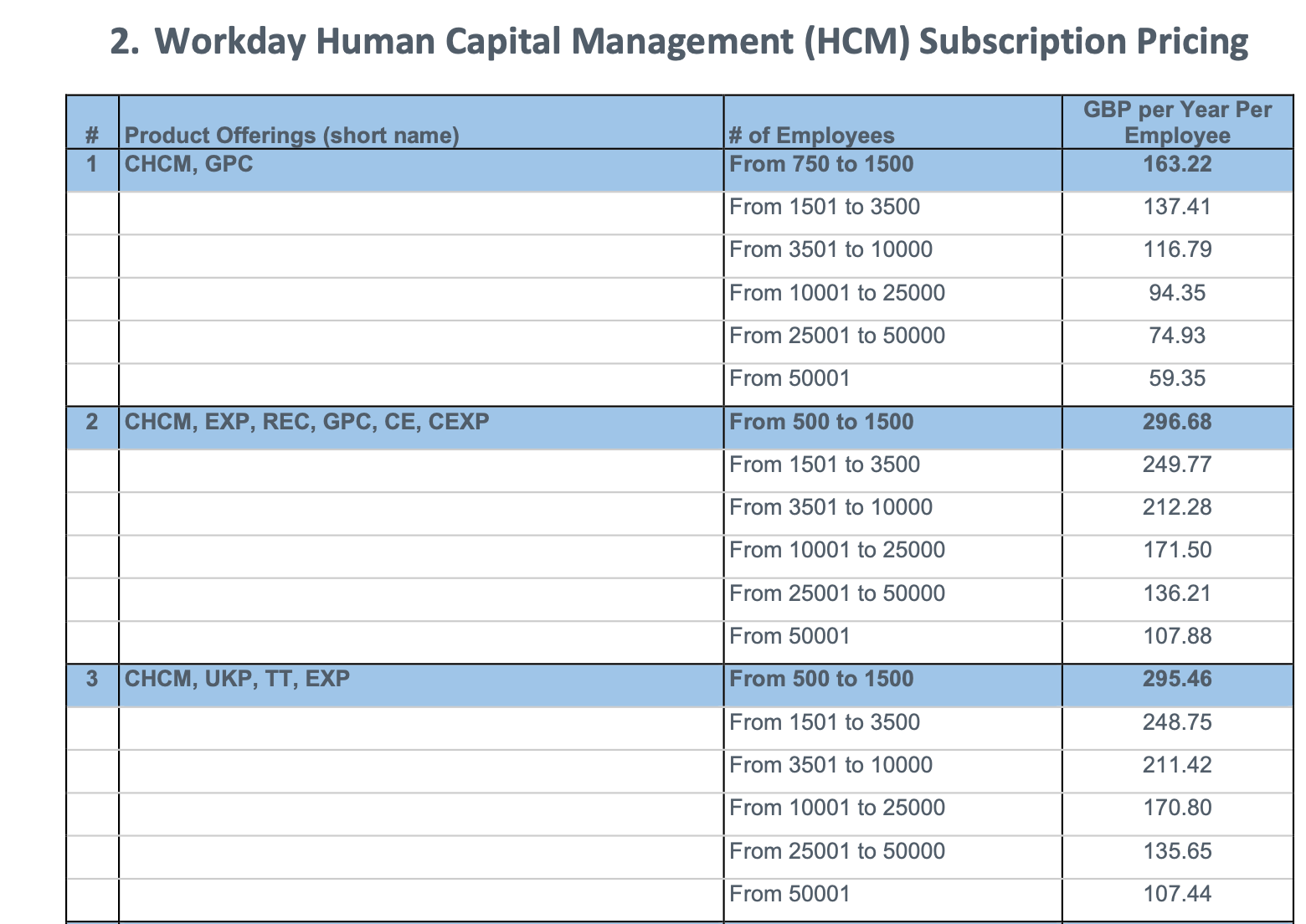
The first three HCM bundles in Workday’s G-Cloud 15 price list, dated January 29, 2026, as captured on November 20, 2026. Prices are in pounds per employee per year, excluding VAT.
Core HCM: HR records, organization management, compensation, absence and benefits. Global Payroll Connect links it to outside payroll providers.
Payroll: Workday’s own payroll for the US, UK and Ireland, Canada and Australia, sold as separate modules.
Talent and time: Recruiting, Talent Optimization, Time Tracking, Scheduling and Learning. Since February 12, 2026, new buyers get Learning powered by Sana; the older Learning module is for renewals only.
Financial Management: core financials, expenses, procurement, projects, billing and inventory, priced per employee like HCM.
Adaptive Planning: financial and workforce planning, from £21.86 to £90.17 per employee a year on the UK list.
Extend: custom apps built on Workday, priced by company size, from £83,116 ($109,088) for three apps at up to 3,500 FSE to £208,546 ($273,711) for ten apps at the same size.
Support comes in Success Plans: Standard is included with every product, and Accelerate Essentials, Accelerate and Accelerate Plus add guidance, training and a technical account manager at prices Workday doesn’t publish.
Is Workday free?
No, not for employers. Workday has no free plan, and its UK listing offers no free trial. It is free for employees: if your employer uses Workday, you sign in to it at no cost.
The free part is AI testing. Workday gives Complimentary Flex Credits based on company size, and most agents can be tested for free outside production. Training isn’t free either: customers buy training credits at £445 to £575 each, valid for 18 months.
Add-ons, fees and contract terms
How Workday Flex Credits work
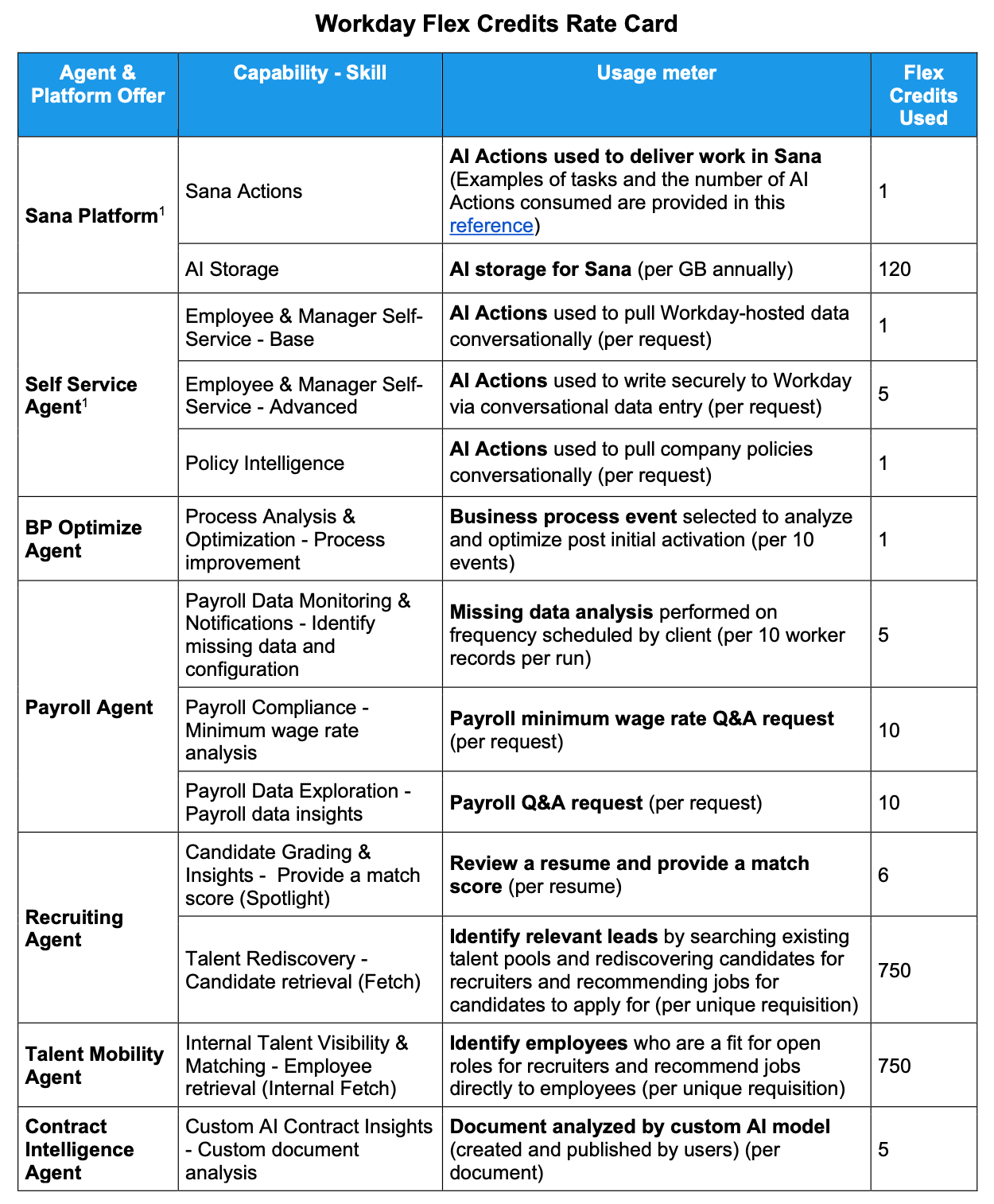
Page one of Workday’s Flex Credits rate card, last updated November 5, 2026, as captured on November 20, 2026.
Flex Credits are an annual subscription of credits used across Workday’s agents, Sana and Data Cloud. Each action has a fixed credit cost, and the rates are locked for your order term.
At the UK list price of about £0.76 a credit, a Self-Service Agent answer (1 credit) costs £0.76 ($0.99), a resume match score (6 credits) £4.53 ($5.95), a contract reviewed and redlined (500 credits) £378 ($496) and talent rediscovery for one job opening (750 credits) £567 ($744) (our calculation).
Workday sends alerts at 80%, 90% and 100% of your balance. If you go over, its account teams reconcile usage rather than shutting off access.
Contract terms
Length: subscriptions typically run three years or longer, are generally noncancelable and are invoiced annually in advance (Workday 10-K).
Headcount can’t go down: during the term, “subscription fees may not be reduced”, even after layoffs, an acquisition or a divestiture (Workday contract FAQ). Extra employees are added at a per-head price set in your order form.
No exit for convenience: Workday doesn’t offer termination for convenience. If a contract ends, you can buy up to three months of transition at 1/12 of the prior year’s fee plus 5%, and you get 60 days to retrieve your data at no extra cost.
Payment: invoices are due within 30 days, and late payments can accrue 1% a month.
Renewal increases: Workday’s public terms set no cap; it is negotiated in your order form. Workday’s 2026 annual report notes more customers asking for price concessions.
Extras: an optional customer audit program costs £246 an hour on the UK list, and Adaptive Planning’s list prices assume a 3-year subscription term.
What changed: Workday pricing from 2024 to 2026
When | Change |
|---|---|
October 2024 | Hull City Council and nine UK government departments pick Workday; Hull estimates the software at £700,000 a year |
Fiscal 2026 (February 2025 to January 2026) | Flex Credits introduced: a subscription-based, flexible pricing model for AI and platform features |
Fiscal 2026 | Workday GO, packaged and priced for midsize companies, adds a partner network, a Deployment Agent and global payroll |
January 29, 2026 | Workday’s UK price list publishes per-employee rates by band, with Flex Credits at £7,556 per 10,000 |
February 2026 | About 2% of staff cut; co-founder Aneel Bhusri returns as CEO |
February 12, 2026 | New buyers of Workday Learning must take Learning powered by Sana |
June 1, 2026 | Workday’s blog sets out Flex Credits: complimentary credits to test agents, then an annual credit subscription |
July 30, 2026 | Workday’s finance team writes that per-seat licensing is shifting toward a hybrid model driven by consumption |
August 27, 2026 | AI drives more than 25% of new annual contract value; Workday says it is answering shifts in buying with new pricing models |
September 29, 2026 | About 2.5% of staff cut, mainly in Product and Technology |
November 5, 2026 | Flex Credits rate card updated; AI narration in Workday Learning starts using credits around November 21 |
The direction is clear in Workday’s own filings: renewals have brought “reduced growth in headcount-level commitments upon renewals of existing customers”, so the per-employee model grows more slowly, and usage-priced AI is how Workday plans to make up the difference.
What this means if you’re buying or renewing
Use the UK list as a reference: even outside the UK public sector, it shows Workday’s own per-employee rates by band. Compare your quote module by module.
Get the headcount right before you sign: fees are fixed for the whole term and can’t fall if you shrink. Ask how part-timers, contractors and former workers are counted.
Watch the band edges: the rate per employee drops at 1,501, 3,501, 10,001, 25,001 and 50,001 employees. If you will cross one during the term, negotiate the lower rate now.
Buy AI separately and late: use the complimentary Flex Credits and the free non-production testing first, then size the subscription from real usage.
Price implementation as its own deal: budget 1–2 times the first year’s subscription, compare partners with Workday’s own day rates, and ask for a fixed fee where you can.
Settle renewal terms on day one: there is no termination for convenience, so agree the renewal increase cap in the first order form. Workday’s fiscal year ends January 31, and Vendr’s data shows fiscal year-end timing helps discounts.
Selling to HR or enterprise software companies?
Workday’s rivals, partners and the HR tech companies around it are a market of their own. LeadWave tracks 1,859 HR SaaS companies (November 2026), from HRIS and payroll to recruiting, engagement and workforce planning tools. The full list with CEO contacts is part of our SaaS companies list: 15,000+ SaaS companies and 16,000 CEOs with verified emails, for $249 once. It covers companies and their CEOs and founders, not every employee.
Selling to HR or enterprise software companies? Start with the HR SaaS companies list or get the full SaaS companies list.
More on Workday and its rivals
Rippling pricing: what Rippling costs per employee, for teams too small for Workday
European alternatives to Workday: HR and payroll suites that keep data in Europe
HR SaaS companies: Workday next to the rest of the HR software market
Enterprise SaaS companies: Workday among the largest software employers
Public SaaS companies: Workday’s revenue next to other listed software companies
California SaaS companies and North American SaaS companies: where Workday, based in Pleasanton, fits in