
Pick Apollo if you want published prices, a free plan and monthly billing; pick ZoomInfo if you’re a mid-market or enterprise team that wants the bigger database and intent data and can sign an annual contract. On November 19, 2026, Apollo’s paid plans cost $49, $79 or $119 per seat a month billed annually, or $65 and $99 billed monthly (Apollo pricing). ZoomInfo publishes no prices: every plan is quoted, and the median buyer pays $33,500 a year across 1,581 purchases in Vendr’s data.
Real contracts show the same gap. Among SpendHound’s customers with 50 to 1,000 employees, Apollo costs $9,885 a year on average and ZoomInfo $48,724. ZoomInfo counts 500M+ contacts and 100M+ companies, Apollo 240M+ contacts and 30M+ companies, each by its own count. And the two are in court: ZoomInfo sued Apollo for patent infringement in March 2025, and in May 2026 a judge let Apollo’s antitrust counterclaims go ahead. Everything below was checked on November 19, 2026.
ZoomInfo vs Apollo at a glance
At a glance | Apollo | ZoomInfo |
|---|---|---|
Published prices | Basic $49, Professional $79, Organization $119 per seat a month billed annually; Basic $65 and Professional $99 billed monthly | None: every paid plan is quoted. Vendr’s median is $33,500 a year; GTM.AI data credits cost $0.25 to $0.45 each |
Free plan | Free: 900 credits per seat a year (75 a month), 2 sequences, Gmail only, no time limit | ZoomInfo Lite: 10 credits a month (25 with Community Edition) |
Free trial | 14 days on Basic and Professional, with 75 credits | Typically 7 days; business email, no credit card |
Billing and contract | Monthly (cancel anytime) or annual (12 months, up to 24% cheaper); Organization is annual only, 3 seats minimum | One to three years, billed in advance, not cancellable mid-term |
Database, own count | 240M+ contacts and 30M+ companies; claims 98% email accuracy | 500M+ contacts and 100M+ companies, 200M+ verified business emails, 120M+ direct dials |
Credits | 30,000, 48,000 or 72,000 per seat a year by plan; an email costs 1 credit, a phone number 8; unused credits expire each billing cycle | One credit per exported contact or company; the allowance is set in your quote |
Records per bulk action | 25 on Free, 1,000 on Basic, 2,500 on Professional, 10,000 on Organization | None on its pricing page; each export uses a credit |
Outreach tools | Sequences, email warmup, US dialer and call recording on paid plans | Phone and email outreach, intelligent dialing, automated outreach workflows on higher plans |
AI | AI Assistant (out of beta March 2026), AI research and lead scoring, MCP for Claude, ChatGPT and others | GTM Workspace agents (October 2025), Agent Teams (October 2026), GTM.AI API and MCP (June 2026) |
Company | Private; approaching $200M ARR (February 2026) (Apollo) and 100,000+ paying customers (March 2026); last valued at $1.6B (August 2023) | Public (Nasdaq: GTM); $1.25B revenue in 2025; 35,000+ customers |
ZoomInfo vs Apollo pricing
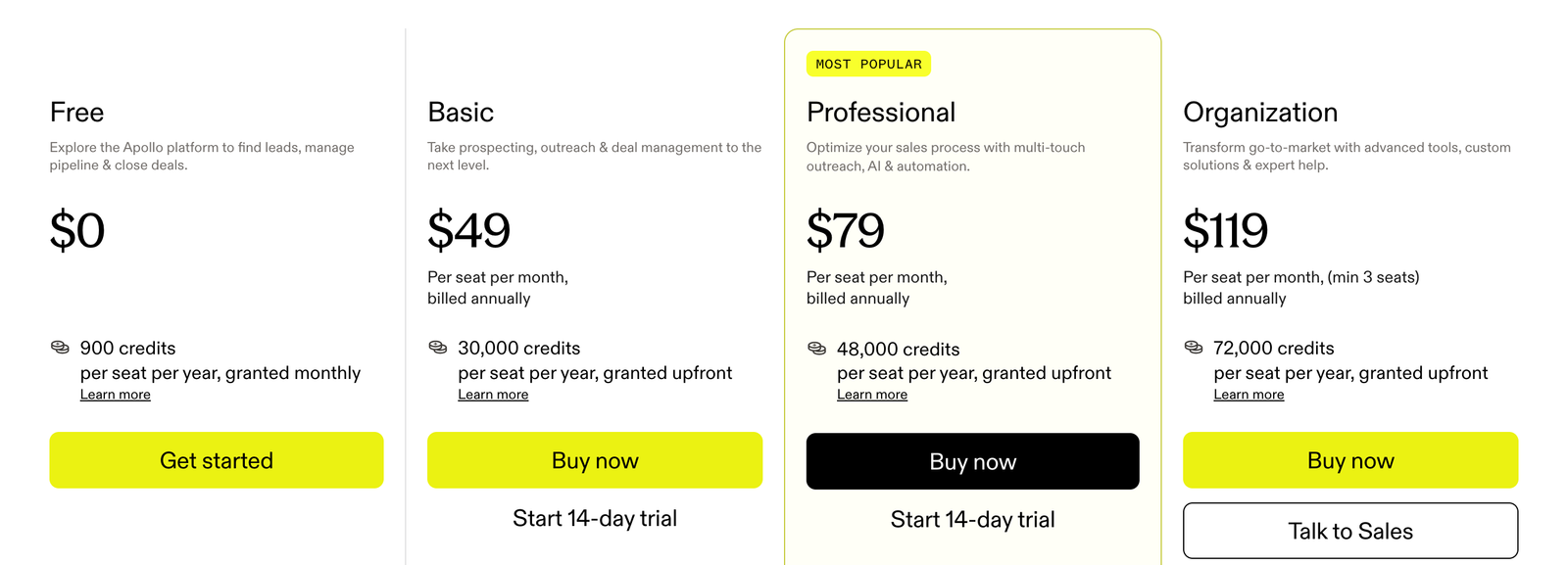
Apollo’s plan cards on November 19, 2026, with annual billing selected. Switch to monthly billing and Basic costs $65 a seat with 2,500 credits a month, Professional $99 with 4,000 credits; Organization is annual only. Prices exclude tax.
How Apollo bills: per seat, every seat on the same plan. Monthly billing is “Pay month-to-month, cancel anytime.” Annual billing is paid upfront for 12 months and can’t be downgraded mid-cycle.
Apollo credits: an email costs 1 credit, a phone number 8, and the US dialer 1 credit per 30 seconds. Credits are pooled across the team and don’t roll over.
Apollo add-ons: Inbound (website visitors, routing, forms) from $119 to $639 a month per team, and an Advanced Dialer (international, parallel and power dialing) at $119 a month per team, both billed annually.
How ZoomInfo bills: a quote for seats plus a credit allowance, paid in advance for one to three years. The free ZoomInfo Lite plan and GTM.AI, its pay-as-you-go API and MCP service, are the only published prices. The full breakdown is on our ZoomInfo pricing page.
Apollo has sold against ZoomInfo on exactly this point. In August 2023 co-founder Tim Zheng told TechCrunch that Apollo “allows monthly pricing rather than expensive multi-year contracts,” and named ZoomInfo as its main competitor.
What companies actually pay
Procurement platforms that see real contracts give the closest like-for-like numbers. These are estimates from their own customers, not list prices:
Benchmark | Apollo | ZoomInfo |
|---|---|---|
Vendr: median contract a year | $19,004 (102 purchases) | $33,500 (1,581 purchases) |
Vendr: low to high | $4,284 to $46,156 | $7,267 to $156,000 |
SpendHound: average a year, 50 to 1,000 employees | $9,885 | $48,724 |
SpendHound: average a year, 1,000+ employees | $51,741 | $226,925 |
What a team of 5 or 10 pays a year
Plan | 5 seats | 10 seats |
|---|---|---|
Apollo Basic, billed annually | $2,940 | $5,880 |
Apollo Basic, billed monthly | $3,900 | $7,800 |
Apollo Professional, billed annually | $4,740 | $9,480 |
Apollo Professional, billed monthly | $5,940 | $11,880 |
Apollo Organization, billed annually | $7,140 | $14,280 |
ZoomInfo | Quote only | Quote only |
Our calculation: Apollo’s list price × seats × 12 months, before tax and add-ons. Five Professional seats come with 240,000 pooled credits a year, enough for 240,000 emails or 30,000 phone numbers. ZoomInfo publishes no price per seat, so there is no like-for-like figure; Vendr’s median ZoomInfo contract of $33,500 is about 3.5 times the price of 10 Apollo Professional seats billed annually.
ZoomInfo’s plans: no prices on the page
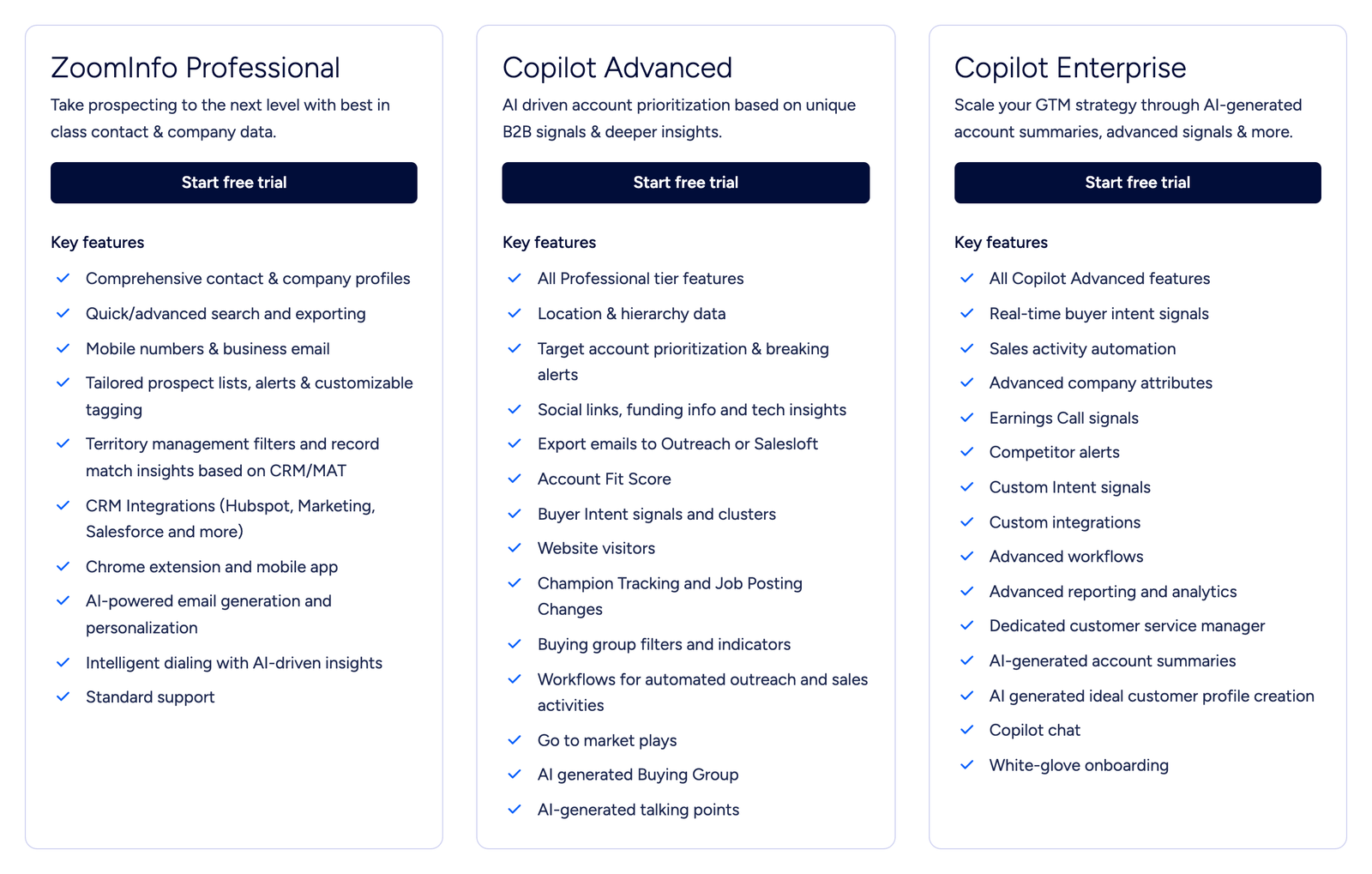
ZoomInfo’s sales plans on November 18, 2026: ZoomInfo Professional, Copilot Advanced and Copilot Enterprise, each with a free-trial button and no price. Its license terms say the agreement “is not cancellable” once signed.
Data: coverage and quality
Both companies count their own databases, and neither count is audited. ZoomInfo says it has 500M+ contacts, 100M+ companies, 200M+ verified business emails and 120M+ direct dials, verified with machine learning, partners and 300+ human researchers. Apollo says it has 240M+ contacts and 30M+ companies with 98% email accuracy.
ZoomInfo’s about page leads its comparison with “A larger database than Apollo.io, Lusha, and Cognism” and puts Apollo at 270M contacts and 70M companies, figures Apollo itself no longer uses. Apollo claimed over 270 million contacts in 2023, 224 million in November 2025 and 240 million by September 2026.
Where the data comes from: both crowdsource. Apollo describes a community-based approach that mixes contributor data with public data and third-party providers. ZoomInfo’s free Community Edition gives extra credits in return for reading your connected inbox.
Independent tests: Apollo commissioned the Tolly Group to run a month-long cold campaign in April 2026 (384 contacts at 205 companies), which reported a 2.37% email-to-meeting rate and a 45% open rate. We found no independent test of ZoomInfo’s data, and none that compares the two.
Phone numbers: ZoomInfo’s plans include mobile numbers from its entry sales plan; on Apollo a phone number costs 8 credits, so a Basic seat’s 30,000 annual credits cover 3,750 numbers (our calculation).
LinkedIn: in early 2025 LinkedIn temporarily delisted Apollo’s company page after a dispute, as Apollo’s own court filings say. Apollo alleges that ZoomInfo staff then told prospects it had been banned from LinkedIn; that is part of its false-advertising claim (below).
Features side by side
Feature | Apollo | ZoomInfo |
|---|---|---|
Email sequences | 2 on Free; unlimited on paid plans, with A/Z testing from Professional | Phone and email outreach; automated outreach workflows from Copilot Advanced; export to Outreach or Salesloft |
Daily email sends | 250 on Free and Basic, unlimited on Professional and Organization | Not published |
Dialer | US dialer on paid plans (credits apply); Advanced Dialer add-on | Intelligent dialing on ZoomInfo Professional |
Buyer intent | 1 topic on Free, 6 on Basic and Professional, 12 on Organization | Intent signals from Copilot Advanced; real-time and custom intent on Copilot Enterprise; 25 to unlimited topics on marketing plans |
Website visitors | 20 companies a month on Free, 100 on paid plans; up to 5,000 with the Inbound add-on | Up to 10 a day on the free plan; website visitors from Copilot Advanced |
Call recording | 150 minutes on Free and Basic, 4,000 on Professional, 8,000 on Organization | Conversation intelligence (Chorus) |
AI writing and research | AI writing from 5,000 to 1,000,000 words a month by plan; AI research on every plan | AI email writing on ZoomInfo Professional; AI account summaries on Copilot Enterprise |
CRM integrations | Salesforce, HubSpot, Outreach, Salesloft, Marketo and major email providers | Salesforce, HubSpot, Marketo, Eloqua, Dynamics, Zoho, Outreach, Salesloft and more |
API and AI assistants | API access listed on every plan; MCP server for ChatGPT, Claude, Cursor and others | GTM.AI API, MCP and CLI from 1,000 free credits, then pay per credit |
On AI, both now sell agents. Apollo’s AI Assistant came out of beta on March 4, 2026 with nearly 20,000 weekly users, and on September 30 it launched an Intelligence Layer and announced Builder Studio. ZoomInfo folded its Copilot AI into GTM Workspace in October 2025, opened GTM.AI on June 1, 2026 and added Agent Teams in October 2026.
Who each one is for
Spend data shows the split. Among businesses buying sales data tools, Apollo’s adoption is highest at micro and small businesses (44% and 41%) and still 30% to 31% at mid-market and enterprise companies. ZoomInfo’s is highest at mid-market and enterprise companies (32% and 31%) and falls to 18% and 14% at smaller ones. Across the whole category in November 2026, LinkedIn Sales Navigator led with 43%, Apollo had 39%, Clay 24% and ZoomInfo 21%, and Apollo was the fastest-growing vendor (Ramp).
Choose Apollo if you want to start free or pay month to month, you’re a founder or a small sales team buying with a card, or you want data, sequences and a dialer in one subscription.
Choose ZoomInfo if you want the largest contact and direct-dial count either company claims, you run account-based marketing with intent topics and ad audiences, or procurement can negotiate an annual contract.
Where each is heading: ZoomInfo is moving upmarket and cutting resources for smaller customers; 77% of its annual contract value came from upmarket customers in Q3 2026. Apollo is heading the same way from below: it reported 400% growth in enterprise accounts in the year to March 2026 and bought Pocus, a revenue intelligence platform.
Is there a ZoomInfo and Apollo lawsuit?
Yes. ZoomInfo Technologies LLC sued Zenleads Inc., the company behind Apollo, in the U.S. District Court for the District of Delaware in March 2025 (case 1:25-cv-00324). ZoomInfo says Apollo’s platform infringes two patents for predictive analytics that generate sales leads, U.S. Patents 10,380,609 and 11,392,964. Apollo says they came to ZoomInfo with its purchase of EverString.
Date | What happened |
|---|---|
March 2025 | ZoomInfo files the patent suit |
December 15, 2025 | The judge denies Apollo’s motion to dismiss, which argued the patents claim ineligible subject matter (court opinion) |
After that ruling | Apollo answers with four counterclaims: monopolization, false advertising, deceptive trade practices and interference with its business |
May 6, 2026 | The judge lets three of the four go ahead and lifts the stay on discovery for them; the deceptive trade practices claim is dismissed without prejudice (court opinion) |
Apollo’s counterclaims allege that ZoomInfo holds over 55% of the US sales intelligence data market, spent about $1 billion buying at least eight companies between 2015 and 2022, and used the patent suit and false statements about Apollo’s data and LinkedIn access to hold back competition. These are allegations: the May ruling found them plausible enough to proceed, not proven. Judge Jennifer Choe-Groves, of the U.S. Court of International Trade, hears the case by designation. We found no settlement, verdict or trial date in the public record as of November 19, 2026.
ZoomInfo vs Apollo vs Clay, and other matchups
ZoomInfo vs Clay: Clay works differently: it pulls data from 150+ partners in waterfalls and adds AI research, with a free plan (100 data credits and 500 actions a month), Launch from $185 a month and Growth from $495 ($167 and $446 billed annually). In Ramp’s spend data more of the businesses buying sales data tools now pay for Clay than for ZoomInfo (24% against 21%). More in our Clay profile.
ZoomInfo vs Lusha: Lusha publishes prices: a free plan with 40 credits a month, then Starter at $37.45 and Pro at $52.45 a month billed yearly. SpendHound’s customers with 50 to 1,000 employees spend $4,519 a year on Lusha on average.
ZoomInfo vs LinkedIn Sales Navigator: Sales Navigator works inside LinkedIn, with search filters, buyer intent and 50 InMails a month. Core costs $119.99 a month or $1,079.88 a year, Advanced $159.99 or $1,799.88. It is the most widely adopted tool in Ramp’s sales data category.
ZoomInfo vs 6sense: both are quote-only. 6sense sells Revenue Marketing, Sales Intelligence and 6sense Intelligence plans, all through its sales team.
ZoomInfo vs RocketReach: RocketReach publishes prices: Essentials (email only) at $329 a year, Pro at $829 and Ultimate at $1,699, with 1,200, 3,600 and 20,000 exports a year; team plans start at $6K a year.
A cheaper option if you sell to SaaS or AI companies
If your buyers are SaaS or AI companies, you may not need either subscription. LeadWave’s SaaS companies list costs $249 once for 15,000+ SaaS companies with verified CEO emails, and the AI companies email list costs $149 for the CEOs and founders of 9,000+ AI companies. That’s less than one Apollo Basic seat for a year ($588) and less than a tenth of one month at Vendr’s median ZoomInfo price. The lists cover companies and their CEOs and founders, not every employee, and they don’t include phone numbers.
More on ZoomInfo, Apollo and their rivals
ZoomInfo pricing: plans, real costs, credits and what changed in 2026
ZoomInfo company profile: revenue by year, market value, layoffs and who owns it
ZoomInfo CEO Henry Schuck: his background, pay and stake, and how to reach him
European alternatives to ZoomInfo: Cognism, Leadfeeder, Vainu and others that keep data in Europe
Sales SaaS companies: ZoomInfo and Apollo next to Gong, Outreach and the rest of the category
Lead generation SaaS companies: the data and prospecting tools both compete with
AI sales companies: Apollo among the AI-first sales tools
Fastest-growing SaaS companies: Apollo on Ramp’s and Brex’s growth lists
Clay company profile: the data enrichment tool in this comparison