
Gong doesn’t publish prices: you pay a yearly license for each user plus a platform fee, both quoted by its sales team, and the median buyer pays $55,359 a year across 1,161 purchases in Vendr’s data (November 2026). Per seat, Vendr’s buyers usually pay $1,200 to $2,400 a year (Vendr). Tropic, another procurement platform, puts the list price of Gong’s core license, Gong Foundation, at $1,600 per user a year.
The big change in 2026 is Gong Credits. Since late May, AI that runs in the background or at scale (question-based AI Trackers, the API and MCP server, Deep Mode and Gong Enrich) draws on a pool of credits instead of being covered by the seat. Each paid core seat includes 2,000 credits a year; more are sold in prepaid bundles. It follows the March 2025 repackaging that split Gong’s all-in-one license into Gong Foundation plus paid applications. Everything below was checked on November 20, 2026.
Gong pricing in 2026 at a glance
Option | Price | What you get |
|---|---|---|
Gong Foundation (core license, per user) | Quote only; Tropic’s list price $1,600 a year | Capture and analysis of calls, emails and web meetings, AI Smart Trackers, account pages and starter deal boards; 2,000 credits a year per seat |
Platform fee (per account) | Quote only; Tropic’s list price $50,000 a year, often waived | Charged on top of seats and based on the number of users |
Applications (per user) | Quote only; Tropic’s list prices $300 to $800 a year each | Enable Essentials, Forecast Essentials, Gong Forecast and Gong Engage; Data Cloud for data exports |
Call Intelligence seat | Quote only | Call recording, transcripts and Ask Anything on calls; no applications |
Collaborators | Free | Limited access for people without a seat |
Extra Gong Credits | Quote only, prepaid bundles | More AI Tracker, API and MCP use, Deep Mode and Gong Enrich contact data |
Free plan or self-serve trial | None | A demo, a product tour or a trial agreed with sales |
What companies actually pay for Gong
Three procurement platforms that see real contracts give the clearest numbers. They are estimates, and they differ because each sees different buyers:
Vendr: a median of $55,359 a year across 1,161 purchases, from $11,600 at the low end to $205,110 at the high end; its buyers saved 14% on average. Per seat, they usually pay $1,200 to $2,400 a year: about $70,000 to $110,000 a year for 50 seats and $240,000 to $360,000 for 200 seats.
SpendHound: an average of $82,423 a year at companies with 50 to 1,000 employees and $650,635 at larger ones, from 160 Gong customers, updated October 29, 2026. Among its customers, Gong prices rose 31.75% in a year for smaller companies and 22.11% for enterprises.
Tropic: list prices of $1,600 per user a year for Gong Foundation plus a $50,000 annual platform fee since March 2025, up from $10,000; Enable Essentials and Forecast Essentials at $300 per user, Gong Forecast at $700 and Gong Engage at $800. Its customers pay less than list: the middle half pay $1,000 to $1,349 per user for the old Professional license, $642 to $761 for Engage and $475 to $603 for Forecast (Tropic).
The repackaging shows in the numbers. Tropic says customers now pay around $1,400 for Gong Foundation where they paid $1,000 for Gong Professional a year earlier, and calls it plainly: “The new pricing model means buyers pay about the same but get less.” SpendHound’s averages sit above Vendr’s median mostly because of size: an average is pulled up by very large deployments, and Gong has some (Cisco has deployed 18,000 Gong licenses).
Gong cost per user and per month
There is no monthly plan and no published price per seat. Contracts run for a year or more; Gong’s AWS Marketplace listing offers 12-, 24- and 36-month terms, with every product available through private offer only. At Vendr’s $1,200 to $2,400 per seat a year, a seat costs $100 to $200 a month, and Tropic’s $1,600 list price is about $133 a month (our calculation). A whole contract at Vendr’s median comes to about $4,610 a month (our calculation). The platform fee and any applications come on top of the seat price.
Gong pricing for small teams and one person
Gong doesn’t sell to individuals. Its pricing form starts at teams of 1 to 50, every deal goes through sales, and Vendr says contracts typically have a minimum of 10 to 15 seats, with small teams paying more per seat: $1,600 to $2,400 a year. At those rates a 10-seat team pays $16,000 to $24,000 a year before the platform fee (our calculation); Vendr’s smallest deals total about $11,600 a year. For one person or a team of two or three, a note-taker priced per user per month costs a fraction of that; several are among the European alternatives to Gong.
Minimum seats and the platform fee
Gong publishes no minimum; Vendr puts it at typically 10 to 15 seats. The platform fee is charged per account on top of seats, and Gong says only that it is “based on the number of users supported”. Tropic’s $50,000 is a list price, and Vendr’s smallest deals total $11,600 a year, so many buyers pay far less or have the fee waived. SpendHound says 36-month terms can get the platform and implementation fees waived, commonly worth $7,500 or more.
Gong implementation cost
Implementation is sold as a package on the order form, with no public price. Gong’s service terms list Standard (up to five remote sessions), Advanced, Gong Essentials (up to three one-hour calls) and add-ons for Forecast (up to 12 hours) and Engage. Unused hours expire: 30 days after the start for Standard and Essentials, 60 days for Advanced and 90 days for the Forecast add-on. Premium Support, with a 6-hour first response, is a separate paid package.
Gong enterprise pricing
Large accounts are where Gong makes its money. SpendHound’s enterprise average is $650,635 a year, Vendr puts 200 seats at $240,000 to $360,000 a year, and Gong says it added more $1M+ customers in the two quarters to May 2026 than in the previous six combined. Gong’s annual recurring revenue passed $500 million that month, growing over 55% a year.
Gong’s plans and what each one includes
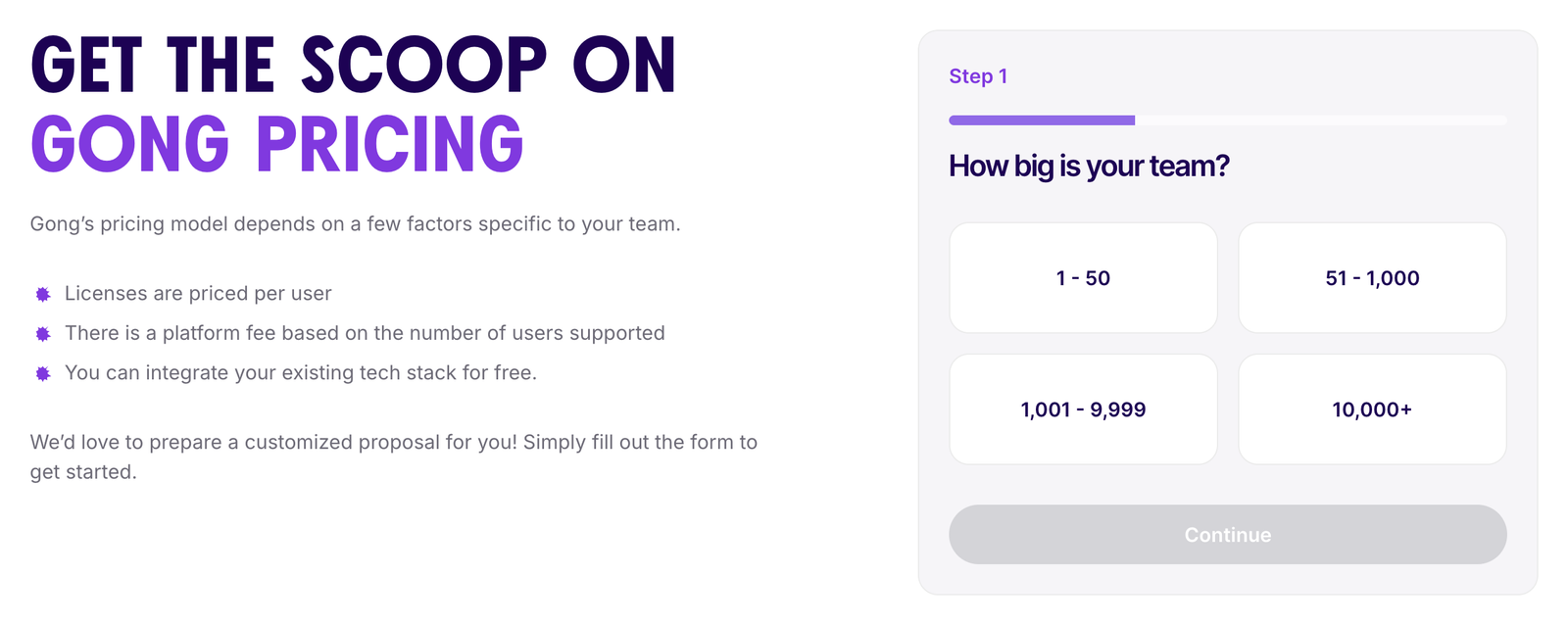
Gong’s pricing page on November 20, 2026: three rules and a team-size form, no prices.
Behind the form, a Gong contract is built from seats. Every user who records and analyses calls needs a core license, and applications are added per user on top.
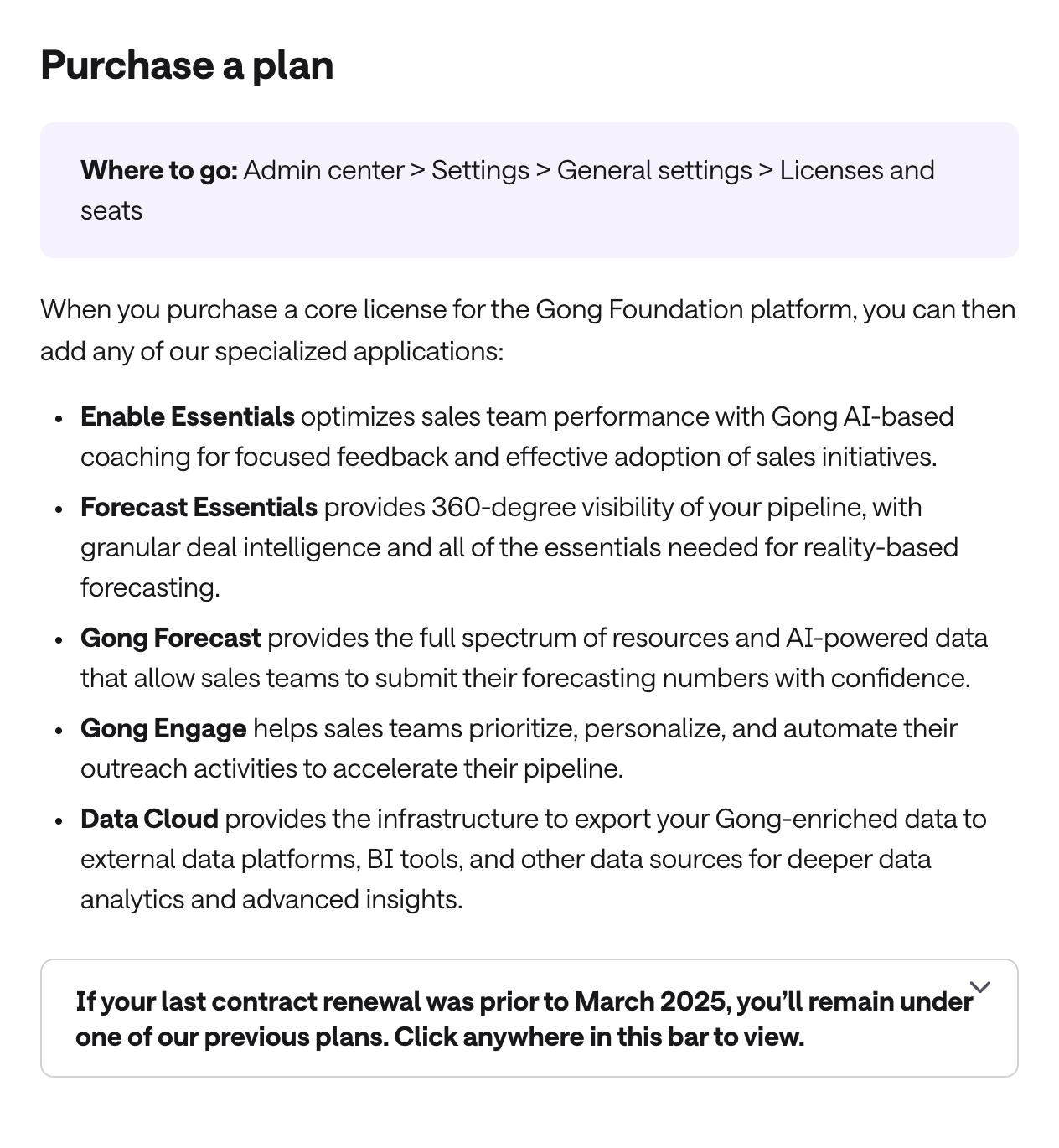
How Gong’s help center lays out a plan, as of November 20, 2026 (article updated January 8, 2026).
Gong Foundation: the core license. It captures and analyses calls, emails and web meetings and includes AI Smart Trackers, account pages and starter deal boards, plus 2,000 Gong Credits a year per seat.
Call Intelligence seat: a narrower core seat with call recording and transcription, call collaboration, Ask Anything on a call, CRM mapping and the mobile app. Applications can’t be added to it.
Enable Essentials: AI-based coaching for sales teams.
Forecast Essentials and Gong Forecast: pipeline visibility and deal intelligence, and the full forecasting product.
Gong Engage: sales engagement, to prioritize, personalize and automate outreach.
Data Cloud: exports Gong data to data platforms and BI tools.
Collaborators: people without a seat get limited access, free of charge.
Customers whose last renewal was before March 2025 stay on the old plans until they renew: Gong Core Professional, Gong Forecast and Gong Engage for those who joined between 2022 and 2025, and Coaching, Professional and Enterprise before that. At renewal they move to Gong Foundation, and Gong adds Forecast Essentials seats so users keep the deal features they had, at no extra cost. Seats added after the renewal are paid for separately.
How Gong Credits work
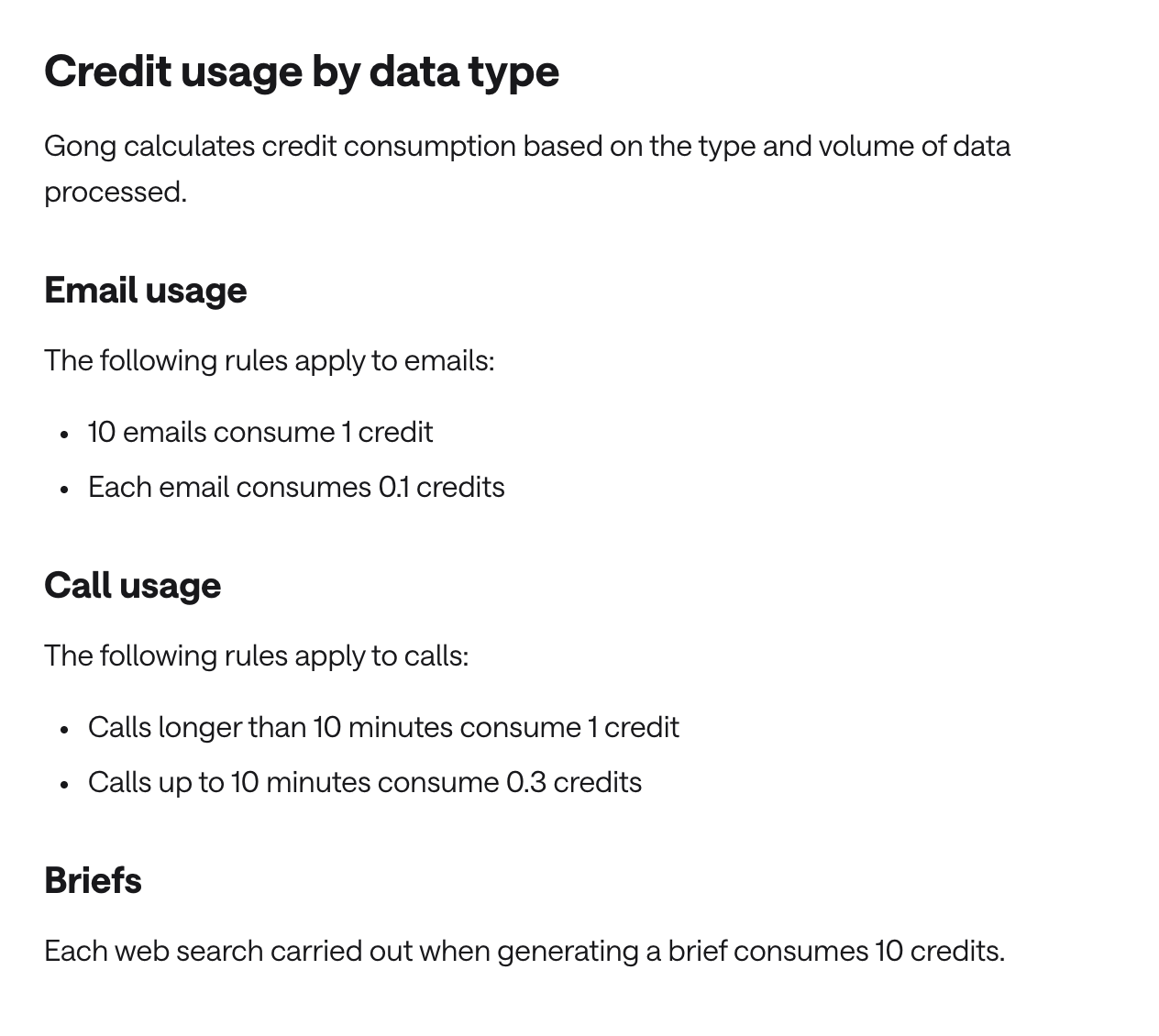
Gong’s credit rates as published on November 20, 2026 (article updated November 18, 2026).
Credits pay for AI that runs in the background or at scale: question-based AI Trackers, the AI Ask Anything and AI Briefer APIs, the MCP server, Deep Mode, automated briefs, AI Data Extractor and Gong Enrich.
Everyday AI stays in the seat: call summaries, coaching, deal and forecast insights, pre-trained trackers, and briefs or questions a user runs by hand.
Each paid core seat brings 2,000 credits a year into one shared pool. Application seats bring none. The pool resets each contract year and unused default credits don’t roll over.
Extra credits are sold in prepaid bundles through your account team and expire at the end of your contract term. Self-serve buying and automatic top-ups are promised for a later release.
Gong Enrich, which fills in contact details from outside data providers, uses one credit for each email address or phone number it returns, and nothing when it finds no data.
There are no overage charges. When the pool runs out, AI Trackers stop processing new calls and API and MCP requests return errors until you add credits.
Automated custom agents get 1,200 promotional credits per seat, available through February 7, 2027.
A worked example (our calculation): a 20-seat team gets 40,000 credits a year. One AI Tracker reading 1,000 calls a month that each run over 10 minutes uses 12,000 of them; the same tracker over 20,000 emails a month uses another 24,000. A tracker’s first run over past calls and emails also uses credits, and Gong shows an estimate before you publish it.
Gong says most customers won’t pay more, calling credits “a deliberate choice Gong made to avoid raising seat prices across the board”. Teams that lean on trackers, the API or Gong Enrich are the ones who will buy bundles.
Is Gong free?
No. Gong has no free plan and no self-serve trial with a price: every plan starts with a sales conversation and a quote, with no self-serve sign-up. Gong’s terms allow an evaluation period that Gong can end at any time, so ask for a trial on your own calls during the sales process.
A few things are free: collaborators, people without a seat, get limited access at no charge; integrations with your existing tools cost nothing extra; and anyone can take the product tour on Gong’s website.
Add-ons, fees and contract terms
Gong’s standard terms and conditions set the rules unless your order form says otherwise:
Auto-renewal: subscriptions renew for another year unless either side gives written notice, email included, at least 60 days before the term ends.
Cutting seats costs you the discount: a renewal with fewer seats or a shorter term is re-priced “without regard to the prior term’s per-unit pricing”.
Promotional prices end: a promotional or one-time price renews at Gong’s list price.
No refunds: “Payment obligations are noncancelable and fees are non-refundable”. Invoices are due within 30 days, and late payments cost 1.0% a month.
Fewer seats mid-term: you can’t reduce licenses yourself; your account’s Revenue Architect handles it, subject to your contract. Seats bought inside Gong mid-term are prorated to the end of the term.
Add-ons: applications are priced per user, extra credits come in prepaid bundles, and implementation and Premium Support are separate packages. Vendr says modules added mid-contract cost 15% to 30% more per seat than modules bought at signing.
Buying through AWS: Gong also sells on AWS Marketplace, by private offer only, on 12-, 24- or 36-month terms.
Gong’s pricing page used to spell out the platform fee: “A fixed annual subscription—on top of the seat price—based on number of users supported.” In 2023 and 2024 it said that fee covered unlimited collaborators, unlimited data storage and export, customer success resources and support.
What changed: Gong pricing from 2024 to 2026
When | Change |
|---|---|
2023 to September 2024 | The pricing page says “All licenses offered by Gong are priced per recorded user”, plus a fixed annual platform subscription |
November 2024 | The page shrinks to three points: licenses priced per user, a platform fee based on users supported, free integrations |
March 2025 | New plans: a Gong Foundation core license plus paid applications (Enable Essentials, Forecast Essentials, Gong Forecast, Gong Engage, Data Cloud); older plans move over at renewal |
April 16, 2025 | Gong launches over a dozen AI agents for revenue teams |
June 2025 | The pricing page is retitled “Gong Revenue AI Pricing”; Gong counts 4,500+ customers |
December 2025 | The page asks for team size first, from 1-50 to 10,000+; 5,000+ customers |
May 12, 2026 | Annual recurring revenue passes $500 million, growing over 55% a year |
Late May 2026 | Gong Credits: heavier AI use moves to a shared credit pool, with seat prices unchanged, Gong says |
September 30, 2026 | Gong Enrich, Agent Builder and Deep Mode launch at Celebrate ’26; Enrich and Deep Mode use credits |
November 2026 | Each paid core seat includes 2,000 credits a year; custom agents get 1,200 promotional credits per seat through February 7, 2027 |
Archived copies of the pricing page show the same model throughout: a price per user plus a platform fee. What changed is what a seat includes. Co-founder and product chief Eilon Reshef explained credits in May 2026: with agents now set up “with simple prompts”, Gong “wanted to make sure we don’t let infrastructure economics (i.e. LLM costs) be the ceiling on what our customers can automate.”
What this means if you’re buying or renewing
Diary the notice date: the standard terms renew for a year unless you give notice 60 days before the end, and SpendHound says “Gong’s 60-day non-renewal clause exceeds industry norms.” Vendr advises starting renewal talks 90 days or more ahead.
Don’t cut seats without a new price in writing: fewer seats at renewal means re-pricing without your old per-seat rate. Agree the per-seat price for the lower count before you sign.
Go after the platform fee: Tropic says Gong is often open to waiving platform fees or giving one-time credits, and SpendHound says 36-month terms can get platform and implementation fees waived.
Buy applications at signing: Engage or Forecast added mid-contract cost 15% to 30% more per seat in Vendr’s data. Give people who only listen to calls free collaborator access instead of a seat.
Size your credits: check the Gong Credits report before renewal. If you rely on AI Trackers, the API, MCP or Gong Enrich, price a credit bundle into the deal rather than buying it later.
Use competition and timing: Vendr says deals at quarter-end or year-end often get 10% to 20% better pricing, and that quoting rivals such as Chorus, Clari or Outreach unlocks more.
Filling the pipeline Gong analyses
Gong works on conversations your team is already having; it doesn’t find the accounts. If you sell to SaaS or AI companies, LeadWave’s SaaS companies list costs $249 once for 15,000+ SaaS companies with verified CEO emails, and the AI companies list costs $149 for 9,000+ AI companies with CEO emails and LinkedIn profiles. Either costs less than one Gong seat at its $1,600 list price. The lists cover companies and their CEOs and founders, not every employee. Load them into your CRM and let Gong record what follows: start with the list of SaaS companies.
More on Gong and its rivals
European alternatives to Gong: Modjo, Jiminny, Kickscale and others, with prices and where they host data
ZoomInfo pricing: what ZoomInfo, which also sells Gong rival Chorus, charges and what buyers pay
Outreach pricing: the sales engagement platform Gong Engage competes with
Sales SaaS companies: Gong next to the rest of the sales software category
AI sales companies and AI SaaS companies: where Gong sits among AI-first sales tools
AI note-taker companies: lighter, cheaper tools for recording and summarizing calls
Fastest-growing SaaS companies: Gong’s ARR from $300 million to $500 million
List of SaaS unicorns: Gong at $7.25 billion, its 2021 valuation