PitchBook doesn’t publish prices: every licence is quoted by its sales team and priced mainly by the number of users, and US government orders from 2024 to 2026 show $7,500 to $10,500 per seat a year for teams and $24,300 for a single seat. Third-party contract data puts the typical PitchBook contract at about $31,750 a year. Across all customers, PitchBook earned about $5,900 per licensed user in 2025 (our calculation).
The big change in 2026 is AI. PitchBook data now works inside Claude, ChatGPT and Perplexity through PitchBook’s own connector, included at no extra charge for subscribers, and PitchBook is piloting connector-only seats and pay-per-use access while it raises prices at renewal. In November it also opened free access for startups that haven’t raised an institutional round. Everything below was checked on November 20, 2026.
PitchBook pricing in 2026 at a glance
Option | Price | What you get |
|---|---|---|
PitchBook platform, one seat | Quote only; $24,300 a year in a 2025 government order | Desktop, mobile app, Excel and PowerPoint plug-ins and the Chrome extension |
PitchBook platform, a team | Quote only; $7,500 to $10,500 per seat a year in 2024–2026 government orders | The same, priced per licensed user; the price per seat falls as seats rise |
Direct Data (API and data feeds) | Quote only; one feed licence cost $21,000 a year in a 2026 government order | PitchBook data in your own systems, priced by volume, refresh frequency and technical specs |
Premium connector (Claude, ChatGPT, Perplexity) | Included for subscribers “at no additional charge today” | Most of the platform’s data inside AI assistants; not PitchBook’s own scores and valuation estimates |
Connector-only seats | Pilot; price not published | AI-assistant access for extra users, next to at least one full platform licence |
PitchBook for Startups | Free | Platform access for founders seeking a first institutional round, in exchange for sharing their financials |
Free trial | Free, on request | Granted after a form and a sales call; no published length |
What companies actually pay for PitchBook
PitchBook prices are private, so the best public numbers come from three places:
Vendr’s contract data: a median of about $31,750 a year, with deals from $20,000 to $122,500, as read by FundedIQ on August 22, 2026. These are estimates from anonymised contracts, not PitchBook prices.
Customer reports collected by Failory (January 2024): $12,000 and $13,500 a year for one seat, $18,000 to $24,000 a year for three seats, and one buyer quoted $7,000 a seat with a five-seat minimum.
Government purchase records, which have to be public: per-seat prices from $7,500 to $10,500 for teams of 3 to 21 users, and $24,300 for one seat (details below).
PitchBook’s own filings give the average. Morningstar, which owns it, says pricing “is primarily based on the number of licensed users, with customized pricing available for large enterprises, boutique firms, and startup clients” (Morningstar 10-K). In 2025 PitchBook made $671.8 million from about 10,200 client accounts and 113,451 licensed users: about $66,000 per account and $5,900 per user (our calculation). That average includes data feeds and large enterprise accounts, so small teams pay well above it.
PitchBook cost per seat, per user and per year
Count on $7,500 to $10,500 per user a year for a team, and about $24,000 for a single seat. The per-seat price falls with volume: an average client account has about 11 users (our calculation), and large firms pay far less per seat than a one-person buyer. Add-ons such as Direct Data and CRM Integration are priced on top.
PitchBook cost per month
There is no monthly plan: licences are annual or multi-year. At $8,000 a seat, a PitchBook licence works out to about $667 per user per month; a single $24,300 seat is about $2,025 a month; and the $31,750 median contract is about $2,646 a month (our calculation).
PitchBook for one person or a small firm
One person can buy a seat, but it’s the most expensive way in. The US Military Academy at West Point paid $24,300 for one standard platform subscription for a year in March 2025, about three times the per-seat price agencies with 10 to 21 users paid (our calculation). PitchBook’s pricing page says it is “geared towards sophisticated investment professionals” and that cost depends on “how many seats you need and your firm type.”
What customers say they pay
Government buyers publish their PitchBook orders, so they are the clearest record of real prices. Here is what six of them wrote down, from one seat to a data feed:
“One (1) subscription for a PitchBook standard platform subscription for a period of performance of one year”
— the US Military Academy at West Point, which paid $24,300, March 2025
“Standard platform subscription authorized users: (3) USD 27,000.00”
— the US Department of Education, April 2023
“The purpose of this action is for the PitchBook subscription renewal … for 19 users/seats (at $7,500 per seat)”
— the US Department of Energy, September 2025
“Call for $96,000.00 (12 users at $8,000 ea) for web-based investor database licenses for option year 1 of PitchBook’s BPA”
— the US Department of Energy, a year later, September 2026
“PitchBook - standard platform subscription authorized users: (15) for the National Security Division (NSD)”
— the US Justice Department, which paid $157,500, August 2026
“This call orders 1 user license for web-based investor database ($8,000.00) and 1 direct data feed license ($21,000.00)”
— ARPA-E, the Energy Department’s research agency, September 2026
Together they show three things. A team seat costs $7,500 to $10,500 a year, and a lone seat about three times that. A direct data feed licence costs more than a seat. And prices rise at renewal: the same Energy Department agreement went from $7,500 to $8,000 a seat in a year, up 6.7% (our calculation). Government buyers may get public-sector terms, and Failory’s 2024 reports of $12,000 to $13,500 for one seat are lower and older, so treat all of these as reference points, not list prices.
Buyer | Order date | Users | Price a year | Per user (our calculation) |
|---|---|---|---|---|
US Military Academy at West Point | March 2025 | 1 | $24,300 | $24,300 |
US Department of Education | April 2023 | 3 | $27,000 | $9,000 |
US Department of Labor (EBSA) | September 2024 | 10 | $80,000 | $8,000 |
FBI (with research add-ons and the CRM plug-in) | September 2024 | 21 | $168,000 | $8,000 |
US Department of Energy | September 2025 | 19 | $7,500 per seat | $7,500 |
US Department of Energy | September 2026 | 12 | $96,000 | $8,000 |
US Justice Department, National Security Division | August 2026 | 15 | $157,500 | $10,500 |
Bigger buyers spend far more. The State Department’s yearly PitchBook order grew from $463,336 in September 2023 to $756,962.94 in September 2026, and Global Affairs Canada signed a CAD 420,925 platform subscription for March 2026 to March 2027, about US$309,000 at the Bank of Canada rate of 1.3613 on March 6, 2026 (our calculation).
PitchBook’s plans and what each one includes
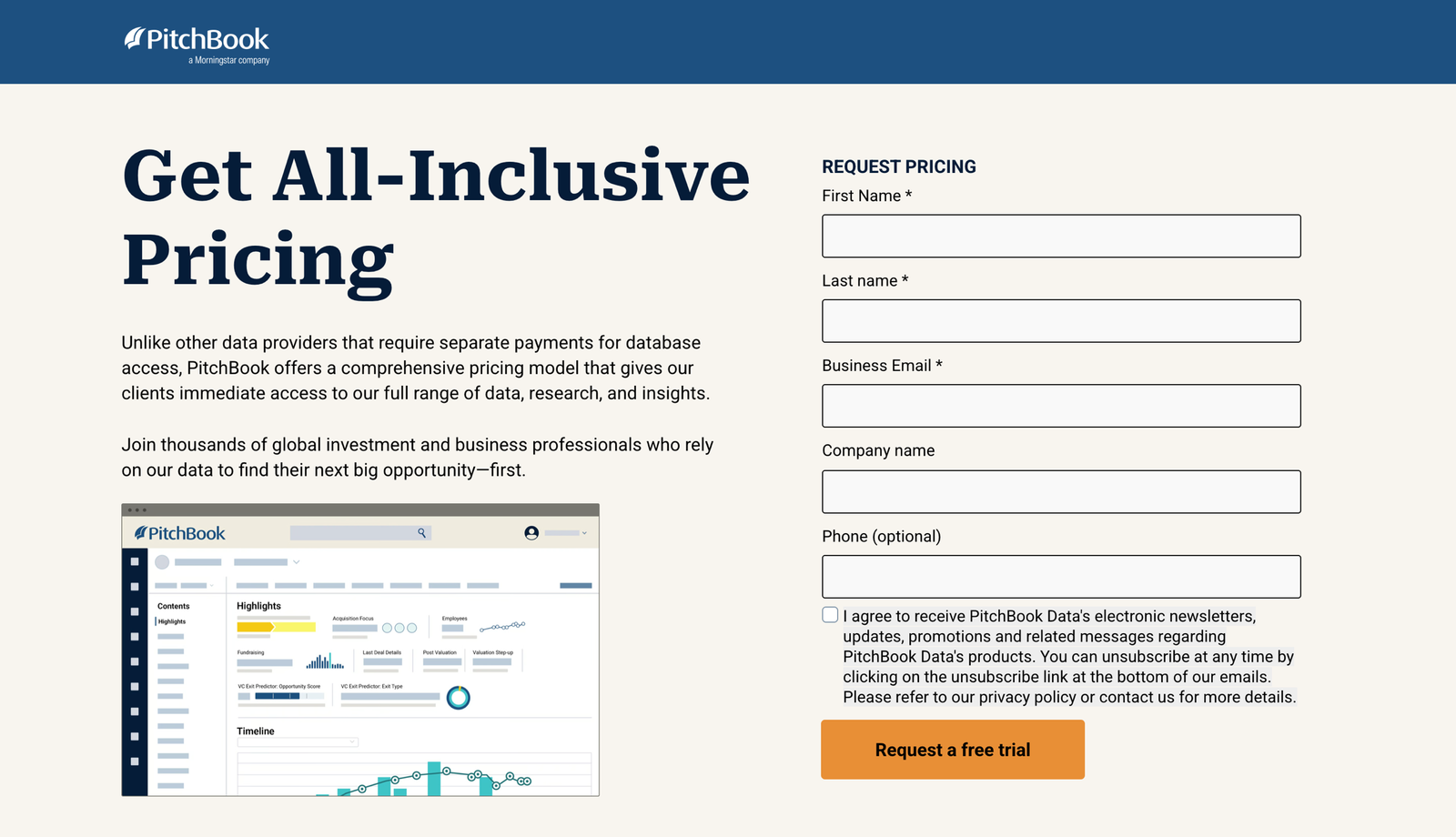
PitchBook’s pricing request page as it looked on November 20, 2026. There are no plans or prices on it, only a form that leads to a sales call.
PitchBook sells one main product, the platform, and prices extras on top. The names below come from PitchBook’s pages and from customers’ order records:
Standard platform subscription: company, deal, investor, fund, limited partner, people and credit data, with the desktop app, mobile app, Excel and PowerPoint plug-ins and Chrome extension included.
Research add-ons: government orders list PitchBook Emerging Technology Research, Morningstar Equity Research and a CRM plug-in next to the platform.
Direct Data: the API or a scheduled data feed, priced “by data volume, refresh frequency, and technical specifications”; it doesn’t need a platform licence.
CRM Integration: PitchBook data inside your CRM, named on the pricing page as a premium offering.
Leveraged Commentary & Data (LCD): PitchBook’s credit news and data, bought as its own subscription.
Lumonic: portfolio monitoring for institutional investors, bought in 2025.
New in late 2026: PitchBook AI, in preview with a limited group of clients, and PitchBook Origin, a deal-sourcing tool sold on its own or as an add-on, with no published price.
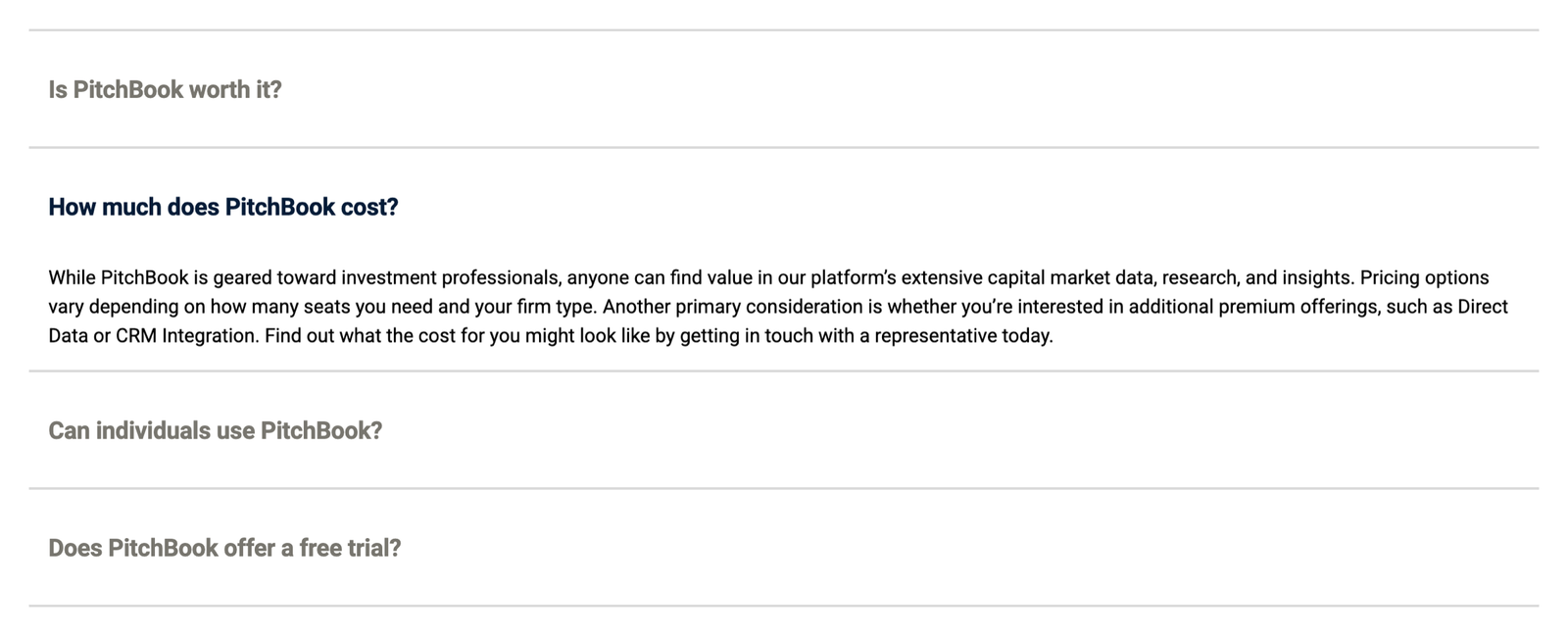
PitchBook’s own answer to “How much does PitchBook cost?”, on its pricing page as archived on July 28, 2026; the same answer has been there since at least October 2024.
Is PitchBook free?
Not for most buyers: there is no free plan. There are four ways to use PitchBook without paying for a seat:
PitchBook for Startups, launched November 10, 2026 at Web Summit: free platform access for founders who have bootstrapped or raised only from angels, grants or accelerators and are seeking a first institutional round. The price is your data: you share financials and details on your team and product (SiliconANGLE).
Students use their university’s licence. PitchBook’s pricing form has asked “Are you a student?” since late 2025, and university licences come with limits: Purdue’s allows 10 downloads per day and 25 per month per user.
AI assistants: PitchBook’s Essential connector gives limited data to people without a licence, with the AI company or enterprise partner paying PitchBook on their behalf.
A free trial, on request. PitchBook’s FAQ says “Fill out a form and we’ll see if a free trial might be right for you.” It doesn’t publish a length, and a sales rep books a call first.
PitchBook API, data feed and MCP pricing
API and data feeds: sold as Direct Data, separately from the platform licence. One feed licence cost $21,000 a year in a September 2026 order, and the US Treasury pays $332,641.05 a year for the data feeds its foreign-investment reviewers use.
Premium connector (MCP): paying subscribers can use PitchBook data “through premium connectors in platforms like Claude and ChatGPT at no additional charge today,” Morningstar said in August 2026, adding that it can price them separately later (Morningstar investor Q&A).
Connector-only seats: being piloted; they still need “at least one full PitchBook platform license.” A separate direct MCP service with consumption-based pricing is in testing.
What AI access leaves out: PitchBook’s VC Exit Predictor, Manager Scores and Valuation Estimates stay inside the platform.
Contract terms, renewals and price increases
Term: Morningstar’s license agreements “typically range from one to three years,” and it invoices some clients in advance. There is no monthly option; Failory’s buyers reported that only annual licences are offered.
Minimum seats: none published. One buyer was told five seats was the minimum at $7,000 a seat; West Point bought a single seat.
Renewal increases: PitchBook “seeks expansion at renewal, including price increases where appropriate,” and decides price “on a contract-by-contract basis,” Morningstar told investors in March 2026 (Morningstar investor Q&A). Revenue per client rose in 2025.
What that looks like: a Justice Department office renewed for $40,000 in 2024, $44,000 in 2025 and $48,000 in 2026, rises of 10% and 9.1% (our calculation); the Energy Department’s per-seat price rose 6.7%.
Caps: none of the public orders we found shows a cap on renewal increases, so ask for one in your order form.
What changed: PitchBook pricing from 2024 to 2026
When | Change |
|---|---|
October 2024 | The pricing page shows no prices: a request form and an FAQ saying cost depends on seats, firm type and premium offerings such as Direct Data or CRM Integration |
2024 annual report | Pricing is “based on the number of seats, with standard base license fees per user”; renewal rate about 107% |
2025 | PitchBook buys Lumonic, a portfolio monitoring tool |
Late 2025 | The Premium connector launches: subscribers can use PitchBook data in AI assistants at no extra charge |
By December 2025 | The pricing page is redesigned and its form asks “Are you a student?” |
February 2026 | The 2025 annual report shows the renewal rate falling to about 103% from 108%, with more churn among corporate clients |
March 2026 | Morningstar confirms price increases at renewal “where appropriate” |
By May 2026 | Paid Perplexity users with a PitchBook subscription get the Premium connector |
June 2026 | The Essential connector gives limited data to AI users without a licence, paid for by the AI partner |
August 2026 | Morningstar is “actively evaluating a more modular approach” to PitchBook pricing and pilots connector-only seats |
September 2026 | An Energy Department renewal shows the per-seat price rising from $7,500 to $8,000 |
October 2026 | Q3 revenue grows 3.9% to $175.6 million; licensed users reach 118,684, now counting connector-only users; PitchBook AI enters preview |
November 10, 2026 | PitchBook for Startups opens free access for early founders; PitchBook Origin launches |
The pressure behind the changes shows in the numbers. PitchBook revenue grew 8.6% in 2025 but only 3.9% in the third quarter of 2026, with “particular softness in the corporate and venture capital client segments, which continued to experience higher churn.” Morningstar says some clients want seat licences while “others are shifting toward value- or consumption-based models.”
What this means if you’re buying or renewing
Buy seats in a block: one seat costs about three times the per-seat price of a 10-seat team. If several people need access, quote them together.
Plan for a renewal increase: recent renewals rose 6.7% to 10% a year. Ask for a written cap and a multi-year price before you sign; one buyer cut $25,000 to $20,000 a year with a two-year commitment.
Ask about connector-only seats: if some colleagues only need PitchBook answers inside Claude or ChatGPT, the pilot lets you add them next to one full licence.
Price data feeds separately: Direct Data doesn’t need a platform licence, so a team that only feeds a CRM or a model may not need seats at all.
Founders: apply before you pay. If you haven’t raised an institutional round, PitchBook for Startups is free in exchange for your company data.
Compare quotes: Dealroom publishes €250 per seat a month at 10 seats (€30,000 a year, 3-seat minimum), and Vendr puts Preqin’s median at $49,334 a year. CB Insights, like PitchBook, quotes seat-based prices privately.
A cheaper option if you only need investors or SaaS companies
PitchBook is built for deal and fund research: valuations, deal histories and fund returns. If the job is a list of investors to pitch or SaaS companies to sell to, a one-off list costs a fraction of a seat. LeadWave’s 800 Search Funds List costs $49 one-time for 830+ search funds with 870+ decision makers’ emails. The VC firms list (3,600+ firms, 2,700+ emails) and the private equity firms list (920+ firms, 270+ emails) are on a waitlist at a $99 launch price, and the SaaS companies list covers 15,000 SaaS companies with CEO emails for $249. None of them has deal data, valuations or fund returns, so they don’t replace PitchBook for diligence. Browse every list free in LeadWave’s investor database.
More on PitchBook and private-market data
Investor database: VC firms, private equity firms, search funds and angels, by sector and city
List of VC firms: 3,600+ venture firms with a decision maker for each
List of search funds: 830+ search funds and their searchers
List of private equity firms: 920+ firms, from buyout to growth equity
Seattle SaaS companies: PitchBook next to Outreach, Highspot and its hometown peers
Washington SaaS companies: the state’s software companies, PitchBook included
ZoomInfo pricing: what the B2B contact database costs in 2026