Skip to content

Acquisition

Champagne Outbound: Brex's Gift-and-Note Campaign to Newly Funded Startups (75% Demo Rate)

Send a gift and a handwritten note from your CEO to companies at the moment they need you, then follow up by email. Brex's version turned 300 bottles into ~169 customers.

Champagne outbound: real examples from Brex, Brex, EchoSign
Impact
High
Effort
Medium
Time to results
Weeks
Budget
Needs a budget
Team
Sales, SDR

Tools for this growth idea

  • Clay
  • Apollo.io
  • LinkedIn
  • HubSpot

What Brex did

Brex launched in 2018 as the first corporate card for startups. Shortly after launch, with about 30 employees and almost no revenue, it ran what Sam Blond, later its CRO, calls the most successful outbound campaign he has ever seen (Sam Blond on LinkedIn):

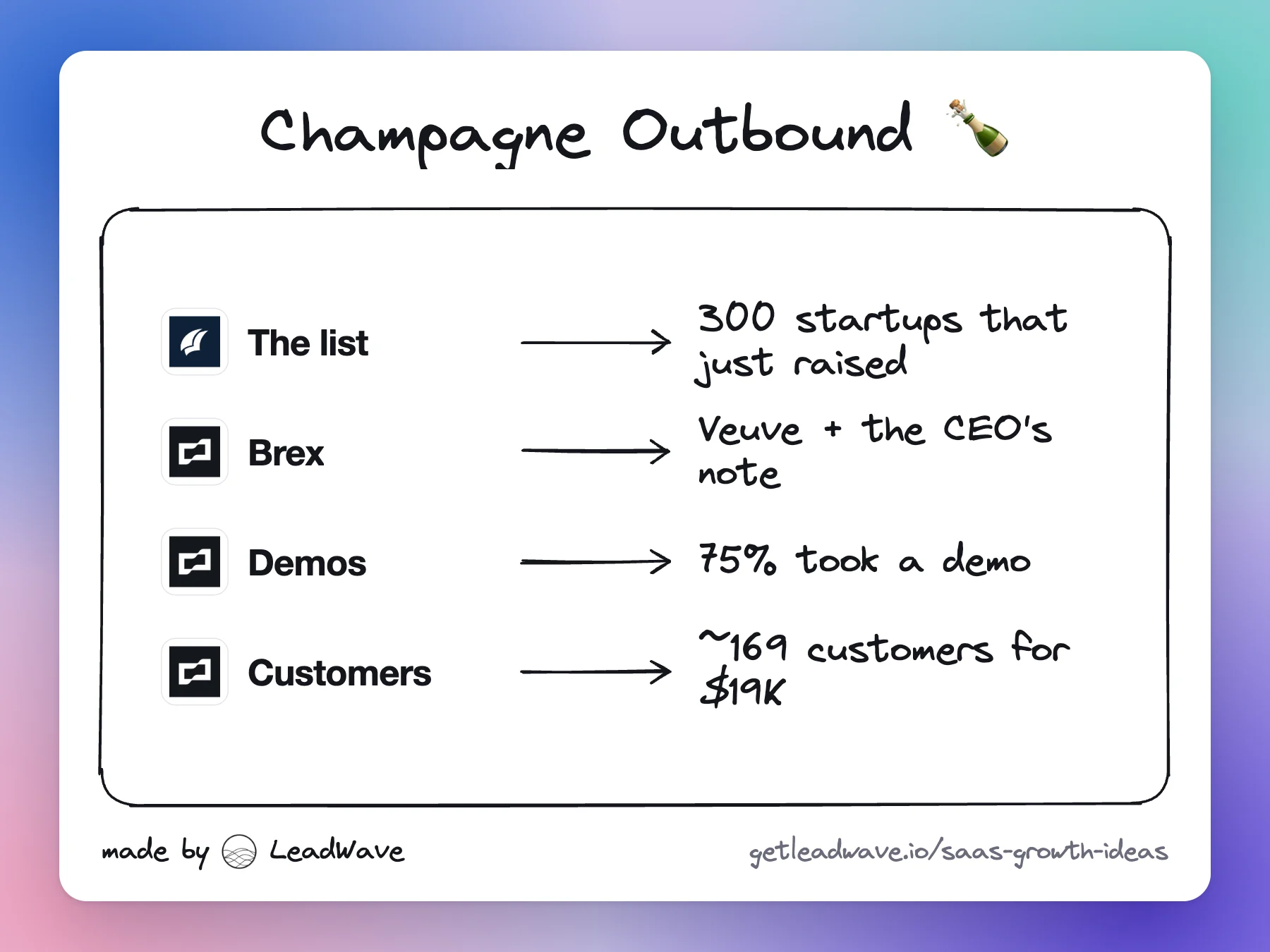
  1. The list. A PitchBook report of seed to Series B startups in the Bay Area that had raised a round in the last six months: about 300 companies.
  2. The gift. 300 bottles of Veuve Clicquot at about $50 each, delivered to each company's founders.
  3. The note. Handwritten, from the CEO, along the lines of: "Congrats on your recent fundraise! We know how hard it is to build a startup and we're rooting for you."
  4. The follow-up. Shortly after delivery, the CEO emailed asking if they'd be open to a demo.
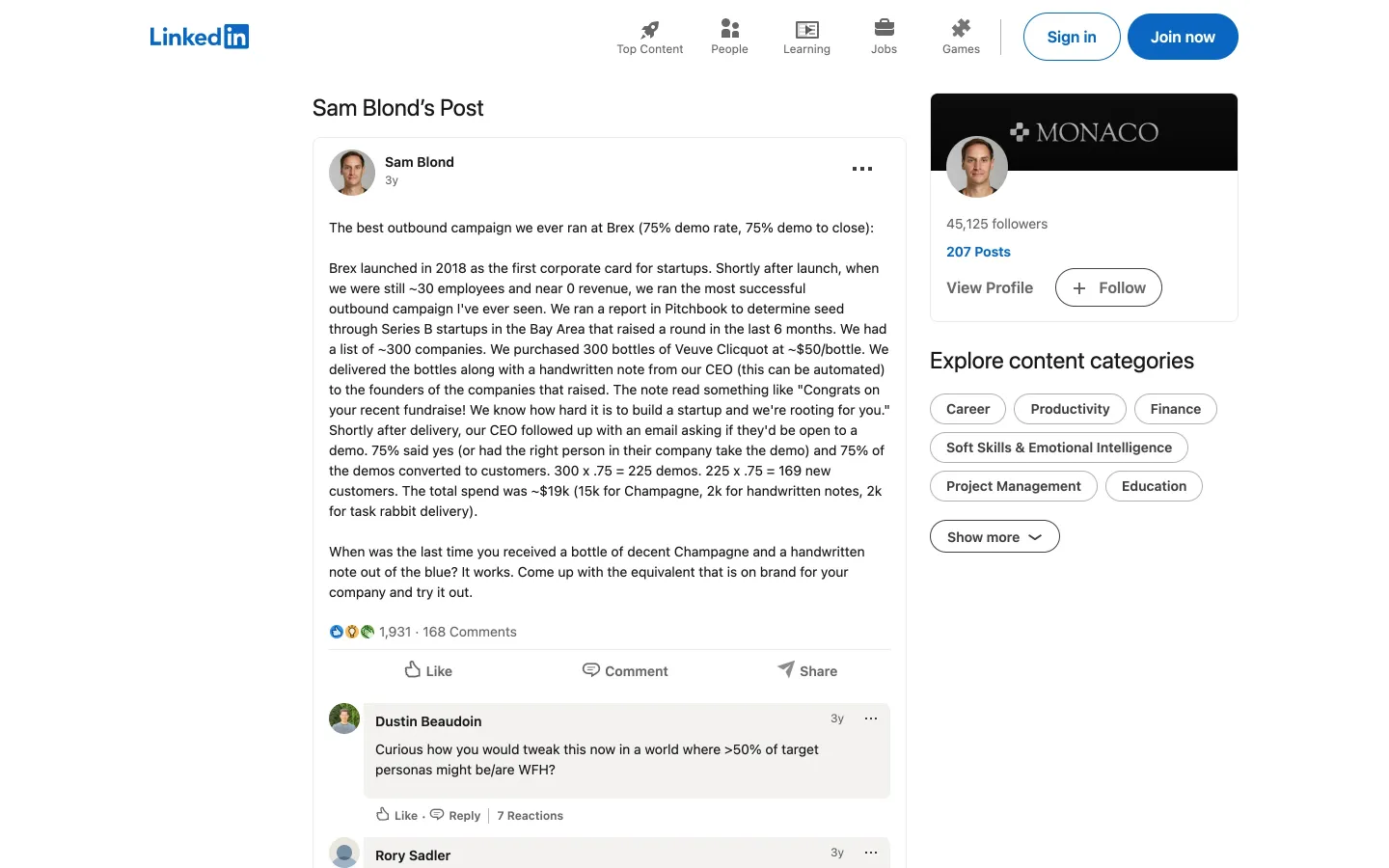
Sam Blond's post on the campaign: the PitchBook list, 300 bottles of Veuve Clicquot, the CEO's note and the follow-up email, with every number.

The result: 75% said yes to a demo, or passed it to the right person at their company, and 75% of the demos became customers. That's 225 demos and about 169 new customers. The total cost was about $19,000: $15,000 for the champagne, $2,000 for the handwritten notes and $2,000 for TaskRabbit delivery, or roughly $112 per customer.
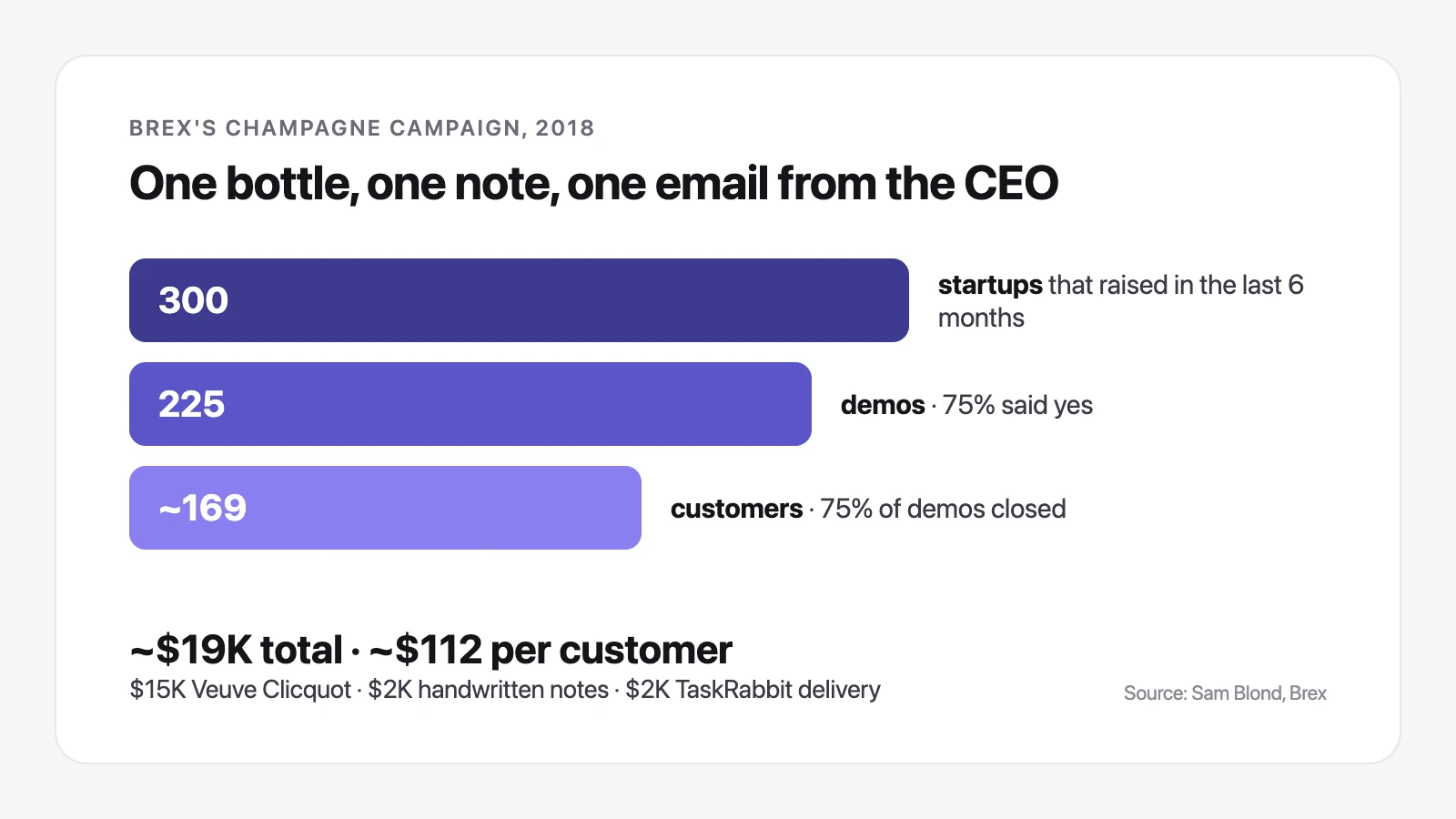
The campaign in numbers: 300 startups, 225 demos, ~169 customers, ~$19K. Figures from Sam Blond.

The numbers are self-reported, from one campaign in 2018, by a company with a new product its market wanted. Read them as what's possible, not what to expect.

Why it worked

The trigger matched the need. A startup that just raised has new money, is hiring, and is setting up its finance stack. That is the moment a corporate card gets chosen. Brex didn't send champagne to random startups; it sent it to the ones about to make the decision it wanted.

The gift matched the moment. Founders celebrate a round. A bottle of champagne joins the celebration instead of interrupting it, and it lands on a desk where the whole team sees it.

The CEO signed it and sent the follow-up. A handwritten note from the CEO, then an email from the same person, reads as one company leader to another. It's the same effect as founder messages to new users, before the signup.

Physical beats inbox. In the weeks after a round, founders get flooded with "congrats on the raise" emails that all say the same thing. A bottle with a handwritten note is the one they remember when the follow-up arrives.

Brand was already working. In the same thread on how to do outbound, Blond explains that Brex launched with PR, billboards across San Francisco, events and podcasts, and aimed outbound at companies likely to have heard of it. Before launch, while in stealth, its only outbound went to Y Combinator companies, starting with its own batch (Sam Blond's thread).
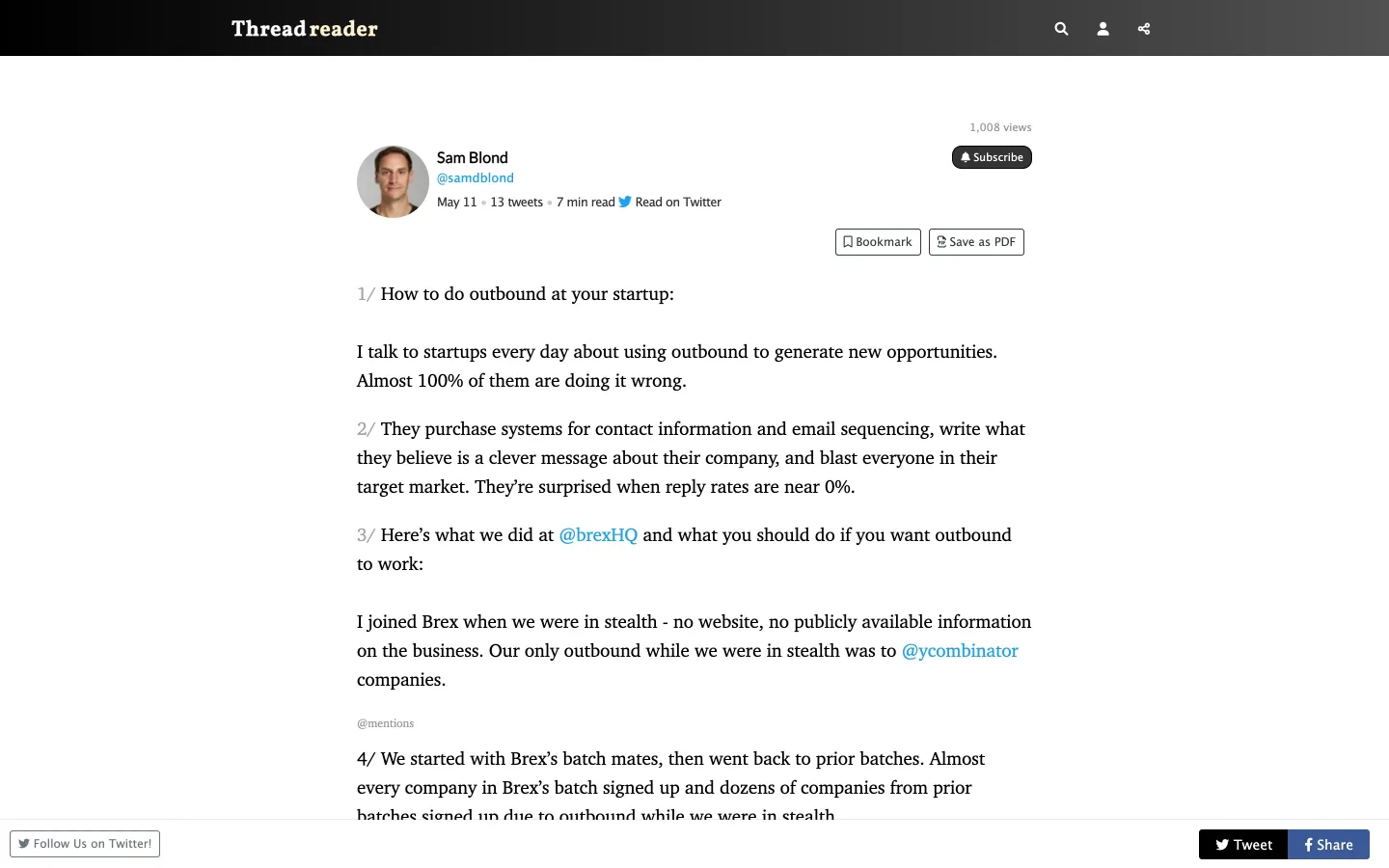
Sam Blond's thread on outbound at startups: most teams buy contact data and blast their market, and get reply rates near 0%. Brex started with its YC network, then used brand and campaigns like the champagne.

His general point: cold outreach from a startup nobody has heard of gets almost no replies. Start with your network, do things that don't scale while each customer matters, and aim outbound where your brand already reaches.

Make your own version

Blond's advice is not to copy the bottle: "Come up with the equivalent that is on brand for your company and try it out." Four decisions make the campaign:

  1. The trigger. The event after which your product gets bought. A funding round for finance, HR, recruiting and security tools; a new VP of Sales or Marketing for sales and marketing tools; a new office for workplace tools; a first SOC 2 audit for compliance tools; a product launch for analytics.
  2. The list. A few hundred companies that hit the trigger recently and match your best customers. Funding data comes from PitchBook, Crunchbase or a list of funded startups; job changes from LinkedIn.
  3. The gift. Something that fits the moment and your brand, worth keeping on a desk: champagne for a round, a book for a new executive, something for the team's first office. Check the buyer's company and country rules: some ban alcohol or cap gift value.
  4. The follow-up. From the person who signed the note, within a few days of delivery, with one ask: a demo, or a call with the right person.

Then do the math before you buy anything. Brex spent about $63 per target and got a customer from 56% of them. Your break-even is the gift and delivery cost per target divided by (demo rate × close rate). If even a third of Brex's rates would beat your current cost to acquire a customer, it's worth one test cohort.

Where it fails

  • No trigger. A gift to a company with no reason to buy now is a nice gesture with no follow-through.
  • Addresses. Under the post, the first commenter asked how this works when most targets work from home. Send to an office where there is one, or let the person choose the gift and the address online, and accept a lower delivery rate.
  • Alcohol. Not everyone drinks, and some companies and countries restrict alcohol gifts or cap gift value. Have an equivalent that isn't a bottle.
  • Scale. At a few hundred targets it's memorable; sent to thousands, it's a marketing expense with a handwritten font. Blond's own framing is doing things that don't scale while each customer makes a difference.
  • A weak follow-up. The bottle opens the door; a generic sequence from an SDR closes it. The follow-up has to come from the person who signed the note.
  • The product. 75% demo-to-close says as much about Brex's product in 2018 as about the champagne. If demos don't convert today, the gift won't fix it.
Champagne outbound examples

  • BrexChampagne to newly funded startups

    Veuve Clicquot and a handwritten CEO note to ~300 Bay Area startups that raised in the last six months, then a demo ask by email. 75% took a demo, 75% closed: ~169 customers for ~$19K.

    See it liveSource

  • BrexOutbound to YC batches in stealth

    Before launch, with no website, Brex's only outbound went to Y Combinator companies: its own batch first, then earlier ones. Almost every company in its batch signed up, and dozens from earlier batches.

    See it liveSource

  • EchoSignA customer's press release as outbound

    After closing Aetna, Blond published a joint press release on the paper it saved with e-signatures and sent it to other big insurers. It led to deals with United, Cigna and several Blues. EchoSign is now Adobe Acrobat Sign.

    Source

How to run it: the playbook

  1. Pick the trigger. The event after which your product gets bought: a funding round, a new executive, an office move, an audit, a launch.
  2. Build a list of a few hundred. Companies that hit the trigger in the last few months and match your best customers. Brex used a PitchBook report: seed to Series B, Bay Area, raised in the last six months.
  3. Choose an on-brand gift. Something that fits the moment and lands on a desk, around $50–100. Have a non-alcohol version.
  4. Write the note by hand, from the CEO. Two sentences of congratulations and support, no pitch. A service can write it in the CEO's words.
  5. Deliver to a person. To the office where there is one, or let the recipient choose the gift and the address. Brex used TaskRabbit.
  6. Follow up from the same person. An email from the CEO within a few days of delivery, asking for a demo or the right person to talk to.
  7. Measure the cohort. Delivery rate, demo rate, close rate and cost per customer, against your usual outbound.

What to measure

  • Demo rate per target (Brex: 75%)
  • Demo-to-close rate (Brex: 75%)
  • Total cost per customer, gift, note and delivery included (Brex: ~$112)
  • Delivery rate: gifts that reached the person
  • The same rates for your usual outbound, as the baseline

Pitfalls

  • Sending to companies with no trigger and no reason to buy now
  • Gifts that don't reach anyone because people work from home
  • Alcohol where it isn't welcome or allowed
  • Scaling it to thousands until it's just expensive direct mail
  • A follow-up from an SDR sequence instead of the person who signed the note
  • Expecting the gift to fix a product whose demos don't convert

Champagne outbound: experts and agencies

Agencies that can build it

  • ColdIQ

    Outbound and GTM systems: B2B contact data with a team that builds and runs it for you

    An outbound agency that builds trigger-based lists and the sequences that follow them

Frequently asked questions

LinkedIn posts on this tactic

Sources

More SaaS growth ideas

All growth ideas
  • Acquisition

    Cold outreach

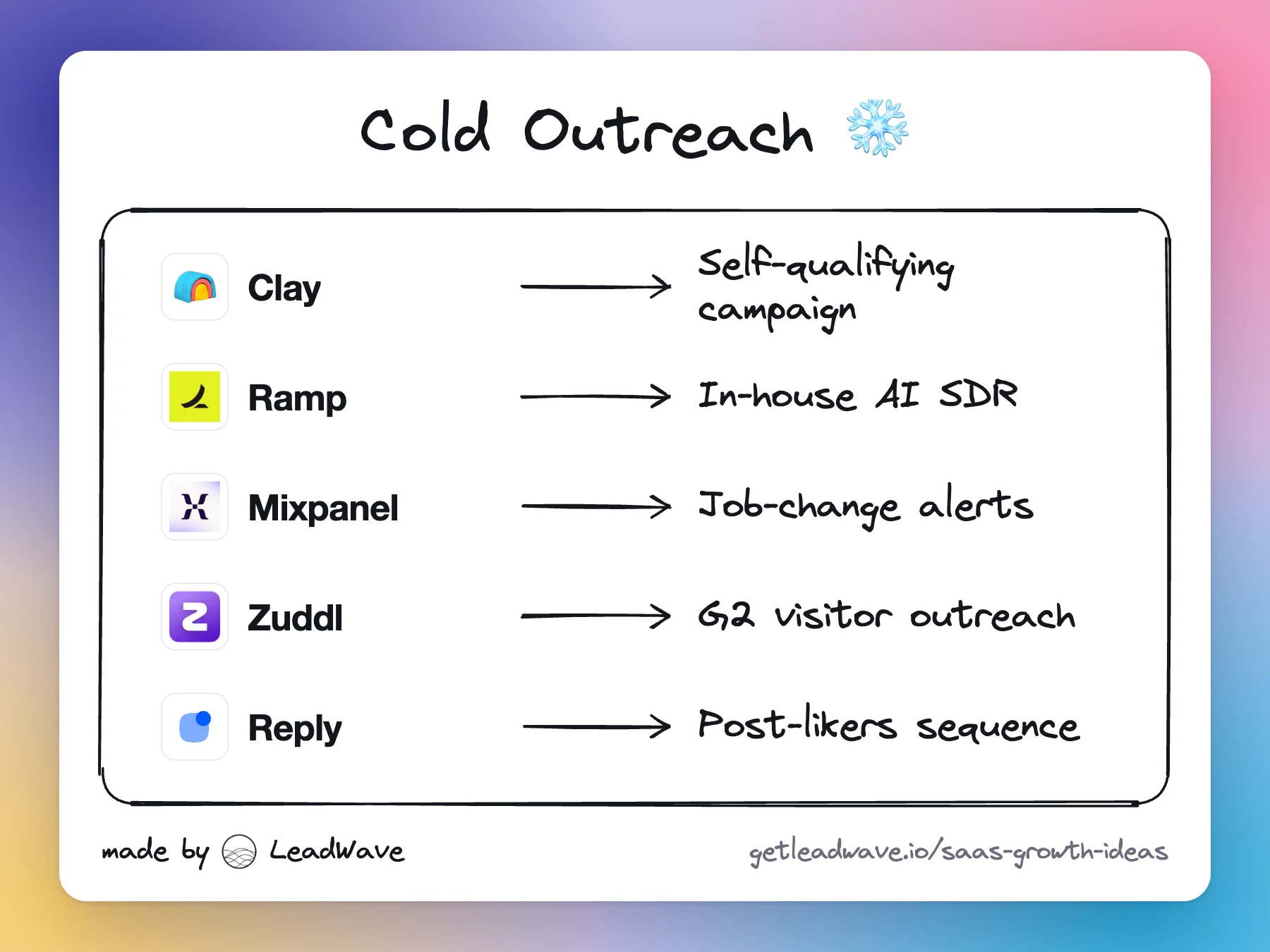
    Email and message the companies you want as customers, timed to a buying signal, from domains and inboxes set up so the emails land.

    Impact HighEffort Medium10 examples
    Read the tacticFull playbook in the list
  • Activation

    Founder messages to new users

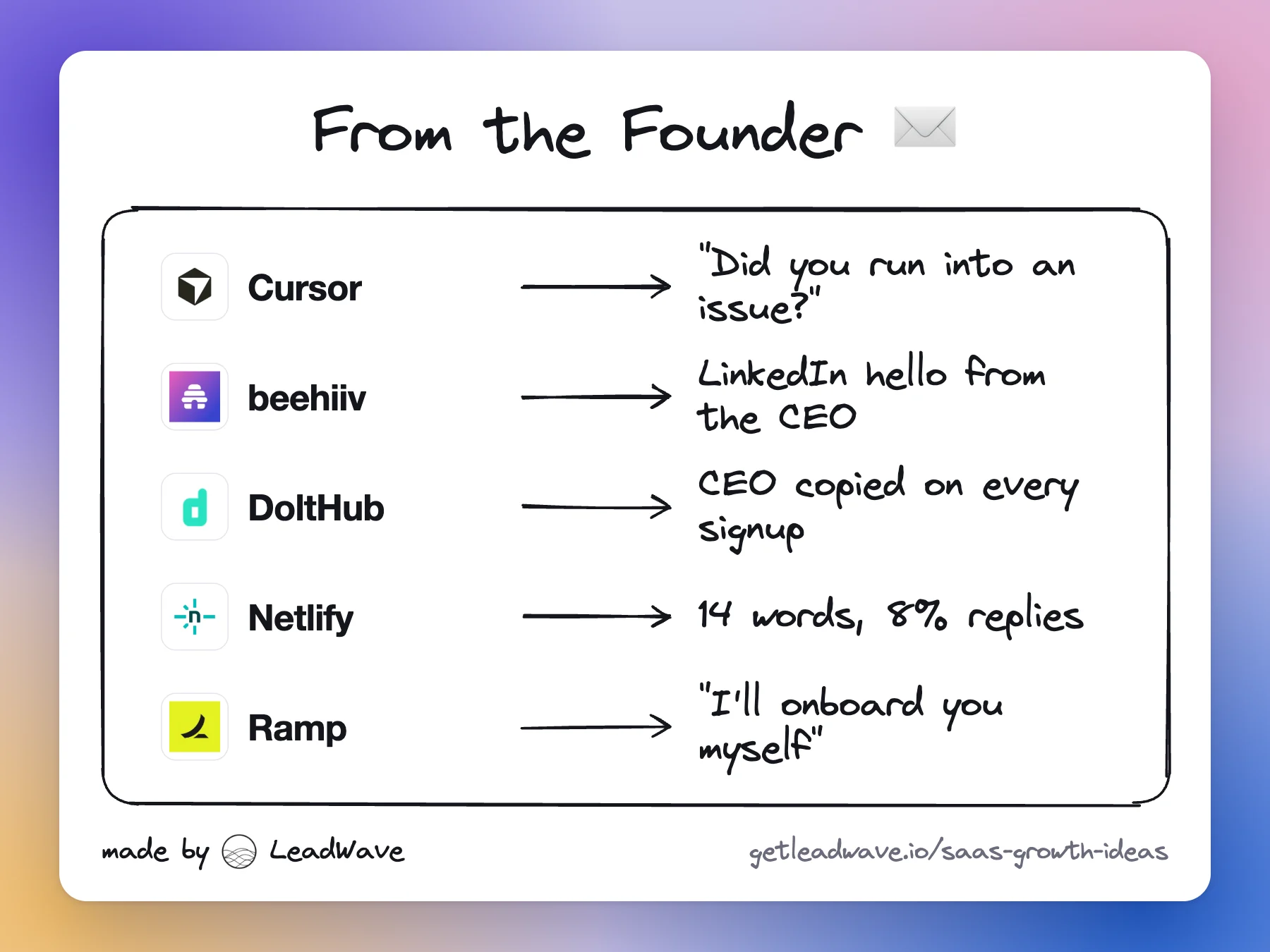
    The founder or CEO writes to new users in person, on LinkedIn or by email, to welcome them, unblock them or fix a failed upgrade. It wins customers a big team can't win.

    Impact MediumEffort Low6 examples
    Read the tactic
  • Acquisition

    Billboard marketing

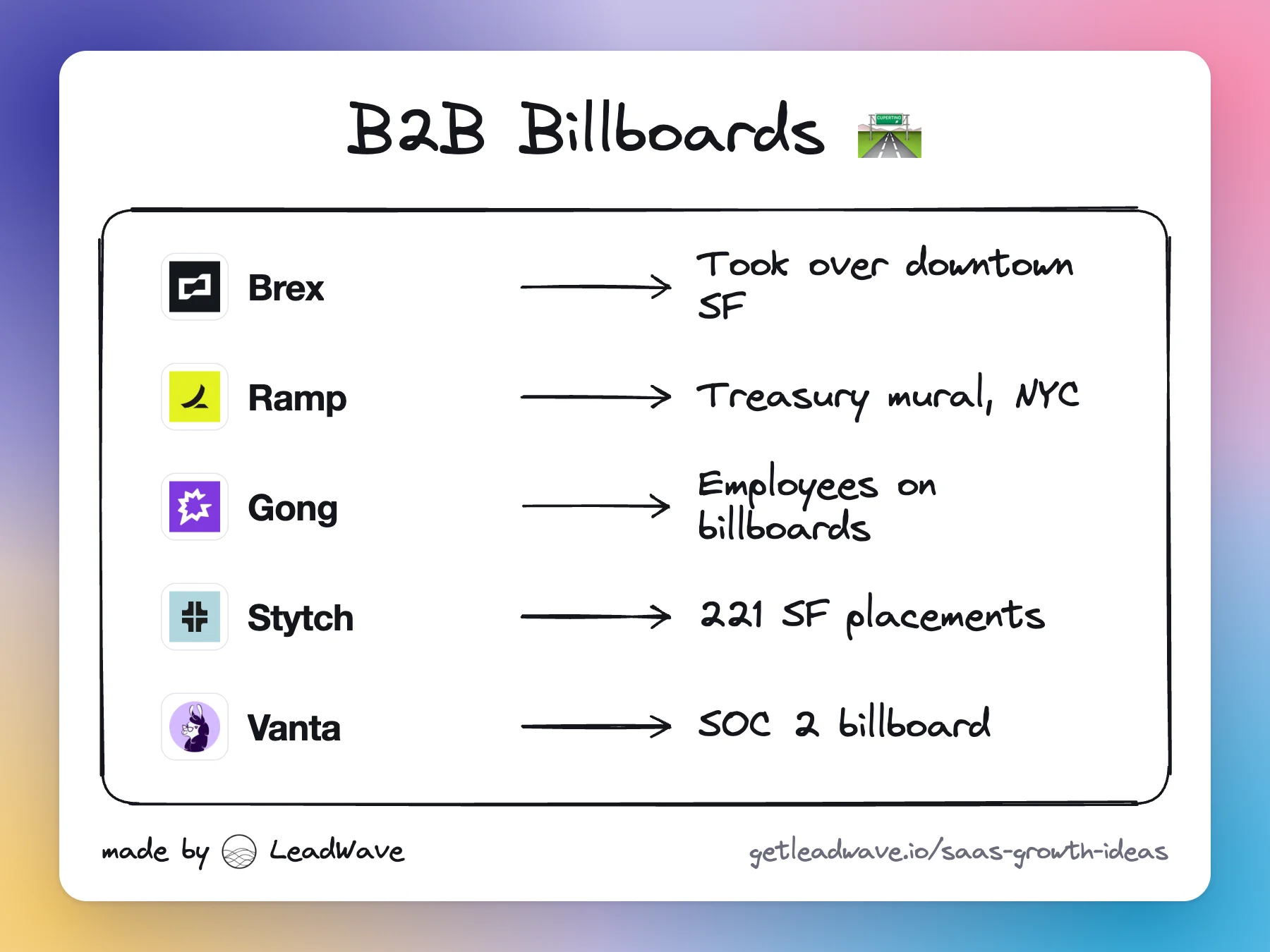
    Brex, Ramp, Gong and Stytch bought billboards to make a B2B brand feel big. What they paid, how they measured it, and why the photo matters more than the board.

    Impact MediumEffort Medium12 examples
    Read the tactic