Skip to content

Acquisition

TikTok for B2B SaaS: How ClickUp, Reply.io and tl;dv Grow (6 Examples)

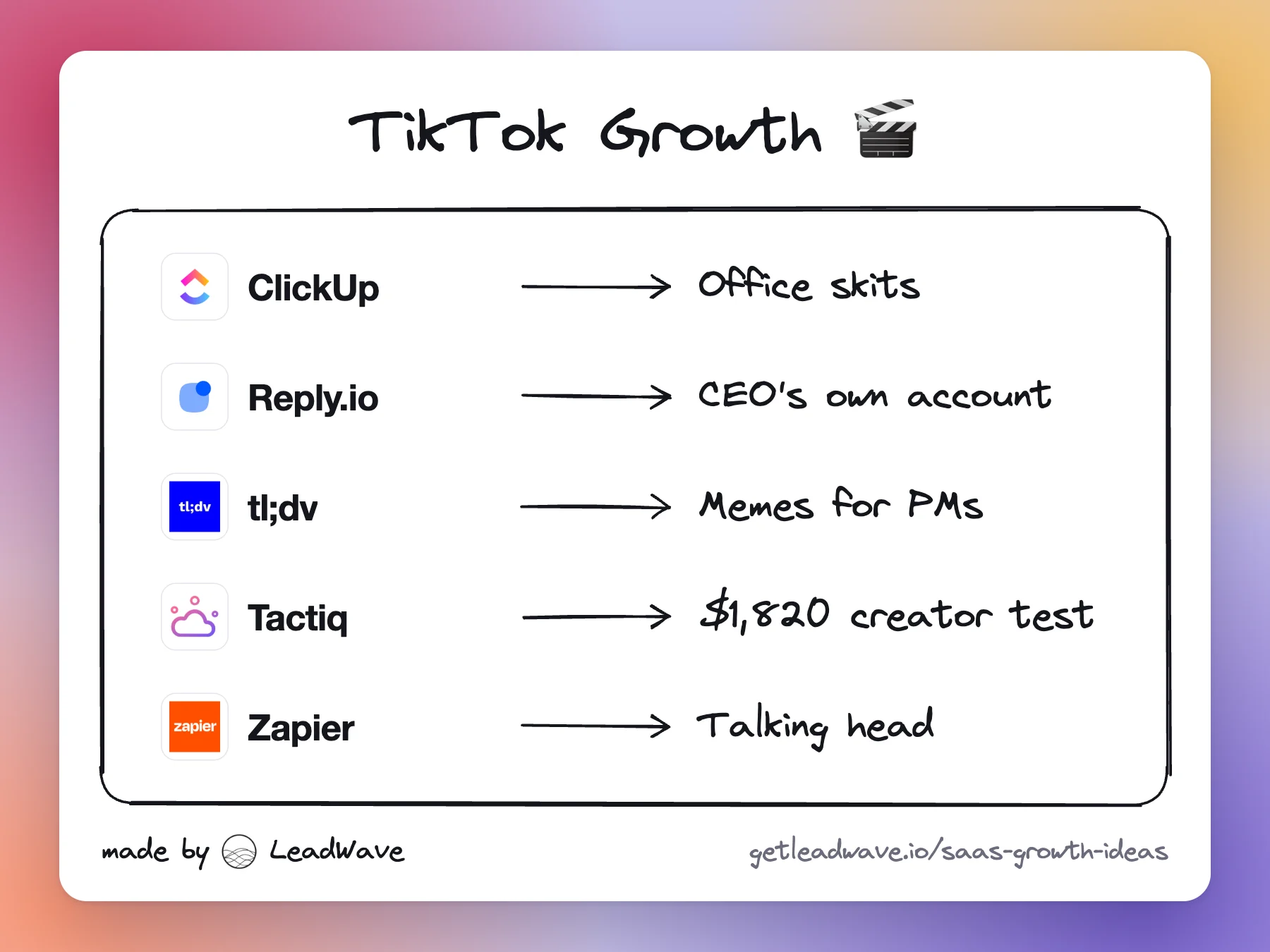
Make short, funny videos about your buyers' work life, from the brand or a founder's own account, and let people share them with their team.

TikTok growth: real examples from ClickUp, Reply.io, tl;dv
Impact
Medium
Effort
Medium
Time to results
Months
Budget
None needed
Team
Marketing

Tools for this growth idea

  • Canva
  • Google Analytics
  • LinkedIn

Why TikTok works for B2B

Your buyers don't stop being people when they open TikTok. They scroll it after work, and they laugh at videos about bad meetings, annoying coworkers and pointless reports. A software company that makes those videos gets remembered by the people who'll choose the next tool.

Few SaaS companies do it well, so there's room. And the way it spreads suits B2B. Raphael Allstadt, who built tl;dv's account, described it this way: “It takes one person to see it on TikTok, and it's shared in the company Slack to share a laugh with your team. Huge multiplier.”
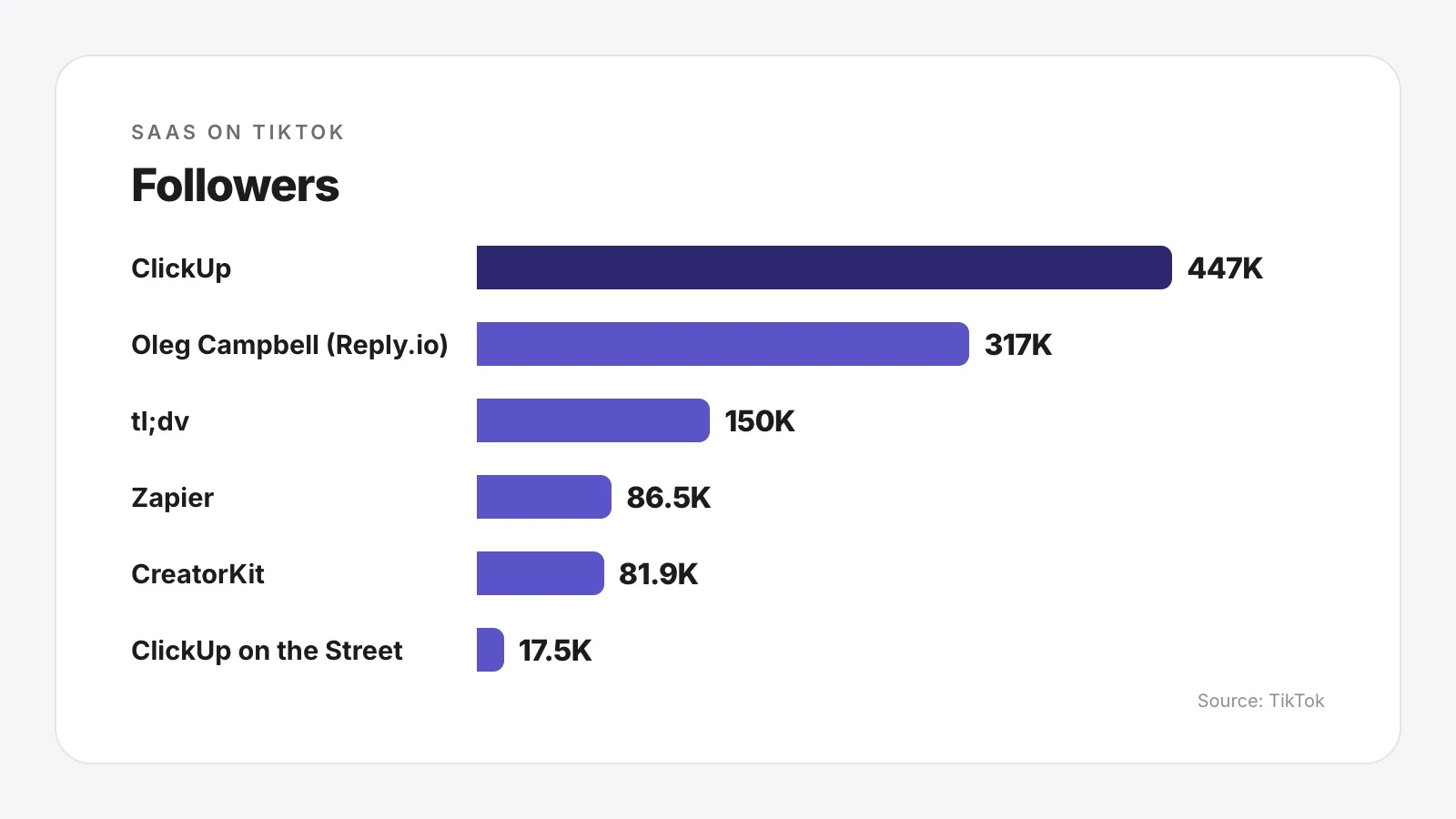
Six SaaS accounts on TikTok, by followers. Counted November 2026, except ClickUp's main account (July 2026).

ClickUp: skits about office life

ClickUp is the best-known B2B brand on TikTok, with about 447,000 followers and 14.6 million likes as of July 2026. It didn't start that way. Its first videos promoted the product, and they got little attention. Then it stopped selling and made skits about casual Fridays, corporate jargon and the personality types in each department, with recurring characters like Jan in accounting, who's waiting for 5pm.

Chris Cunningham, who built ClickUp's social team, started with almost nothing: one creator, paid a small monthly fee. “We did 15 million impressions, which is one creator in this small budget,” Cunningham told the COO, and that won the budget for a second. Across social, the team later averaged about 155 million impressions a month, with a goal of 200 million.
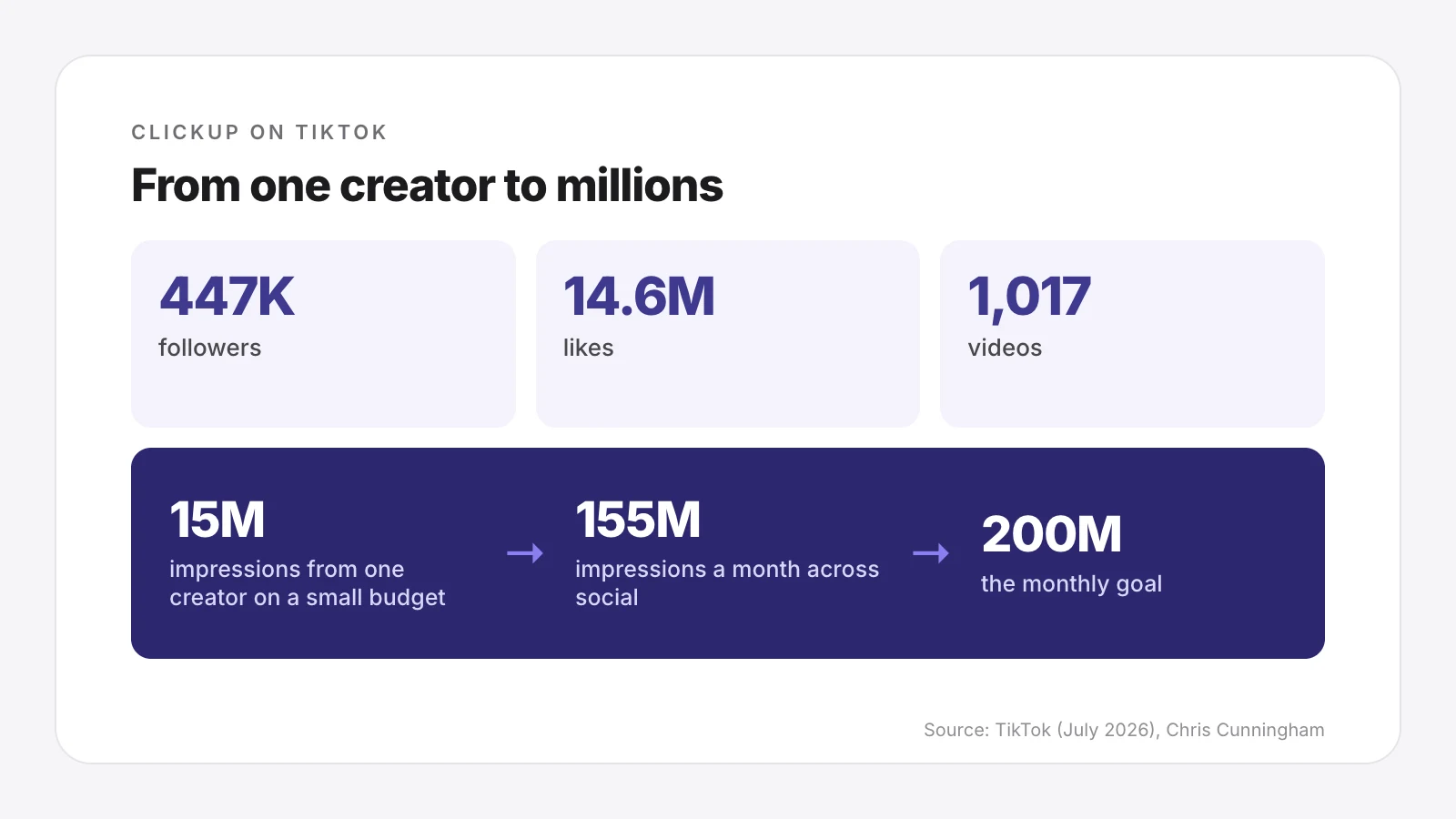
ClickUp on TikTok. Account numbers from July 2026; impressions are from all of ClickUp's social channels.

The measurement grew up with it. “At the beginning, it's impressions,” Cunningham says. Later the team began tracking signups with a landing page that only appears on its social accounts, so all the traffic to it comes from social. ClickUp's second account, “ClickUp on the Street,” has its own tagged link in the bio for the same reason.

Reply.io: the CEO's personal account

A person gets more reach than a logo. Reply.io's CEO, Oleg Campbell, posts from a personal account (@olegxyz, under the name Oleg Bilozor) about AI tools, with Reply.io in the bio. It now has about 317,000 followers and 1.7 million likes.
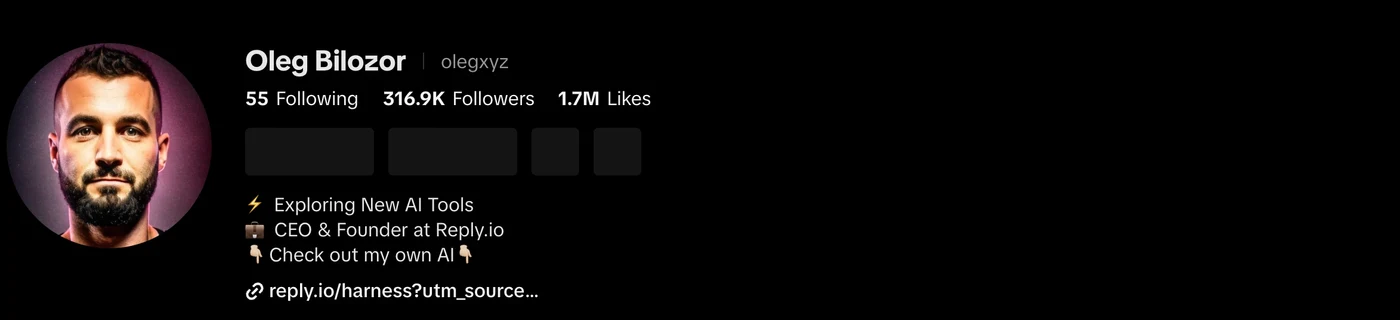
Oleg Campbell's TikTok profile, November 2026: 316.9K followers, “CEO & Founder at Reply.io,” and a link to the product.

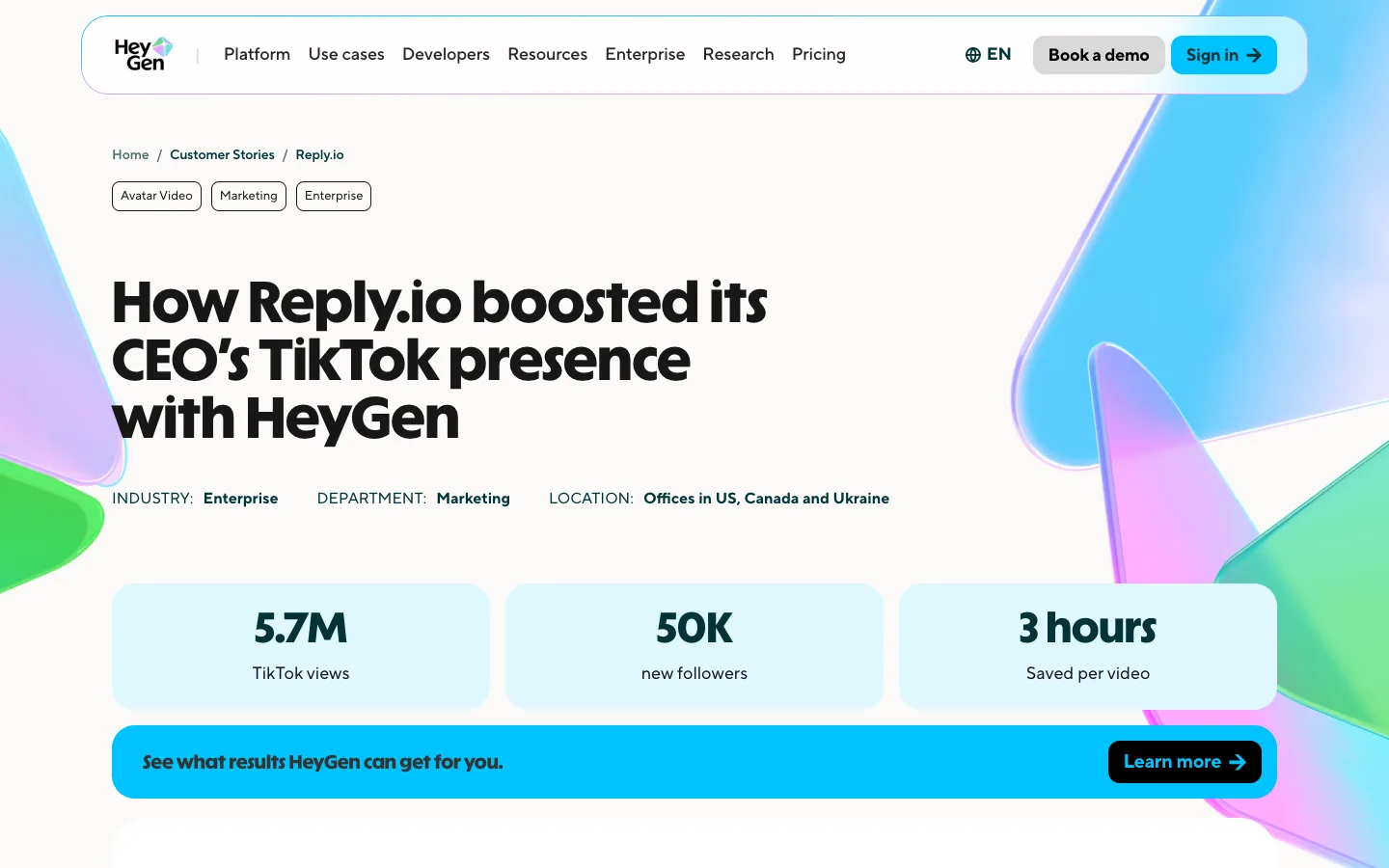
The unusual part is how it's made. A CEO doesn't have time to film every day, so Reply.io's social team uses AI avatars of Campbell, made with HeyGen. In HeyGen's case study, the team produces 10 to 14 videos a week. The account reached 200,000 followers in 10 months, its top video got 5.7 million views, and others regularly got 8,000 to 30,000. The team says the link in the bio now drives more traffic than any other social platform.

“We didn't have any viral videos until we started using HeyGen,” says Anastasiia Nak, Reply.io's social media manager. Those numbers come from the vendor's own story, so read them as a best case. If you try this, TikTok requires a label on realistic AI-generated video.

tl;dv: “Be the Kardashians, not the ad break”

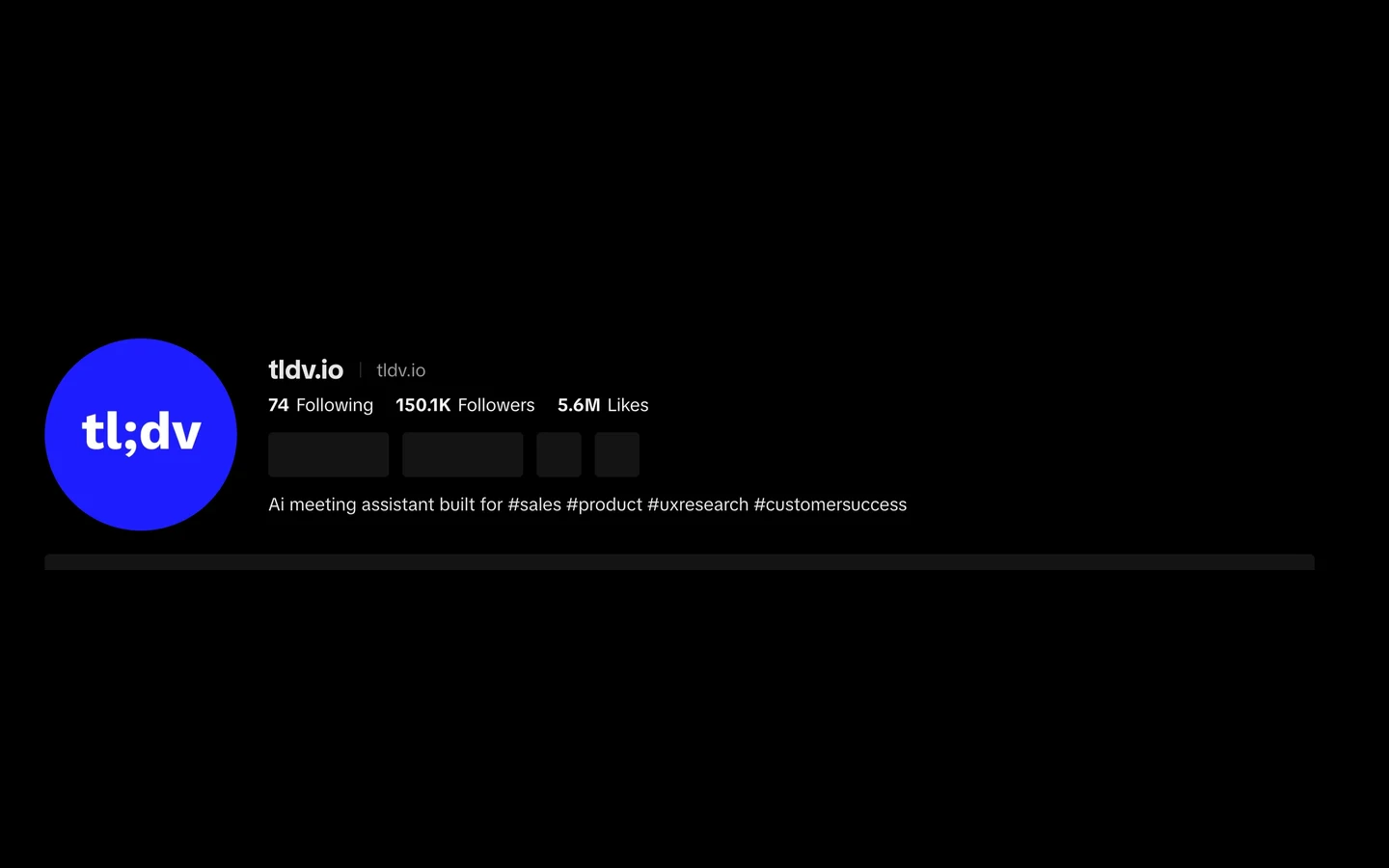
tl;dv, an AI meeting assistant, passed 100,000 TikTok followers in 2023, when that was rare for a SaaS company, and has about 150,000 today. Allstadt shared five lessons from getting there:
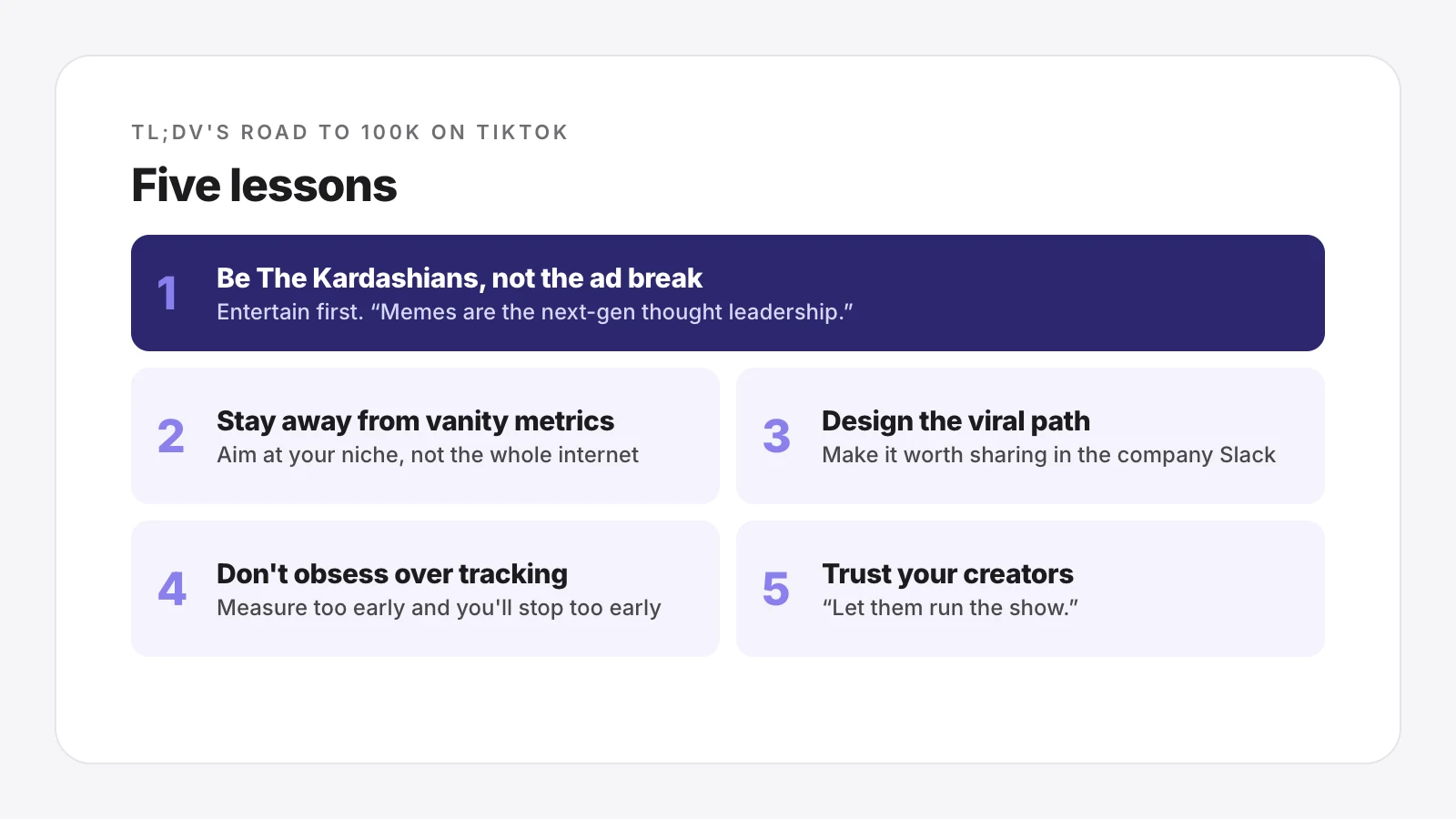
tl;dv's five TikTok lessons, from Raphael Allstadt's LinkedIn post in 2023.

The second lesson is the one most teams learn the hard way. tl;dv's general memes reached tens of millions of people on big accounts, with “virtually no spike in revenue.” Growth only came when it aimed its jokes at product teams, the people who buy it.

The fourth is the hardest to accept. “Nowadays, our TikTok is mentioned in more than 50% of our customer interactions,” Allstadt wrote. “But if we would have started measuring business results early on, we would have stopped early.”

Tactiq: rent someone else's audience

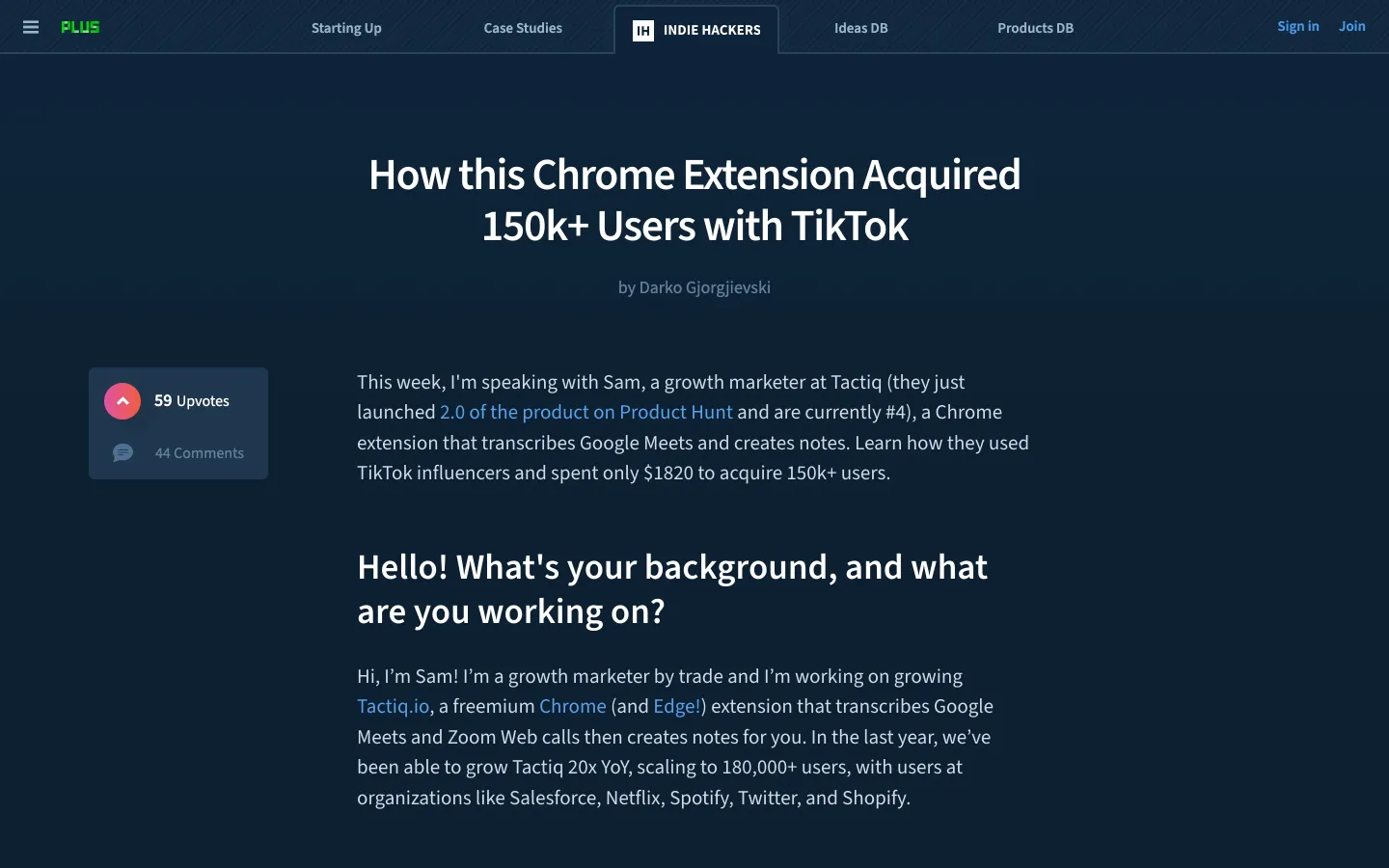
You don't need your own account. Tactiq, a Chrome extension that transcribes meetings, paid creators to post instead. In 2021 it contacted 320 creators, 16 agreed, and together they posted 22 videos, for $1,820 in total.
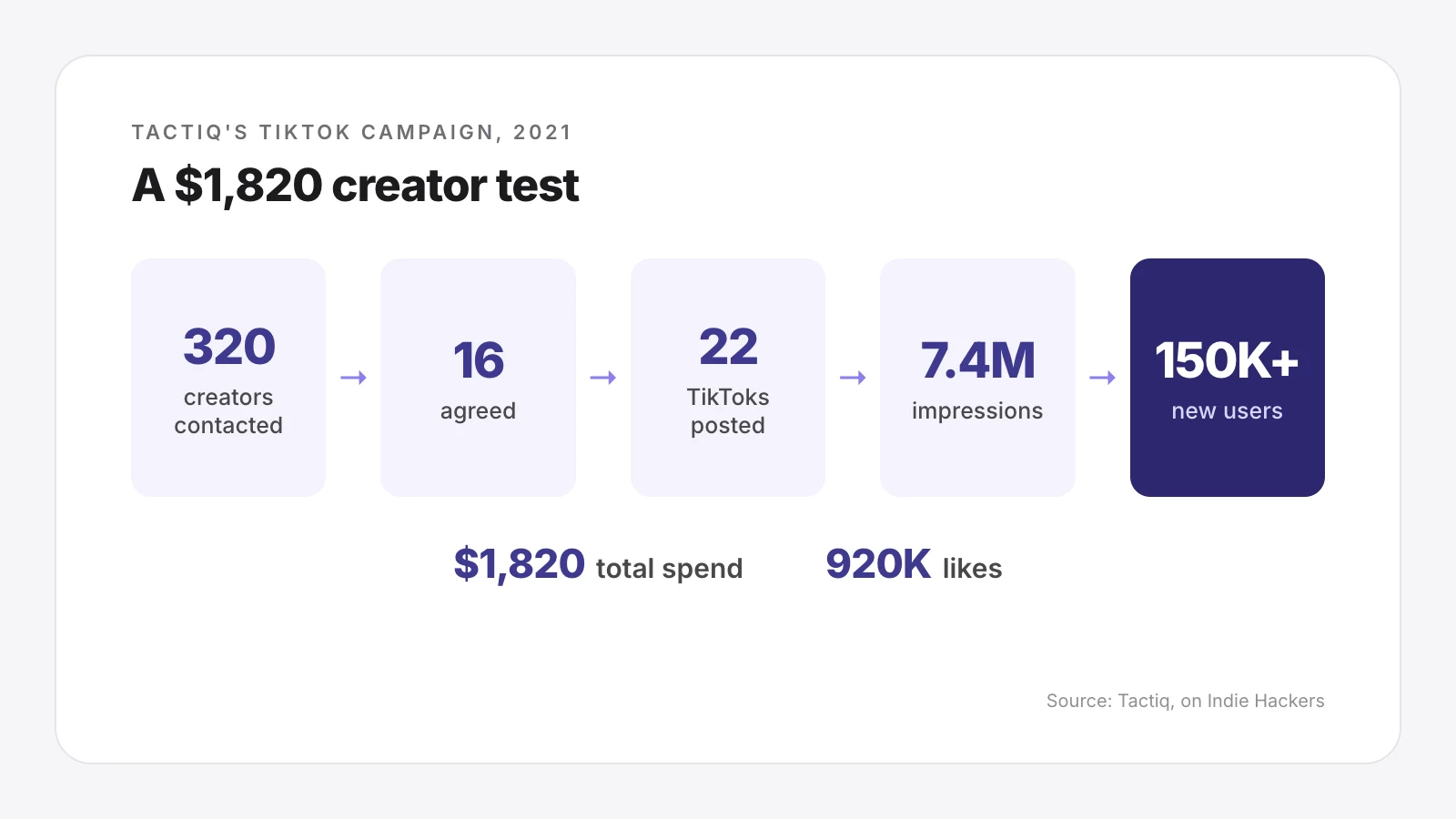
Tactiq's TikTok creator campaign, 2021. Its team notes the tracking wasn't fully accurate.

The videos named a specific person and a specific pain: “Hate taking notes? Try Tactiq” and “Too many product meetings? Try Tactiq.” It's a free Chrome extension, which is why a cheap TikTok view could turn into a user. A paid B2B product won't convert like this, but the same approach works for getting attention. For how to run it at scale, see B2B influencer marketing.

Pick a format, and when to skip TikTok

  • Skits. Office humor with recurring characters. ClickUp and tl;dv. High reach, and needs someone funny.
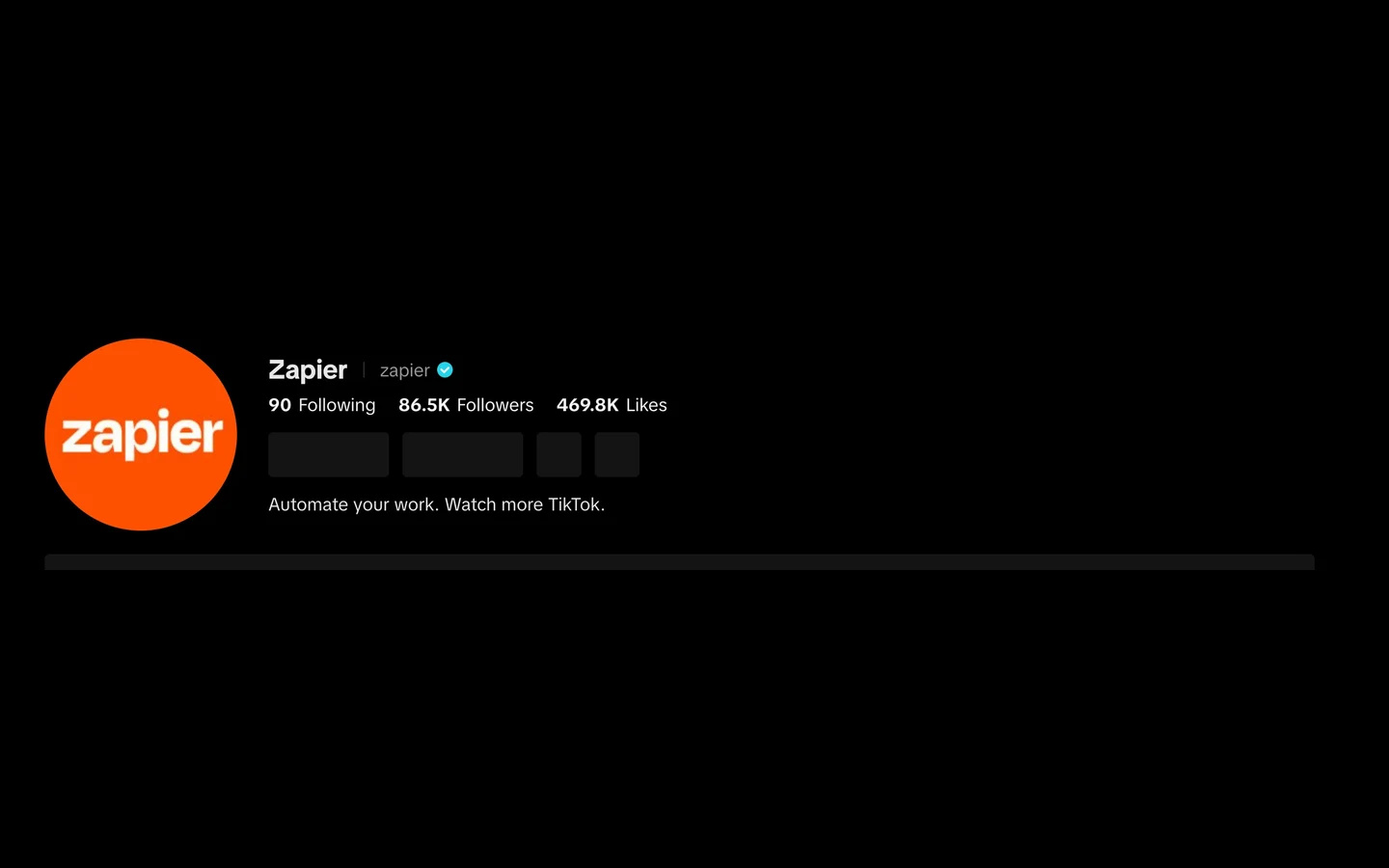
  • A person talking to camera. One employee or founder explaining something. Zapier uses this for announcements and feature breakdowns.
  • Quick tutorials. One useful trick in 30 seconds. CreatorKit built about 82,000 followers on AI tips and product-photo how-tos.
  • Creators. Pay people who already have the audience. Tactiq and ClickUp both started here.

Post the same videos to Instagram Reels and YouTube Shorts too, so you aren't relying on one app.

Skip TikTok if your buyers are a few hundred enterprise executives, if you sell in a regulated field where a joke could cause trouble, or if nobody on the team enjoys making this kind of video. Forced fun is easy to spot.
TikTok growth examples

  • ClickUpOffice-life skits

    Skits with recurring office characters built an account of about 447,000 followers and 14.6 million likes (July 2026). It started with one paid creator and a small budget.

    See it liveSource

  • Reply.ioCEO's personal account

    CEO Oleg Campbell's personal TikTok has about 317,000 followers. The social team makes 10 to 14 videos a week with AI avatars, and says TikTok drives more traffic than any other social platform.

    See it live

  • tl;dvMemes for product teams

    tl;dv grew to about 150,000 followers with jokes aimed at product teams. Its team said TikTok came up in more than half of its customer conversations.

    See it liveSource

  • Tactiq$1,820 creator campaign

    16 creators posted 22 TikToks for $1,820 in 2021: 7.4 million impressions and, by Tactiq's own count, over 150,000 new users for its free Chrome extension.

    See it live

  • ZapierTalking-head explainers

    A real person on camera shares announcements and feature breakdowns. The account has about 86,500 followers.

    See it live

  • CreatorKitQuick AI how-tos

    Short tutorials on AI product photos and marketing prompts built about 82,000 followers, with a tagged link in the bio.

    See it liveSource

How to run it: the playbook

  1. Pick who the joke is for. One job title: product managers, sales reps, marketers. Write down what annoys them at work.
  2. Choose the face. A funny teammate, a founder willing to post, or a creator you pay. A person beats a logo.
  3. Post 3–5 times a week for two months. Short videos with one idea and a strong first three seconds. Use the same layout and characters so people recognize you.
  4. Entertain first. Leave the product out of most videos. Let your name in the profile do the selling.
  5. Try a few creators. Message creators your buyers already watch, and test a small paid post with each.
  6. Set up a TikTok-only landing page. Link it in the bio with its own tag, so everything that arrives there came from TikTok.
  7. Ask how people found you. Add TikTok to your signup survey and listen for it on sales calls.
  8. Reuse what works. Post winners to Reels, YouTube Shorts and LinkedIn, and make more of the format that hit.

What to measure

  • Followers and views from your target job title, judged by comments
  • Signups from a TikTok-only landing page
  • “TikTok” answers in your “How did you hear about us?” survey
  • Mentions of your videos on sales and customer calls
  • Saves and shares per video, which predict reach better than likes

Pitfalls

  • Posting product ads that nobody watches
  • Chasing general viral memes that reach the wrong people
  • Judging the channel on signups in the first few weeks
  • Rewriting your creators' jokes until they aren't funny
  • Using AI avatars without the label TikTok requires

Frequently asked questions

LinkedIn posts on this tactic

Sources

More SaaS growth ideas

All growth ideas
  • Acquisition

    YouTube growth

    Teach your buyers on YouTube, so they find you when they search for how to do the job your product does.

    Impact HighEffort High5 examples
    Read the tactic
  • Acquisition

    B2B influencer marketing

    Pay creators your buyers already follow on LinkedIn, newsletters, YouTube and TikTok to show your product in their own words, then boost the winners as ads.

    Impact HighEffort Medium9 examples
    Read the tacticFull playbook in the list
  • Acquisition

    Launch videos

    Make launch videos people share: a person, a story, humor or a stunt instead of floating UI and swelling music, posted natively where your buyers scroll.

    Impact MediumEffort Medium13 examples
    Read the tactic