Grammarly is owned by its own company, Superhuman Platform Inc., which was called Grammarly, Inc. until it renamed itself after the Superhuman email app it bought in 2025. The company is private and belongs to its founders, employees and investors such as General Catalyst; no outside company has bought it. It announced the new name on October 29, 2025, and as of November 26, 2026 its terms of service name the company as Superhuman Platform Inc., formerly known as Grammarly, Inc. Grammarly is still a product, and Shishir Mehrotra is the CEO.
Who owns Grammarly? The ownership chain
Level | Who | What it means |
|---|---|---|
The product | Grammarly | The AI writing assistant, sold as Grammarly Free and Grammarly Pro; one of the apps in the Superhuman suite |
The company | Superhuman Platform Inc. (formerly Grammarly, Inc.) | The same company that has made Grammarly since 2009, renamed Superhuman on October 29, 2025 |
What the company owns | Coda Project LLC, Superhuman Labs LLC, GPTZero, Fathom | Coda (now Superhuman Docs) since January 2025, Superhuman Mail since 2025, GPTZero by September 30, 2026 and Fathom since September 14, 2026 |
The shareholders | Founders, employees and venture investors | A private company: no stock exchange listing, and individual stakes aren’t published |
Control | Not disclosed | No owner has said it holds a majority. General Catalyst, an investor since 2017, holds equity; its $1 billion of 2025 financing came with no shares |
Superhuman’s own terms make the family tree plain: Superhuman Platform Inc. “is the parent company of Coda Project LLC and Superhuman Labs LLC, the creators of Coda and Superhuman Mail, respectively.” So the answer to “what company owns Grammarly” is Superhuman, but Superhuman is not a new owner. It is Grammarly’s own company under a new name.
Is Grammarly owned by Superhuman?
Yes, but only because Grammarly’s company took the name. No, Superhuman didn’t buy Grammarly: it was the other way round. Grammarly agreed to buy the Superhuman email app in 2025 and then gave the whole company that app’s name. Mehrotra’s post on the change says: “the Grammarly product will still exist, but we're changing our company name to Superhuman.”
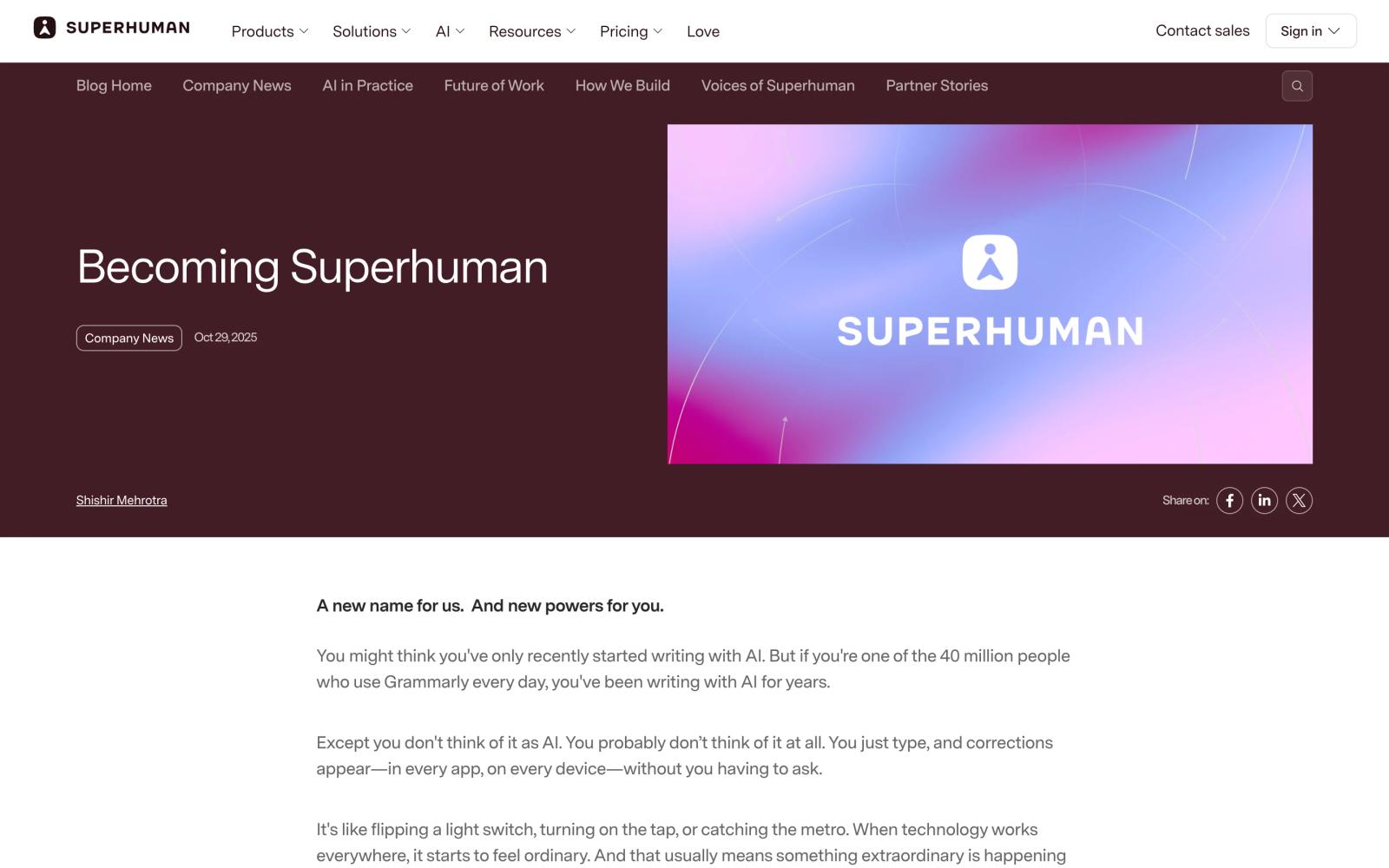
Mehrotra announced the new company name in “Becoming Superhuman” on October 29, 2025.
The email app is now called Superhuman Mail. It sits in the suite next to Grammarly, Superhuman Docs (Coda until July 8, 2026) and Superhuman Go, an AI assistant launched with the new name.
How Grammarly bought Coda and Superhuman
Two deals turned the one-product company into a suite. Neither price was disclosed, so it isn’t public whether the sellers were paid in cash, in Grammarly shares or both.
Deal | Announced | Closed | Price | Cash or stock |
|---|---|---|---|---|
Coda (documents, now Superhuman Docs) | Dec 17, 2024 | January 2025 | Not disclosed. Coda was valued at $1.4 billion in 2021 | Not disclosed |
Superhuman (email app, now Superhuman Mail) | Jul 1, 2025 | By Oct 29, 2025; no date announced | Not disclosed. Superhuman’s last valuation was reportedly $825 million | Not disclosed |
Rows (spreadsheets, Porto) | Feb 23, 2026 | No completion notice found | Not disclosed | Not disclosed |
GPTZero (AI detection) | Jun 23, 2026 | By Sep 30, 2026 | Not disclosed | Not disclosed |
Fathom (AI notetaker) | Sep 14, 2026 | Sep 14, 2026 (announced as done) | Not disclosed | Not disclosed |
The Coda deal brought the CEO. Rahul Roy-Chowdhury wrote on December 17, 2024 that he would be “stepping down as Grammarly’s CEO and leaving the company in the highly capable hands of Shishir Mehrotra, co-founder and CEO of Coda.” Grammarly later dated the closing to January 2025.
The Superhuman deal was announced as an intent to acquire and went public on July 1, 2025. Superhuman’s CEO and co-founder, Rahul Vohra, and its staff moved to Grammarly. The company confirmed in October 2025 that it had “acquired Coda and Superhuman Mail earlier this year”, without giving a closing date.
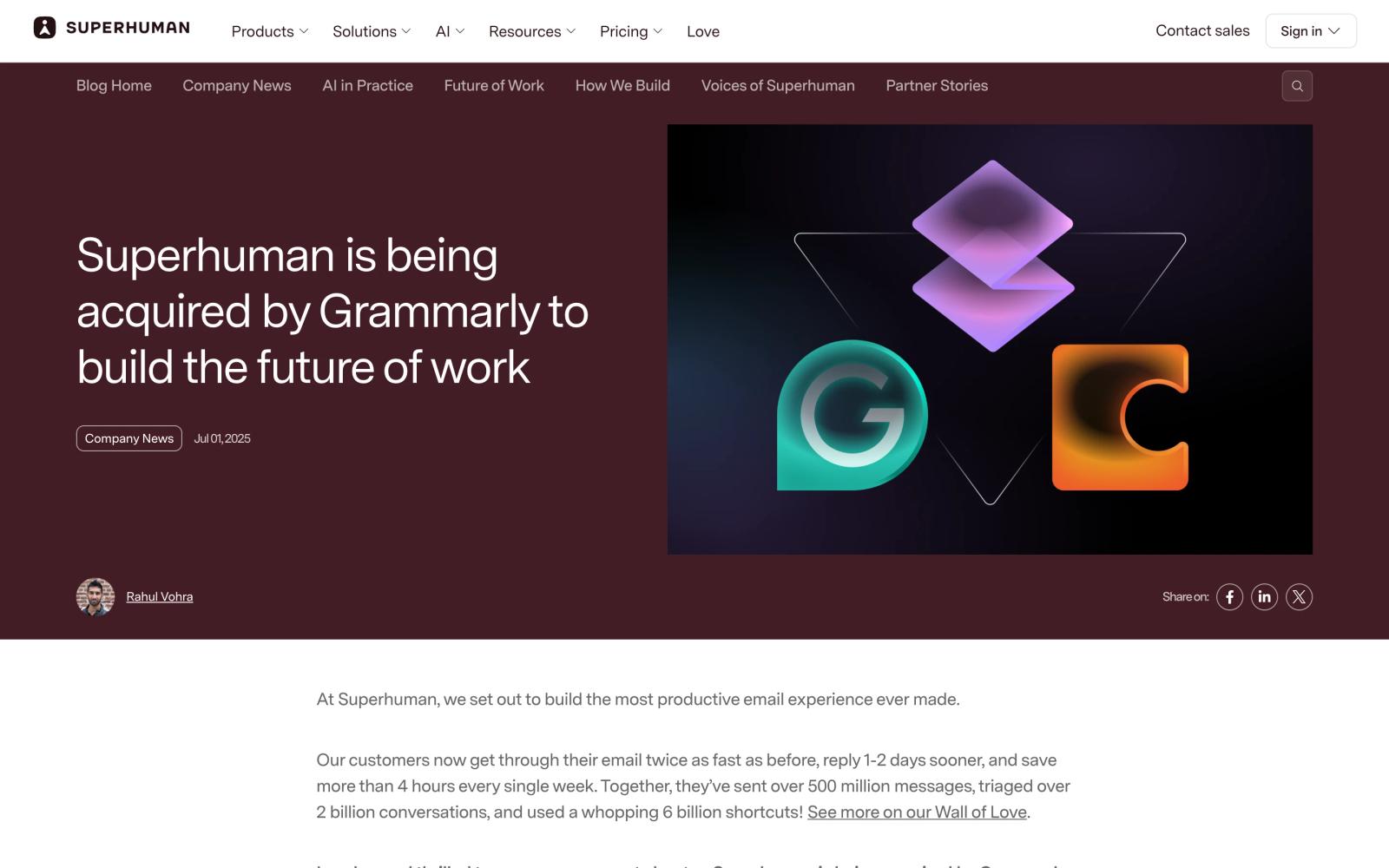
Rahul Vohra announced the sale of Superhuman to Grammarly on July 1, 2025.
“Superhuman is being acquired by Grammarly. Together, we will build the AI-native productivity suite of choice.”
Rahul Vohra, CEO of Superhuman, July 1, 2025
Who is Grammarly’s CEO now?
Shishir Mehrotra, the co-founder of Coda and a former Chief Product Officer and CTO of YouTube. He became Grammarly’s CEO when the Coda deal closed in January 2025 and kept the job when the company became Superhuman. Superhuman’s media page still lists him as Chief Executive Officer in November 2026.
CEO | Dates | Note |
|---|---|---|
Shishir Mehrotra | January 2025 to today | Came with the Coda acquisition; also joined the board |
Rahul Roy-Chowdhury | May 1, 2023 to January 2025 | Former Google executive, Grammarly’s Global Head of Product before that; stayed on as an advisor |
Brad Hoover | About 12 years, to April 2023 | Stayed on the board |
Who owned Grammarly before? The founders and investors
The same people who own it now. Max Lytvyn, Alex Shevchenko and Dmytro Lider founded Grammarly in 2009, and the company raised equity in three announced rounds, about $400 million in total (our calculation). Its last priced round, $200 million at a $13 billion valuation in November 2021, brought in Baillie Gifford and funds managed by BlackRock. Individual stakes have never been published.
Round | Date | Amount | Investors | Valuation |
|---|---|---|---|---|
Growth financing (no shares) | May 29, 2025 | $1B | General Catalyst’s Customer Value Fund | None set |
Equity round | Nov 17, 2021 | $200M | Baillie Gifford, funds managed by BlackRock, others | $13B |
Equity round | Oct 2019 | $90M | General Catalyst (lead), IVP | Over $1B |
Equity round | May 2017 | $110M | General Catalyst (co-lead) | Not disclosed |
The 2025 money isn’t ownership. In Grammarly’s announcement it is growth financing from General Catalyst’s Customer Value Fund; instead of taking shares, the fund is repaid with a capped share of the revenue the money produces. The same release put annual revenue at more than $700 million, and the company was reportedly profitable at the time.
Co-founders Max Lytvyn and Alex Shevchenko were still with the company when it agreed to buy Coda, and Shevchenko was quoted in its announcement. Superhuman lists Kyiv among its hubs, with Berlin and Warsaw.
Is Grammarly owned by Microsoft, Google, Amazon, OpenAI or Adobe?
No. Grammarly’s company is independent and privately held, and none of these companies owns it.
Microsoft: no. Grammarly works inside Outlook and other Microsoft apps, which gives Microsoft no ownership.
Google: no. Grammarly works in Gmail and Google Docs, and both Mehrotra and Roy-Chowdhury used to work at Google, but Google holds no stake that has been reported.
Amazon: no. Amazon has no reported stake.
OpenAI (ChatGPT): no. ChatGPT is a separate product from a separate company; Superhuman Docs can connect to ChatGPT and Claude, which is an integration, not ownership.
Adobe: no. Adobe has no reported stake.
Turnitin: no, and it isn’t the other way round either. Advance Publications agreed to buy Turnitin in 2019. Grammarly’s company owns a different AI detector, GPTZero.
What changed for Grammarly users
Mostly the company name on the paperwork. Grammarly Free and Grammarly Pro are still sold under the Grammarly name, and the terms now sign you up with Superhuman Platform Inc. The changes users notice:
Name: the company is Superhuman; the writing assistant is still Grammarly.
Product: Grammarly is part of a suite with Superhuman Mail, Superhuman Docs and Superhuman Go, also offered as a bundled subscription.
Address: the terms give Superhuman Platform Inc., 2261 Market Street STE 85232, San Francisco, CA 94114.
Expert Review: the company disabled this AI feature on March 11, 2026, the day journalist Julia Angwin filed a proposed class action, Angwin v. Superhuman Platform, Inc., over its use of real experts’ names. Mehrotra said the company would disable the feature while it reassesses it.
The suite keeps growing by acquisition. Fathom’s notetaker joined in September 2026.
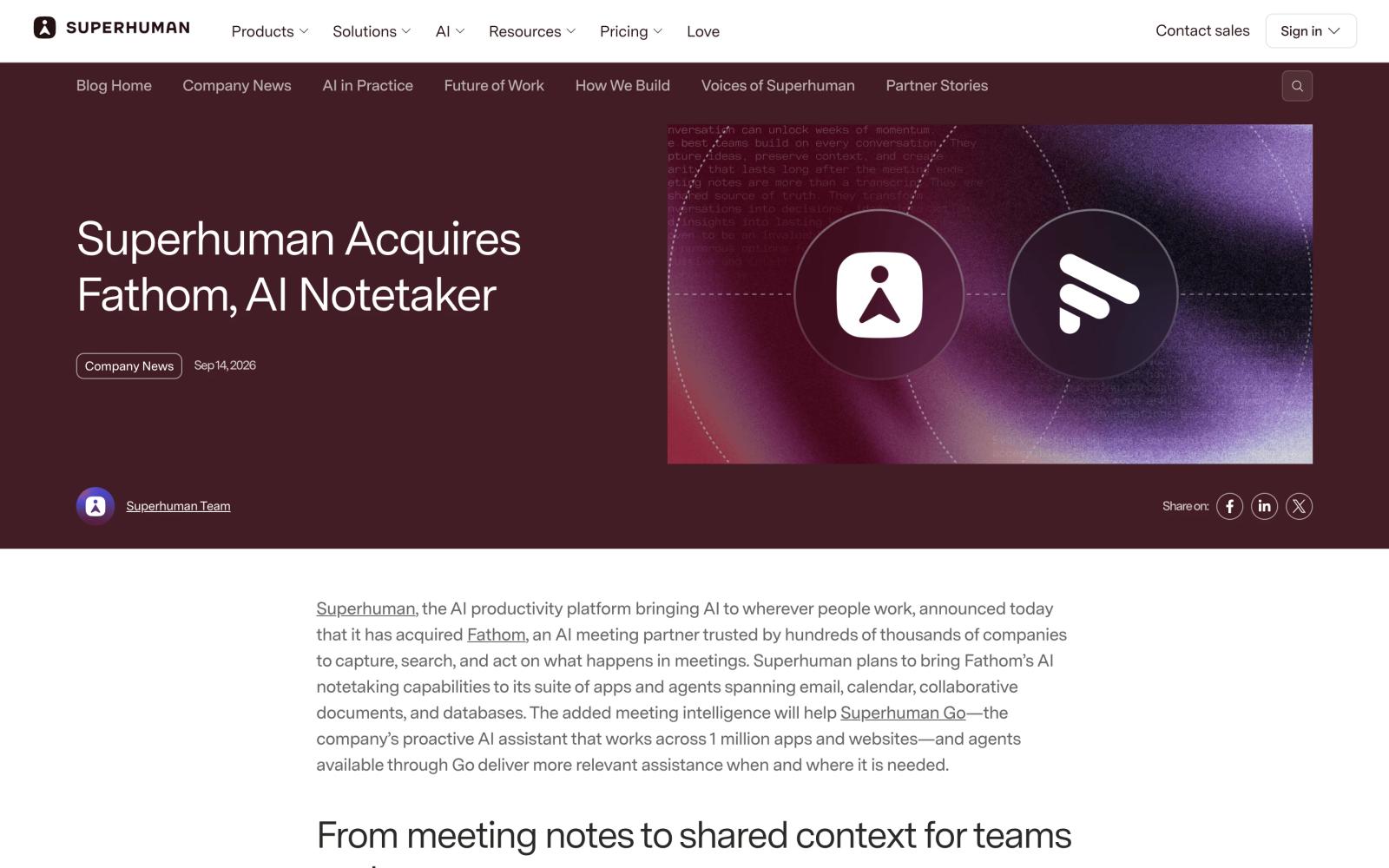
Superhuman announced on September 14, 2026 that it had acquired Fathom.
Can you buy Grammarly stock?
No. Grammarly has no stock of its own, and its company, Superhuman Platform Inc., is private. It hadn’t filed for an IPO or announced a listing as of November 26, 2026, so its shares change hands only privately.
How much is Grammarly worth?
The last announced figure is $13 billion, from the November 2021 round. The company hasn’t set a new price since: the $1 billion of 2025 financing was designed not to. An investor told TechCrunch in May 2025 that the value in today’s market was “significantly lower”.
Could Grammarly’s owner change again?
Only if the company lists its shares or sells itself, and neither has been announced. So far it has been the buyer: Coda, Superhuman, Rows, GPTZero and Fathom in under two years. General Catalyst’s 2025 money said it was meant for sales, marketing and strategic acquisitions.
More on Grammarly
Need verified CEO emails for outbound? The LeadWave SaaS companies list has hand-checked CEO contact details for 15,000+ SaaS companies in one CSV.