


Skip to content
PostHog logoPostHogFully remote; mailing address in San Francisco, US
Website

How PostHog Grew: Open Source, No Sales Team, 500,000 Teams

Curated by Khrystyna Oleksiienko · Published

PostHog launched as open-source product analytics on Hacker News in February 2020. Six years later more than 500,000 teams have signed up, 97% of companies use it for free, and it was valued at $1.4 billion, all without an outbound sales team. Its founders and marketers explain how in their own posts.

Teams signed up
500,000+
Nov 2026
Of companies use it for free
97%
Nov 2026
Of every Y Combinator batch use it
65%
Nov 2026
Valuation
$1.4B
Sep 2025

PostHog’s growth in charts

People at PostHogFrom the company's own story page and budget posts. 2023 grew revenue 4x with three net hires.
0100200300Jun 2021: 252021Sep 2021: 30Dec 2022: 382022Nov 2023: 43Oct 2024: 652024Dec 2024: 80Oct 2025: 1402025Jan 2026: 200Jun 2026: 215215
Teams using PostHogAs PostHog counted them: deployments in 2020, customers paying or free in 2021–24, sign-ups since.
0200K400K600KDec 2020: 3K3KDec ’20Dec 2021: 7K7KDec ’21Oct 2024: 100K100KOct ’24Jun 2025: 176K176KJun ’25Nov 2026: 500,000+500KNov ’26
Products in PostHogOne product at launch; customers “show up for one product and end up using four”.
051015Feb 2020: 11Feb ’20Nov 2020: 33Nov ’20Oct 2024: 99Oct ’24Dec 2024: 1212Dec ’24Jun 2025: 1414Jun ’25
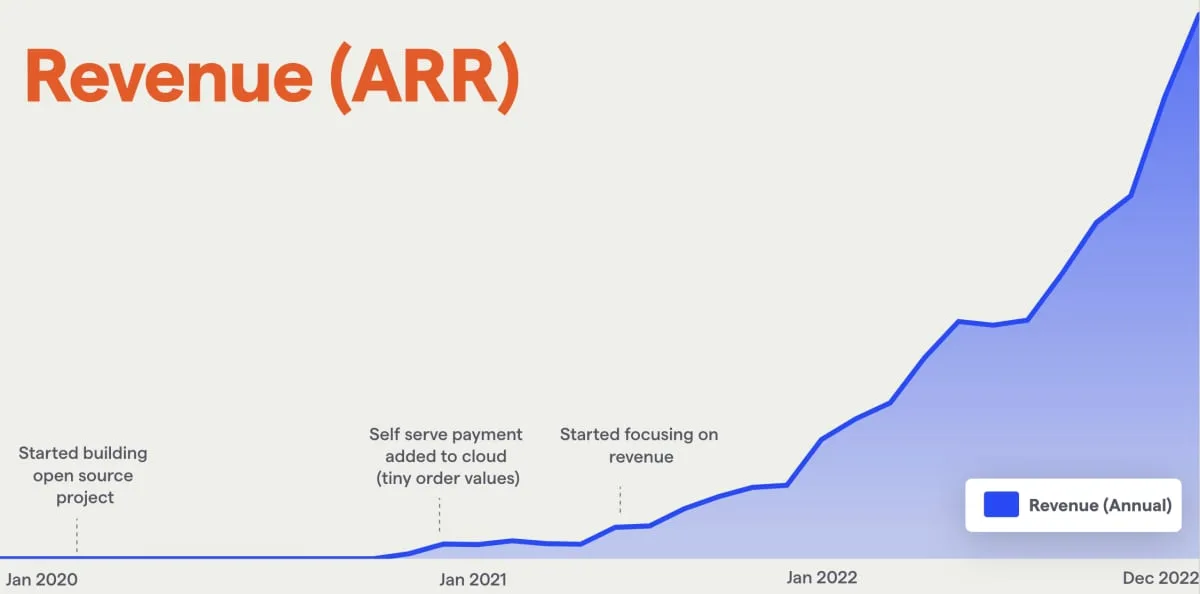
PostHog's ARR, 2020 to 2022PostHog's ARR curve from January 2020 to December 2022, annotated: started building open source project, self-serve payment added, started focusing on revenue
From PostHog's 2022 review: revenue grew nearly 6x that year with no outbound sales team. PostHog shows the curve, not the numbers.
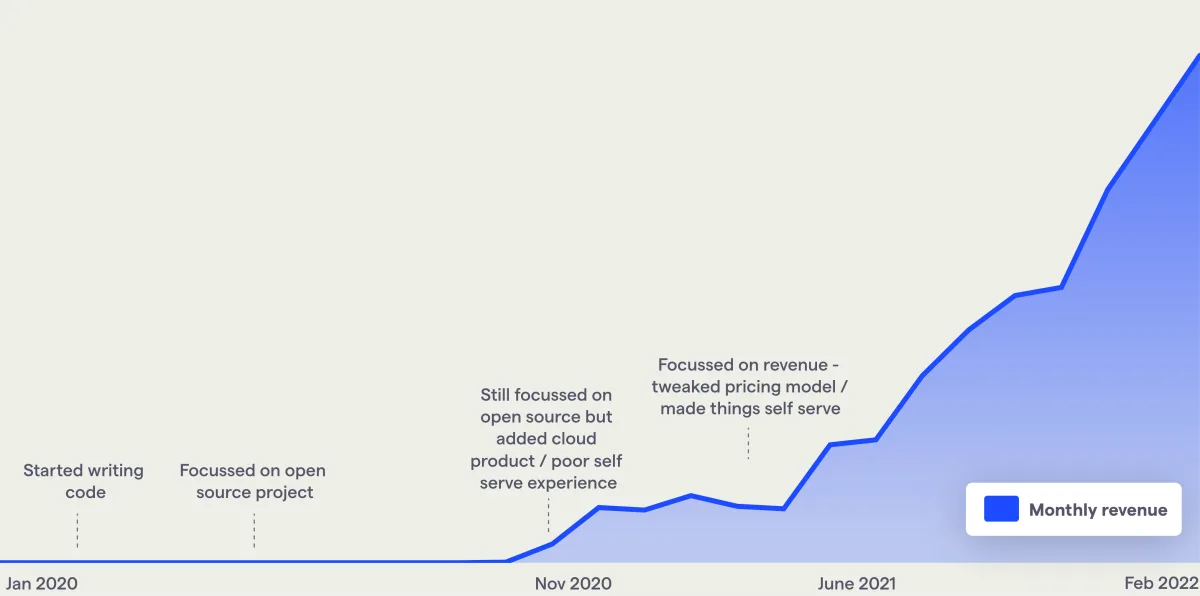
Monthly revenue, before and after the pricing changePostHog's monthly revenue from January 2020 to February 2022, annotated with the move to self-serve pricing in mid-2021
From James Hawkins' pricing lessons, March 2022: revenue took off once PostHog focused on revenue and made pricing self-serve.

The PostHog growth playbook at a glance

9 moves, one card each. The proof is further down the page; the full how-to is on each tactic’s page.

  1. Launch HN: PostHog (YC W20), open-source product analytics
    01

    Launch open source on Hacker News

    Open-source product analytics on Launch HN: 282 points and 300 deployments in a couple of days.

    See the proof

  2. PostHog handbook: How we get users
    02

    No sales team: the website sells

    “Customers buy from us, we don't sell to them.” Sales and marketing spend pays back within three months.

    See the proof

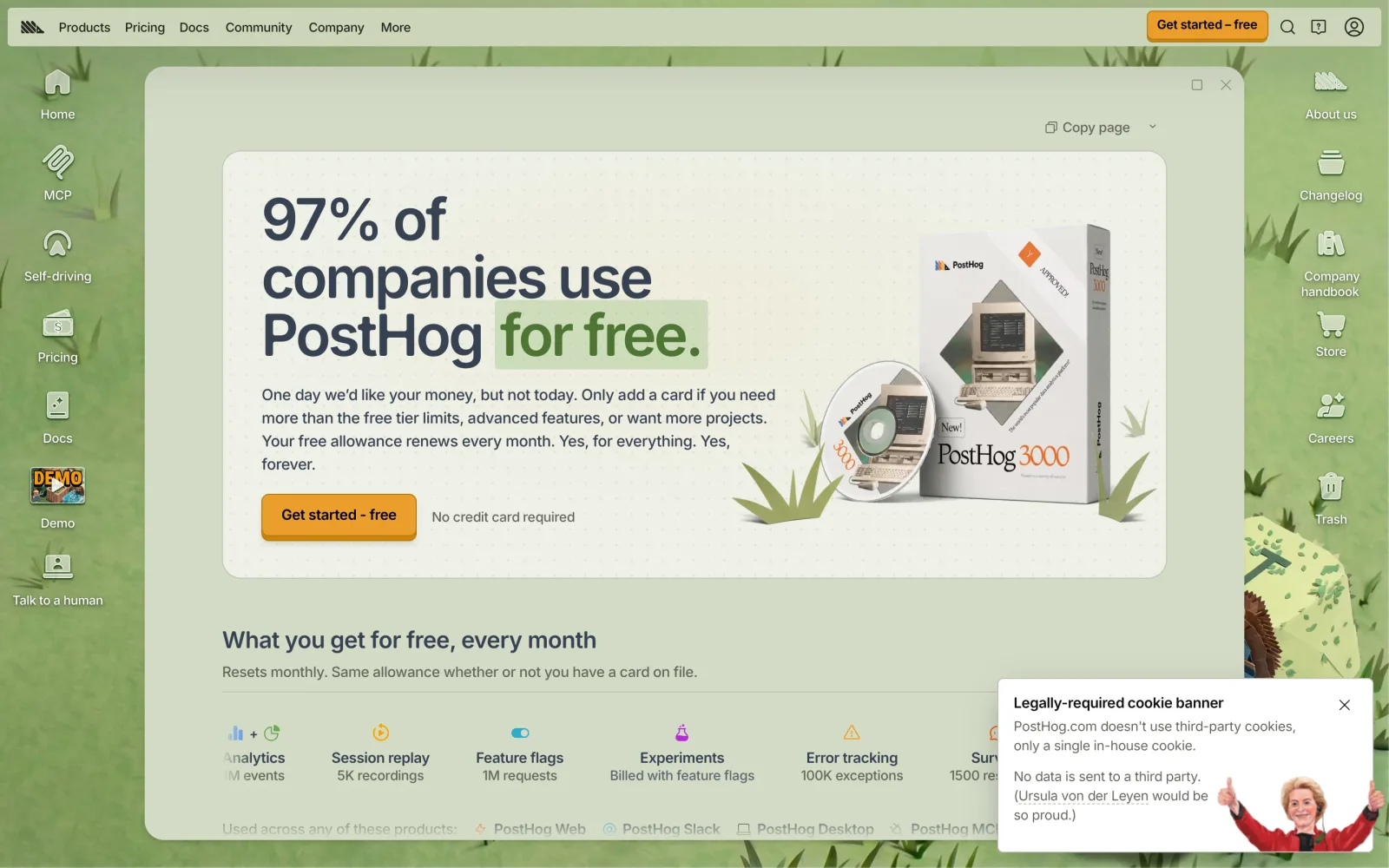
  3. PostHog pricing: 97% of companies use PostHog for free
    03

    Give it away, charge for scale

    97% of companies pay nothing; usage pricing with big free tiers, and price cuts of up to 80%.

    See the proof

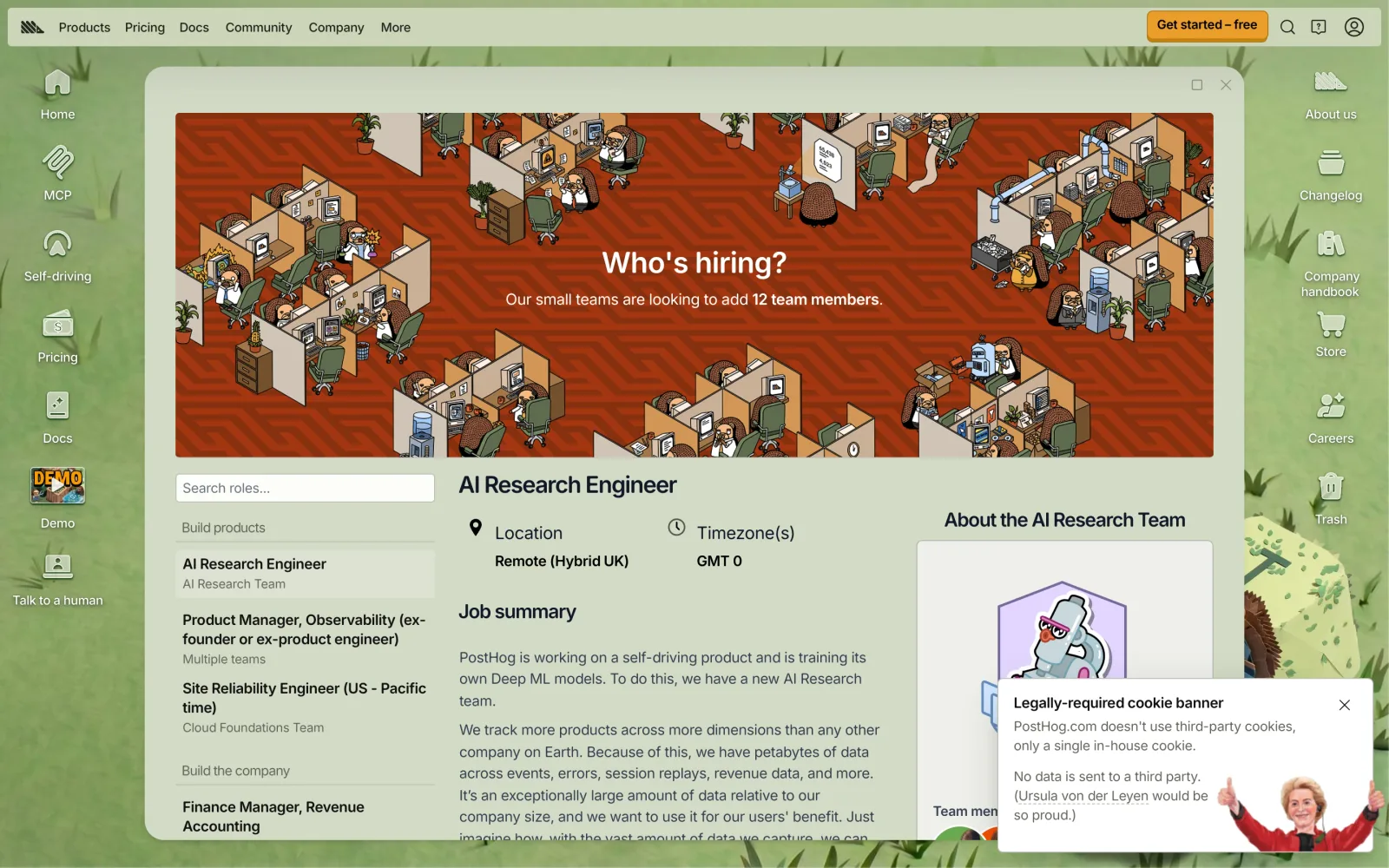
  4. PostHog careers: small teams
    04

    Many products, small teams

    Teams of up to six run each product like a startup; customers come for one and use four.

    See the proof

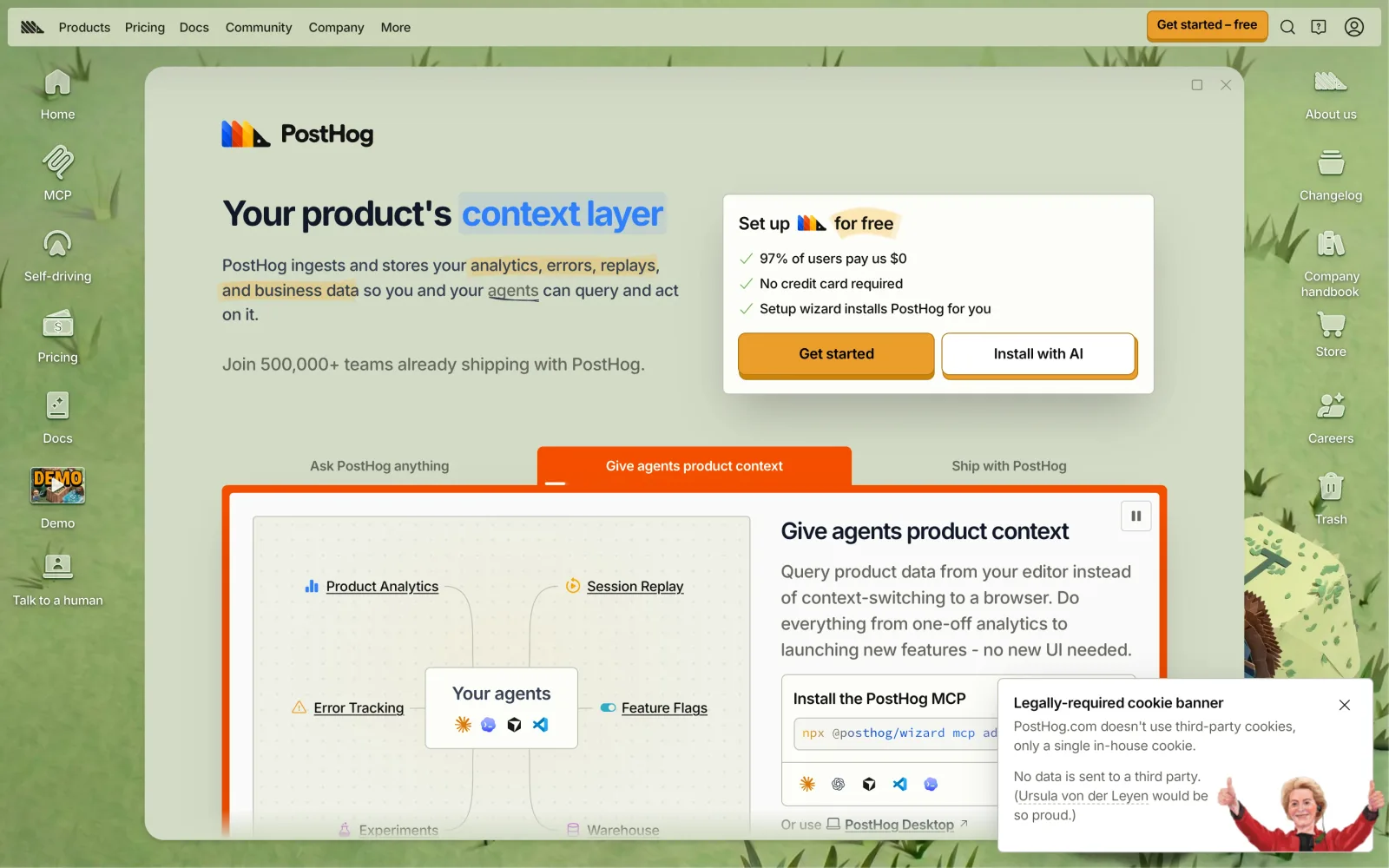
  5. PostHog's desktop-OS homepage
    05

    A brand nobody else would dare

    Hedgehogs, a website that works like a desktop OS, and a $45k-a-month budget for weird ideas.

    See the proofFull playbook

  6. 06

    Content written by developers

    A newsletter that grew from 38k to 100k+ subscribers in 2025, written by developers for developers.

    See the proofFull playbook

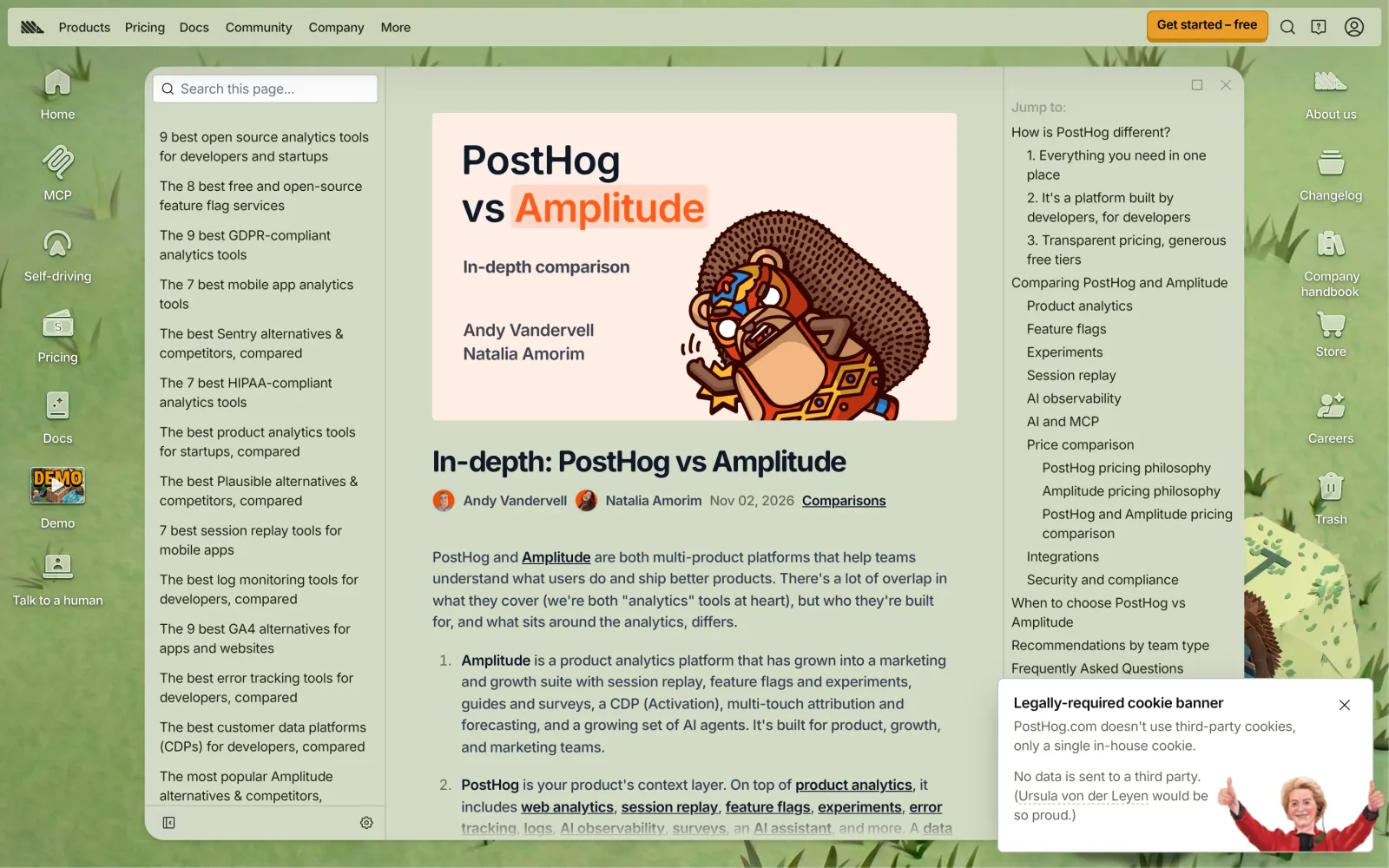
  7. PostHog vs Amplitude: in-depth comparison
    07

    Honest comparison pages

    About 90 pages comparing PostHog with rivals, honestly: 25,000+ signups since 2021.

    See the proofFull playbook

  8. PostHog for startups: $50,000 in credits
    08

    Win every YC batch

    $50,000 in credits for young startups; 65% of every Y Combinator batch now use PostHog.

    See the proofFull playbook

  9. PostHog merch store
    09

    Publish everything

    A public handbook, the real marketing budget, and the reasoning behind decisions.

    See the proof

PostHog growth timeline

  1. Sixth idea: open-source product analytics

    After pivoting almost monthly for half a year, in Y Combinator W20. Source

  2. Launch HN

    282 points, 300+ deployments in days, 1,500 GitHub stars in two weeks. Source

  3. $3M seed during lockdown Source

  4. From one product to three

    Feature flags and session recording join product analytics. Source

  5. $9M Series A led by GV

    3,000 deployments since launch. Source

  6. Free tier raised 100x

    From 10,000 to 1 million events a month. Source

  7. $15M Series B Source

  8. 6x revenue with no outbound sales

    In a tech crash, with CAC paid back in under two months. Source

  9. Kills paid self-hosting, goes all-in on the free tier Source

  10. 4x revenue, three net hires Source

  11. 54% of a YC batch adopt PostHog Source

  12. “We've decided to make less money”

    Prices cut by up to 80%, existing customers included. Source

  13. Cash-flow positive, “mostly unplanned” Source

  14. $70M Series D led by Stripe at $920M

    It began with a Patrick Collison tweet about the website. Source

  15. The website becomes a desktop OS; $1.4B Series E Source

  16. Marketing budget reaches about $1.2M a month Source

  17. Still chasing “The Hundy”: $100M ARR Source

Launch open source on Hacker News

PostHog's founders pivoted almost monthly for half a year before trying open-source product analytics. Five weeks after writing the first line of code they posted it on Hacker News, where developers could inspect and self-host it.

James HawkinsCo-founder and co-CEO, PostHog
We posted on Hacker News, and it went well, mainly because we'd achieved the other steps first. We reached 300 deployments within a couple of days – five weeks after we started building. … We also spent ~$2,000 promoting the repo on Twitter which, combined with the successful launch on Hacker News, got our repo trending on GitHub.

BlogRead the original

Ian VanagasEditorial lead, PostHog
Launching as “open-source product analytics” was instrumental in helping us get our first 1,000 users. … We benefit hugely from this (700+ messages in our #brand-mentions channel include "open source").

Product for Engineers (posthog.com/newsletter)Read the original

James HawkinsCo-founder and co-CEO, PostHog
As a founder, one of the most surprisingly important skills I've realized I have is hitting the front page of Hacker News. Out of five posts that I hoped would get there, four did.

BlogRead the original

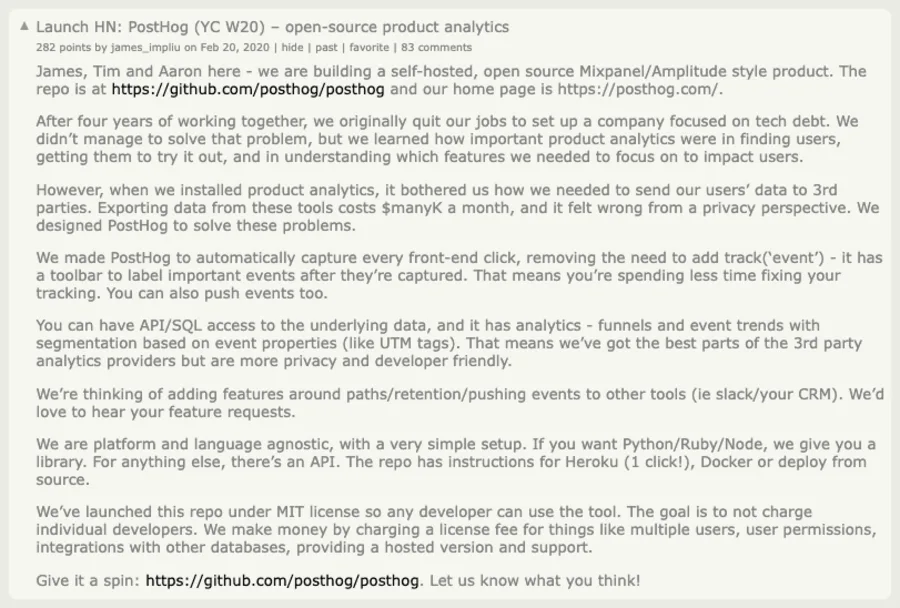
Launch HN: PostHog (YC W20), open-source product analytics, 282 points
Launch HN, February 20, 2020: 282 points and 83 comments.

No sales team: the website sells

PostHog has never done outbound sales. Users find it, install it, add their team and pay when they grow, so the website and the docs do the selling. Sales was added late, to help customers who ask.

James HawkinsCo-founder and co-CEO, PostHog
PostHog follows bottom-up adoption. This means our users find us online, install, hopefully add their team and then reach out to buy our paid version. We're very different from our competitors in this way. This means that design is key. Our website and product are our storefront - not a sales team. It needs to be one of our core competencies.

BlogRead the original

PostHog handbook: How we get users. Over 500,000 teams have signed up
How we get users, from PostHog's public handbook: “Customers buy from us, we don't sell to them.”

Give it away, charge for scale

Each product has a free allowance every month, and you pay only for usage above it. In 2024 PostHog cut prices by up to 80%, betting on customers adopting more products rather than paying more for one.

James HawkinsCo-founder and co-CEO, PostHog
Here is a breakdown of the counterintuitive lesson I've learned as a cofounder at PostHog - the more we give away for free, and the less we ask from users on day 1, the more money we make. … Our numbers reflect that users feel the same way - over half our users enter their card details.

BlogRead the original

PostHogCompany account on X
We've decided to make less money [Part 1] 🔥 As of today, we're drastically cutting prices and making PostHog the cheapest session replay tool among competitive products. … We make money by onboarding customers onto more of them, not maximizing the profitability of individual tools.

X271 likes41K viewsView on X

PostHog pricing: 97% of companies use PostHog for free
Pricing: “97% of companies use PostHog for free.”

Many products, small teams

PostHog grew from one product to more than ten: session replay, feature flags, experiments, surveys, a data warehouse, error tracking. Each is run by a small team that owns its own roadmap and pricing.

James HawkinsCo-founder and co-CEO, PostHog
The most important thing, but the one we didn't anticipate, was charging for session replay very quickly led to more usage. … Session replay took off as a result – it now has similar daily usage to product analytics.

BlogRead the original

James HawkinsCo-founder and co-CEO, PostHog
PostHog works like a group of startups with lots of small teams. Each of our products has a team of up to 6 who can ship with minimal interference from the rest of the company. They make their own product decisions, own their pricing … At the time of writing, we are 37 people, only 11 of whom are in Go To Market or Operations roles

BlogRead the original

PostHog careers: our small teams are looking to add 12 team members
Careers: hiring by small team, not by department.

A brand nobody else would dare

Developers judge a tool by its website, docs and readme first, so PostHog made them unmistakable: hedgehogs, jokes, and since 2025 a website that works like a desktop operating system. “Do more weird” is a company value with its own budget.

James HawkinsCo-founder and co-CEO, PostHog
Being open source helped because people could inspect the code, but we concluded the majority would turn away at the website, the docs, and the readme first. … That's why we set out to create a website and brand that felt both unique and intentional, including a public handbook that explained what we were doing, why, and how. … Everyone judges books by their covers.

BlogRead the original

Cory WatiloLead designer, PostHog
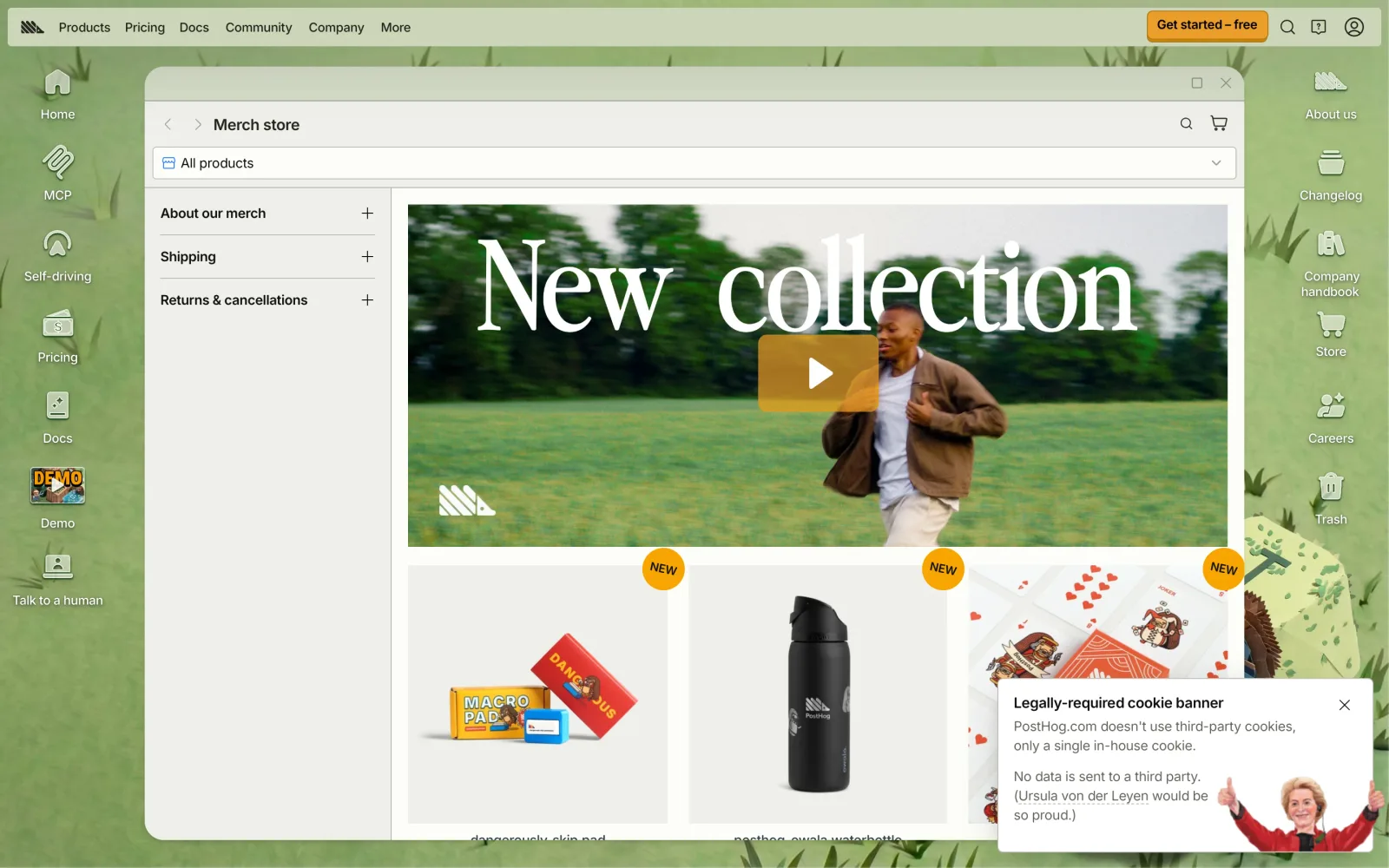
You can multitask, open a few articles simultaneously, and move them around as you please. If anything there's a whitespace deficiency, and your fingers will be jealous you're not scrolling with them as much (because you're so engaged with our content). It has window snapping, keyboard shortcuts, and a bookmark app. It works as well as you’d expect an operating system to work in a browser. … A Windows File Explorer clone that also acts as the UI for our merch store

BlogRead the original

Charles CookMarketing exec, PostHog
"Do more weird" is an actual PostHog company value, and we have a discretionary $45k/mo budget that anyone can use to bring weird ideas to life. … A lot of the billboards we've run have had zero people comment on them. We've had easter eggs that ~3 people have found. We've wasted money on merch people have never worn. Our documentary that we spent a ton of time and money on has 2k views.

BlogRead the original

Ian VanagasEditorial lead, PostHog
We do all this to spend $60,000 every month mostly giving away merch. Basically, 1.5 people are working on merch at PostHog now at any given time. We do have some revenue, but it's not enough to even mention. The biggest reason we do merch is that it brings us joy. We love seeing our team and our users wearing our merch. It excites people and makes them feel like part of what we're building.

BlogRead the original

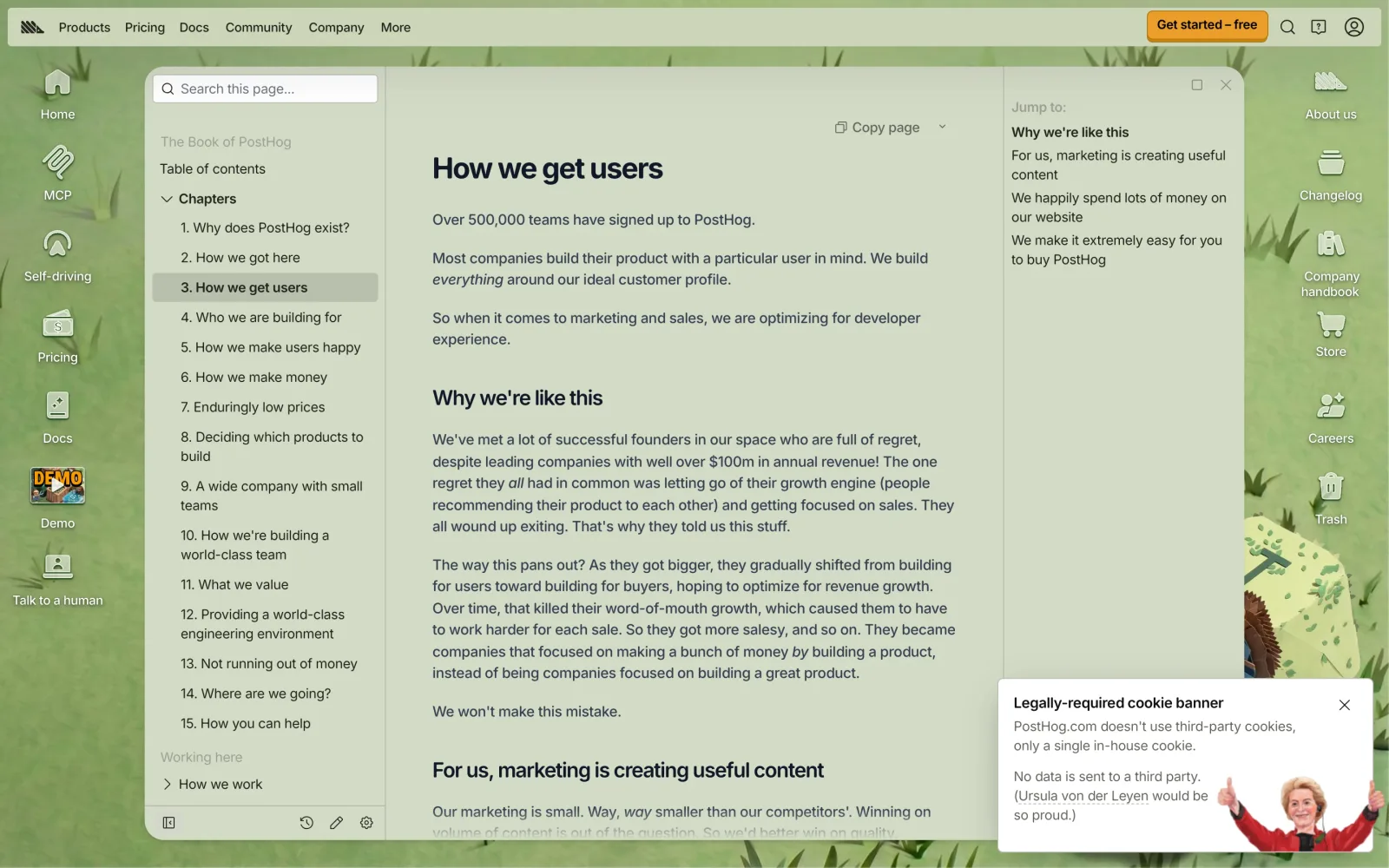
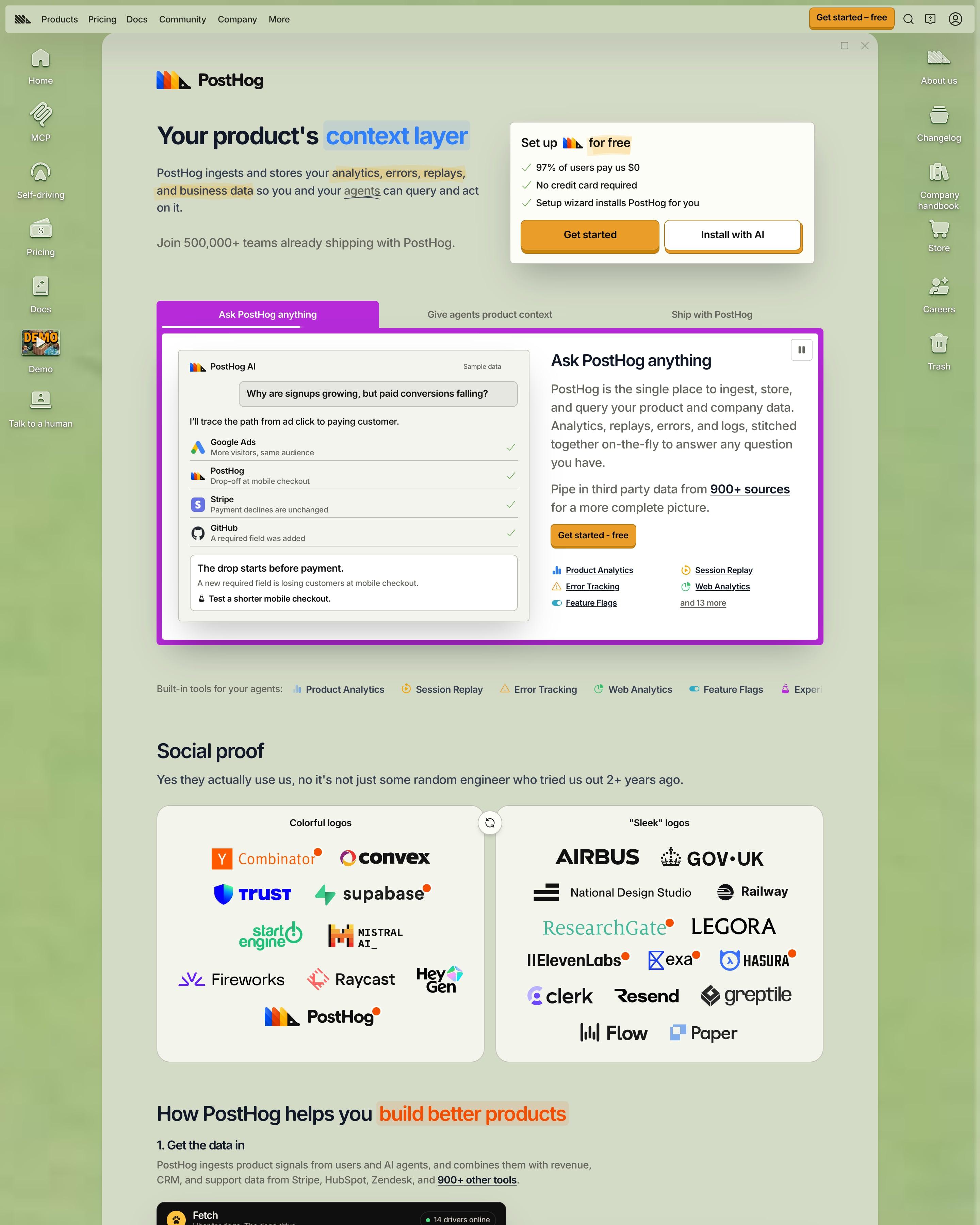
PostHog's homepage, built like a desktop operating system
posthog.com, with its own joke “Legally-required cookie banner”.
PostHog's merch store
The merch store: about $60,000 a month, mostly given away.

The full playbook:Easter eggs

Content written by developers

PostHog hires developers to do marketing, and publishes fewer, better pieces. Its newsletter, Product for Engineers, passed 100,000 subscribers in 2025. Channels are tested as side projects first, then staffed and funded.

Charles CookMarketing exec, PostHog
1 great article >>> 25 mediocre ones. … This means keeping it separate from marketing, which is the opposite of what most companies do. While our marketing and website teams work closely together, the website team has the final say on what appears on posthog.com. This stops the website becoming too marketing-y and falling foul of marketing ‘best practices’ that most developers (and people in general) despise.

BlogRead the original

Ian VanagasEditorial lead, PostHog
We published 28 posts that were read over 1M times. We started the year at ~38k subscribers and ended it at over 100k.

Product for Engineers (posthog.com/newsletter)Read the original

Ian VanagasEditorial lead, PostHog
Because our ICP is developers, we hire developers to do marketing. This gives us the skills we need to understand developers, speak their language, and create content they find genuinely useful.

Product for Engineers (posthog.com/newsletter)Read the original

Charles CookMarketing exec, PostHog
Our general framework for any new marketing channel is, broadly: Have someone try it as a side project, give them a bit of budget. Use this to decide if the thing broadly works. Hire someone dedicated who is really good at that thing. Give them lots of budget. … We've also shifted our budget more broadly from 80/20 conversion/awareness focus to 60/40.

BlogRead the original

The full playbook:Branded newsletter

Honest comparison pages

PostHog writes in-depth pages comparing itself with every rival, including where the rival is better. About 90 pages have brought 25,000+ signups since 2021.

Natalia AmorimWriter, PostHog
Since 2021, over 25k people have signed up for PostHog after reading a comparison. Almost 50% did it within 24 hours of reading; ~75% within 30 days. … Five years, 90-ish pages, and tens of thousands of signups later, "write honestly about the people trying to eat our lunch" has turned out to be one of the best decisions we've made for our organic content strategy

BlogRead the original

PostHogCompany account on X
Most "Tool X vs. tool Y" comparison content is bad, because it's dishonest. Why write about why your competitors are better than you? Because it converts. We've driven 700k pageviews and 25k+ sign ups from content about competitors.

X833 likes82K viewsView on X

PostHog vs Amplitude: an in-depth comparison
PostHog vs Amplitude, one of about 90 comparison pages.

The full playbook:Comparison pagesCompetitor replacement

Win every YC batch

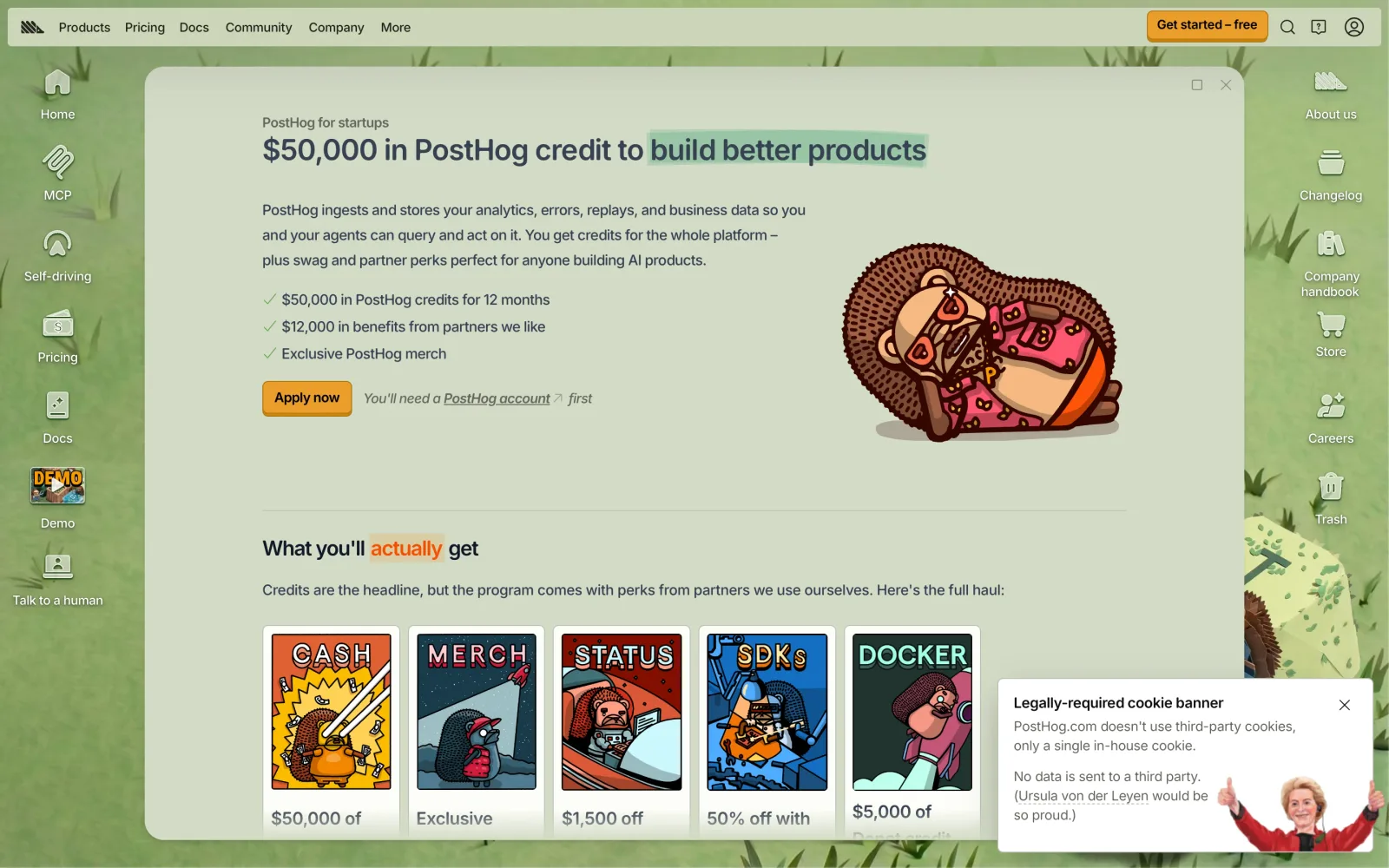
Startups become big customers, so PostHog courts them early: $50,000 in credits for young companies, and a presence at every Y Combinator batch. 54% of the first 2024 batch adopted it; PostHog now says 65% of every batch use it.

PostHog for startups: $50,000 in PostHog credit
PostHog for startups: $50,000 in credits for 12 months.

The full playbook:Startup program

Publish everything

PostHog's handbook, strategy and even its marketing budget are public. It builds trust with developers and makes hiring easier.

James HawkinsCo-founder and co-CEO, PostHog
There really hasn't been a single situation where transparency hasn't been to our company's advantage. … transparency makes hiring great talent much easier. Since we share most of the below publicly, potential hires can trust us much more easily, and it makes us stand apart from the thousands of other startups.

BlogRead the original

What you can copy from PostHog

  1. 1.Launch where your users already are: for developer tools, that's Hacker News and GitHub.
  2. 2.Let the website, docs and product do the selling; add sales only to help buyers who ask.
  3. 3.Give a generous free tier on every product and charge for usage; grow by adding products, not raising prices.
  4. 4.Run each product as a small team that owns its roadmap and pricing.
  5. 5.Make the brand impossible to confuse with anyone else's, and give weird ideas a budget.
  6. 6.Write honest comparison pages for every rival (comparison pages).
  7. 7.Win startups early with credits; they become your biggest customers (startup program).

Knowledge graph

Everything LeadWave has on PostHog: its leaders, our pages on it, the lists it’s on and the growth tactics it uses.

Frequently asked questions

More company dossiers

All dossiers
  • Ramp logo

    Ramp

    How Ramp Grew So Fast: From Launch to $2B Revenue in 6 Years

    Ramp launched its corporate card in February 2020 and passed $2 billion in annualized revenue in the summer of 2026, when it was valued at $60 billion. Its leaders explain how in their own posts: speed, builders, and a card that helps companies spend less.

    Read


  • Cursor logo

    Cursor

    How Cursor Grew: From $1M to $4B ARR in Under Three Years

    Cursor had just passed $1 million in ARR when it raised its seed in October 2023. By June 2026 it was on a $4 billion run rate, and in August 2026 SpaceX bought it for $60 billion. Its founders say they hadn't spent a dollar on marketing; they explain how it grew in their own posts.

    Read
  • Gamma logo

    Gamma

    How Gamma Grew: From a Year of Runway to $100M ARR With 50 People

    In late 2022 Gamma had about 60,000 users and a little over a year of runway. It relaunched as an AI presentation maker in March 2023 and passed $100 million in ARR in November 2025, profitably, with about 50 people. Its founders and growth team explain how in their own posts.

    Read
  • Granola logo

    Granola

    How Granola Grew: No Meeting Bot, No Growth Hacks, Valued at $1.5B

    Granola launched its AI notepad in May 2024 after a year of closed beta. By October 2026, 68% of businesses on Ramp that pay for an AI notetaker used it, up from 6% two years earlier, and it was valued at $1.5 billion. Its founders explain how in their own posts: no bot in the meeting, and word of mouth.

    Read
  • Linear logo

    Linear

    How Linear Grew: $100M ARR With Almost No Marketing

    Linear opened to the public in June 2020 after a year of invite-only beta, turned profitable a year later, and passed $100 million in ARR in 2026 with more than 40,000 paying companies, having spent 0.5% of its revenue on marketing. Its founders explain how in their own posts.

    Read
  • Retell AI logo

    Retell AI

    Retell AI in 2026: Revenue, Valuation, Funding, CEO

    Retell AI makes AI voice agents that answer and place phone calls for businesses. Founded in 2023 and backed by Y Combinator, it reached a $100 million annualized run rate in November 2026 having raised only $4.6 million, and says it is profitable.

    Read