How Ramp Grew So Fast: From Launch to $2B Revenue in 6 Years
Curated by Khrystyna Oleksiienko · Published
Ramp launched its corporate card in February 2020 and passed $2 billion in annualized revenue in the summer of 2026, when it was valued at $60 billion. Its leaders explain how in their own posts: speed, builders, and a card that helps companies spend less.
Speed: “blitzkrieg faster than others could respond”
Ramp had none of a bank's advantages: not the cost of capital, not the interchange. So it competed on speed, and counted the days from the first board meeting on.
at the very beginning of the company, the answer was very easy of like, look, our cost of capital is nowhere close to a bank's. The interchange that we could make is nowhere close to it. We have all the disadvantages of scale. … We need to move fast, we need to have this emphasis around velocity to ship product and just kind of blitzkrieg faster than maybe others could respond. … they sell money and we sell time.
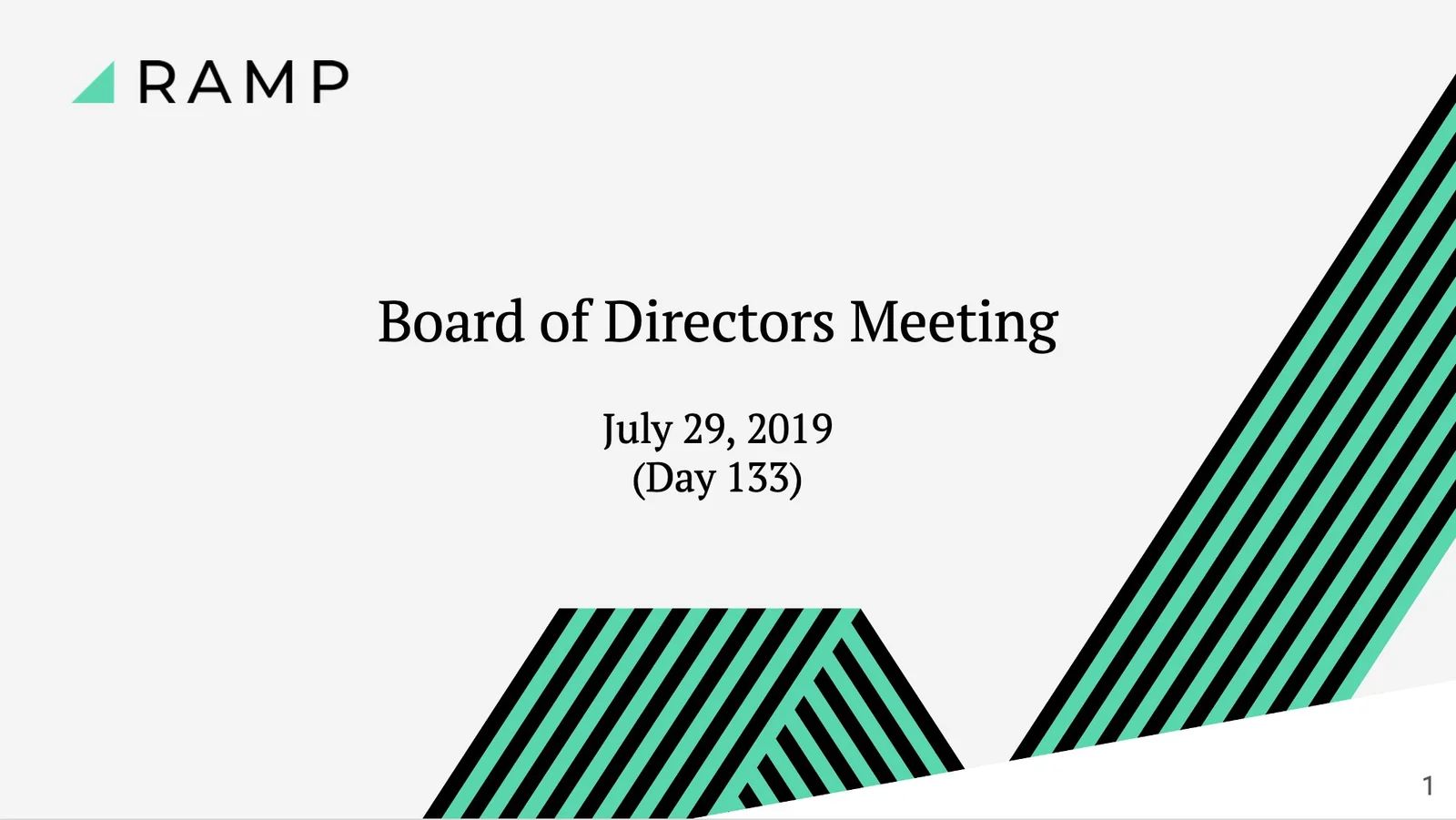
In 1000 days, Ramp became the fastest growing corporate card in America (and the first to try to help customers spend less), scaled to nearly 9 figures in revenue, and did so at sustained hypergrowth (20%+ MoM growth). What was our playbook? … Count the days. In our first board mtg w/ @rabois, we put the day since founding. It became core to our culture. … when you ask hard questions ("How will we do more these next 60 days than the last?"), you grow.
when I joined, we were about 10-ish folks, about eight engineers, and in three months, we built a competitor to Amex. Six months after that, we built a competitor to Expensify … We basically gave a team goal of building a competitor, Bill.com. It was three engineers, one designer, one PM three months, and they hit out of the park. … small teams have a single-threaded focus, give them the resources they need to execute big lofty goals, very tight timelines, and then shield them from the chaos
The world is accelerating. So should our velocity. 6.5 days (incl a 4 day holiday break) from customer feature request to production for all Ramp customers.
At Ramp we ship a new major feature every day - it's impossible for leaders stay up to speed.
To keep a high bar without slowing folks down, teams can ship to early access tier whenever they want but need review for general release.
Crazy fact: 10% of customers opt into early access because they can't get enough. That's 5000+ businesses. Plenty to work with.
To release to general public, teams need to prove this product works and get sign off for heads of eng, product and design. Here is our template:
1. What did we build and why
2. What's the demo in < 3mn (loom)
3. Did we meet our goals in early access (hex dash)
4. Are customers raving about this (LLM on Zendesk tickets, Sprig surveys, and Gong transcripts)
5. Will customers easily discover and start using it (first time user journey)
6. Is sales ready to sell, AM ready to activate, and support ready to troubleshoot
7. Do we have a clear rollout plan (launch tier, pricing, coms)
…
Leadership has 48h to review or it ships.
Ramp's product updates page. The short link ramp.com/whats-new, printed on postcards, leads here.
Hire only builders
The founders' hiring test: “If this person started a company would we join them?” Ramp says about 70 former founders have joined, and every job post asks for “slope over intercept”: how fast you grow, not where you start.
We only hire builders (and we’re on a hiring spree)!
Reply with something you've built. I'll read them personally. We’re interviewing the best ones.
You’ll be a good fit if you:
- work best without permission
- default to “how could I automate this” … - make prototypes, not powerpoints
- don’t like hierarchy
The problem is most people who are exceptional at what they do tend to be very spiky. They don't have an evenly distributed skill set. This approach makes it very easy to find flaws and disqualify candidates. On the other hand, it also makes it very hard to find people who have 10x potential and can grow with you.
We don’t hire external managers in our engineering team and rarely do in sales or other teams either. Instead, we hire builders and individual contributors — as they succeed, they can grow into player-coaches. … Jump on sales calls. Answer customer support tickets. Use and improve your products.
The careers page introduces people by what they built: “Rewrote this careers page in one weekend”, “Manages $55M in marketing spend at age 23”.The block every Ramp job post shares: “We hire people with high agency and high urgency. We look for slope over intercept.”Ramp Builders: a feed of employees' own posts on what they ship.
Make everyone an AI builder
In 2026 Ramp made AI skill a condition of joining, put usage on a company leaderboard, and built its own tools: Inspect, a coding agent, and Glass, an AI workspace for every employee.
We now have an absolute requirement for anyone joining Ramp to be proficient with AI tools. No exceptions. For PM candidates, there's a dedicated interview session: build me a product, show me how you built it, walk me through how it works. It's a full-blown prototype, not a slide deck.
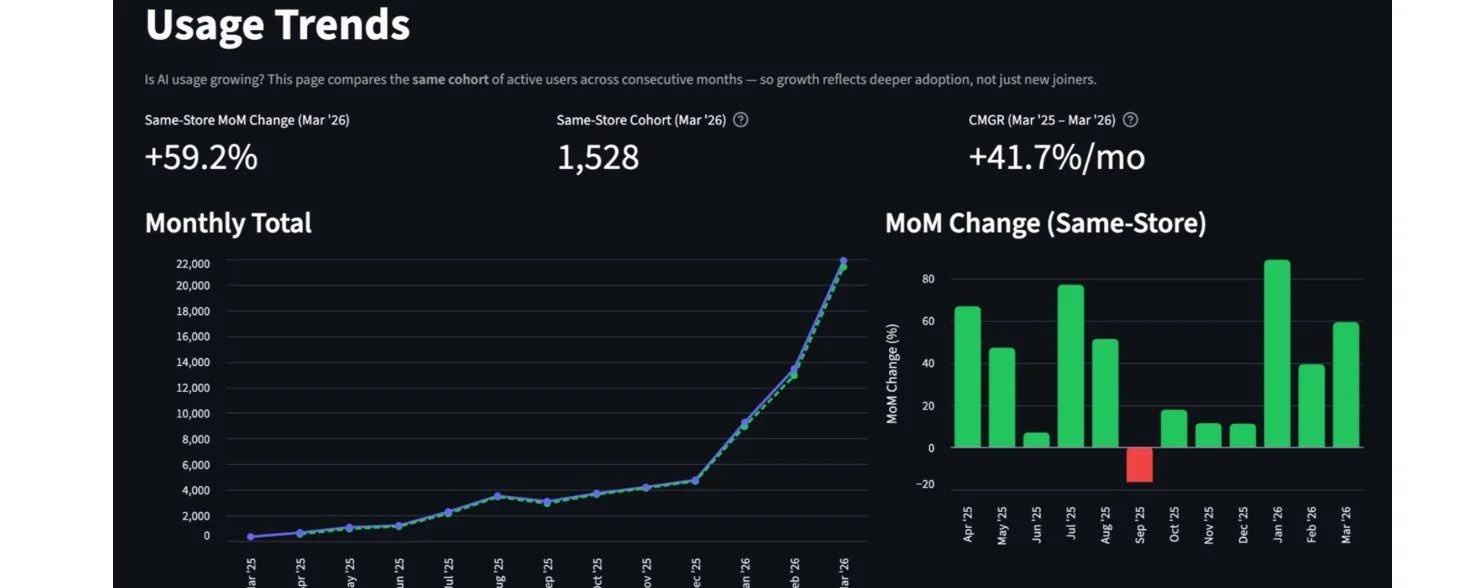
From day one, it’s what I’ve told our team: when a customer runs into a problem, the person who notices should dig in. When someone finds a better way to work, they should build it for the team. … Most orgs slow down as they grow. Our builders now ship 6x as much code per person as they did a year ago … In the past month, 99% of our engineering, design, and product teams used Inspect, and Inspect now accounts for 74% of merged PRs.
Last week, David Senra asked me: “How does Ramp move so fast?” … Take new feature requests. They used to be copied by hand into Salesforce, about 300 a month. In May, an account manager saved a prompt to Glass that pulls them straight from customer calls. Now we capture 20,000 a month. Another prompt prioritizes them. A third emails customers when something they asked for ships. … I sent David four words back: “We learn things once.”
Karim Atiyeh introducing Inspect, October 2026: 99% of engineering, design and product use it.
Sell savings, not points
Corporate cards competed on rewards, which pay a company to spend more. Ramp sold the opposite: “we believe a dollar saved is worth more than any amount of points,” it wrote in 2020. Happy customers did the selling: in 2023 Glyman called word of mouth Ramp's most successful channel. Customers now save over $1B a month.
We’re not some AI-driven finance tool that we’re going to market. Do you want to adopt AI in your finance team? No. We exist to save you time and money. We lead with the benefit. We talk about the outcome that we’re trying to drive, and we put these in simple terms. But I would say it’s actually not possible to use Ramp today without using AI.
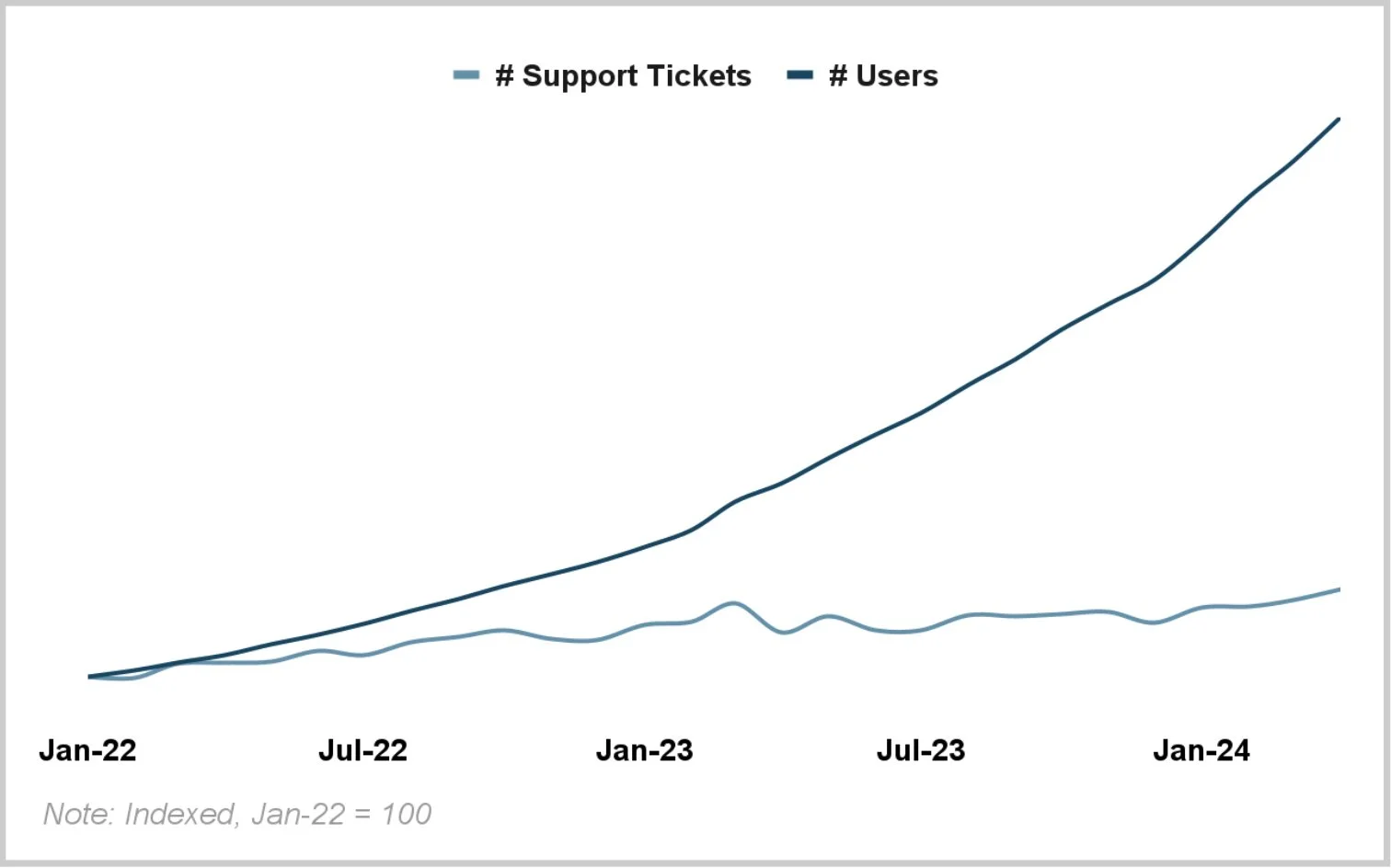
Support reports to product at Ramp, so a ticket is a bug to remove, not a cost to staff. And product says no to what customers ask for when it would pull Ramp off course.
On the time YC cofounder @jesslivingston tore me a new one and changed the future org structure of Ramp:
… Her point was that the real solution isn’t solving tickets, it’s listening to customers and building a better product so customers never need to write in the first place. … You can’t out-hire a bad product, or compensate for poor taste with a big support team. … To this day, almost a decade later, support reports into product at @tryramp
Your product will not be able to solve everything for everyone. You need to be very opinionated as to who you actually want to serve and be willing to walk away from customers that might be lucrative but will take you in a different direction. … Example for us is Expensify integration. Customers wanted it. Sales wanted it. I didn’t want to build it. Five years later look at their stock price vs ours…
Brex had a two-year head start and was the card for startups when Ramp launched. Ramp never matched its rewards points; it kept selling savings, and it kept the customers Brex let go.
“5,500+ teams chose Ramp over Brex. Our product velocity, driven by customer dedication, has consistently won over 85,000 companies.” The page has a button that asks ChatGPT to compare the two. Its short link, ramp.com/vs-brex, redirects with the tag directmail_versus-brex_jan2026: a postcard campaign.The switch page: a dedicated onboarding specialist, migration with no downtime, live team training.
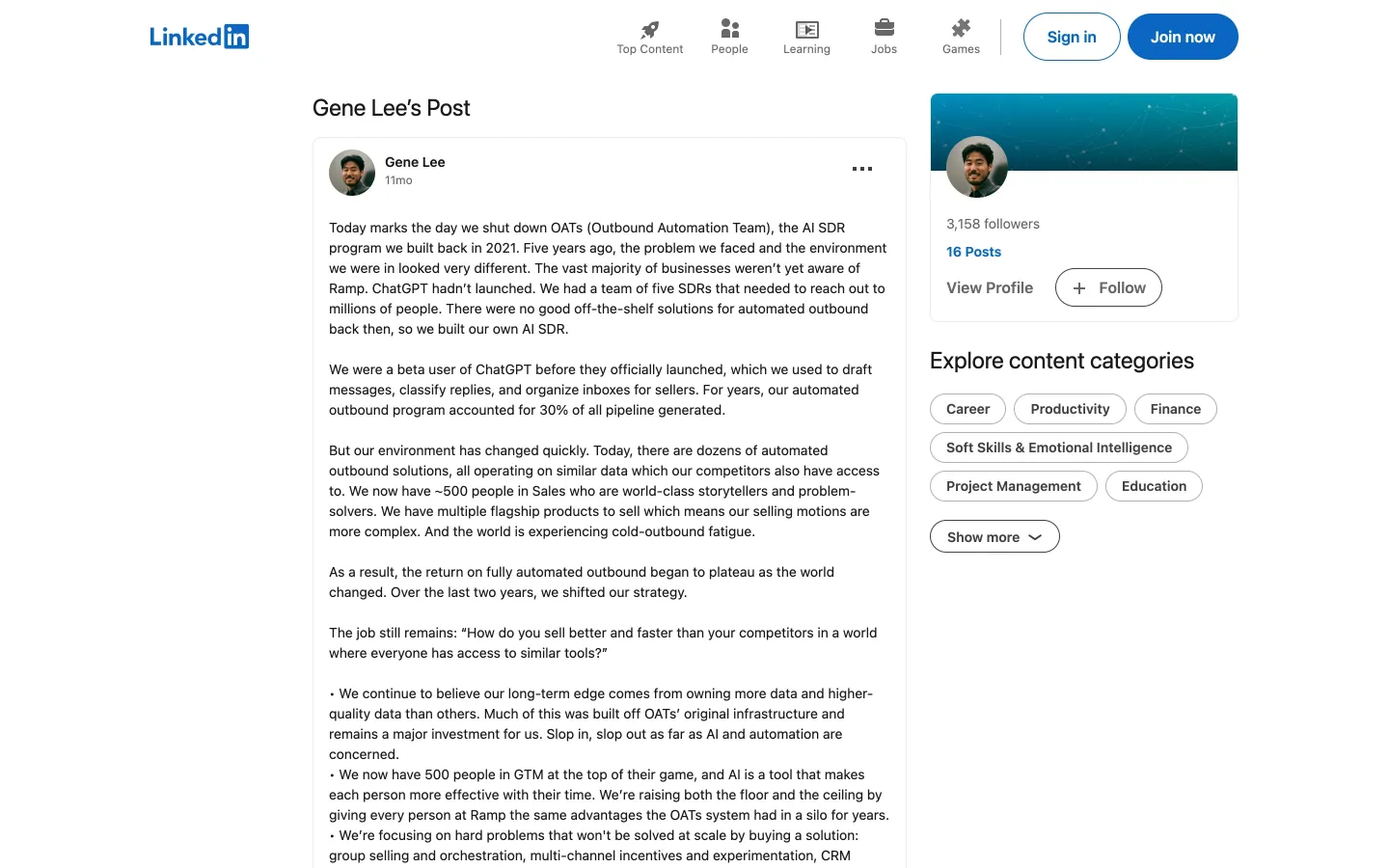
Ramp's first sellers were bankers paid above market. Then engineers automated the best rep's clicks, which grew into OATs, an in-house AI SDR built in 2021 that produced 30% of all pipeline. Co-founder Gene Lee shut it down in December 2025, once rivals could buy the same thing.
MFMax FreemanVP of Sales, Ramp (its first sales hire)
We wanted a product-first sales team that would truly understand what we were selling, the competitive landscape, and the buyer personas. We didn’t look for people with typical SDR or even AE backgrounds. … we were paying well above market rate but we made the math work because the output of Sam, Weber, myself, and others was 5x market value - we were all booking 40-50 meetings a month
MFMax FreemanVP of Sales, Ramp (its first sales hire)
At some point, I believe it was Karim (CTO) who came to us and asked, how do we make outbound an engineering challenge? … They watched my workflow, all my manual clicks, and automated as much as possible. … We had a Slack channel called #outbound-meetings—any time someone booked a meeting, the entire company saw the message, who the prospect was, and the exact outreach that worked.
Ramp sees what 85,000+ businesses buy. It publishes that as an index, a think tank and a newsletter, and gives away tools built on it. Every press citation names Ramp.
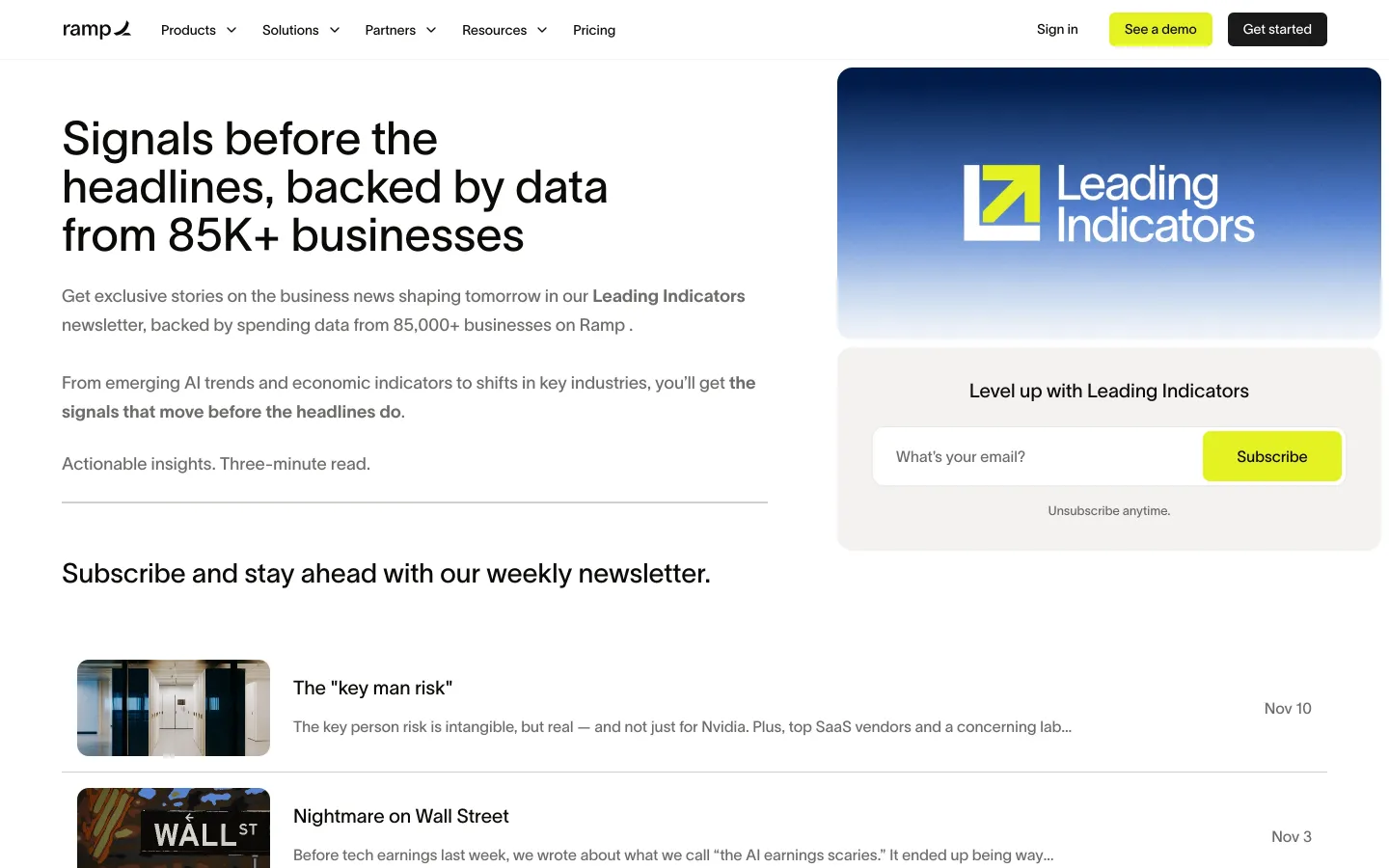
The Ramp AI Index, monthly, also on FRED and as a Claude connector and a ChatGPT app.Leading Indicators: a three-minute weekly read on Ramp's data.The Ramp Economics Lab: economists on staff, cited by Bloomberg, the Wall Street Journal and the Financial Times.Free tools: calculators, generators and a vendor directory built on Ramp's spend data.
We believe that marketing is fundamentally an engineering problem — the systems we need to build to effectively deploy $ (CAC) in exchange for adoption (LTV). So CTO makes sense. … Brand marketing — that also sits under the CTO but reports into our head of design… empowered to take creative action and be bold (e.g. Super Bowl campaign, Brian from The Office...).
KHKendall Hope TuckerHead of Creative Experimentation, Ramp
I had cold DM’d Rohan Kumar who led social at Mr. Beast for 4 years … I invited him plus his friends Lewis Atallah and Mattias Russo-Larsson to our office for a week-long brainstorm. The deal was that each day we’d pitch stunt ideas, and by Friday we’d choose our favorite. … After working 50+ hours, we landed on one idea that stuck: a glass box with someone trapped inside, living the visceral pain of manual expense reporting.
We put our customers’ long-term success first, helping them spend less – even if that sometimes comes at the cost of our own short-term profit. … true to both of our DNA, we pulled together our first Super Bowl ad in less than a week. The team came up with a purposefully absurd scene: show Saquon buried in a mountain of expense reports instead of doing what he does best – playing football.
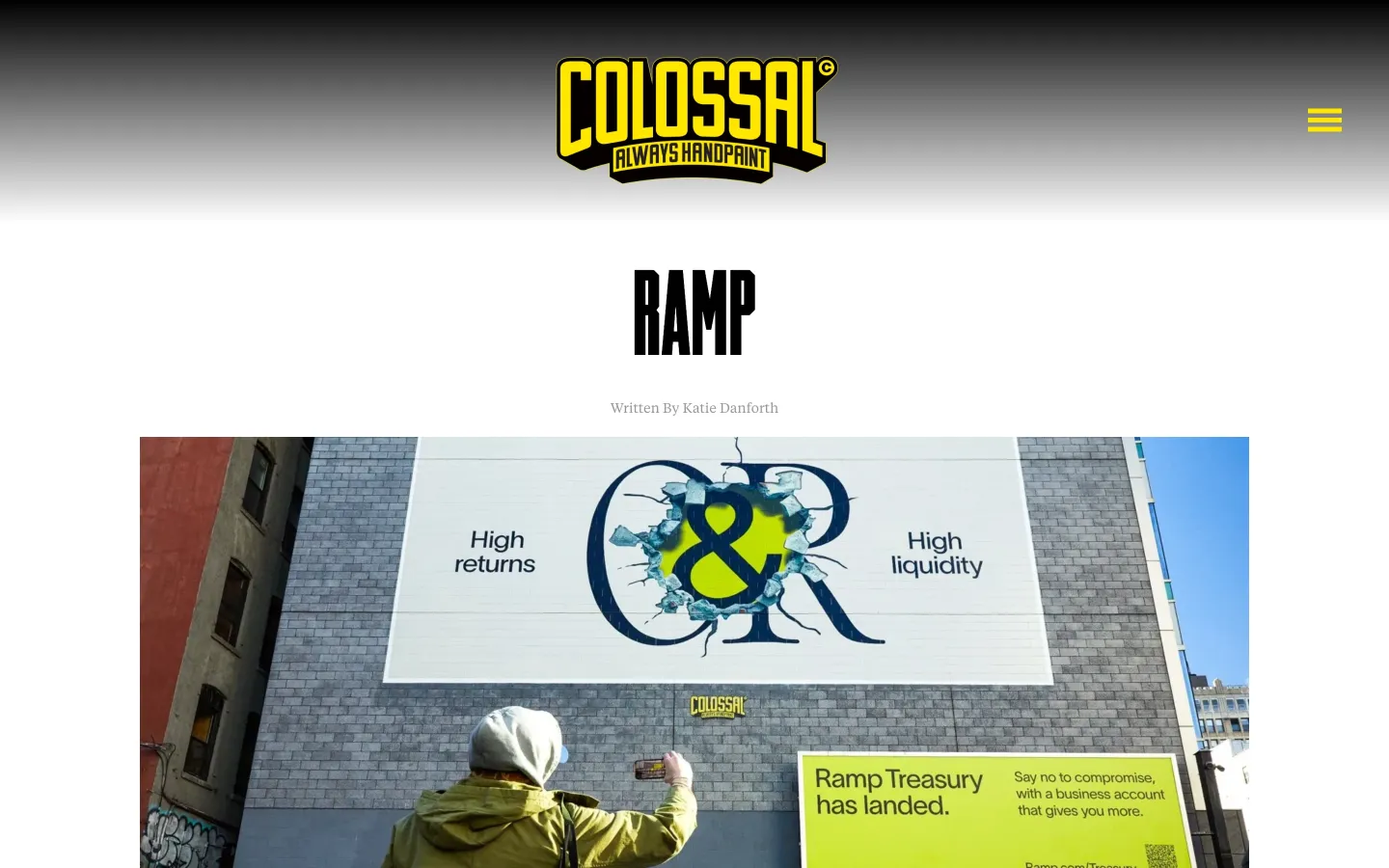
October 2025: Brian Baumgartner, Kevin from The Office, processes receipts by hand in a glass box in Flatiron Plaza. About 10,000 people came; 380,000 watched the livestream on X (Marketing Brew).January 2025: “High returns OR High liquidity” on a Manhattan wall, until a wrecking ball turns the OR into an ampersand for Ramp Treasury. The online version got 300% more views than Ramp's previous best campaign (Colossal).October 2026: Glass launches with a 108-second film on X and two lines of copy.
Ramp's executives post how the company works, and sell in their own name.
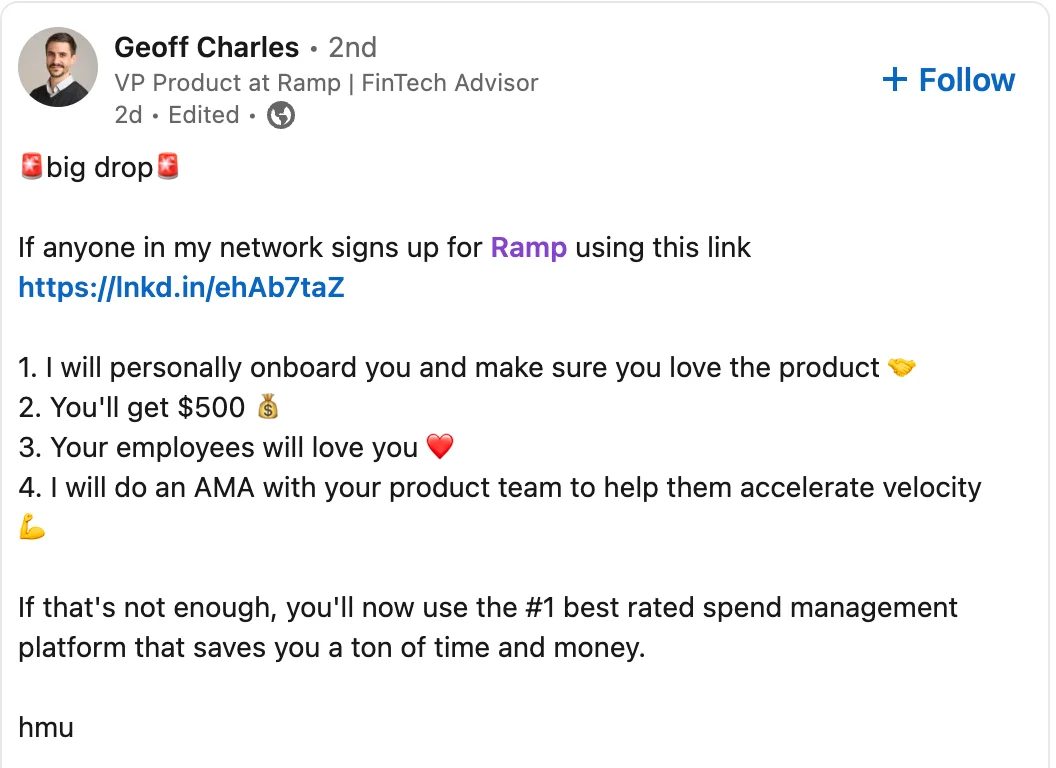
Geoff Charles, then VP of Product, on LinkedIn in 2023: sign up through his link and he onboards you himself, plus $500. The post has since been taken down.
By shipping product faster than rivals could respond (476 features in 2026 by mid-October), hiring only builders, and selling a card that helps companies spend less rather than one that rewards spending. Ramp went from launching its card in February 2020 to over $2 billion in annualized revenue by October 2026.
Ramp sold savings instead of rewards points and kept serving small businesses after Brex dropped tens of thousands of them in June 2022. By August 2025 Ramp's annualized revenue ($1 billion) was above Brex's ($700 million), and in January 2026 Capital One agreed to buy Brex for $5.15 billion, below its $12.3 billion valuation of 2022.
Speed and savings. Its leaders say Ramp had none of a bank's advantages, so it competed on how fast it ships; it hires builders who can ship without permission; and it sells time and money saved. Marketing runs like engineering: growth sits under the CTO, and brand under the head of design.
Ramp passed $2 billion in annualized revenue in the summer of 2026, up from $1 billion as of August 31, 2025 and $500 million in late 2024. Customers grew from 50,000 in November 2025 to 85,000 in October 2026.
By March 2022, about two years after its card launched in February 2020.
No. Ramp's growth team reports to the CTO, and brand marketing reports into its head of design. Its chief product officer, Geoff Charles, says marketing is fundamentally an engineering problem.
Builders. The founders' test is “If this person started a company would we join them?”, and every job post asks for high agency, high urgency and “slope over intercept”: how fast someone is growing, not where they start. Since 2026, AI skill is a requirement for every hire.
Retell AI makes AI voice agents that answer and place phone calls for businesses. Founded in 2023 and backed by Y Combinator, it reached a $100 million annualized run rate in November 2026 having raised only $4.6 million, and says it is profitable.
Riverside, formerly Riverside.fm, is a browser-based studio for recording, editing and publishing podcasts and video. Founded in 2020 by brothers Nadav and Gideon Keyson, it passed $100 million in ARR in October 2026, serving 2.3 million creators, and has raised $80 million.
Sierra builds AI agents that answer customers for large companies, by chat and by phone. Founded in 2023 by Bret Taylor and Clay Bavor, it passed $400 million in ARR in October 2026, four times its level a year earlier, and was valued at over $15 billion in May 2026.
WorkOS sells login and enterprise-readiness APIs to software companies, from single sign-on to user management and authentication for AI agents. Founded in 2019 by Michael Grinich, it passed $100 million in ARR on November 13, 2026, and was valued at $2 billion in March 2026; OpenAI, Anthropic and Cursor are customers.
CodeRabbit reviews pull requests with AI, checking code written by people and by coding agents before it ships. Founded in 2023 by Harjot Gill and Gur Singh, it passed $100 million in ARR on November 12, 2026, up from $10 million about a year earlier, and was valued at $1.5 billion in August 2026.
Framer is an Amsterdam website builder: designers and marketing teams design, publish and run company websites on it, with AI agents since June 2026. Founded in 2014 by Koen Bok and Jorn van Dijk, it reached $50 million in ARR in 2025, has raised about $162 million and was valued at $2 billion in August 2025.